Data Sovereignty of European QA: Challenges and Solutions
Have you already discussed matters of data sovereignty with your stakeholders? Your routine processes may be handling sensitive information and avoiding governance scrutiny for now. However, as frameworks like GDPR, DORA, and NIS2 tighten requirements, you need testing tools that provide legal control over data. This article explores the sovereignty challenges and examines the associated risks. We'll show how to achieve compliance with critical data standards using a secure QA platform like aqua.
Data sovereignty represents legal authority over data and technical enforcement mechanisms. It also includes audit capabilities, going beyond data residency.
QA platforms may be vulnerable to sovereignty issues as they routinely handle sensitive information, including production-like datasets and defect evidence with screenshots. They also process regulated data.
Effective sovereignty strategies include mapping data flows and selecting EU-committed cloud providers. Additional measures involve implementing technical controls like BYOK encryption, strengthening contracts, training teams, establishing AI governance, and planning clean exit paths.
Organizations treating sovereignty as a product strategy are gaining competitive advantages by building trust. They are also winning deals in regulated industries.
QA platforms now face additional security demands, as their users now require provable control over where their data is stored and who can access it. Discover why this matters in QA 👇
Understanding Data Sovereignty
Data sovereignty is the principle that digital information is subject to the laws of the country where it is stored. It also falls under the governance structures of that jurisdiction. This means organizations maintain legal authority over their data and control who can access it. Organizations must also ensure compliance with regional regulations. The Gaia-X framework defines sovereignty as “self-determination” over data, allowing you to decide what information to share and with whom. You also determine under which regulatory framework this sharing occurs.
Many organizations confuse sovereignty with related concepts. Data residency promises that your data stays in a specific location, such as Germany. Data localization is a legal mandate forcing certain data to remain in-country. In contrast, sovereignty of data encompasses legal authority and technical enforcement. It also includes the ability to audit operations and exit cleanly from vendor relationships. For your QA platforms, this distinction matters considerably.
Your tool might run on servers in Frankfurt, but if the vendor’s parent company is subject to foreign law, then your application doesn’t have real sovereignty. When support staff in another jurisdiction can access your production data, that represents a compliance gap. Similarly, if a foreign government compels access to your plaintext data without knowledge, that constitutes a sovereignty violation already.
Why QA is quietly exposed:
Production datasets: QA teams replicate customer records and transaction histories for test realism. They also copy personal identifiers. Without proper anonymization, these become secondary repositories of regulated data subject to GDPR requirements.
Defect evidence: Screenshots capture sensitive UI elements and user sessions. Traces also expose authentication tokens. This evidence exposes your proprietary systems to potential breaches and reveals personal data.
Business requirements: Requirements documentation includes competitive strategies and unreleased features. It also contains operational processes. These documents represent intellectual property that needs protection.
Identity data: Audit trails contain employee information and access patterns. They also store authorization structures. Unauthorized access to this data could enable system exploitation.
Integration points: CI/CD pipelines and issue trackers create multiple data transfer points. Collaboration tools add additional transfer vectors. Each integration potentially weakens your sovereignty protections.
Governance gaps: QA platforms avoid the scrutiny applied to CRM systems or ERP platforms. This happens despite handling equally sensitive information, creating compliance vulnerabilities.
You need more than “we encrypt everything.” The current standard requires encryption and customer-controlled keys. It also mandates EU-based processing. Organizations that can demonstrate this level of control are the ones winning deals in regulated sectors.
Since regulatory frameworks like GDPR, DORA, and NIS2 are tightening their requirements, European QA teams are facing pressure to maintain true personal data sovereignty. In this situation, having the right technology partner makes all the difference.
aqua cloud is an AI-powered test management platform and requirement management solution. It stands out as a sovereignty-first QA solution designed specifically for European compliance needs. The platform has ISO 27001 certification built into its architecture and maintains full DORA compliance. aqua delivers complete data processing within Azure EU data centers and provides transparent subprocessor governance. Furthermore, the platform offers contractual commitments that satisfy even the most stringent regulatory requirements. With aqua’s domain-trained AI Copilot, you maintain complete control over data as it uses RAG technology to ground AI responses in your own documentation. This means no exposing sensitive information outside your security perimeter. Besides, aqua can be integrated with Jira and Selenium. It also connects with 12+ other tools that you likely already have in the tech stack.
Achieve 100% data sovereignty without compromising on QA with aqua
Europe’s regulatory environment has transformed data handling from a technical consideration into a strategic priority for your organization. Multiple frameworks now govern how QA platforms must process your data, how they must store it, and how they must transfer it. This creates a complex compliance picture that directly impacts your vendor selection process and operational practices. Understanding these regulations is essential if you want to maintain control over your testing data while meeting legal obligations.
Many organizations believe that data sovereignty, auditability, and zero-trust architecture are requirements. The ones who are most likely to get it wrong are the ones who think they're unique in this regard. They assume they need something special or in-house to achieve them.
Requires explicit legal basis for processing personal data in your testing environments. This includes production data copied for QA purposes
Mandates data protection by design and by default. This forces QA platforms to implement technical measures and organizational measures that protect personal data
Establishes accountability requirements for data transfers outside the EU. It requires you to assess whether destination countries provide adequate protection
Grants data subjects rights to access and rectification. These rights extend to test data containing personal information and include erasure capabilities
Invalidated Privacy Shield framework. This established that Standard Contractual Clauses alone are insufficient for lawful data transfers to countries without adequate protection
Requires case-by-case assessment of destination country laws. These laws could undermine EU data protection standards, particularly regarding government surveillance access
Mandates supplementary measures when transferring data to jurisdictions with problematic legal frameworks. These include technical controls, contractual protections, and organizational safeguards
Forces you, as a QA platform buyer, to evaluate whether US-based vendors could face foreign intelligence surveillance orders. You must also assess whether their subprocessors face this risk
Imposes ICT third-party risk management obligations on financial entities. This includes comprehensive due diligence for QA platforms handling your financial data
Requires contractual arrangements that specify service locations and subprocessor governance. These arrangements must also define audit rights and termination procedures
Mandates incident reporting that extends to third-party tools used in your software development lifecycles. It also requires resilience testing
Establishes an oversight framework for critical ICT third-party service providers. This creates enhanced scrutiny for major platform vendors
NIS2 (Network and Information Security Directive 2)
Expands cybersecurity requirements to essential entities across multiple sectors and important entities. This includes supply chain security obligations
Requires risk management measures that address the security of your network systems and information systems. These measures include third-party QA platforms
Mandates incident notification to national authorities within 24 hours. This applies once you become aware of significant incidents
Establishes supply chain security requirements. These force you to assess the cybersecurity practices of your QA tool vendors
Challenges for European Businesses
Your organization faces significant obstacles in maintaining data sovereignty while using modern QA platforms. These challenges span legal dimensions, technical requirements, and operational considerations. Compliance gaps often become visible only during audits or security incidents.
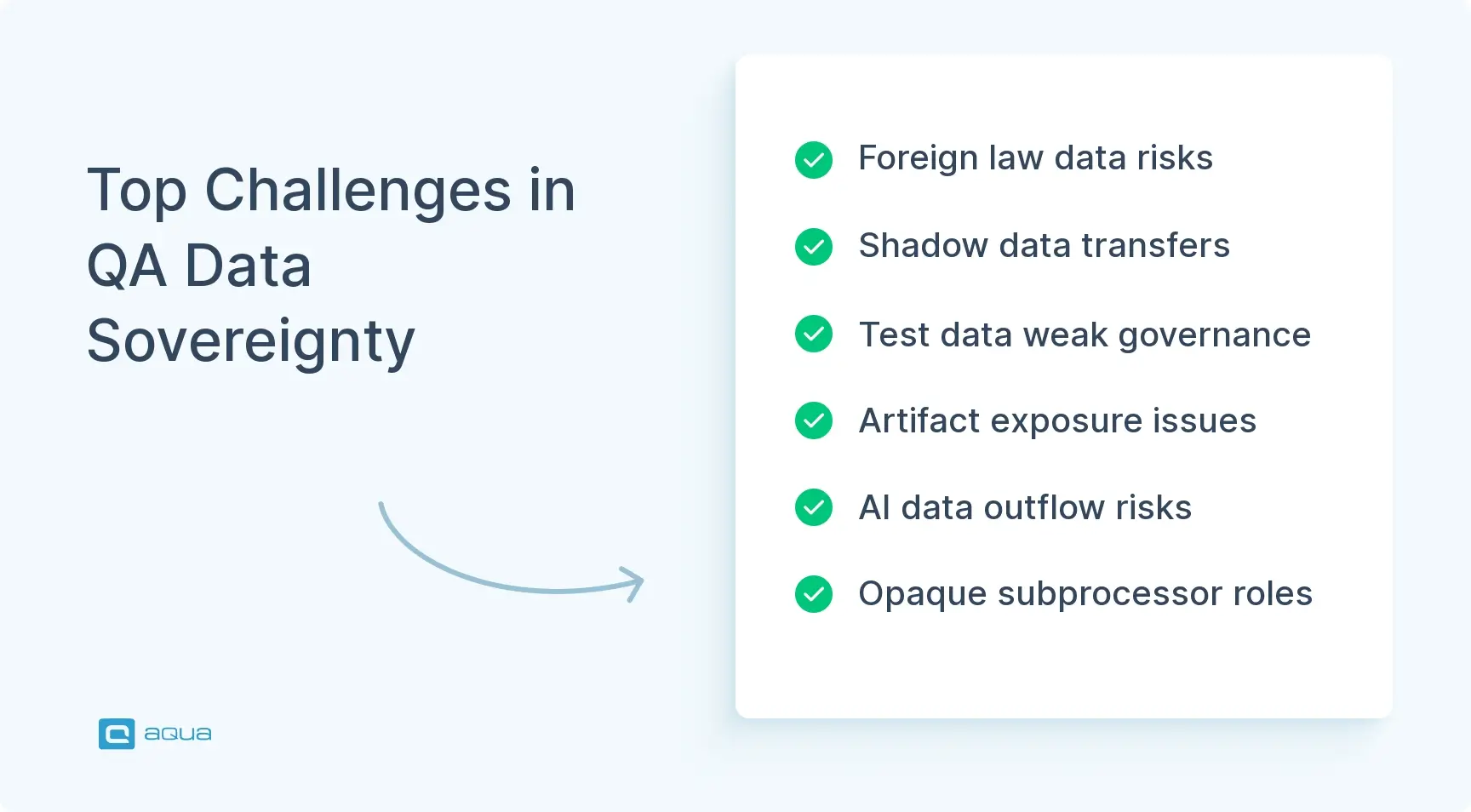
Jurisdiction and compelled access risk: When your QA platform data is stored outside the EU, you face exposure to disclosure without knowledge. Besides, you’re also at risk when the platform is managed by vendors subject to foreign laws. The US CLOUD Act, for example, can compel access to your personal data and trade secrets. It can also force disclosure of security findings through foreign government requests.
Cross-border data flows: Platform telemetry creates “shadow transfers” that violate transfer rules when not properly assessed under EDPB guidance. Error tracking services contribute to this issue as well. Integrations with tools like Jira, Slack, and CI/CD pipelines compound this issue for your team. These flows are often buried in vendor documentation or not disclosed at all.
Test data governance gaps: Your QA teams copy production data for test realism. This creates secondary repositories containing customer identifiers and transaction histories. These repositories also hold health or HR fields and authentication tokens. These are subject to the same regulations as production systems, but rarely receive equivalent governance controls in your organization.
Evidence and artifact management: Modern QA practices generate screenshots and screen recordings. They also produce HAR files and network traces containing personal data or secrets. Your teams share these broadly and store them longer than retention policies allow. They lack the permission controls you apply to production systems.
AI feature sovereignty risks: QA platforms offering AI-assisted testing routinely send prompts containing your defect evidence to external model providers. These prompts also include code snippets. These copilot features often process your data outside the EU without contractual control. That’s why your team may also lack the ability to disable AI functionality.
Subprocessor opacity and change risk: Vendors frequently use undisclosed subprocessors for analytics and support functions. They also use them for infrastructure operations and AI capabilities. Without a notification process when subprocessors change or expand to new jurisdictions, you cannot assess transfer risks.
Strategies for Compliance and Adaptation
Building a sovereignty-compliant QA operation requires you to layer technical controls with contractual safeguards. You must also implement organizational measures. European teams are implementing these strategies to close compliance gaps without sacrificing operational efficiency. Understanding data sovereignty and security together helps organizations build robust protection frameworks that address both legal requirements and technical threats.
Map comprehensive data flows: Start by documenting every data category your QA platform processes. This includes tests, requirements, logs, and attachments. Also, document user identities. Then trace where it goes through integrations, subprocessors, and telemetry endpoints. Include support systems in this mapping. This establishes a baseline for protection and makes invisible transfers visible to your team.
Select cloud providers with contractual EU commitments: Look for vendors that contractually commit to EU-only processing across all features. This includes search indexing, analytics, and AI capabilities. They should publish detailed subprocessor lists with purpose information and location data. You’ll also want providers that give you notification of changes with objection rights. Additionally, guarantee data residency in specific EU regions for your organization.
Implement technical sovereignty enforcement: Deploy encryption in transit as your baseline and implement encryption at rest. Consider bringing your own key patterns for real control over data. Enforce tenant isolation to prevent cross-contamination. Establish granular RBAC down to object level and action level in your systems. Maintain immutable audit logs with export capability. Then implement time-bound customer-approved support access limited to EU staff. Selecting the right data sovereignty tools ensures you can enforce these controls effectively across your entire QA infrastructure.
Strengthen Data Processing Agreements: When negotiating DPAs, start by clarifying controller roles and processor roles for relationship. You’ll want to specify exact hosting locations. Define subprocessor governance with notification requirements. Setting incident notification SLAs is essential. Grant comprehensive audit rights to the team. Your next step should be committing to data portability mechanics. Together, these elements help you ensure enforceability in EU courts.
Establish team training on data sovereignty: Focus on educating your QA engineers about personal data identification. Train them on test dataset anonymization techniques as well. At the same time, empower your security teams and compliance teams to own integration approvals. They should also govern AI feature usage. This creates operational hygiene in your organization around what data can be uploaded to third-party tools and why transfer rules matter.
Emerging Opportunities from Data Sovereignty
When you treat data sovereignty as a strategic asset, it brings competitive advantages. Besides, early adoption of sovereignty-aligned practices is opening new market opportunities. Here are some of the most important benefits you may reap by focusing on data sovereignty:
Differentiated market positioning: When you demonstrate EU-only processing and customer-controlled encryption keys, you move to procurement shortlists in regulated industries. This advantage is gained through transparent subprocessor governance. This happens before feature evaluation even begins in sectors like finance, healthcare, and public sector procurement.
Better operational resilience: Sovereignty requirements force architectural decisions in your systems. These include clearer data boundaries and tighter access controls. They also drive documented retention policies. As a result, you achieve improved overall system reliability that extends beyond compliance needs for your organization. As an extra benefit, you also gain enhanced auditability.
Regulated market access: When you provide Data Protection Impact Assessment support, you unlock enterprise deals. When you offer transfer risk documentation aligned with EDPB guidance, you gain similar access. Contractual commitments satisfying DORA requirements or NIS2 expectations open doors in sectors that competitors without sovereignty capabilities cannot access.
Improved customer retention through transparency: Publishing subprocessor lists builds trust with your customers. Sending change notifications has the same effect. Maintaining updated Trust Centers with compliance artifacts creates long-term partnerships. Treating audit requests as standard business operations strengthens relationships with customers who value control over their data.
First-mover advantage in sovereignty-ready platforms: When you demonstrate EU operations and strong data governance, you capture enterprise procurement cycles. When you show AI controls aligned with European expectations, you gain the same advantage. These were previously dominated by US-based incumbents. The competitive shift is accelerating as regulations tighten.
How aqua cloud, a European QA Platform, Helps Preserve Data Sovereignty
In QA, selecting the right platform to support your test management is a strategic decision. It also impacts requirement management capabilities. This directly impacts both your operational efficiency and legal risk exposure. aqua cloud was designed specifically to address the data sovereignty challenges facing your QA team. The platform combines comprehensive testing capabilities with architectural commitments to EU data protection standards. As a leading SaaS platform, aqua delivers enterprise-grade functionality while maintaining complete data sovereignty.
Core sovereignty capabilities:
ISO 27001 certified platform architecture with full DORA compliance
Complete data processing within Azure EU data centers with contractual guarantees
Transparent subprocessor governance with published lists and change notification
Flexible deployment options, including public cloud and private cloud. On-premise installations are also available
Granular role-based access control down to object level and action level
Immutable audit logs with comprehensive export capabilities for regulatory review
Customer-controlled encryption. Bring-your-own-key options are available for sensitive deployments
EU-based support staff with time-bound access protocols. Customer approval is required for all access
aqua provides these capabilities while maintaining the testing efficiency your modern QA team demands. The platform architecture ensures sovereignty at every layer, from data storage through processing to AI-assisted features.
How aqua supports data sovereignty in practice:
Jurisdictional control through Azure EU regions: All your customer data remains within Azure’s EU data centers. This includes test cases, requirements, and defect evidence. It also covers attachments. Processing occurs under EU jurisdiction with no replication to non-EU regions for backup purposes or disaster recovery operations.
AI sovereignty with RAG technology: The aqua AI Copilot uses Retrieval-Augmented Generation to ground AI responses in your own documentation. This means your sensitive test data never leaves the security perimeter. Your requirements and defect evidence also stay within controlled boundaries. And that’s exactly how intellectual property remains protected along with regulated information.
Transparent data flow documentation: aqua provides complete visibility into all data processing locations and subprocessor relationships. You also see integration pathways and this enables you to perform transfer impact assessments. You can also maintain GDPR accountability without reverse-engineering vendor infrastructure.
Contractual sovereignty commitments: Data Processing Agreements specify EU-only processing for all platform features. They establish subprocessor notification for your organization and provide objection rights. These agreements include incident notification timelines and grant comprehensive audit rights. Moreover, these agreements are enforceable in EU courts.
Integration sovereignty controls: All integrations with Jira, Azure DevOps, and Jenkins are designed with data minimization principles. CI/CD platforms follow the same approach. You control exactly what information flows to external systems. You also maintain sovereignty across your entire QA toolchain.
Evidence lifecycle management: Comprehensive retention policies ensure your screenshots are managed according to regulatory requirements. Legal hold capabilities provide additional control. Automated deletion controls handle logs containing personal data. As a result, evidence artifacts don’t accumulate indefinitely in your systems.
Audit-ready traceability: Complete linking from requirements through test cases to defects creates the comprehensive audit trail required by regulations like DORA. Execution results are also included in this traceability. You can demonstrate who accessed what data, when they accessed it, and under what authority in the organization.
As European QA teams struggle to maintain compliance requirements alongside testing excellence, sovereignty adds another layer of complexity. Luckily, aqua cloud is an AI-powered test management platform and requirement management solution. It offers comprehensive QA management with sovereignty at its core. Our ISO 27001-certified platform is DORA-compliant and ensures your testing data remains within EU jurisdiction. We offer flexible deployment options including public cloud and private cloud. On-premise installations are also available to meet your specific sovereignty requirements. Beyond compliance, aqua’s AI Copilot accelerates your testing processes while keeping data sovereignty intact. It uses RAG technology to ground AI in your project’s documentation without sending sensitive information to external systems. With aqua, you can demonstrate complete traceability in audits. You can also enforce granular permission controls and maintain comprehensive audit trails. All of this happens while leveraging AI for your test generation, requirement management, and defect handling. Documentation generation and management are also AI-powered.
Data sovereignty is a new frontline procurement requirement for your European QA platforms. The regulatory environment shaped by GDPR, Schrems II, and DORA now demands that you maintain enforceable control over testing data. NIS2 adds to these requirements. This includes EU-jurisdictional processing and transparent subprocessor governance. It also requires technical measures that make sovereignty auditable. Your QA platforms face unique exposure because they handle production-like data without the governance scrutiny of traditional enterprise systems. They also process defect evidence. That’s exactly why choosing a compliant QA test management platform like aqua is the right call. A compliant requirement management platform is equally important.
What is the difference between data sovereignty and data residency?
Data residency refers to the physical location where your data is stored, such as servers in Germany or France. In contrast, data sovereignty is broader. It includes legal authority over your data and technical enforcement mechanisms. It also encompasses audit capabilities. You can have data residency without sovereignty if, for example, a foreign company subject to non-EU laws operates the servers. True sovereignty means you control who accesses your data under EU legal frameworks.
Why are QA platforms particularly vulnerable to sovereignty issues?
QA platforms handle production-like datasets and defect evidence with screenshots. They also process requirements documentation that often contains personal data. Unlike CRM systems or ERP platforms, they rarely receive the same governance scrutiny despite processing equally sensitive information. Your teams routinely copy production data for testing. This creates secondary repositories that are subject to the same regulations but lack equivalent controls.
Does the EU-US Data Privacy Framework solve data sovereignty concerns?
The Data Privacy Framework addresses lawful transfer requirements for certified US organizations. However, it doesn’t eliminate foreign compulsion risks. Regulated industries still require EU hosting and EU operations. Sovereignty-focused buyers also demand customer-controlled encryption keys. This is because adequacy decisions don’t provide immunity from foreign court orders. Many organizations treat the framework as a baseline rather than a complete solution.
How can I evaluate if my current QA platform meets sovereignty requirements?
Start by mapping all data flows to identify where your testing data goes through integrations. Also trace subprocessor pathways. Review your vendor’s Data Processing Agreement for specific hosting locations. Check for subprocessor governance details as well. Ask whether support staff can access your data from non-EU locations. Determine if you control encryption keys. Finally, verify whether the vendor commits contractually to EU-only processing across all features. This should include AI capabilities.
Enhancement of the aqua product is Martin’s main responsibility and biggest mission. His expertise covers ITIL Process Consulting, Change Management, Quality Assurance, Quality Management, and Requirements Management. Martin works in QA services for regulated industries for more than 18 years being an irreplaceable leader at…
Pavel, a Quality Assurance Consultant and Author, brings deep expertise to solving complex testing challenges. His background in software development has helped organizations transform their QA practices from reactive to proactive. Beyond consulting, Pavel develops best practice guides and case studies for aqua cloud that…
Home » Best practices » Data Sovereignty of European QA: Challenges and Solutions
Do you love testing as we do?
Join our community of enthusiastic experts! Get new posts from the aqua blog directly in your inbox. QA trends, community discussion overviews, insightful tips — you’ll love it!
We're committed to your privacy. Aqua uses the information you provide to us to contact you about our relevant content, products, and services. You may unsubscribe from these communications at any time. For more information, check out our Privacy policy.
X
🤖 Exciting new updates to aqua Intelligence are now available! 🎉