Swarm Software Testing: Key Strategies and Benefits
Most bugs do not hide where you expect them. They hide in the spaces between features. Or in the combinations nobody thought to test, or in the interactions that only surface when feature A is off and feature B is running at the same time. Swarm software testing was built around exactly this insight. Instead of isolated testers working through predetermined scripts, the whole team tests the same build simultaneously. Each person has a different randomly generated set of features enabled. The result is a configured diversity that exposes what traditional testing consistently misses.
Swarm testing brings multiple testers together to simultaneously test the same software build with different random feature combinations enabled or disabled for each tester.
Research shows that software bugs often hide in feature interactions, with studies finding 10-15% more bugs detected per testing hour using swarm testing compared to traditional approaches.
Swarm sessions typically run between 90 minutes and three hours with 4-8 participants, creating a collaborative environment where testers share discoveries in real-time.
Companies implementing swarm testing have found critical bugs missed by traditional test suites, including a fintech company that discovered eleven hidden issues two weeks before launch.
While effective, swarm testing faces challenges including coverage gaps, coordination overhead for distributed teams, and potential false positives from unusual configurations.
Traditional testing might leave your software vulnerable to interaction bugs hiding between features. Discover how random feature toggling and collaborative sessions could catch the critical issue that saves your next release from disaster 👇
Principles of Swarm Testing
The theoretical foundation comes from a 2012 study that challenged a core assumption in QA: that testing everything simultaneously is the most thorough approach. The research found the opposite.
Testing with all features enabled creates blind spots. A bug that only appears when feature X is off, and feature Y is on, will never surface in a test suite that always runs both together. The study introduced the concept of configuration diversity, showing that random feature exclusion catches bugs that comprehensive full-feature testing does not.
The mathematics backs this up. A system with just 20 binary features produces over a million possible configurations. Testing all of them is not feasible. Swarm testing uses controlled randomness to sample from that space efficiently, and studies comparing it to traditional approaches found 10 to 15 per cent more bugs detected per testing hour, with the strongest results in interaction failures and integration issues.
The randomness is the point. It is not chaos. It is structured diversity, and it is what makes swarm testing a powerful addition to any broader set of software testing strategies.
As we explore swarm testing, it’s worth considering how the right test management platform can amplify these collaborative sessions. aqua cloud perfectly complements swarm testing methodologies. It provides a centralized environment where testers can efficiently coordinate their diverse feature configurations and share real-time findings. With aqua’s integrated test management capabilities, you can quickly document the various feature combinations being tested during swarm sessions, track bugs discovered, and ensure complete traceability back to requirements. What’s particularly powerful is how aqua’s domain-trained AI Copilot with RAG grounding can help teams prepare for swarm testing by quickly generating comprehensive test cases from requirements. Each of them is grounded in your project’s actual documentation and context. This means your swarm testing sessions start with higher-quality test foundations, allowing your team to focus on those unexpected feature interactions where bugs typically hide.
Generate project-specific test scenarios for swarm testing in seconds with aqua AI
Setting up a swarm session is straightforward once you understand what makes it work.
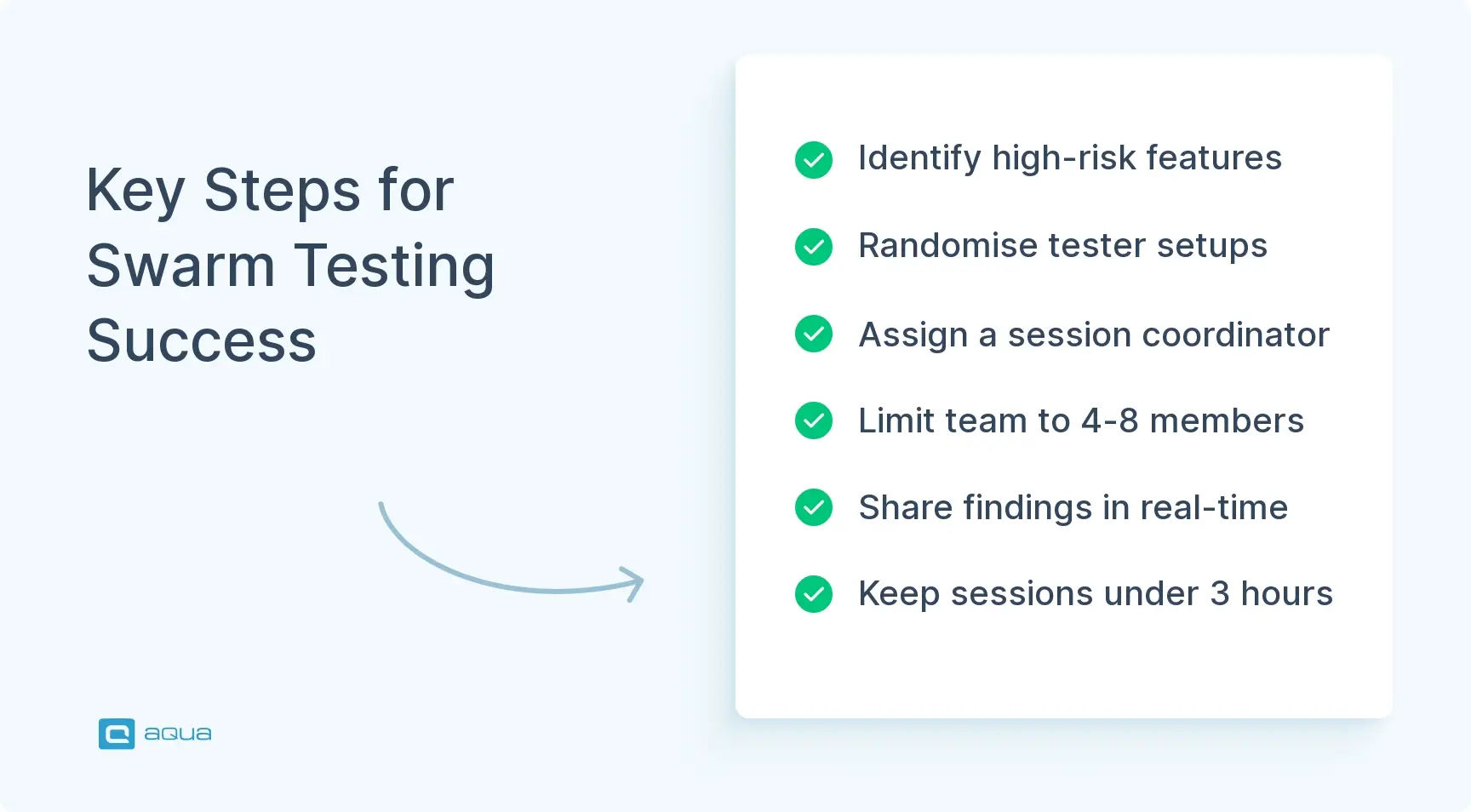
Start by identifying the features that will participate. Focus on interconnected functionality where interactions carry real risk. For an e-commerce platform, that might mean search filtering, cart management, payment processing, and authentication. You are not trying to include everything. You are targeting the areas where unexpected combinations are most likely to cause problems.
Next, build a randomisation mechanism. This can be as simple as a configuration file generator that randomly enables or disables features for each tester at session start. The requirement is true randomness. Patterns or biases in which features get tested together undermine the whole method.
For participants, 4 to 8 people work best. Smaller groups lack the configuration variety. Larger groups create coordination overhead. Mix skill levels and domain knowledge deliberately. Assign one person as session coordinator whose job is to track discoveries and manage communication, not to test.
Phase
Duration
Focus
Setup
15 min
Distribute configurations, verify environments
Initial exploration
30 min
Independent exploration, first findings logged
Collaborative testing
60 to 90 min
Share discoveries, investigate related scenarios
Synthesis
15 to 20 min
Prioritisation and follow-up assignments
Sessions should run between 90 minutes and three hours. Shorter sessions do not give testers enough time to explore. Longer ones see diminishing returns as fatigue sets in.
A fintech company running a swarm session two weeks before a major release found eleven bugs their standard test suite had missed entirely. The most critical was a race condition that only appeared when biometric authentication was disabled during certain payment operations. Their test cases had never covered that scenario because the assumption was that all users would use biometric login. One swarm session caught what months of traditional testing had not.
Benefits of Swarm Testing
The primary benefit is finding bugs that conventional testing misses, specifically interaction failures between features. But the advantages stack up beyond that.
Speed is significant. Traditional testing cycles can take weeks to surface certain bugs because discovery is sequential. A swarm session compresses that timeline dramatically. What might take a solo tester three days to stumble upon can appear in the first hour because someone randomly received the exact configuration that triggers the issue.
The collaboration dynamic is equally valuable. Junior testers learn from veterans in real time. Developers see how their code behaves under conditions they did not design for. Everyone leaves the session with a sharper understanding of where the system is fragile. That shared knowledge does not disappear when the session ends.
Cost efficiency follows naturally. A two-hour session with five people costs ten person-hours. The bug detection rate typically exceeds what those same five people would find working independently. And bugs caught in swarm sessions cost far less to fix than issues discovered in production. The benefits of automated testing for small business apply here too: you are maximising the return on testing time without proportionally increasing calendar time.
Swarm Testing Challenges and Considerations
Coverage gaps are the most legitimate concern. When features are randomly disabled, certain combinations may never appear across the team in a given session. This is why swarm testing works alongside traditional testing rather than replacing it. Standard suites cover known scenarios. Swarm sessions layer on top to catch what those suites miss.
Coordination is a practical challenge, especially for distributed teams. Getting everyone focused simultaneously requires scheduling discipline. Treat swarm sessions as non-negotiable calendar events, equivalent in priority to sprint planning.
Result interpretation takes some adjustment. A tester might encounter behaviour that looks like a bug but is actually expected given their specific configuration. Experienced testers calibrate this quickly. Newer team members benefit from being paired with someone who can help them distinguish genuine defects from expected behaviour in an unusual feature state.
Finally, demonstrating ROI takes patience. Not every session surfaces a showstopper. The value accumulates across sessions over time, which means tracking bug detection rates across multiple swarm sessions rather than judging the method on any single one.
Future of Swarm Testing in Software Engineering
Swarm testing is well-positioned for what is coming in software development.
The most immediate development is AI-assisted configuration generation. Rather than purely random feature toggling, machine learning models can analyse historical bug data to weight configurations toward combinations that have historically been more likely to produce failures. AI in software testing is already influencing how test cases are generated, and applying similar approaches to swarm configuration selection is a natural next step.
Continuous integration pipelines are also beginning to incorporate automated swarm-style configuration sampling on every build. The human collaborative element is harder to automate, but automated configuration diversity can run continuously without requiring scheduled sessions, catching interaction bugs earlier in the development cycle.
As systems grow more complex and feature sets expand, the configuration space that needs coverage grows exponentially. The future trends in software testing point consistently toward methods that sample efficiently from large spaces rather than attempting exhaustive coverage. Swarm testing fits that direction precisely.
Ready to take your swarm testing approach to the next level? Consider how aqua cloud can transform your testing efforts by combining centralised test management with AI-driven assistance. You won’t be struggling with coordination overhead or coverage gaps during swarm sessions. aqua provides a unified platform where your entire team can document configurations, share discoveries, and track results in real-time. The platform’s Jira integration ensures seamless workflow between development and testing. Its advanced reporting capabilities help you measure the ROI of your swarm testing efforts with precision. Most impressively, aqua’s domain-trained AI Copilot (which grounds every suggestion in your actual project documentation) can generate diverse test scenarios in seconds, dramatically increasing the configuration coverage of your swarm sessions. This is an AI that truly understands your project context, ensuring the test combinations you explore are directly relevant to your specific application. By integrating aqua into your testing toolkit, you’ll not only maximize the effectiveness of your swarm testing but potentially save up to 97% of your testing time across your entire QA process.
Boost your swarm testing effectiveness with AI that understands your project's unique context
Swarm testing is a direct response to a real problem. Most bugs hide in feature interactions, not individual functions, and traditional testing is not designed to find them efficiently. By bringing a team together to test randomised feature configurations simultaneously, you get the configuration diversity that exposes what same-state testing misses, combined with the collective intelligence that comes from real-time collaboration.
The research behind it is solid. The real-world results are consistent. The challenges are manageable with the right structure. Once swarm testing becomes part of the regular testing rhythm, the improvement in bug detection shows up in the numbers.
The bugs hiding in unexpected feature combinations will eventually make it to production if nobody goes looking for them. A swarm session is a much better place to find them.
Swarm testing is a collaborative testing approach where multiple team members test the same build simultaneously, each with a different randomly generated subset of features enabled. The swarm testing meaning comes from the insight that bugs frequently hide in interactions between features rather than in individual functions. By generating diverse feature configurations across the team in a single session, swarm testing surfaces interaction failures that standard test suites miss. Research validated the approach by showing that random feature exclusion detects bugs that testing with all features enabled does not, because certain bugs only appear in specific combinations of enabled and disabled states.
How can swarm testing improve collaboration among QA teams?
Swarm sessions create conditions for real-time knowledge transfer that structured testing rarely produces. When the whole team explores the same build with different configurations at the same time, discoveries get shared immediately. Others can check whether the same issue appears in their setup, which often leads to pattern recognition that points to systemic problems. Junior testers learn directly from how experienced testers investigate and report. Developers who participate see how their code behaves under conditions they did not anticipate. The format concentrates collective attention on the same problem space at the same time, which accelerates discovery and builds shared understanding of where the system is fragile.
What are the key challenges when implementing swarm testing in an agile environment?
Scheduling is the most immediate obstacle. Agile sprints are busy and pulling the full team into a simultaneous session requires treating swarm testing as a planned sprint event. Coverage gaps are the methodological challenge: random feature toggling means some combinations may never appear in a given session, which is why swarm load testing complements rather than replaces existing test suites. Interpreting results requires experience, since behaviour that looks like a bug in one configuration may be expected given which features are disabled. Teams new to swarm testing benefit from pairing less experienced members with veterans during sessions. Demonstrating ROI also takes time, since the value accumulates across multiple sessions rather than being immediately visible in a single one.
Nurlan, a QA Coordinator & Quality Standards Officer, takes pride in orchestrating seamless QA operations. His expertise in coordinating QA-focused projects and integrating QA solutions has consistently yielded top-tier client satisfaction. Aside from a full-time QA coordinator, Nurlan's role involves creating compelling content that educates…
Embodying the essence of a QA Coordination Maestro, Paul has excelled in curating and implementing quality strategies tailored to the nuances of each project. His expertise in the market of QA and Test Management solutions has contributed to a vast portfolio of successfully managed TMS…
Home » Best practices » Swarm Software Testing: Key Strategies and Benefits
Do you love testing as we do?
Join our community of enthusiastic experts! Get new posts from the aqua blog directly in your inbox. QA trends, community discussion overviews, insightful tips — you’ll love it!
We're committed to your privacy. Aqua uses the information you provide to us to contact you about our relevant content, products, and services. You may unsubscribe from these communications at any time. For more information, check out our Privacy policy.
X
🤖 Exciting new updates to aqua Intelligence are now available! 🎉