Testing Chapter in Software Testing: Complete Guide
Every quality software product goes through structured phases of validation. Without that structure, testing becomes reactive: teams poke around the application without a clear strategy and hope they catch the important issues before users do. A testing chapter in software testing is the framework that prevents this. It organises testing efforts into distinct phases with defined objectives, clear ownership, and measurable completion criteria. This guide covers what a test chapter in software testing actually is, why the structure matters, and how to write one that your team will use rather than ignore.
Testing chapters are structured phases in software testing that organize efforts around specific objectives, methods, and deliverables with clear entry and exit criteria.
Each testing chapter corresponds to different testing types like unit testing, integration testing, system testing, and acceptance testing with specific roles and responsibilities.
Well-designed testing chapters prevent testing debt, create visibility for stakeholders, and ensure knowledge transfer when team members change.
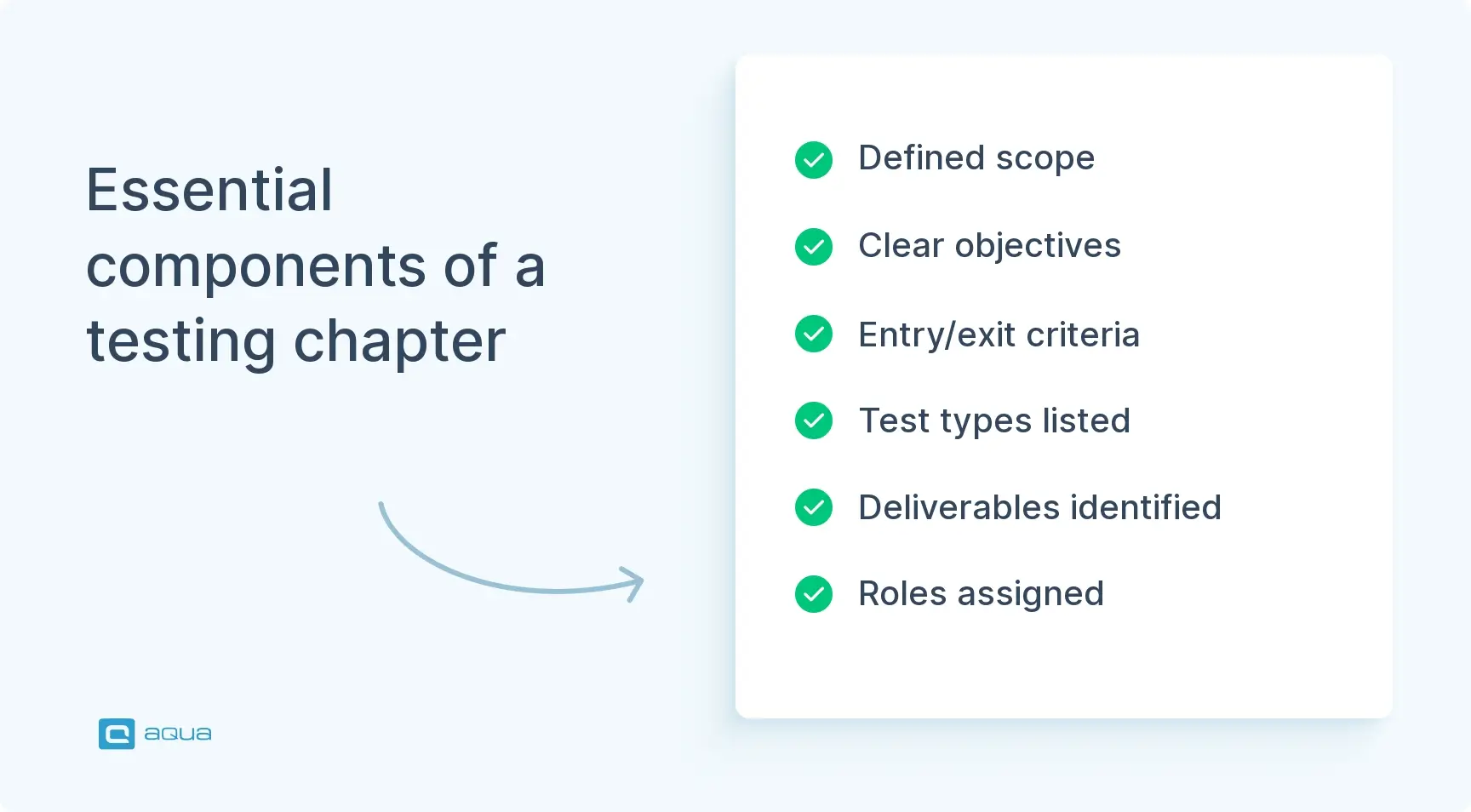
Effective testing chapter documentation includes scope definition, clear objectives, specified test techniques, deliverables, and automation strategies while remaining flexible.
Testing chapters transform quality assurance from reactive bug hunting to a structured process that builds confidence throughout the development lifecycle.
Wondering why your team keeps shipping bugs despite extensive testing? The missing piece might be in how you structure your testing process, not just the tests themselves. Learn how testing chapters can transform your QA strategy 👇
What Is a Testing Chapter in Software Testing?
A testing chapter in software testing is a distinct phase within your overall testing strategy where effort is focused on specific objectives, methods, and deliverables. It is not an arbitrary division. It is a deliberate way to organise testing so the team is not trying to cover everything simultaneously and ending up with half-validated features across the board.
Each test chapter typically corresponds to a different level or type of testing. One chapter covers unit testing, where developers verify individual components work as expected. Another covers functional software testing, validating that features meet documented requirements. A third covers integration, confirming those components communicate correctly. The structure creates natural quality gates throughout the development lifecycle. Before moving forward, the team confirms that specific criteria have been met for the current chapter.
Testing chapters also align with how development actually works. In Agile sprints, each sprint might incorporate elements of multiple chapters running in parallel. In waterfall projects, chapters become sequential phases. Either way, the structure creates accountability. Each chapter has defined entry and exit criteria, specific objectives, and measurable success metrics. This is not documentation for its own sake. It is how teams avoid shipping something that looked tested but was not.
Organizing your testing efforts into structured “chapters” as discussed is exactly where modern test management solutions shine. aqua cloud takes this testing chapter approach to the next level by providing a centralized hub where test cases, requirements, and all testing artifacts are perfectly organized and cross-linked. Rather than piecing together documentation across different tools, aqua’s platform gives you visual traceability features that instantly show which test cases cover which requirements, making those testing chapters crystal clear and eliminating coverage gaps. The platform’s nested test case structure and reusable test steps align perfectly with the chapter approach described, allowing you to organize by test types like unit, integration, and system testing while maintaining full traceability. Now, with aqua’s domain-trained AI Copilot, you can even generate entire test chapters automatically from requirements, with each AI suggestion grounded in your project’s actual documentation and context, saving QA professionals an average of 12+ hours per week.
Transform chaotic testing into structured, traceable chapters with aqua's AI-powered test management
The primary purpose of a testing chapter is to bring order to what could otherwise become testing chaos. Without structure, teams fall into random testing, covering ground based on what someone remembers to check rather than what the risk profile demands. Testing chapters force intentionality. Each chapter has a specific mission, whether that is validating business logic, checking system integrations, or confirming the application holds up under load.
Structure also creates visibility. When you tell a product manager the team is in the integration testing chapter, they immediately understand what is being validated and what risks remain. The difference between “we are still testing” and “we have completed unit testing and are halfway through integration testing” is the difference between vague anxiety and informed confidence. Stakeholders get an accurate picture of quality status rather than reassurances that everything is probably fine.
Testing chapters also build resistance to testing debt. The impulse to defer thorough testing under deadline pressure is real and persistent. When acceptance testing is its own chapter with defined criteria, skipping it is a visible decision that requires explicit acknowledgement. It cannot quietly disappear. The structure makes shortcuts harder to take without everyone noticing.
Knowledge transfer is another benefit that compounds over time. A new team member can read the testing chapter documentation and understand exactly what phases the team follows and what each one requires. When someone leaves mid-project, their work can be picked up without starting from scratch. As teams scale or work across multiple projects, this standardisation reduces the amount of tribal knowledge required to operate effectively.
What Are the Key Components of a Testing Chapter?
Every testing chapter needs clear components to be effective. Without them, a chapter is just a label with no substance. These components are the structure that ensures nothing critical gets missed and that the chapter can be executed consistently by different people at different times.
Scope and Objectives
Scope defines exactly what the chapter covers and, equally importantly, what it does not. A unit testing chapter covers individual functions and methods, not full user workflows. Setting this boundary keeps teams focused and prevents different test types from bleeding into each other.
Objectives define what success looks like. A useful objective is specific enough to evaluate: “verify all API endpoints return correct status codes and response formats” or “confirm database transactions maintain data integrity under concurrent access.” A vague objective like “make sure the system works” provides no guidance for test case creation and no clear way to determine whether the chapter is complete.
Entry and Exit Criteria
Entry criteria are the prerequisites that must be satisfied before the chapter begins. For system testing, entry criteria might require all integration tests passing and the test environment deployed with production-like configuration. These prevent teams from wasting time testing in conditions where failure is guaranteed because foundational work is incomplete.
Exit criteria define when the chapter is finished and the team is ready to advance. This might be a specific pass rate for test cases, all critical defects resolved, or defined performance benchmarks met. Clear exit criteria prevent endless testing cycles where the team never feels confident enough to proceed. They create a finish line rather than an open-ended process.
Test Types and Techniques
Each testing chapter uses specific test types and techniques appropriate to its goals. A unit testing chapter focuses on white-box techniques, examining code coverage and path analysis. An acceptance testing chapter leans on black-box techniques, validating functionality from the user’s perspective without concern for internal implementation.
Documenting these techniques ensures consistency. Everyone knows that during the integration testing chapter, the team uses specific integration approaches agreed upon in advance. It is not “test the integrations” but “test the integrations using these specific methods.” This level of detail makes testing reproducible and teachable to new team members.
Test Deliverables
What does this chapter actually produce? Typically: test plans, test cases, test data sets, execution reports, and defect reports. A unit testing chapter delivers code coverage reports and unit test suites. An acceptance testing chapter delivers UAT scripts, sign-off documents, and traceability matrices linking tests back to requirements.
Deliverables serve multiple purposes. They document what testing was performed, which matters for audits and compliance. They provide evidence of quality to stakeholders. They create reusable assets for future cycles. When the next release begins, the team is not starting from zero.
Roles and Responsibilities
Unit testing chapters are typically developer-owned with QA providing guidance. System testing chapters shift to dedicated test engineers. Acceptance testing involves end users or product owners. Defining these roles explicitly prevents the gaps in coverage that come from everyone assuming someone else handled something.
Beyond execution, document who reviews test cases, who prioritises defects, who approves chapter completion, and who maintains test environments. This clarity matters most on larger teams or when working with contractors and distributed resources. Everyone operates in a defined lane, which reduces confusion and speeds up execution.
What Types of Testing Does a Testing Chapter Cover?
Testing chapters span the full range of testing types, each serving a distinct purpose in validating software quality.
Unit testing: Developers test individual functions, methods, or classes in isolation to verify correct behaviour. This is the first defence against bugs, catching issues before they compound. Frameworks like Jest, JUnit, and pytest make this fast and automatable.
Integration testing: Validates that separate components work together correctly. This is where architectural decisions get tested against reality and where communication breakdowns between services surface.
System testing: Tests the complete, integrated system against specified requirements. Performance testing, security testing, and compatibility testing typically occur here.
Acceptance testing: Users or stakeholders validate that the system meets business needs. This is less about technical correctness and more about whether the product solves the problem it was built to solve. The beta testing chapter often falls within this type.
Regression testing: Verifies that recent changes have not broken existing functionality. In Agile environments, this chapter runs continuously. Automated regression suites become essential here.
Smoke testing: Quick sanity checks confirming that basic critical functionality works before deeper testing begins. It catches showstoppers early and prevents wasted effort on a build that is fundamentally broken.
Together these types create layered defences against quality failures. Unit tests provide confidence in individual components. Integration tests reveal communication breakdowns. System tests validate holistic behaviour. Acceptance testing confirms the product actually serves user needs. The testing pyramid provides a useful framework for thinking about how these layers should be balanced in terms of volume and automation investment.
What Are the Best Practices for Writing a Testing Chapter?
A well-written testing chapter is actionable, not archival. The goal is a document detailed enough to guide decision-making and flexible enough to remain useful as the project evolves.
Align each chapter with specific SDLC phases and requirements. Unit testing aligns with development sprints. Integration testing aligns with component completion milestones. This synchronisation means testing is integrated into the workflow rather than added at the end.
Be explicit about ownership. If the integration testing chapter does not state who configures test environments, writes integration test cases, and triages defects, the team will waste time resolving those questions mid-execution. Document primary owners, backup resources, and escalation paths. Make it impossible to claim you did not know something was your responsibility.
Balance detail with usability. A 50-page testing chapter that no one reads or maintains provides no value. Use templates and examples rather than exhaustive lists. Provide a performance test case template that teams can customise rather than attempting to document every possible scenario upfront. This scales better and does not become obsolete as requirements change.
Document automation expectations explicitly. Which tests in this chapter should be automated? What is the coverage target? What tools and frameworks will the team use? Without this, teams write hundreds of manual test cases with vague intentions to automate them eventually. Understanding the importance of automated testing and building those expectations into each chapter prevents inconsistent practices across releases. Knowing whether to use manual vs automated testing for specific scenarios within each chapter should be a documented decision, not an ad hoc one.
Build in review cycles. Testing chapters should be updated regularly based on lessons learned, new requirements, and tooling changes. If the acceptance testing chapter consistently reveals the same misunderstandings with stakeholders, update it to address those gaps proactively. Treat testing chapter documentation as a living asset, not a historical record.
What Does a Testing Chapter Structure Look Like in Practice?
A concrete example makes the structure easier to adapt. This is what an integration testing chapter for an e-commerce platform might look like.
Chapter Title: Integration Testing Chapter
Scope and Objectives: Validates that the payment gateway, inventory management, user authentication, and order processing components communicate correctly and maintain data consistency across all integration points. Objective: confirm 100% of defined integration points function correctly under both normal and error conditions.
Entry Criteria: Unit testing complete with 85% or higher code coverage; all components deployed to the integration test environment; test data sets loaded; API documentation finalised and reviewed.
Exit Criteria: All critical and high-priority integration test cases passing; no open severity-one defects; integration test coverage at 90% or higher of defined integration points; performance benchmarks met for all API calls.
Test Types: API testing using Postman and RestAssured; database integration testing; message queue validation for async processes; third-party service integration verification.
Test Deliverables: Automated integration test suite running in CI pipeline; execution reports; API response time analysis; defect logs with root cause analysis.
Roles: QA Lead owns test case review and chapter approval. API test engineers own execution and automation. DevOps owns environment maintenance. Developers own defect resolution and integration code review.
Test Scenarios: Ten to fifteen high-level scenarios such as “verify payment processing integrates correctly with order management,” “validate inventory updates propagate to all consuming services,” and “confirm authentication tokens work across microservices.” Each expands into detailed test cases.
Tooling and Environment: Test environment details, database connection information, API authentication credentials, testing tools, and monitoring dashboards for integration points.
Risk Assessment: Known risks such as third-party API rate limiting, network latency variability, or database transaction volume constraints, each with a documented mitigation strategy.
This structure gives the team a complete playbook. Anyone joining mid-project can read it and understand what is happening, why, and how to contribute. It is detailed enough to be useful and concise enough that people will actually reference it rather than letting it gather dust.
aqua cloud was designed specifically to support this structured approach, providing all the tools needed to organize your testing efforts into well-defined chapters with complete visibility. With aqua, you can create nested test cases, link them directly to requirements, track test execution across environments, and generate comprehensive reports that demonstrate coverage and quality at each testing phase. The platform’s intuitive interface makes it easy to organize testing artifacts by chapter while maintaining traceability throughout. Plus, aqua’s deep integration with tools like Jira and Azure DevOps ensures your testing chapters remain synchronized with development activities. The game-changer is aqua’s domain-trained AI Copilot, which leverages your project’s own documentation to generate contextually relevant test cases and scenarios that speak your product’s language, not generic testing jargon. This RAG-grounded AI approach ensures your testing chapters contain precise, project-specific test cases that validate exactly what matters for your unique software.
Eliminate testing chaos with structured chapters and domain-aware AI that truly understands your product
Testing chapters transform software testing from a reactive, unpredictable activity into a structured process with clear phases, defined ownership, and measurable outcomes. Each chapter, whether it covers unit testing, integration, system validation, or acceptance, plays a specific role in managing quality risk across the development lifecycle. Teams that operate with this structure spend less time firefighting production incidents and more time shipping with confidence. Start by documenting one chapter thoroughly. Get the team aligned on using it consistently. Expand from there as the structure demonstrates its value.
How do different testing chapters integrate within the overall software development lifecycle?
Testing chapters map directly to SDLC phases rather than sitting outside them. Unit testing chapters run during active development as features are built. Integration testing chapters activate when components are ready to be connected. System testing chapters align with release candidate preparation. Acceptance testing chapters involve stakeholders at the point when the product needs validation against business requirements. The beta testing chapter, where applicable, sits between internal acceptance and public release. In Agile environments, multiple chapters often run in parallel across a sprint, with unit testing happening continuously while integration testing occurs at defined checkpoints. In more linear development models, chapters are sequential with each one completing before the next begins. The connection between chapters is managed through entry and exit criteria: the exit criteria of one chapter define the entry criteria of the next, creating a chain of quality gates that a release must pass through before reaching users.
What are the best practices for documenting and managing test cases in each testing chapter?
Test cases within a chapter should be traceable back to the requirements or objectives they validate. Each test case needs a clear expected outcome, not just a set of steps, so the person executing it can make an objective pass or fail determination. Within a chapter, test cases should be organised by the functional area or integration point they cover, making it straightforward to assess coverage at a glance. Reusable test data sets and preconditions should be documented at the chapter level rather than repeated in individual test cases. As the chapter is executed, test case status should be updated in real time rather than recorded after the fact, so anyone checking the chapter’s progress sees an accurate picture. When defects are found, they should be linked directly to the test case that uncovered them. After each release, test cases should be reviewed for continued relevance: outdated cases should be retired, and any edge cases discovered in production should be added as new cases before the next testing cycle begins.
Nurlan, a QA Coordinator & Quality Standards Officer, takes pride in orchestrating seamless QA operations. His expertise in coordinating QA-focused projects and integrating QA solutions has consistently yielded top-tier client satisfaction. Aside from a full-time QA coordinator, Nurlan's role involves creating compelling content that educates…
Enhancement of the aqua product is Martin’s main responsibility and biggest mission. His expertise covers ITIL Process Consulting, Change Management, Quality Assurance, Quality Management, and Requirements Management. Martin works in QA services for regulated industries for more than 18 years being an irreplaceable leader at…
Home » Best practices » Testing Chapter in Software Testing: Complete Guide
Do you love testing as we do?
Join our community of enthusiastic experts! Get new posts from the aqua blog directly in your inbox. QA trends, community discussion overviews, insightful tips — you’ll love it!
We're committed to your privacy. Aqua uses the information you provide to us to contact you about our relevant content, products, and services. You may unsubscribe from these communications at any time. For more information, check out our Privacy policy.
X
🤖 Exciting new updates to aqua Intelligence are now available! 🎉