ERP Test Management: A Comprehensive Guide + Free Tips
ERP test management is very different from testing standalone applications. Your standard testing procedure doesn't work when a single transaction spreads through finance, inventory, HR, and manufacturing simultaneously. When a test fails in an ERP system, you're not dealing with debugging code anymore. You're solving cross-module dependencies, custom configurations, and business processes that vary wildly between organizations. But what makes ERP testing so challenging? How do you test systems where everything connects to everything else? This guide covers the distinct challenges of ERP testing, the approaches that actually work, and the frameworks you need when standard methodologies fall short. Ready to tackle ERP complexity? Let's get into it.
ERP test management verifies interconnected business processes across multiple departments, focusing on both technical aspects and business functionality rather than just isolated features.
Effective ERP testing significantly reduces costs, as fixing bugs during testing is 5-15 times cheaper than addressing them post-implementation, while unplanned ERP downtime costs manufacturers an average of $22,000 per minute.
The complete ERP testing process involves four key phases: preparation (strategy and test case development), execution (running tests and logging defects), evaluation (analyzing results), and regression (ensuring fixes don’t break existing functionality).
Risk-based testing prioritizes critical business processes and high-impact areas when resources are limited, ensuring the most important functionalities receive thorough verification.
Cross-functional testing teams with both IT specialists and business users are essential for comprehensive ERP validation, as technical testers understand system functionality while business users recognize process nuances.
ERP systems connect everything from finance to inventory under one digital roof, but what happens when these complex systems fail? Proper testing is the difference between successful digital transformation and operations grinding to a halt. See how to build an effective testing strategy that protects your business 👇
What is ERP Testing?
ERP testing verifies your Enterprise Resource Planning system meets business requirements and functions correctly across integrated modules. Unlike standalone applications, ERP systems connect multiple departments and modules that must work together.
Testing ERP systems means testing complete business processes, not individual screens. A sales order in Sales and Distribution (SD) updates inventory in Materials Management (MM), creates accounting entries in Financial Accounting (FI), and kicks off manufacturing in Production Planning (PP). These modules work together. So you need to test them together. Breaking one connection will end in disaster: everything downstream will break.
ERP testing focuses on business processes, not isolated features. Submitting a form does more than save data. It updates inventory, accounting, and customer records, and keeps all affected modules consistent.
Data complexity adds challenges. Changes in one module can affect several others, so tests must ensure connections remain intact after configuration changes, custom code, or system updates.
We use realistic data for system test and integration test, large volumes of realistic data for stress / flow tests, real data for user acceptance test. BUT; the data should only be as "real" as your relevant privacy/data protection laws (e.g. GDPR) allow.
Take a manufacturing company implementing SAP S/4HANA. Creating a production order reserves materials, schedules capacity, calculates costs, updates work-in-progress inventory, and transfers finished goods to available stock while maintaining financial accuracy. Each step depends on the previous one. Testing means validating the complete flow, not individual transactions.
So generic testing approaches don’t work here. You need strategies specific to your ERP implementation and a test management solution built for integrated business processes. With the definition clear, let’s look at the benefits of ERP testing.
Benefits of ERP Test Management
So, what is ERP test management?
ERP test management protects the business from expensive failures and brings order to implementation chaos. When multiple teams test different modules simultaneously without coordination, different problems arise. Coverage gaps occur, effort gets wasted, and surprises hit after launch. Test management for ERP provides the structure to prevent all that.
Less business disruption
Catching issues before go-live means avoiding system failures that stop operations. Unplanned ERP downtime costs manufacturers around $22,000 per minute. ERP software testing keeps the organization out of that zone.
Lower implementation costs
Finding bugs during testing costs 5-15 times less than fixing them after deployment. This pattern repeats across implementations.
Stronger user adoption
When the system works smoothly, employees trust it and actually use it. Well-tested workflows drive adoption naturally.
Compliance handled upfront
Testing verifies regulatory requirements are met. Audit trails work. Security controls function. Data privacy measures hold up. When auditors arrive, there is no scrambling.
Performance under real load
Testing catches bottlenecks before users experience them. The system handles actual load efficiently, not just theoretical scenarios.
Trustworthy business decisions
With validated data accuracy, leadership trusts the reports driving critical decisions. No questioning whether the numbers are correct.
Simpler future updates
A well-tested initial implementation with documented test cases makes future patches easier to verify. This means lower ongoing maintenance costs.
Protected revenue streams
The order-to-cash process must work flawlessly. Testing ensures revenue-generating workflows don’t break when the business needs them most.
ERP tests management tool provides visibility into what’s tested, what’s not, and where risks exist. The difference between hoping everything works and knowing it does. Understanding the different types of testing ERP systems need comes next.
As you navigate ERP test management, one challenge keeps coming up: managing the massive scope of testing across different modules without burning through resources. This is where a specialized test management system becomes essential.
aqua cloud tackles ERP testing challenges directly. Its centralized repository stores all test assets with nested test case functionality, so you can create reusable test components across ERP modules. Less redundant work, more consistency. The platform’s AI-powered test case generation cuts manual test design time by up to 43%. Your team spends time on high-value testing activities instead of tedious documentation. For ERP implementations, aqua’s traceability features give you complete visibility from requirements to test cases. You can prove compliance during audits and identify coverage gaps before they turn into costly production issues. And because ERP testing involves teams across IT, business units, and implementation partners, aqua integrates seamlessly with the tools your teams already use. Native integrations with Jira, Azure DevOps, and Confluence mean defects, requirements, and documentation flow automatically between systems. No more context switching or manual updates across multiple platforms. Everyone stays in sync without the friction.
Reduce ERP testing time by 43% while achieving comprehensive coverage with aqua
ERP systems require multiple testing approaches. Each type targets different aspects of the system. Together, they deliver the coverage ERP implementations need.
Unit Testing
Unit testing focuses on individual components in isolation. Developers verify custom code, configurations, and single transactions to ensure each piece functions independently. A custom tax calculation routine gets tested separately. A purchase requisition form is validated for required field capture. This catches fundamental errors early before they cascade through the system.
Integration Testing
Integration testing verifies that modules connect properly and data flows correctly between them. A sales order created in one module must update inventory, trigger shipping, and generate billing entries automatically. This testing validates connections across SAP modules and with external systems like CRM platforms, e-commerce, or banking software.
System Testing
System testing evaluates the complete application as one integrated environment. This represents the dress rehearsal before go-live. The entire ERP ecosystem runs with realistic data volumes and processing loads. System testing validates end-to-end functionality under conditions that mirror production.
User Acceptance Testing (UAT)
UAT involves business users executing the processes they perform daily. This validates whether the system is both functional and usable. UAT uncovers issues technical testing misses: confusing workflows, process gaps, or business logic that doesn’t align with actual operations.
Regression Testing
Regression testing ensures that updates, customizations, and patches haven’t broken existing functionality. Previously passed tests run again to confirm nothing regressed. For frequently changing ERP systems, automation makes this manageable.
Performance Testing
Performance testing evaluates how the system handles stress. Stress testing applies peak loads. Load testing simulates many concurrent users. Volume testing runs massive data sets. The system must handle end-of-quarter processing or year-end closings without performance degradation.
Security Testing
Security testing validates access controls, data protection, and audit trails for sensitive financial data, employee information, and customer details. This includes testing user permissions, role-based access, and data encryption while identifying vulnerabilities before they become exploits.
Each testing type addresses specific risks. Comprehensive coverage requires all of them. Managing this complexity requires the right approach to automation.
The ERP Testing Process
Testing an ERP system requires a structured approach that builds progressively toward go-live. Here’s how it typically breaks down:
Preparation Phase
This is where you set the foundation. Define your testing strategy, identify requirements, and build your testing infrastructure.
Work with stakeholders to understand business processes and what’s critical. Develop test plans that cover scope, approach, resources, and schedules. Build a test case library for key business scenarios and technical validations.
Test data is crucial here. You need representative data sets that enable realistic testing without exposing sensitive production information. That means data masking or synthetic data generation to keep things private but relevant.
Set up test environments that mirror production. Match the hardware, software configurations, and network settings. If your test environment doesn’t reflect reality, your test results won’t either.
Execution Phase
Now you actually run the tests. Work through test cases methodically and document everything.
Follow your test scripts to verify functions perform as specified. Record outcomes. Note discrepancies between expected and actual results. When you find defects, log them with details: steps to reproduce, screenshots, severity, business impact.
Expect multiple testing cycles. You find issues. Developers fix them. You retest. Repeat until you hit quality thresholds.
Execution works best when technical testers and business users collaborate. Testers catch functional errors. Business users spot process inconsistencies or usability problems that would hurt daily operations.
Evaluation Phase
Time to analyze results and determine if the system is ready. Compile metrics like test coverage percentages, defect counts by severity, fix rates, and pass/fail ratios.
Review outstanding defects for business impact. Which issues must be fixed before go-live? Which can wait with acceptable workarounds? This risk-based approach helps prioritize what’s left.
Hold formal review meetings where stakeholders examine test results and make readiness decisions. Demonstrate key business processes to show how the system will support real operations.
Pay special attention to performance results. Analyze response times, throughput, and stability metrics to confirm the ERP can handle expected transaction volumes without slowing down.
Regression Phase
As we mentioned above, every time developers fix something, you need to verify they didn’t break something else.
Focus on affected areas and critical business processes. Many teams automate regression testing for efficiency, especially for test cases that run repeatedly.
Use risk-based approaches here. Concentrate on high-impact business processes and complex integrations. The goal is maintaining stability while improving functionality.
Regression testing continues throughout implementation. After each batch of changes or fixes, run another regression cycle. This keeps the system stable as it evolves toward production.
With a solid testing process in place, you need the right ERP testing tools to manage it all efficiently.
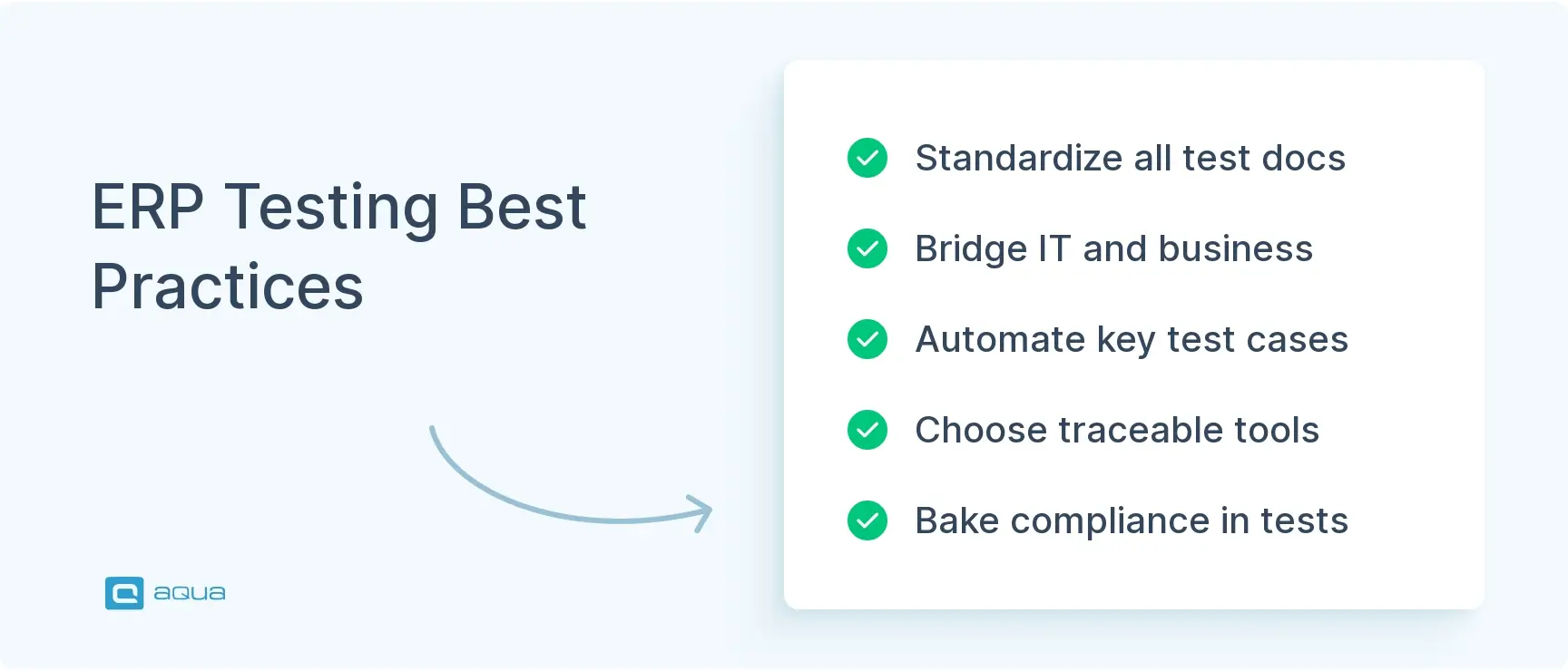
Best Practices for ERP Test Managers
Managing ERP testing well means balancing thoroughness with practical efficiency. These practices help you get better results without burning through resources.
Standardize everything
Consistent test methodologies, documentation formats, and defect tracking make testing repeatable and comparable across modules. Standardization also makes onboarding new team members easier and maintains quality regardless of who runs the tests.
Create templates for test cases, test plans, and defect reports. Include fields for prerequisites, test steps, expected results, actual results, and supporting evidence like screenshots. Templates save time and ensure nothing critical gets missed.
Bridge IT and business teams
Technical testers understand system functionality but might miss business process nuances. Business users know operational requirements but might overlook technical implications. You need both perspectives for robust testing.
Build cross-functional teams with IT, key business departments, and implementation partners. Hold regular sync meetings to align priorities and share insights. Co-locate testers and developers when possible to speed up defect resolution and knowledge sharing.
Automate smartly
Automation improves efficiency for repetitive regression tests. Identify stable, frequently executed test cases as automation candidates. Modern ERP testing tools can simulate user interactions, verify results, and report outcomes without manual work.
Start small. Automate high-value processes like month-end closing or order-to-cash flows first. Expand coverage as your team gains experience. Not everything should be automated. Complex scenarios with many variables or infrequent processes might be more efficient to test manually.
Choose the right tools
What are the best test management tools for ERP implementations? Look for solutions with complete traceability from requirements to test cases. They should support manual and automated testing, integrate with defect tracking, offer customizable reporting, and enable collaboration across distributed teams. A prime example is aqua cloud, which brings AI into traditional test management practices and turns it into a breeze.
Bake in compliance
Don’t treat compliance as a separate activity. Test cases should explicitly verify regulatory requirements, audit trails, approval workflows, and security controls. Document compliance-focused tests clearly for future audits.
Include negative testing for compliance features. Try to bypass controls or process unauthorized transactions. This confirms the system properly prevents what it should, not just enables what’s approved.
Following these practices turns test management from a bottleneck into an advantage. But even with best practices, challenges will pop up. Let’s look at the common ones and how to handle them.
Challenges of ERP Test Management and How to Overcome Them
Testing ERP applications comes with unique headaches. System complexity, integrated business processes, and organizational dynamics all create obstacles. Recognizing these challenges and having strategies ready helps you navigate them.
The Scope Problem
ERP systems involve hundreds or thousands of business processes across multiple departments. Achieving comprehensive coverage feels impossible. The interconnected nature means a change in one area ripples everywhere, making it hard to isolate test cases.
How to handle it:
Use risk-based testing that prioritizes critical business processes and high-impact areas
Categorize processes by importance to operations and financial reporting
Allocate more resources to high-priority areas
Use ERP test management tools that analyze change impact to identify affected processes instead of retesting everything
Test Data Headaches
Creating realistic test scenarios needs representative data that mimics production complexity. But using actual production data raises privacy and compliance issues. Plus, test data must stay consistent across test cycles for accurate comparisons.
How to handle it:
Develop a comprehensive test data strategy
Use data masking or anonymization to create realistic data without exposing sensitive information
Consider test data management tools that generate synthetic data with realistic relationships
Establish a baseline test dataset you can refresh to a known state between cycles
Resource Constraints
Finding testers with both technical ERP knowledge and business process expertise is tough. Time pressure from aggressive deadlines leads to rushed testing, which increases the risk of missing critical defects.
How to handle it:
Build mixed teams of technical testers and business subject matter experts
Invest in training to develop in-house expertise instead of relying on consultants
Use parallel testing with multiple teams working on different modules simultaneously
Automate repetitive test scenarios
Set realistic timelines that account for multiple test cycles and defect resolution
Organizational Resistance
Business users view testing as a distraction from regular work. They resist providing detailed feedback. Management doesn’t appreciate thorough testing and sees it as somewhere to cut corners for deadlines or budget.
How to handle it:
Communicate testing’s business value in executive terms: risk reduction, cost avoidance, business continuity
Schedule testing sessions during less busy periods
Provide clear, straightforward test scripts that don’t overwhelm users
Celebrate testing milestones publicly
Recognize business testers’ contributions to reinforce their value
Understanding these challenges is half the battle. The other half is having the right ERP test management software to help you manage them effectively. Let’s start with the tips for effective testing, and then give you the ultimate solution that’ll help you with all those.
Best Prompts for ERP Test Management
ERP test management involves complex, multi-module processes that can overwhelm even experienced teams. AI helps you tackle this complexity head-on. With the right prompts and an LLM model, you can generate comprehensive test suites and risk assessments in minutes. Below are two practical prompts that address common ERP test challenges.
Prompt 1: Generate End-to-End ERP Test Cases for Business Processes
Copy and paste the following prompt into an LLM model of your choosing:
Create comprehensive end-to-end test cases for the following ERP business process.
Provide output in plain text markdown format that can be easily copied into Google Docs:
1. PROCESS FLOW DIAGRAM
Format as a text-based flow:
## Business Process Flow
[Module 1] → [Module 2] → [Module 3] → [Module 4]
↓ [Specific action] ↓ [Specific action] ↓ [Specific action]
Show all touchpoints and data transfers between modules.
2. TEST CASES TABLE
Format as a markdown table:
| Test Case ID | Test Scenario | Modules Involved | Test Steps | Expected Result | Data Requirements |
Rules:
- Test Case ID: Use format TC-[ProcessName]-XXX (e.g., TC-O2C-001 for Order-to-Cash)
- Test Scenario: Clear description of what business function is being tested
- Modules Involved: List all ERP modules that interact (e.g., SD, MM, FI, PP)
- Test Steps: Write detailed, numbered steps in format "1. Action → 2. Action → 3. Verify"
- Expected Result: Specific, measurable outcome
- Data Requirements: Types of test data needed (customer records, material masters, etc.)
- Use clear, action-oriented language
- Each test step must be executable by someone unfamiliar with the process
- Include verification points after each module transition
- Specify which user role should execute each step
3. INTEGRATION CHECKPOINTS
Format as a bulleted list:
## Critical Integration Points to Verify
- **[Module A] → [Module B]**: [What data flows] - *Verify:* [Specific validation check]
- [Next integration point...]
4. NEGATIVE TEST SCENARIOS
Format as:
## Negative Testing (What Should Fail)
1. **Scenario:** [Incorrect action] - **Expected System Response:** [How system should prevent/handle]
2. [Next negative scenario...]
Business Process to Test:
[Describe your ERP business process - e.g., "Procure-to-Pay cycle in SAP S/4HANA" or "Order-to-Cash process including inventory, shipping, and billing"]
ERP System: [Specify system - SAP, Oracle, Microsoft Dynamics, etc.]
Modules Involved: [List known modules or leave blank for AI to suggest]
Use Case: Test managers and QA leads can quickly create comprehensive test coverage for complex ERP business processes. The test cases span multiple modules. This ensures no integration point is overlooked during test cycles.
AI Output Format:
Text-based process flow diagram that shows module connections
Markdown test cases table with detailed step-by-step instructions
Integration checkpoint list that highlights critical data transfers between modules
Negative test scenarios as numbered list with expected system responses
Create comprehensive end-to-end test cases for the following ERP business process.
Provide output in plain text markdown format that can be easily copied into Google Docs:
1. PROCESS FLOW DIAGRAM
Format as a text-based flow:
## Business Process Flow
[Module 1] → [Module 2] → [Module 3] → [Module 4]
↓ [Specific action] ↓ [Specific action] ↓ [Specific action]
Show all touchpoints and data transfers between modules.
2. TEST CASES TABLE
Format as a markdown table:
| Test Case ID | Test Scenario | Modules Involved | Test Steps | Expected Result | Data Requirements |
Rules:
- Test Case ID: Use format TC-[ProcessName]-XXX (e.g., TC-O2C-001 for Order-to-Cash)
- Test Scenario: Clear description of what business function is being tested
- Modules Involved: List all ERP modules that interact (e.g., SD, MM, FI, PP)
- Test Steps: Write detailed, numbered steps in format "1. Action → 2. Action → 3. Verify"
- Expected Result: Specific, measurable outcome
- Data Requirements: Types of test data needed (customer records, material masters, etc.)
- Use clear, action-oriented language
- Each test step must be executable by someone unfamiliar with the process
- Include verification points after each module transition
- Specify which user role should execute each step
3. INTEGRATION CHECKPOINTS
Format as a bulleted list:
## Critical Integration Points to Verify
- **[Module A] → [Module B]**: [What data flows] - *Verify:* [Specific validation check]
- [Next integration point...]
4. NEGATIVE TEST SCENARIOS
Format as:
## Negative Testing (What Should Fail)
1. **Scenario:** [Incorrect action] - **Expected System Response:** [How system should prevent/handle]
2. [Next negative scenario...]
Business Process to Test:
[Describe your ERP business process - e.g., "Procure-to-Pay cycle in SAP S/4HANA" or "Order-to-Cash process including inventory, shipping, and billing"]
ERP System: [Specify system - SAP, Oracle, Microsoft Dynamics, etc.]
Modules Involved: [List known modules or leave blank for AI to suggest]
Use Case: Test managers and QA leads can quickly create comprehensive test coverage for complex ERP business processes. The test cases span multiple modules. This ensures no integration point is overlooked during test cycles.
AI Output Format:
Text-based process flow diagram that shows module connections
Markdown test cases table with detailed step-by-step instructions
Integration checkpoint list that highlights critical data transfers between modules
Negative test scenarios as numbered list with expected system responses
Outcome: AI delivers a complete test suite for an end-to-end ERP business process. You receive test cases that cover normal flows, integration validation, and negative scenarios. The output pastes directly into Google Docs with proper table format. Each test case includes module touchpoints, detailed steps, and specific validation criteria. You can assign them to your test team immediately.
Expected Benefit: This reduces test case creation time for complex multi-module ERP processes. It ensures comprehensive coverage across all integration points. This helps prevent costly failures after implementation.
Prompt 2: Generate ERP Test Risk Assessment and Priority Matrix
Copy and paste the following prompt into an LLM model of your choosing:
Conduct a comprehensive risk assessment for ERP tests. Create a prioritized test strategy.
Provide output in plain text markdown format optimized for Google Docs:
1. RISK ASSESSMENT TABLE
Format as a markdown table:
| Business Process/Module | Business Impact | Technical Complexity | Change Frequency | Risk Score | Priority Level |
Rules:
- Business Process/Module: Name specific ERP process or module
- Business Impact: "Critical" (revenue/compliance), "High" (operations), "Medium" (efficiency), "Low" (convenience)
- Technical Complexity: "High" (many integrations/customizations), "Medium" (standard config), "Low" (out-of-box)
- Change Frequency: "High" (frequent updates), "Medium" (periodic), "Low" (stable)
- Risk Score: Calculate as numerical score 1-10 based on impact + complexity + change frequency
- Priority Level: "P0" (test first, most resources), "P1" (high priority), "P2" (medium priority), "P3" (test if time allows)
- Rank processes from highest to lowest risk score
- Be specific about why each process receives its impact rating
- Consider both technical and business perspectives
2. RECOMMENDED TEST APPROACH
Format as:
## Test Strategy by Priority
### P0 (Critical Priority, Test First)
- **[Process name]**: [Test approach] - *Resources:* [Recommended team size/skills] - *Test cycles:* [How many]
### P1 (High Priority)
- [Process details...]
### P2 (Medium Priority)
- [Process details...]
### P3 (Low Priority, Time Permitting)
- [Process details...]
3. RESOURCE ALLOCATION RECOMMENDATIONS
Format as a table:
| Priority Level | % of Test Budget | % of Test Time | Recommended Team Composition |
Provide realistic percentages that total 100% for budget and time.
4. RISK MITIGATION STRATEGIES
Format as:
## Risk Mitigation Plans
For each P0 and P1 process, provide:
- **[Process name]**:
- *Primary Risk:* [Main concern]
- *Mitigation:* [Specific actions to reduce risk]
- *Contingency:* [Backup plan if issues arise]
- *Success Criteria:* [How to know it's tested well]
ERP Implementation Details:
System: [Your ERP system]
Go-Live Date: [Timeline or "Not set"]
Key Business Processes: [List main processes like Order-to-Cash, Procure-to-Pay, Record-to-Report, etc.]
Known Customizations: [Describe any custom code or unique configurations]
Regulatory Requirements: [Any compliance needs like SOX, GDPR, FDA, etc.]
Resource Constraints: [Team size, timeline pressure, budget limits, or "None specified"]
Use Case: Test managers who face limited resources and tight timelines can create a data-driven test strategy. This strategy focuses effort on the highest-risk areas. It ensures critical business processes receive proper validation even when comprehensive tests aren't feasible.
AI Output Format:
Risk assessment table that ranks all ERP processes by risk score
Priority-based test strategy with specific approaches for each level
Resource allocation table that shows budget and time distribution
Risk mitigation plans with actionable strategies for high-risk areas
Conduct a comprehensive risk assessment for ERP tests. Create a prioritized test strategy.
Provide output in plain text markdown format optimized for Google Docs:
1. RISK ASSESSMENT TABLE
Format as a markdown table:
| Business Process/Module | Business Impact | Technical Complexity | Change Frequency | Risk Score | Priority Level |
Rules:
- Business Process/Module: Name specific ERP process or module
- Business Impact: "Critical" (revenue/compliance), "High" (operations), "Medium" (efficiency), "Low" (convenience)
- Technical Complexity: "High" (many integrations/customizations), "Medium" (standard config), "Low" (out-of-box)
- Change Frequency: "High" (frequent updates), "Medium" (periodic), "Low" (stable)
- Risk Score: Calculate as numerical score 1-10 based on impact + complexity + change frequency
- Priority Level: "P0" (test first, most resources), "P1" (high priority), "P2" (medium priority), "P3" (test if time allows)
- Rank processes from highest to lowest risk score
- Be specific about why each process receives its impact rating
- Consider both technical and business perspectives
2. RECOMMENDED TEST APPROACH
Format as:
## Test Strategy by Priority
### P0 (Critical Priority, Test First)
- **[Process name]**: [Test approach] - *Resources:* [Recommended team size/skills] - *Test cycles:* [How many]
### P1 (High Priority)
- [Process details...]
### P2 (Medium Priority)
- [Process details...]
### P3 (Low Priority, Time Permitting)
- [Process details...]
3. RESOURCE ALLOCATION RECOMMENDATIONS
Format as a table:
| Priority Level | % of Test Budget | % of Test Time | Recommended Team Composition |
Provide realistic percentages that total 100% for budget and time.
4. RISK MITIGATION STRATEGIES
Format as:
## Risk Mitigation Plans
For each P0 and P1 process, provide:
- **[Process name]**:
- *Primary Risk:* [Main concern]
- *Mitigation:* [Specific actions to reduce risk]
- *Contingency:* [Backup plan if issues arise]
- *Success Criteria:* [How to know it's tested well]
ERP Implementation Details:
System: [Your ERP system]
Go-Live Date: [Timeline or "Not set"]
Key Business Processes: [List main processes like Order-to-Cash, Procure-to-Pay, Record-to-Report, etc.]
Known Customizations: [Describe any custom code or unique configurations]
Regulatory Requirements: [Any compliance needs like SOX, GDPR, FDA, etc.]
Resource Constraints: [Team size, timeline pressure, budget limits, or "None specified"]
Use Case: Test managers who face limited resources and tight timelines can create a data-driven test strategy. This strategy focuses effort on the highest-risk areas. It ensures critical business processes receive proper validation even when comprehensive tests aren't feasible.
AI Output Format:
Risk assessment table that ranks all ERP processes by risk score
Priority-based test strategy with specific approaches for each level
Resource allocation table that shows budget and time distribution
Risk mitigation plans with actionable strategies for high-risk areas
Outcome: AI produces a strategic test roadmap that justifies resource allocation to stakeholders. It guides daily test priorities. You receive a defensible, risk-based approach that shows which processes need the most attention and why. The document includes specific mitigation strategies for your highest-risk areas. It also has realistic resource recommendations. This is perfect to present to project sponsors or to align cross-functional teams on test priorities.
Expected Benefit: This enables test teams to focus limited resources on areas with the greatest business impact. It prevents critical failures in revenue or compliance-sensitive processes. It also manages scope effectively under tight deadlines.
These prompts help you generate test cases and assess risks manually. But ERP testing involves hundreds of interconnected processes across multiple modules. What if AI could handle this complexity automatically, right inside your test management platform? That’s where aqua, an AI-driven test and requirement management platform can help with enterprise testing scenarios like ERP implementations. The domain-trained AI Copilot understands business process flows across SAP, Oracle, and Microsoft Dynamics environments. It generates end-to-end test suites that cover module integrations, data flows, and negative scenarios automatically. You get complete audit trails and traceability matrices required for compliance. aqua adapts to any methodology with customizable workflows and supports parallel testing across distributed teams. Native integrations with Jira, Azure DevOps, Selenium, and Jenkins connect your entire testing ecosystem. The platform learns your ERP configuration and business logic to create contextually relevant test scenarios. No more missed integration points or manual coverage tracking.
Enough with the challenges, now let’s focus on the best practices you should implement. These practical tips will streamline your testing process, make it more efficient, and help you avoid common mistakes most QA make:
Start testing early in the project lifecycle. Don’t wait until configuration is complete. Early testing, even with partially completed modules, catches design flaws and integration issues when they’re easier and cheaper to fix. Build testing into each development sprint instead of treating it as a separate end phase.
Create business scenario-based test cases. Test complete business processes from start to finish, not individual transactions in isolation. Test the entire procure-to-pay cycle, not just purchase order creation. This reflects how users actually work with the system.
Maintain a living test case repository. Document test cases clearly so different testers can execute them consistently. Store them in a central repository accessible to everyone. Update test cases as business processes or system functionality changes. This repository becomes invaluable for future updates.
Implement a clear defect management process. Establish procedures for logging, categorizing, assigning, and tracking defects through resolution. Define severity levels with objective criteria and response time expectations. Regular defect review meetings help prioritize fixes and prevent things from slipping through.
Test across different browsers and devices. Modern ERP systems work on multiple platforms. Test critical functions across browsers, operating systems, and mobile devices your organization will support. Pay attention to responsive design elements and touch interfaces.
Include negative testing scenarios. Don’t just verify the system works when used correctly. Test how it handles incorrect inputs, invalid processes, or unexpected user actions. Try to create duplicate records, process transactions with insufficient data, or bypass approval workflows to confirm the system prevents these actions.
Document testing evidence systematically. Capture screenshots, test logs, and detailed notes about execution. This helps developers reproduce and fix issues, provides audit evidence for compliance, and creates a knowledge base for future reference.
Conduct performance testing under realistic conditions. Simulate actual user loads, data volumes, and peak processing periods to find performance bottlenecks. Include batch jobs and background processes, as these consume significant system resources. Test with realistic network conditions, especially for global implementations.
Involve end users throughout the testing process. Include key users from each functional area on the testing team, not just for final UAT but throughout the entire testing lifecycle. Their expertise helps create realistic test scenarios and identifies usability issues early. This involvement also builds system knowledge and ownership.
Plan for multiple test cycles. Schedule adequate time for initial testing, defect fixing, retesting, and regression testing. Each cycle improves system quality but requires sufficient calendar time. Avoid planning for a single test pass. It rarely catches all significant issues.
Following these tips becomes exponentially easier when you have the right best test management software supporting your efforts. The right platform literally transforms how your team approaches ERP testing from start to finish.
aqua cloud provides the structure and tools you need to tackle complex ERP testing with confidence. Its unified platform centralizes all test assets from requirements to test cases and defects, eliminating the tool sprawl that often complicates ERP projects. The built-in AI Copilot helps generate comprehensive test cases from requirements in seconds, dramatically reducing the time spent on test creation while ensuring thorough coverage. With customizable dashboards and detailed reporting, you gain instant visibility into testing progress across all ERP modules, helping you identify risks early and make data-driven decisions. aqua’s integration capabilities connect seamlessly with your existing tools like Jira and automated testing solutions, creating a cohesive ecosystem that supports your entire testing lifecycle.
Transform ERP testing from a project bottleneck to a strategic advantage with aqua
ERP test management separates smooth implementations from expensive disasters. A structured testing approach protects the business from costly disruptions, ensures system reliability, and maximizes ERP investment. If you want to successfully implement it, you have to recognize testing as a business imperative, not just a technical checkbox. You should engage stakeholders across departments, focus on end-to-end business processes, and maintain rigorous standards throughout implementation and beyond. Modern tools and automation make this manageable through better visibility and collaboration between teams. ERP systems continue evolving with cloud deployments, continuous updates, and deeper integrations. So testing approaches must evolve with them.
ERP testing is the validation process for Enterprise Resource Planning systems that connect your core business operations. When you test ERP system components, you’re not just checking if features work in isolation. You’re verifying complex, interconnected workflows that span multiple departments. This means ensuring integrated processes like order-to-cash or procure-to-pay function correctly across modules while maintaining data consistency and accurate financial reporting. ERP testing combines technical validation with business process verification to confirm the system actually supports real-world operations.
What are the benefits of ERP testing?
ERP testing delivers tangible business advantages. It minimizes costly disruptions by catching issues before they impact operations. It reduces implementation costs by finding defects early when they’re cheaper to fix. It increases user adoption by ensuring the system works intuitively. It ensures regulatory compliance through validation of controls and audit trails. It optimizes performance under real-world conditions. It verifies data accuracy for reliable business decisions. It streamlines future updates with reusable test assets. And it protects revenue by ensuring critical business processes work correctly. These benefits collectively reduce risk while maximizing return on your ERP investment.
What is ERP in testing?
ERP stands for Error Recovery Procedure in software testing. It refers to testing how well a system can detect, handle, and recover from errors or failures. ERP testing verifies that when something goes wrong (like a crash, network failure, or invalid input), the application can return to normal operation without data loss or corruption. This type of testing is crucial for ensuring system reliability and resilience under abnormal conditions.
Home » Best practices » ERP Test Management: A Comprehensive Guide + Free Tips
Do you love testing as we do?
Join our community of enthusiastic experts! Get new posts from the aqua blog directly in your inbox. QA trends, community discussion overviews, insightful tips — you’ll love it!
We're committed to your privacy. Aqua uses the information you provide to us to contact you about our relevant content, products, and services. You may unsubscribe from these communications at any time. For more information, check out our Privacy policy.
X
🤖 Exciting new updates to aqua AI Assistant are now available! 🎉
We use cookies and third-party services that store or retrieve information on the end device of our visitors. This data is processed and used to optimize our website and continuously improve it. We require your consent fro the storage, retrieval, and processing of this data. You can revoke your consent at any time by clicking on a link in the bottom section of our website.
For more information, please see our Privacy Policy.
This website uses cookies to improve your experience while you navigate through the website. Out of these, the cookies that are categorized as necessary are stored on your browser as they are essential for the working of basic functionalities of the website. We also use third-party cookies that help us analyze and understand how you use this website. These cookies will be stored in your browser only with your consent. You also have the option to opt-out of these cookies. But opting out of some of these cookies may affect your browsing experience.
Necessary cookies are absolutely essential for the website to function properly. These cookies ensure basic functionalities and security features of the website, anonymously.
Cookie
Duration
Description
cookielawinfo-checkbox-analytics
11 months
This cookie is set by GDPR Cookie Consent plugin. The cookie is used to store the user consent for the cookies in the category "Analytics".
cookielawinfo-checkbox-functional
11 months
The cookie is set by GDPR cookie consent to record the user consent for the cookies in the category "Functional".
cookielawinfo-checkbox-necessary
11 months
This cookie is set by GDPR Cookie Consent plugin. The cookies is used to store the user consent for the cookies in the category "Necessary".
cookielawinfo-checkbox-others
11 months
This cookie is set by GDPR Cookie Consent plugin. The cookie is used to store the user consent for the cookies in the category "Other.
cookielawinfo-checkbox-performance
11 months
This cookie is set by GDPR Cookie Consent plugin. The cookie is used to store the user consent for the cookies in the category "Performance".
viewed_cookie_policy
11 months
The cookie is set by the GDPR Cookie Consent plugin and is used to store whether or not user has consented to the use of cookies. It does not store any personal data.
Functional cookies help to perform certain functionalities like sharing the content of the website on social media platforms, collect feedbacks, and other third-party features.
Performance cookies are used to understand and analyze the key performance indexes of the website which helps in delivering a better user experience for the visitors.
Analytical cookies are used to understand how visitors interact with the website. These cookies help provide information on metrics the number of visitors, bounce rate, traffic source, etc.
Advertisement cookies are used to provide visitors with relevant ads and marketing campaigns. These cookies track visitors across websites and collect information to provide customized ads.






 Bankingaqua ALM helps banks increase testing productivity by over 50%