Metrics that Matter: Tracking and Measuring Your Testing Success with aqua cloud’s Insights
Software is now a part of our everyday lives. We use various technology and systems to order food, complete tasks, stay fit, etc. Good testing and quality checking are at the heart of software development that successfully gains users and delivers value.
Ensuring the quality and reliability of your product is as vital as the product itself. This is where aqua cloud, a robust platform for tracking and measuring testing success, can come in handy.
However, recognising what metrics to track and understanding their significance isn’t always a straightforward assignment. Software developers, product designers, and everyone involved in the development pipeline should understand what metrics matter and what don’t.
In this article, we explore testing metrics and discuss key performance indicators (KPIs) crucial for software testing. We’ll also examine the importance of benchmarking test performance and why real-time metrics are indispensable for a successful testing strategy.
Understanding Testing Success Metrics
So, what are success metrics, and why should we test them? Testing success metrics are essential to the data we use to assess if a software testing task is effective and efficient. These metrics clearly show how your testing phase goes and help your team understand whether the software meets the desired quality standards to ship a product out.
As important as these metrics are, they’ve become textbooks for all software developers. You’ll run into this if you’re studying any programming course or taking a master’s in software engineering.
Testing success metrics cover various testing aspects. We’ll look at some of the most crucial ones in a while. For now, you should keep this in mind: always make it a point to determine the right testing success metrics. Doing so will help your team identify improvement areas, ensuring the software is high-quality and market-ready.
You can use aqua cloud to save time on test life cycles. As a test management tool, aqua brings a more structured approach to your team, which will help you with resource management and in-house communication. Using aqua brings full visibility into your QA process while ensuring smooth cooperation between internal users, partners, and customers. With an intuitive interface, you’ll eliminate human error, getting maximum out of the mix of automated & manual testing.
Choose aqua and take away the pain of testing for good
Key Performance Indicators (KPIs) in Software Testing
Several Key Performance Indicators (KPIs) will effectively demonstrate how reliable your testing process is. You’ll need these to achieve key development and business objectives.
For software testing, some of the most important KPIs you might want to measure could include the following:
Test Coverage measures the amount of testing performed by quantifying the proportion of tested code versus the total amount of code.
Defect Density calculates the number of defects found in the software per thousand lines of code, helping to identify areas of the code that need more attention.
Pass/Fail Rate will indicate the percentage of tests that pass and fail, providing insight into the software’s overall stability.
Time to Test helps track the time taken to perform testing activities, an essential factor for project scheduling and time management.
Automated Test Percentage is the ratio of tests performed automatically to those conducted manually, showcasing the efficiency and speed of the testing process.
Benchmarking will be a crucial aspect of the process when you run tests. It involves comparing your current test performance with past performance or industry standards. When you test performance measurement, you can set more realistic goals and expectations for the testing team.
Proper benchmarking also matters because it aids in identifying best practices and areas where your testing process could be improved. aqua cloud’s platform can be utilized to maintain a history of testing metrics, making it easier to conduct comparative analyses and track progress over time.
Importance of Real-Time Metrics
In a dynamic test environment, you should have access to real-time metrics because it enables better decision-making and adaptability. You’re more likely to make the right adjustments immediately. Accordingly, the process becomes more adaptable, and you can address issues as soon as they arise.
Real-time metrics provide a live overview of the testing process, which will enhance the overall efficiency of the development cycle. That’s why our users benefit greatly from aqua cloud’s real-time insights. With this capability, teams can come up with up-to-the-minute data, allowing for a proactive approach to software testing.
Leveraging aqua cloud's Insights
At aqua cloud, we aim to give development teams and software departments a comprehensive solution for the entire testing lifecycle. We achieve that goal by providing reliable and easy-to-manage tools to optimize, monitor, and track software testing processes. This platform is designed to significantly speed up release cycles and increase the efficiency of QA management.
Key Features for Metrics Analysis
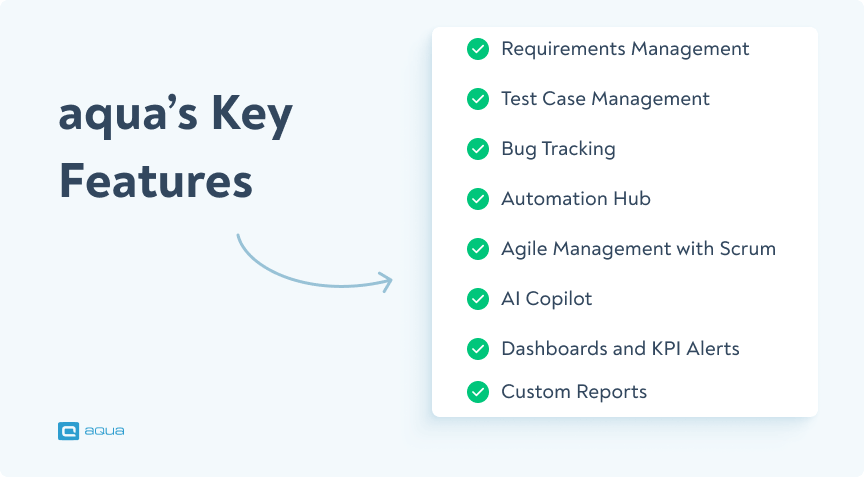
Here are some key features for metrics analysis in aqua cloud and how they help you.
Requirements Management — aqua cloud enables you to manage and link requirements with test cases and defects, ensuring better traceability and coverage.
Test Case Management — It provides structured, clear, and audit-proof management of test cases, with a history of past test runs for improvements.
Bug Tracking — The aqua cloud Chrome extension quickly records defects and links them with test cases for efficient regression testing.
Automation Hub — aqua cloud can manage various manual and automated QA tools, offering real-time data visualisation in reports.
Agile Management with Scrum Boards — This feature lets project and product managers add cases to backlogs and sprints for better planning and prioritization.
AI Copilot — aqua cloud’s AI assistant can auto-create test cases and descriptions, helping save time and covering more edge cases.
Dashboards and KPI Alerts — our highly customizable dashboards provide real-time insights into testing processes, with KPI alerts to monitor trends and emergencies.
Custom Reports — Users can generate detailed reports with charts, external data, and custom scripts, scaling from executive summaries to full QA overviews.
Integration with Testing Processes
Integration with Industry-leading Systems — aqua cloud integrates with tools like Selenium, JMeter, Ranorex, and more. These extensive capabilities support a range of third-party tools and REST API for seamless workflow integration.
This versatility makes it suitable for various industries, including banking, insurance, tech, manufacturing, government, and medical sectors. It allows easy test data management and migration, ensuring compliance and revision security throughout the process.
aqua cloud is not just a solution for testers but a comprehensive solution for entire teams, including project managers, tech leads, and upper management. It facilitates quicker regulation compliance, enhanced communication, and efficient workflow management.
Incorporating aqua cloud’s Insights into your testing processes means embracing a future where testing success is not just an aspiration but a measurable, achievable reality. With its powerful features for metrics tracking and robust integrations, aqua cloud stands out as a pioneering force in quality assurance and software testing.
Implementing Effective Measurement Strategies
If you’re planning to implement effective measurement strategies in your testing processes, we highly recommend that you follow these best practices:
1) Set Clear Objectives for Metrics
Setting clear, precise objectives for software testing metrics is paramount to harnessing aqua cloud’s Insights’ full potential. Begin by identifying what you want to achieve with your testing process.
Is it reducing the number of bugs, enhancing the speed of test cycles, or improving the overall quality of the software? With a solid understanding of your objectives, you can tailor aqua cloud’s robust analytics to focus on what matters most to your project.
2) Choose Appropriate Metrics for Projects
Selecting the right metrics is crucial for insightful analysis. The beauty of aqua cloud’s Insights lies in its versatility – whether it’s measuring test coverage, bug tracking efficiency, or the effectiveness of your automated testing tools.
For instance, if your goal is to improve test coverage, focus on metrics like requirements traceability and test case effectiveness. Remember, the key is not to measure everything but to measure what’s most aligned with your project goals.
3) Make Improvements through Feedback Loops
Implementing a feedback loop is a dynamic way to ensure continuous improvement in your testing processes. aqua cloud’s dashboards and real-time analytics enable you to monitor key metrics closely and adjust strategies as needed.
Here are some key considerations when creating your feedback loops:
Give feedback promptly. Delayed feedback can lose its relevance and impact.
Feedback should be constructive, meaning it should focus on areas for improvement and provide actionable suggestions rather than just pointing out flaws.
Establish a regular schedule for feedback. Consistency helps in tracking progress and maintaining momentum.
Encourage a culture where feedback is not just top-down but a two-way dialogue. This approach fosters openness and trust.
Incorporate both quantitative metrics and qualitative observations for a comprehensive view.
Tailor feedback to individual needs and situations. Generic feedback often lacks impact.
Create an environment where people feel safe giving and receiving honest feedback without fear of negative consequences.
Implement a system for following up on feedback given to ensure that it is being used effectively and to assess its impact.
This ongoing process of measuring, analysing, and refining ensures that your testing is effective and continually evolves with the changing needs of your project. Leverage aqua cloud’s AI-powered insights to detect patterns and anomalies, helping you to fine-tune your approach for optimum results.
Final Thoughts
aqua cloud is a game-changer in the realm of software testing and quality assurance. Organisations can significantly elevate their testing processes by setting clear objectives, choosing the right metrics, and establishing continuous feedback loops. aqua offers a comprehensive suite for tracking and measuring testing success and provides an integrated platform for proactive testing management.
Embrace aqua cloud to navigate the complexities of software testing with ease and precision. Transform your approach from reactive to proactive, and watch as your testing process becomes more streamlined, efficient, and effective. With aqua cloud, the journey towards outstanding software quality and testing success becomes a tangible reality for you and your entire team and company.
KPIs in software testing tell you if your QA is actually working or just wasting time. Here’s how to track what matters:
Defect detection rate – If you’re catching 90%+ of bugs before release, you’re winning.
Test coverage – More coverage = fewer surprises. Aim for at least 80%, but don’t obsess over 100%. Only using solutions like aqua cloud will give you that number.
Escaped defects – Bugs in production? If this number is rising, your tests aren’t doing their job.
Time to fix – If it takes weeks to fix a bug, your process is broken. Keep it tight.
Test execution speed – Slow tests kill efficiency. Automate and parallelize to move faster.
How do you choose the right metrics for software testing?
It’s easy to get lost in numbers, but not all metrics drive real improvements. Start by aligning your metrics with business goals, do you need:
Faster releases?
Better test coverage?
Or fewer production bugs?
Focus on actionable metrics like defect escape rate. It tells you how many issues slip past testing, or test stability. It is also crucial to highlight flaky tests that waste time. Avoid vanity metrics like the total number of test cases if they don’t lead to better decisions. The right metrics are about impact, not quantity.
Why do some teams struggle with using test metrics effectively?
Metrics should guide decisions, and not just fill reports—but many teams track numbers without context. If a team sees test execution time increasing, they might assume their pipeline is slow, but what if it’s due to adding more comprehensive tests?
Instead of reacting blindly, you need to analyse trends and correlations. A rising defect detection rate isn’t always bad—it could mean better testing, not worse code. The key is understanding what the data actually says and making informed adjustments rather than chasing “ideal” numbers.
Home » Best practices » Metrics that Matter: Tracking and Measuring Your Testing Success with aqua cloud’s Insights
Do you love testing as we do?
Join our community of enthusiastic experts! Get new posts from the aqua blog directly in your inbox. QA trends, community discussion overviews, insightful tips — you’ll love it!
We're committed to your privacy. Aqua uses the information you provide to us to contact you about our relevant content, products, and services. You may unsubscribe from these communications at any time. For more information, check out our Privacy policy.
X
🤖 Exciting new updates to aqua AI Assistant are now available! 🎉
We use cookies and third-party services that store or retrieve information on the end device of our visitors. This data is processed and used to optimize our website and continuously improve it. We require your consent fro the storage, retrieval, and processing of this data. You can revoke your consent at any time by clicking on a link in the bottom section of our website.
For more information, please see our Privacy Policy.
This website uses cookies to improve your experience while you navigate through the website. Out of these, the cookies that are categorized as necessary are stored on your browser as they are essential for the working of basic functionalities of the website. We also use third-party cookies that help us analyze and understand how you use this website. These cookies will be stored in your browser only with your consent. You also have the option to opt-out of these cookies. But opting out of some of these cookies may affect your browsing experience.
Necessary cookies are absolutely essential for the website to function properly. These cookies ensure basic functionalities and security features of the website, anonymously.
Cookie
Duration
Description
cookielawinfo-checkbox-analytics
11 months
This cookie is set by GDPR Cookie Consent plugin. The cookie is used to store the user consent for the cookies in the category "Analytics".
cookielawinfo-checkbox-functional
11 months
The cookie is set by GDPR cookie consent to record the user consent for the cookies in the category "Functional".
cookielawinfo-checkbox-necessary
11 months
This cookie is set by GDPR Cookie Consent plugin. The cookies is used to store the user consent for the cookies in the category "Necessary".
cookielawinfo-checkbox-others
11 months
This cookie is set by GDPR Cookie Consent plugin. The cookie is used to store the user consent for the cookies in the category "Other.
cookielawinfo-checkbox-performance
11 months
This cookie is set by GDPR Cookie Consent plugin. The cookie is used to store the user consent for the cookies in the category "Performance".
viewed_cookie_policy
11 months
The cookie is set by the GDPR Cookie Consent plugin and is used to store whether or not user has consented to the use of cookies. It does not store any personal data.
Functional cookies help to perform certain functionalities like sharing the content of the website on social media platforms, collect feedbacks, and other third-party features.
Performance cookies are used to understand and analyze the key performance indexes of the website which helps in delivering a better user experience for the visitors.
Analytical cookies are used to understand how visitors interact with the website. These cookies help provide information on metrics the number of visitors, bounce rate, traffic source, etc.
Advertisement cookies are used to provide visitors with relevant ads and marketing campaigns. These cookies track visitors across websites and collect information to provide customized ads.






 Bankingaqua ALM helps banks increase testing productivity by over 50%