Next-Generation Software Testing: Leveraging AI and Automation for Quality Assurance
Software testing has gone through massive changes in recent years. AI is already transforming how we test software, but we're still in the early stages of what's possible. Current AI tools help automate test creation and catch bugs faster, yet this is just the beginning. Sounds exciting? Next-gen testing goes beyond basic automation to create intelligent systems that learn from your application's behavior, adapt to changes automatically, and provide insights that help you test smarter rather than just faster. This article shows you what's coming next and how to prepare your testing approach for this evolution.
Next-generation testing uses AI to create autonomous systems that handle entire testing workflows with minimal human intervention, moving beyond basic task automation to intelligent test ecosystems.
AI-powered tools can generate complete test cases from plain English requirements in seconds, with some platforms like Aqua cloud reducing test creation time by up to 98%.
Self-healing tests automatically adapt when developers change UI elements, with one consultant reporting over 70% reduction in test maintenance overhead.
Visual AI testing compares applications pixel by pixel while filtering out meaningless differences, catching layout issues across browsers that human testers often miss after hours of manual checking.
Production testing is becoming mainstream through feature flags, synthetic monitoring, and real user monitoring, breaking the old rule about never testing in production environments.
Next-gen testing promises to free QA teams from script maintenance hell, but the transition requires choosing platforms that actually deliver on AI automation promises rather than just marketing hype. See how these tools work in practice and what to watch out for 👇
What is Next-Gen Software Testing?
As we mentioned, the change is already here. But how is next-gen software testing different from generic AI implementation in testing?
Next-generation testing is about fundamentally changing what humans do in the testing process. While current AI tools automate individual tasks like test creation or execution, next-gen testing creates intelligent systems that handle entire testing workflows with minimal human intervention.
Here’s what distinguishes it from today’s AI-assisted testing:
Autonomous test ecosystems that generate, execute, and maintain tests based on application changes
Predictive quality intelligence that identifies potential issues before code is written
Self-optimizing test strategies that continuously improve based on real-world usage patterns
Seamless integration where testing becomes invisible infrastructure, like monitoring or logging
Context-aware decision making that understands business impact, not just technical functionality
The key shift is from humans managing AI tools to AI systems managing testing processes. Traditional testing requires constant human oversight. Current AI testing still needs humans to configure, monitor, and interpret results. Next-gen testing operates more like autopilot; humans set the destination and intervene when needed, but the system handles navigation.
To eliminate your doubts: this doesn’t mean fewer testing jobs. It means testing professionals become quality strategists, focusing on business risk, user experience, and complex scenarios that require human judgment about what matters most.
Why Next-Gen Testing Matters for Your Team
Next-generation testing solves the daily problems that current approaches can’t handle. You know those moments when your test suite takes forever to run, breaks when someone moves a button, or misses the exact bug that crashes your app? This is where testing needs to evolve.
Know What Actually Needs Testing
Stop guessing whether you’re testing the right things. Next-gen systems watch how people really use your software and focus testing on those areas. They find the weird edge cases you’d never think of and test the scenarios that actually break in production, not just the happy path you wrote down in requirements.
Get Results When You Need Them
Next-gen testing doesn’t just run faster, it runs smarter. These systems learn which tests tell you something useful and which ones just waste time. They run the important stuff first and skip the tests that never find real problems. Your test results come back in minutes instead of hours, and they actually mean something.
Stop Fixing Broken Tests Every Morning
Here’s the real game-changer. When developers change the interface, the testing system figures out what those changes mean and updates everything that needs updating. You don’t spend your morning fixing selectors and tweaking scripts. You spend it looking at actual test results and figuring out what they tell you about your software.
Find Bugs That Actually Matter
These systems don’t just catch more bugs; they catch the bugs that break things for real users. They spot visual problems you’d miss after staring at screens all day and notice when your app starts behaving differently in ways that might cause trouble. You get fewer false alarms and more real issues you can actually fix.
As we dive into the era of next-gen testing, the tools you choose will decide your transformation journey. While next-gen AI-driven automation testing promises dramatic improvements, implementing it effectively requires more than just theoretical knowledge; it demands the right platform.
Aqua cloud delivers exactly what you need to step into next-gen, offering AI-powered test case generation that can slash your test creation time by up to 98%. Unlike traditional tools that simply execute predefined scripts, aqua’s AI Copilot can transform requirements into comprehensive test cases in just seconds, ensuring 100% traceability and requirement coverage. This is all about freeing your QA team from repetitive tasks so they can focus on strategic testing work. With aqua cloud, you can centralize both manual and automated testing in one platform, creating a seamless workflow that adapts to your evolving application needs. Integrations with popular platforms like Jira, Confluence, Azure DevOps, and automation frameworks like Selenium, Jenkins, Ranorex, turn your testing efforts into a breeze. Why settle for mediocrity when you can smash your testing efforts with a few clicks?
Turn hours of effort into a few clicks with AI-powered test management
You can’t jump straight from manual testing to fully autonomous systems. Getting to next-gen testing means making smart choices about what to automate first and how to prepare your team for bigger changes ahead.
Figure Out What's Worth Changing
Look at your current testing honestly. Which parts eat up time without teaching you anything useful? Start there. If your regression suite takes two days to run and breaks every week, that’s your first target. Save the complex user journey testing for later. You need some wins before tackling the hard stuff.
Start Small and Prove It Works
Pick one testing problem that’s driving everyone crazy and fix it well. Maybe it’s the login tests that break when developers touch the CSS, or the data setup that takes an hour before you can test anything. Get that working smoothly, then show people the time you saved. You’ll need those success stories when you want a budget for bigger changes.
Prepare Your Team for What's Coming
Your testers aren’t going anywhere, but what they do will change. Instead of writing test scripts, they’ll be analyzing patterns and deciding what risks matter most. Start building those skills now. Have your team spend more time thinking about user behavior and business impact, less time maintaining automation.
Plan for the Long Game
The tools you pick today should work with whatever comes next and provide next-gen testing services. Don’t lock yourself into systems that only solve today’s problems. Choose platforms that can grow with new capabilities and integrate with the testing approaches you’ll need in two years, not just this quarter.
The foundation you build now determines how smoothly you can adopt the more advanced tools that are already changing how testing works. Let’s look at what’s actually available today and how these tools are moving us toward truly autonomous testing.
How AI-Powered Testing Tools Revolutionise Software Testing
AI testing tools work differently from traditional automation. Instead of spending half your time maintaining broken test scripts, you get tools that actually think about what they’re testing and why.
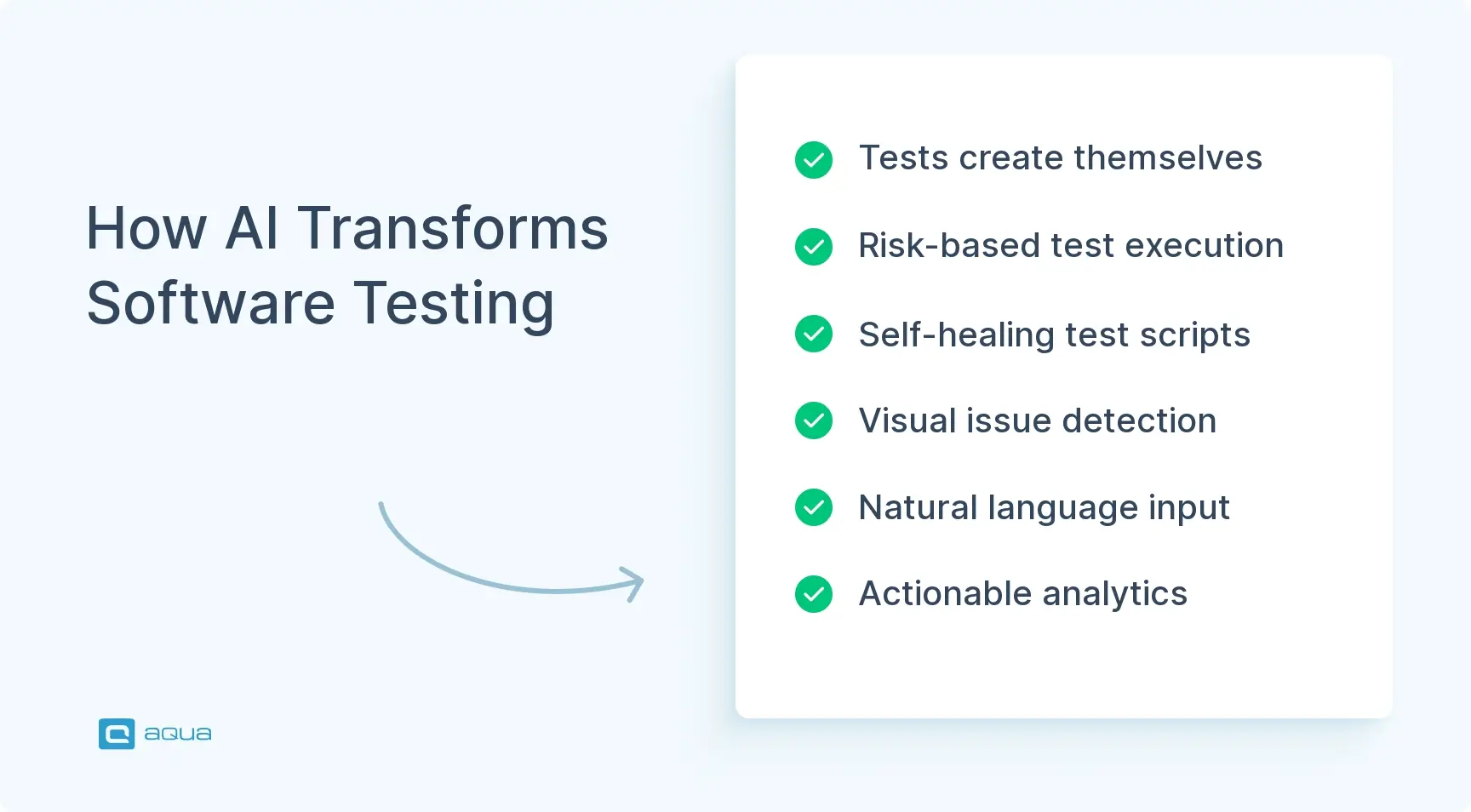
Tests That Write Themselves
Forget recording user sessions or writing test scripts line by line. The newest tools can create complete test cases just from reading your requirements. Aqua cloud is a prime example of this. Tell the system “users should be able to reset their password using email verification,” and with the power of generative AI in software testing, you get the full test scenario, including edge cases like expired tokens and invalid email formats.
Key capabilities include:
Requirements-to-tests conversion that turns plain English descriptions into executable test cases
Voice-to-test generation where you can literally speak your testing ideas and get working tests back
Context-aware test creation that understands your application domain and suggests realistic test data
What used to take you weeks of scripting now happens in minutes. You describe what should work, and the system figures out how to test it, no recording sessions, no manual scenario mapping, no writing code.
Smarter Test Execution That Actually Makes Sense
AI runs your tests intelligently instead of blindly executing the same sequence every time. These tools understand risk, prioritise accordingly, and optimise execution for maximum efficiency.
Smart execution features:
Risk-based prioritisation that runs critical tests first
Dynamic execution ordering for optimal efficiency
Intelligent parallel processing when tests can run simultaneously
Your most important tests complete first, and you get meaningful results when you need them most.
Visual Testing That Sees Like a Human
Here’s where AI gets really impressive. Tools like Applitools compare your application pixel by pixel against baseline images, but they’re smart enough to ignore meaningless differences that would trigger false positives.
Visual AI capabilities:
Pixel-perfect comparison with intelligent filtering of irrelevant changes
Cross-browser layout validation across different screen sizes
Meaningful change detection that focuses on functional impact
Self-Healing Tests That Fix Themselves
This is the game-changer. When developers move a button or change a form field, traditional tests break, and you spend your morning fixing selectors. Self-healing tests work differently.
Self-healing benefits:
Automatic UI element identification when interface changes occur
Dynamic locator adjustment without manual intervention
Recovery capabilities from unexpected application states
One testing consultant reported that self-healing technology reduced their test maintenance by over 70%, freeing up the team for actual exploratory testing instead of script maintenance.
Natural Language Test Creation
AI tools now understand testing requirements written in everyday language. You can describe what your application should do, and the AI translates that into working test cases.
Natural language features:
User story conversion directly into executable test cases
Realistic test data generation based on written requirements
Test scenario suggestions from application documentation
No more translating business requirements into technical test scripts. The AI handles that translation automatically.
Insights That Help You Test Smarter
Beyond finding bugs, AI provides intelligence about your testing strategy. These tools analyze patterns and provide recommendations that help you focus your efforts where they matter most.
Analytics capabilities:
Defect probability forecasting for high-risk application areas
Test failure pattern analysis to identify systemic issues
Coverage optimization recommendations based on actual usage data
Instead of guessing where to focus your testing efforts, you get data-driven recommendations that improve your overall strategy.
Traditional Automation
AI-Powered Testing
Rigid scripts that break when UI changes
Self-healing tests that adapt to application changes
Manual creation of test cases
Automatic generation of test scenarios
Fixed execution regardless of risk
Smart prioritization based on risk assessment
Pass/fail results with limited insights
Predictive analytics and quality guidance
High maintenance overhead
Significantly reduced maintenance requirements
The difference shows up in your daily work. AI-powered testing gives you back the time you’ve been losing to maintenance work and lets you focus on testing that actually requires human judgment and creativity.
The Future of Next-Gen Software Testing
Testing is evolving faster than most of us can keep up with. Several trends are reshaping not just how we test, but who gets to participate in testing and where testing actually happens.
Testing for Everyone, Not Just Testers
The walls between technical and non-technical team members are crumbling. Low-code and no-code testing platforms let your product managers and business analysts create automated tests without writing a single line of code.
What’s becoming possible:
Visual test builders that work like drawing applications
AI assistants that help anyone create robust test scenarios
Business-friendly interfaces that make test management accessible
Your marketing team can now validate their own user journeys. Your sales team can test the demo scenarios they actually show to customers. Testing is spreading beyond the QA department, and that’s a good thing.
I think the short-term future is that AI will augment the software testing process, taking some of the boilerplate and routine work off the shoulders of QA engineers.
The old rule about never testing in production is dead. Smart teams now treat production as another testing environment, just one they approach very carefully.
Modern production testing includes:
Feature flags for controlled rollouts and real user testing
Synthetic monitoring that continuously validates production systems
Real user monitoring that catches issues affecting actual customers
Continuous performance testing that spots slowdowns and resource issues as they happen in real-world conditions
Quantum Computing Changes Everything
Quantum computing sounds like science fiction, but it’s approaching fast enough to start thinking about. When quantum systems become mainstream, our entire approach to testing will need to evolve.
Quantum testing challenges ahead:
New methodologies for applications that work fundamentally differently
Quantum-powered testing tools with capabilities we can barely imagine today
Security testing for quantum-resistant systems and encryption
This isn’t something you need to worry about next quarter, but it’s worth understanding that another major shift is coming.
Testing AI for Fairness and Ethics
As AI systems make more decisions that affect real people, testing for bias and ethical behavior becomes critical. You’re not just checking if the AI works, but whether it works fairly for everyone.
Ethical AI testing involves:
Bias validation across different user demographics and scenarios
Transparency testing to ensure AI decisions can be explained
Compliance verification as AI regulations continue to develop
This type of testing requires understanding both technical functionality and human impact. It’s testing that goes beyond “does it work” to “should it work this way.”
The future of testing is all about testing becoming more inclusive, more continuous, and more aware of its impact on real people using real systems.
As you consider evolving your testing approach for next-gen, having the right tools becomes crucial to success.
Aqua cloud embodies the future of testing described throughout this article, combining the benefits of AI test automation and advanced analytics in one comprehensive platform. With aqua’s AI Copilot, you can instantly generate test cases, requirements, and test data with remarkable accuracy, eliminating the maintenance burden that plagues traditional automation. The platform seamlessly integrates with your existing CI/CD pipeline and testing tools like Selenium, Ranorex, and JMeter, enabling true continuous testing throughout your development lifecycle. By centralising all your testing activities from requirements to execution and reporting, aqua provides the transparency and insights needed for faster, more informed decision-making. The customisable dashboards and reports give you real-time visibility into your quality metrics, helping you identify potential issues before they impact production.
Transform your QA approach with 100% traceable, AI-powered test management
Next-gen tests change how you approach quality assurance every day. Instead of spending time fixing broken test scripts, you focus on exploratory testing and complex scenarios that actually require human insight. The benefits show up immediately: faster releases, better bug detection, and fewer late-night emergency fixes. The teams making this transition now are catching more bugs, shipping faster, and spending their time on testing work that actually matters. Your choice is simple: evolve your testing approach to match modern development speed, or keep fighting the same maintenance battles while competitors pull ahead.
A next-generation testing platform is an integrated testing solution that leverages AI, machine learning, and automation to deliver faster, more reliable testing outcomes. These platforms typically include capabilities like self-healing tests, autonomous test generation, intelligent test execution, and predictive analytics. Unlike traditional testing tools that focus solely on automation, next-gen platforms provide intelligence that can adapt to changing applications, learn from outcomes, and provide actionable insights beyond simple pass/fail results. Aqua cloud is a prime example of such platforms.
What does next gen mean in software?
In software, “next-gen” refers to cutting-edge approaches that break away from traditional methodologies and leverage emerging technologies. For software development and testing specifically, next-gen approaches incorporate AI, cloud-native architectures, DevOps integration, and advanced analytics. These approaches emphasise speed, intelligence, and adaptability rather than fixed processes. Next-gen software solutions typically focus on delivering continuous value through frequent iterations rather than big-bang releases.
What is next-gen testing?
Next-gen testing is a modern approach to software quality assurance that goes beyond traditional manual and automated software testing methods. It’s characterized by continuous testing throughout the development lifecycle, shift-left practices that find issues earlier, and the use of AI and machine learning to amplify testing effectiveness. Next-gen testing prioritizes test intelligence over test volume, focusing on running the right tests at the right time rather than simply executing more tests. It’s deeply integrated with CI/CD pipelines and provides real-time feedback to development teams.
Home » Testing with AI » Next-Generation Software Testing: Leveraging AI and Automation for Quality Assurance
Do you love testing as we do?
Join our community of enthusiastic experts! Get new posts from the aqua blog directly in your inbox. QA trends, community discussion overviews, insightful tips — you’ll love it!
We're committed to your privacy. Aqua uses the information you provide to us to contact you about our relevant content, products, and services. You may unsubscribe from these communications at any time. For more information, check out our Privacy policy.
X
🤖 Exciting new updates to aqua AI Assistant are now available! 🎉
We use cookies and third-party services that store or retrieve information on the end device of our visitors. This data is processed and used to optimize our website and continuously improve it. We require your consent fro the storage, retrieval, and processing of this data. You can revoke your consent at any time by clicking on a link in the bottom section of our website.
For more information, please see our Privacy Policy.
This website uses cookies to improve your experience while you navigate through the website. Out of these, the cookies that are categorized as necessary are stored on your browser as they are essential for the working of basic functionalities of the website. We also use third-party cookies that help us analyze and understand how you use this website. These cookies will be stored in your browser only with your consent. You also have the option to opt-out of these cookies. But opting out of some of these cookies may affect your browsing experience.
Necessary cookies are absolutely essential for the website to function properly. These cookies ensure basic functionalities and security features of the website, anonymously.
Cookie
Duration
Description
cookielawinfo-checkbox-analytics
11 months
This cookie is set by GDPR Cookie Consent plugin. The cookie is used to store the user consent for the cookies in the category "Analytics".
cookielawinfo-checkbox-functional
11 months
The cookie is set by GDPR cookie consent to record the user consent for the cookies in the category "Functional".
cookielawinfo-checkbox-necessary
11 months
This cookie is set by GDPR Cookie Consent plugin. The cookies is used to store the user consent for the cookies in the category "Necessary".
cookielawinfo-checkbox-others
11 months
This cookie is set by GDPR Cookie Consent plugin. The cookie is used to store the user consent for the cookies in the category "Other.
cookielawinfo-checkbox-performance
11 months
This cookie is set by GDPR Cookie Consent plugin. The cookie is used to store the user consent for the cookies in the category "Performance".
viewed_cookie_policy
11 months
The cookie is set by the GDPR Cookie Consent plugin and is used to store whether or not user has consented to the use of cookies. It does not store any personal data.
Functional cookies help to perform certain functionalities like sharing the content of the website on social media platforms, collect feedbacks, and other third-party features.
Performance cookies are used to understand and analyze the key performance indexes of the website which helps in delivering a better user experience for the visitors.
Analytical cookies are used to understand how visitors interact with the website. These cookies help provide information on metrics the number of visitors, bounce rate, traffic source, etc.
Advertisement cookies are used to provide visitors with relevant ads and marketing campaigns. These cookies track visitors across websites and collect information to provide customized ads.






 Bankingaqua ALM helps banks increase testing productivity by over 50%