Test Automation Maturity Model: A Roadmap for Success
Your test suite just caught three critical bugs. Or it would have, if you'd actually automated those workflows instead of manually checking the same login flow for the 47th time this sprint. Test automation isn't a binary switch. The Test Automation Maturity Model (TMM) shows you exactly where your automation stands and what to fix next. This guide breaks down the five maturity stages and how to move through them without wasting time on the wrong improvements.
The Test Automation Maturity Model (TMM) provides a structured framework with five distinct levels for organizations to evaluate and systematically improve test automation capabilities.
Organizations at Level 1 operate in reactive mode with scattered scripts, while Level 5 represents optimized testing with embedded continuous improvement and AI-powered automation.
Attempting to skip maturity levels typically backfires, with companies realistically achieving Level 3 in 12-18 months but requiring 2-3+ years to reach Levels 4-5.
Test maintenance consumes 40-60% of total automation effort, making self-healing capabilities critical for long-term success as automation suites grow.
Companies implementing TMM report substantial ROI improvements, with Amazon increasing automation coverage from 30% to 80% and achieving a 50% reduction in manual testing effort.
Without a structured maturity approach, automation often creates more maintenance headaches than value. Discover how your team can evolve from chaotic scripts to strategic quality systems that deliver measurable ROI in the comprehensive guide below 👇
What is the Test Automation Maturity Model?
The Test Automation Maturity Model maps your automation progress across five levels. It shows you where you are and what to fix next. Level 1 is chaotic, ad-hoc testing. Level 5 is continuous optimization. Each level has specific criteria for people, processes, and tools.
The model prevents you from wasting money on automation that collapses under maintenance costs. You get concrete benchmarks for each stage. You know exactly what “good” looks like before moving forward. No guessing whether you’re ready to scale or still fighting infrastructure fires.
This framework came from the Capability Maturity Model, adapted for test automation in 1996. It’s battle-tested. The five stages we’re covering next show you the specific characteristics of each level and how to move between them.
Importance of the Test Automation Maturity Model
TMM prevents the most expensive automation mistake: building a framework that collapses under its own weight. Without structure, teams automate impulsively. They create fragmented scripts nobody understands, maintains, or trusts. TMM ensures you don’t skip foundational steps that cause expensive rework later.
The model stops you from comparing your setup to organizations at completely different scales. You focus on realistic next steps instead. Amazon increased automation coverage from 30% to 80% using a maturity approach. They cut manual testing effort by 50% and sped up releases by 60%. That translated to $500,000 in annual savings. JPMorgan Chase compressed regression testing from three weeks to three days.
TMM gives teams a shared language for quality practices. Technical and non-technical stakeholders align on realistic expectations. Automation investments connect to business outcomes, not vanity metrics like “number of tests automated.” When everyone understands the five levels, conversations shift from vague frustrations to specific improvement targets.
Key benefits:
Prevents automation chaos by establishing foundational processes before scaling
Increases ROI through strategic prioritization of high-value automation
Improves team alignment with shared maturity language
Reduces maintenance burden by enforcing appropriate design patterns
Accelerates delivery by integrating testing into CI/CD systematically
Next, we’ll break down the five maturity stages and what each one looks like in practice.
On your test automation maturity journey, having the right foundational infrastructure becomes critical. Especially when transitioning from those chaotic Level 1 practices to sustainable Level 3 standardization. This is where aqua cloud stands apart as more than just another testing tool. With its unified platform approach, aqua seamlessly bridges manual and automated testing in a single repository. It provides the complete traceability between requirements, test cases, and defects that mature testing practices demand. What truly accelerates your TMM progression is aqua’s domain-trained AI Copilot, which doesn’t just generate generic test cases but learns from your project’s own documentation. It creates automation-ready tests that reflect your specific application’s language and workflows. Teams implementing aqua have reported up to 97% time savings in test case creation while maintaining organizational standards and ensuring comprehensive coverage. It is precisely the foundation needed for higher maturity levels.
Accelerate your test automation maturity journey with AI that understands your project
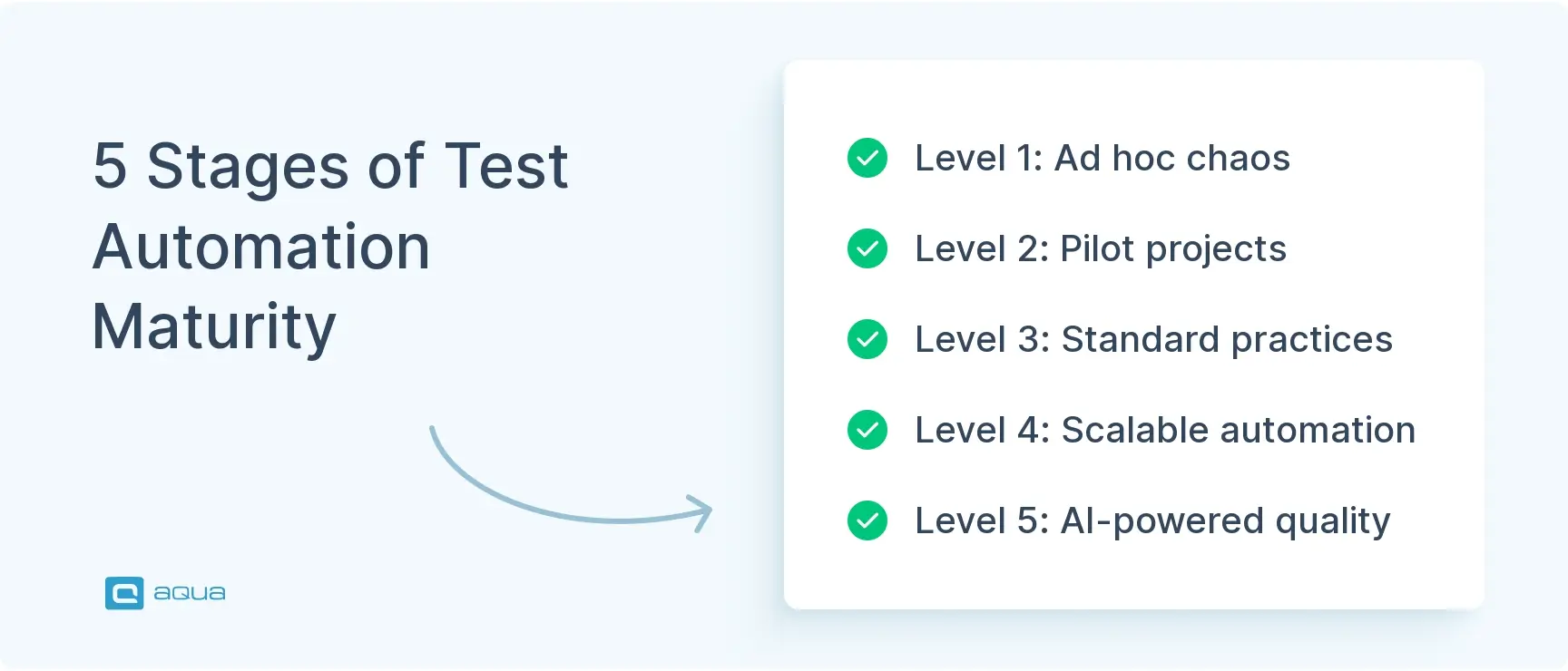
The five maturity stages run from chaotic ad-hoc testing to fully optimized continuous improvement. Level 1 is firefighting. Level 5 is autonomous testing with AI-driven defect prevention. Most teams sit between Levels 2 and 4. Here’s what each stage looks like and how to progress through them.
Stage 1: Initial Stage (Ad Hoc or Reactive)
Testing operates in permanent firefighting mode. There’s no standardized approach and no documentation. Quality depends entirely on whoever’s testing that day. Someone writes a script for this week’s emergency. It works once. Nobody documents it. Six months later, it’s lost or broken and nobody remembers how it worked.
Teams lack test case management or any repeatable methodology. Manual testing dominates, but even that lacks structure. Different testers approach the same features inconsistently. Results are unpredictable. When automation exists, it’s scattered scripts maintained by individuals. This creates knowledge silos and single points of failure.
Real-world example: A startup ships features weekly. Each release brings customer complaints about broken functionality. The single QA person manually tests whatever seems critical and documents nothing. They occasionally write Selenium scripts for repeatedly broken workflows. When they go on vacation, testing stops. When they return, half their scripts no longer work because locators changed.
Moving to Level 2: Start documenting test cases in a shared repository. Launch one automation pilot project for your most painful manual workflow.
Stage 2: Managed Stage (Pilot Projects)
You take your first systematic steps toward consistency. Organizations establish basic test policies and begin documenting test plans and cases. Testing becomes project-specific rather than completely ad hoc. You’re no longer winging it. There’s documentation, defined test environments, and explicit verification that software meets requirements.
Automation starts with pilot projects targeting specific pain points. That critical regression scenario you’re tired of manually testing every sprint. The integration workflow that breaks constantly. These pilots validate automation feasibility and build team skills. Automation remains limited in scope and isn’t integrated into standard development workflows yet.
Real-world example: A mid-sized product company establishes formal test planning for each sprint. They document test cases in a shared repository and define acceptance criteria with developers. They launch an automation pilot for their user registration flow, successfully automating 20 test cases that run before each deployment. Developers start expecting test results before merging code. The team tracks basic metrics like pass rates and execution time.
Moving to Level 3: Standardize testing practices across all teams. Build a dedicated automation framework. Integrate automated tests with your CI/CD pipeline.
Stage 3: Defined Stage (Strategic Implementation)
Testing becomes integrated throughout the software development lifecycle and standardized across your organization. All projects follow consistent standards. Independent testing teams have clear responsibilities. Test training programs ensure everyone operates from shared knowledge. Testing no longer happens solely after development. It’s planned and executed in parallel.
Organizations implement risk-based testing methodologies. You prioritize efforts based on business impact and defect probability. Non-functional testing becomes planned and executed systematically. Performance, security, and usability aren’t optional extras anymore. Automation coverage expands beyond pilot projects to comprehensive regression suites integrated into your test management solution.
Your automation framework matures substantially. Teams adopt patterns like Page Object Model that separate test logic from UI details. This reduces maintenance when interfaces change. Test data management becomes systematic. Parallel execution accelerates feedback. You establish automation standards, coding guidelines, and shared frameworks.
Real-world example: A financial services company standardizes testing across 15 development teams. They implement a shared automation framework using Selenium with Page Object Model design patterns. All projects integrate automated regression suites into Jenkins pipelines. Tests execute automatically on code commits and block merges when critical tests fail. The organization establishes a dedicated automation guild, conducts quarterly training, and maintains 70% automation coverage across critical workflows.
Moving to Level 4: Start collecting comprehensive metrics on test execution, coverage, and defect patterns. Implement test impact analysis to intelligently select which tests to run. Use data to drive testing decisions.
Stage 4: Quantified Stage (Scalable Automation)
You introduce measurement-driven approaches. Organizations collect quantitative metrics at all lifecycle stages and use testing data to drive strategic decisions. Teams track defect detection rates, automation coverage trends, test execution times, and defect leakage rates. You use these metrics to predict quality outcomes and prevent defects proactively.
Test impact analysis identifies which tests are affected by specific code changes. You get intelligent test selection that provides rapid feedback without executing entire regression suites. Predictive quality models analyze historical patterns to forecast where defects will emerge. This guides targeted testing investments.
Automation achieves true scalability. Parallel execution across cloud infrastructure enables comprehensive regression suites that complete in minutes, not hours. Self-healing automation frameworks use AI to automatically detect and repair broken test scripts when application elements change. Teams track test automation ROI systematically. You demonstrate concrete business value through time saved, defect prevention costs, and accelerated release velocity.
Real-world example: An e-commerce platform tracks 50+ testing metrics across their 200,000-line automation codebase. Dashboards visualize trends in test stability, execution time, and defect detection effectiveness. Test impact analysis reduces regression suite execution from 4 hours to 12 minutes for typical commits. Machine learning models predict defect-prone code modules based on complexity and historical patterns. Their automation framework automatically heals 80% of test failures caused by UI changes. They demonstrate $2.5 million annual ROI from automation investments.
Moving to Level 5: Implement AI-driven test generation and autonomous testing capabilities. Build organization-wide process optimization frameworks that capture and share learnings across teams.
Stage 5: Optimized Stage (Continuous Improvement)
Continuous improvement mechanisms are embedded in every testing process. Your focus shifts decisively toward defect prevention, not just detection. Comprehensive test automation tools automate test case design, maintenance, execution, and analysis. Statistical sampling with reliability metrics enables confidence without exhaustive testing of every permutation.
Process reuse becomes systematic through libraries that capture organizational learnings. Knowledge is preserved across projects. New project bootstrapping accelerates. The goal evolves toward zero-defect quality. Testing validates software is defect-free rather than simply catching bugs before customers do. Automation leverages AI systems that autonomously generate test suites from requirements, perform root cause analysis without human investigation, and adapt strategies based on execution feedback.
Organizations at Level 5 view testing as a competitive differentiator. Their automation maturity enables deployment frequencies impossible with manual testing. Quality metrics satisfy the most demanding compliance requirements. Innovation velocity separates them from competitors stuck in reactive firefighting.
Real-world example: A SaaS unicorn operates with fully autonomous testing systems that generate comprehensive test suites from user behavior analytics and requirement specifications. Tests execute continuously across production-like environments and automatically triage failures without human intervention. Their defect leakage rate stays below 3%. They deploy 50+ times daily across microservices architecture. Testing provides rapid feedback that keeps deployment velocity high without sacrificing quality.
Most organizations operate between Levels 2 and 4. The path from Level 1 to Level 5 takes years. Know where you are and focus on the next specific capability to build.
How to Apply the Test Automation Maturity Model
Applying TMM requires honest self-assessment followed by deliberate improvements. Trying to skip levels backfires. You can’t run before you can walk.
Assess where you actually are. Review the characteristics of each maturity level and identify which describes your current practices. Most organizations overestimate their maturity. They assume having some automation means Level 3. Honest assessment reveals Level 1 with scattered scripts and no standardization. Use the TMMi assessment framework if you want structure. It covers 16 process areas across five levels. Engage multiple team members in the assessment to overcome blind spots and build shared understanding.
Set a realistic target. Organizations can reach Level 3 within 12-18 months with focused effort. Level 4-5 progression requires 2-3+ years of sustained commitment. Your target should reflect business drivers and organizational readiness, not arbitrary ambitions. A regulated financial company might prioritize Level 4’s measurement-driven approaches for compliance. A fast-growing startup might optimize for Level 3 standardization to maintain quality across scaling teams. Define clear success criteria. What specific capabilities will you have? What metrics will improve? How will you know you’ve arrived?
Build a phased roadmap. Break the journey into quarterly milestones. This prevents overwhelm and builds momentum through visible progress. Here’s an example progression:
Months 3-8: Define test strategy and automation standards, select tools aligned with your tech stack, develop initial framework with Page Object Model design, integrate with CI/CD, launch pilot projects
Months 8-15: Expand coverage to critical workflows, integrate automation into daily development, establish metrics dashboards, conduct retrospectives, build team competencies
Months 15-24: Scale to 70-80% automation coverage of critical scenarios, implement measurement-driven practices, establish test data management, introduce test impact analysis
Track metrics that matter. Measure automation coverage percentage, test execution time trends, defect detection rates, defect leakage to production, test maintenance effort, and automation ROI. Establish baseline measurements at assessment. Track monthly or quarterly trends that validate you’re progressing or signal problems requiring correction. Share these metrics broadly. Demonstrating concrete improvements builds organizational confidence and sustains investment.
Invest in team skills. Maturity progression depends on people capabilities, not just processes and tools. Establish formal training programs covering automation tools, framework design patterns, and testing best practices. Create communities of practice where team members share innovations, troubleshoot challenges, and build collective capability. Pair experienced automation engineers with those developing skills to accelerate learning. Internal capability development is strategic. The automation market’s explosive growth creates fierce competition for skilled engineers.
The key insight: focus on one level at a time. Master the fundamentals before chasing advanced capabilities.
Choosing the Right Test Automation Tool for TMM
Tools don’t create maturity. They enable it. The right test automation tools accelerate progression. Poor tool choices create technical debt that actively hinders advancement. Your selection criteria should reflect both your current maturity level and target level.
Match tools to your team’s actual skills. The shiniest, most feature-rich tool creates zero value if nobody can use it effectively. Teams at Level 1-2 benefit from low-code platforms like Katalon or TestComplete that reduce technical barriers and enable rapid initial automation. These tools sacrifice some customization but dramatically accelerate time-to-value. Teams at Level 3+ typically need code-based frameworks like Selenium, Playwright, or Cypress that provide greater control for complex enterprise scenarios. Select tools that match skills you have, not skills you wish you had.
Verify integration and scalability. Tools must integrate seamlessly with your existing tech stack and CI/CD infrastructure. Otherwise you’ll spend months on integration before realizing any testing value. Check compatibility with your application technologies, programming languages, and CI/CD platforms. Scalability matters increasingly as maturity progresses. Tools that work fine for 100 tests often collapse when suites grow to thousands. Cloud-based platforms like Perfecto and BrowserStack provide elastic infrastructure that scales on-demand.
Prioritize maintainability. Test maintenance consumes 40-60% of total automation effort. AI-powered tools like Testim and Mabl incorporate self-healing capabilities that automatically detect and repair broken tests when application elements change. This reduces maintenance burden by up to 80%. These capabilities prove valuable for Level 3+ organizations with large automation suites where manual script maintenance becomes untenable. Evaluate tools’ locator strategies and error handling. Robust element identification using multiple strategies dramatically reduces test brittleness.
Calculate total cost of ownership. Tool costs vary dramatically. Open-source frameworks like Selenium and Robot Framework are free but require infrastructure and expertise investment. Enterprise platforms like Tricentis Tosca include comprehensive support but come with six-figure licensing. Calculate total cost including licensing, infrastructure, training, and maintenance, not just upfront costs. For budget-constrained teams, open-source tools combined with cloud-based execution infrastructure often provide the best value.
Consider AI-powered platforms for acceleration. Platforms like aqua cloud’s AI-powered test management enable teams to progress faster through maturity levels. Modern AI-agent-based automation allows test creation using natural language rather than code. Teams describe tests in plain English, and AI translates these instructions into executable tests. This approach dramatically accelerates Level 1-2 progression by eliminating coding barriers while maintaining scalability for Level 3+ requirements. Self-healing AI automatically adapts tests when applications change. Integration with CI/CD platforms supports continuous testing practices.
Key selection criteria:
Team skill alignment – match tool complexity to actual capabilities
Technology compatibility – ensure seamless integration with your stack
Scalability – support growth from hundreds to thousands of tests
Total cost of ownership – include licensing, infrastructure, training, maintenance
Community and support – get help when you encounter challenges
The right tool makes progression possible. The wrong tool makes it painful.
As you’ve seen, progressing through the Test Automation Maturity Model requires more than just technical tools. It demands integrated processes, standardized methodologies, and intelligent systems that scale with your growing test suites. aqua cloud provides exactly this unified ecosystem, combining robust test management with AI-powered efficiency to support your journey from Level 1 chaos to Level 5 optimization. With aqua’s comprehensive test management capabilities, you can establish the governance structures, standardized processes, and metrics dashboards essential for TMM advancement. The built-in AI Copilot dramatically reduces the 40-60% maintenance burden that typically derails automation initiatives. The platform’s seamless integrations with CI/CD tools, Jira, and other development systems ensure your automation becomes a natural extension of your development workflow rather than a separate activity. Most importantly, aqua’s domain-trained AI understands your project’s specific documentation and context. It generates project-specific test cases, requirements, and test data in seconds while maintaining your security and compliance standards. aqua provides the foundation that transforms testing from a constraint into your competitive advantage.
Save 97% of testing time with an AI-powered platform that grows with your automation maturity
Test automation maturity means building sustainable practices that don’t collapse into technical debt. If you progress systematically, you ship faster and catch more bugs. Assess where you are honestly. Define realistic targets. Build foundational capabilities before chasing advanced ones. Start with one level. Master it. Move to the next.
Test automation maturity measures how systematically your organization approaches automated testing. It ranges from chaotic, ad-hoc scripts that nobody maintains to optimized, AI-driven continuous improvement systems. Higher maturity means more sustainable automation practices, better ROI, and fewer maintenance headaches. The Test Automation Maturity Model provides five levels to assess where you stand and what to build next.
What are the levels of maturity model?
The five maturity levels are: Level 1 (Initial/Ad Hoc) with reactive firefighting and scattered scripts, Level 2 (Managed) with pilot projects and basic documentation, Level 3 (Defined) with standardized practices and CI/CD integration, Level 4 (Quantified) with measurement-driven decisions and scalable automation, and Level 5 (Optimized) with continuous improvement and AI-driven testing. Most organizations operate between Levels 2 and 4.
How to measure automation maturity?
Conduct a test automation maturity assessment using the TMMi framework or similar structured questionnaires. Evaluate your practices across key areas like test strategy, test data management, CI/CD integration, metrics collection, and team skills. Track quantitative metrics including automation coverage percentage, test execution time, defect detection rates, defect leakage to production, and maintenance effort. Compare your current practices against the characteristics defined for each maturity level. Engage multiple team members in the assessment to get accurate results.
How can organizations improve their test automation maturity?
Start with honest assessment of your current level. Define realistic targets based on business needs. Build a phased roadmap with quarterly milestones. Focus on foundational capabilities before chasing advanced features. Invest in team skills through formal training and communities of practice. Select tools that match your current capabilities and support future growth. Track metrics that demonstrate progress and ROI. Progress one level at a time instead of trying to skip stages.
What are common challenges faced when advancing test automation maturity?
Organizations struggle with unrealistic expectations about timelines and effort required. Teams try to skip maturity levels, implementing advanced practices before foundational capabilities exist. Test maintenance consumes 40-60% of automation effort, overwhelming teams without proper frameworks. Lack of executive sponsorship starves initiatives of resources. Skills gaps prevent teams from effectively using selected tools. Poor tool selection creates technical debt that hinders advancement. Resistance to standardization across teams slows progression. Organizations also struggle to demonstrate ROI without proper metrics collection, making it hard to justify continued investment.
Home » Test Automation » Test Automation Maturity Model: A Roadmap for Success
Do you love testing as we do?
Join our community of enthusiastic experts! Get new posts from the aqua blog directly in your inbox. QA trends, community discussion overviews, insightful tips — you’ll love it!
We're committed to your privacy. Aqua uses the information you provide to us to contact you about our relevant content, products, and services. You may unsubscribe from these communications at any time. For more information, check out our Privacy policy.
X
🤖 Exciting new updates to aqua AI Assistant are now available! 🎉
We use cookies and third-party services that store or retrieve information on the end device of our visitors. This data is processed and used to optimize our website and continuously improve it. We require your consent fro the storage, retrieval, and processing of this data. You can revoke your consent at any time by clicking on a link in the bottom section of our website.
For more information, please see our Privacy Policy.
This website uses cookies to improve your experience while you navigate through the website. Out of these, the cookies that are categorized as necessary are stored on your browser as they are essential for the working of basic functionalities of the website. We also use third-party cookies that help us analyze and understand how you use this website. These cookies will be stored in your browser only with your consent. You also have the option to opt-out of these cookies. But opting out of some of these cookies may affect your browsing experience.
Necessary cookies are absolutely essential for the website to function properly. These cookies ensure basic functionalities and security features of the website, anonymously.
Cookie
Duration
Description
cookielawinfo-checkbox-analytics
11 months
This cookie is set by GDPR Cookie Consent plugin. The cookie is used to store the user consent for the cookies in the category "Analytics".
cookielawinfo-checkbox-functional
11 months
The cookie is set by GDPR cookie consent to record the user consent for the cookies in the category "Functional".
cookielawinfo-checkbox-necessary
11 months
This cookie is set by GDPR Cookie Consent plugin. The cookies is used to store the user consent for the cookies in the category "Necessary".
cookielawinfo-checkbox-others
11 months
This cookie is set by GDPR Cookie Consent plugin. The cookie is used to store the user consent for the cookies in the category "Other.
cookielawinfo-checkbox-performance
11 months
This cookie is set by GDPR Cookie Consent plugin. The cookie is used to store the user consent for the cookies in the category "Performance".
viewed_cookie_policy
11 months
The cookie is set by the GDPR Cookie Consent plugin and is used to store whether or not user has consented to the use of cookies. It does not store any personal data.
Functional cookies help to perform certain functionalities like sharing the content of the website on social media platforms, collect feedbacks, and other third-party features.
Performance cookies are used to understand and analyze the key performance indexes of the website which helps in delivering a better user experience for the visitors.
Analytical cookies are used to understand how visitors interact with the website. These cookies help provide information on metrics the number of visitors, bounce rate, traffic source, etc.
Advertisement cookies are used to provide visitors with relevant ads and marketing campaigns. These cookies track visitors across websites and collect information to provide customized ads.






 Bankingaqua ALM helps banks increase testing productivity by over 50%