Why You Should Consider European AI for QA and Management
Have you already looked through the recent changes in Europe's AI frameworks and QA regulations? According to Gartner's 2026 Strategic Roadmap, 68% of software engineering functions develop autonomous AI entities. Despite this widespread adoption, only 3% have established documented processes with full adherence. Does this sound like an issue? This complication is exactly what will bring extra compliance overhead for your organization if not handled properly through compliance. This article will guide you through the benefits of European AI platforms like aqua for your QA operations and development workflows. We'll also examine the challenges you'll face.
US-based AI tools raise concerns about data privacy and compliance with European regulations. European AI alternatives offer stronger protection and GDPR alignment that safeguard your business.
Why European AI Matters
GDPR Compliance – Built to meet strict EU privacy laws from the ground up.
Data Sovereignty – Your data stays within European borders.
Transparent Practices – Clear information on AI training and data usage.
Legal Protection – Avoid US laws like CLOUD Act accessing your data.
aqua cloud is a European AI-powered Work OS with full GDPR compliance and EU-based infrastructure. Your data never leaves European jurisdiction.
Europe leads global AI regulation with frameworks that create compliance requirements for organizations implementing AI in software testing. You must navigate multiple regulatory layers while maintaining innovation velocity.
Let’s start by reviewing key regulatory frameworks that already affect the domains your business operates in.
Core Regulatory Frameworks
AS mentioned previously, the European regulatory ecosystem contains several key frameworks. Let’s examine each of them and evaluate their specific impact on your QA operations:
EU AI Act
The world’s first comprehensive legal framework for artificial intelligence operates on a risk-based system that categorizes AI applications from minimal to unacceptable risk. With general application on August 2, 2026, the Act creates dual accountability for organizations both deploying AI systems and using AI tools in development workflows. EU AI Act compliance is essential for your QA operations.
Key provisions:
Risk-based categorization system (unacceptable, high, limited, minimal risk)
Conformity assessments for high-risk AI systems
Risk management documentation requirements
Post-market monitoring obligations
Human oversight mandates for critical applications
GDPR governs how test data containing personal information must be handled and processed. It also defines protection requirements. When your QA teams employ AI to generate test cases from production data or use AI assistants to process customer information, GDPR compliance becomes mandatory. This regulation directly impacts your daily testing operations and the importance of data protection in QA cannot be overstated.
Key provisions:
Data processing agreements for all customer data handling
Right to explanation for automated decision-making
Data minimization and purpose limitation requirements
NIS2 establishes cybersecurity requirements for critical infrastructure and digital service providers. These requirements extend to AI systems used in operations. If your QA teams work in covered sectors, you must ensure AI tools meet operational resilience standards. This adds another layer of security obligations beyond traditional testing requirements.
Key provisions:
Risk management measures for network and information systems
These regulations govern AI usage in healthcare software validation. Naturally, this requires your team to have rigorous testing in place, along with comprehensive documentation and complete traceability. For QA teams validating medical device software, maintaining comprehensive test records that demonstrate system safety and effectiveness becomes a core responsibility rather than an optional best practice.
Key provisions:
Clinical evaluation documentation requirements
Technical documentation for the entire lifecycle
Post-market surveillance obligations
Unique Device Identification (UDI) system compliance
Quality management system certification
Digital Operational Resilience Act (DORA)
DORA specifically targets financial services ICT risk management, should you be using any AI systems in this sector. Banks and financial institutions must demonstrate operational resilience in their testing infrastructure. Moreover, maintaining business continuity even when AI-augmented testing tools experience failures becomes a regulatory requirement rather than merely good practice.
Key provisions:
ICT risk management framework requirements
Digital operational resilience testing programs
Third-party ICT service provider oversight
ICT-related incident classification and reporting
Threat-led penetration testing obligations
This convergence changes the regular scope of work in QA. Your teams now produce evidence trails that satisfy conformity assessments and risk management documentation. They also generate records meeting post-market monitoring requirements. Organizations that master governance early gain a competitive advantage in regulated industries where procurement teams demand AI oversight proof before signing contracts.
As Europe defines the governance standards for AI with frameworks like the EU AI Act, QA teams need to accelerate testing while maintaining the audit trail. aqua cloud, a test management platform with integrated AI and comprehensive requirement management, aligns perfectly with this European perspective on responsible AI adoption. Unlike competitors, aqua provides AI-powered quality assurance management software with built-in compliance safeguards. These range from ISO 27001 certification to full DORA compliance for financial sector requirements. With aqua’s domain-trained AI assistant, your test cases aren’t just generated faster. They’re created with complete traceability and audit-ready documentation. All data processing remains contained within EU data centers. aqua cloud integrates with your existing toolchain, including Jira, Azure DevOps, and Jenkins. It also connects with major CI/CD platforms. With aqua, AI-powered governance extends across your entire development ecosystem.
Achieve 100% compliant, governed AI acceleration in your QA with aqua
To stay compliant with European AI regulations successfully, it’s important to be well-versed in the specific obligations that directly impact your QA operations. These compliance drivers shape how your teams implement AI tools and manage data. They also determine how you maintain accountability throughout the testing lifecycle. Beyond grasping the regulations themselves, you need practical strategies for QA tools integration to address each driver systematically. This approach helps you avoid regulatory exposure while capturing AI efficiency benefits.
Some users doubt that the overregulation of AI in QA can lead to beneficial outcomes. As such:
Europe is trying to over-regulate AI and the only outcome will be its own disadvantage. Everywhere else in the world, AIs will be more open, more capable and completely ignore what Europe is doing.
And here are some of the many compliance drivers that push the niche to be more ethical and data privacy-focused:
Risk categorization obligations. Determining whether your AI-enabled test automation platforms count as “high-risk AI systems” requires legal interpretation combined with business context. The assessment considers the AI system’s purpose and deployment context. It also evaluates potential impact on fundamental rights or safety.
Transparency mandates. Your QA teams must document AI involvement in test case generation and defect prioritization. They must also track AI’s role in quality assessments. This transparency covers internal documentation as well as external audits and regulatory reviews.
Data governance controls. This includes classifying test data by sensitivity level and implementing redaction rules for personal information. You must also maintain records of data processing activities. Managing how training data is sourced and processed proves lawfulness.
Human oversight mechanisms. Building approval gates keeps humans accountable for AI-generated outputs. Gartner research shows top-performing organizations implement human-in-the-loop patterns where AI assists but humans remain responsible for final decisions.
The practical reality shows European QA teams shifting toward “copilot” patterns where AI assists rather than replaces human judgment. This prevents governance failures that can cost millions in fines and reputational damage. Your documentation trails must clearly show human decision points.
Advantages of Using European AI for Quality Assurance
European AI solutions deliver governance-first capabilities that address the critical gap between AI innovation and compliance requirements. According to Gartner’s Market Guide, by 2027, 80% of enterprises will integrate AI-augmented testing tools into their software engineering toolchain, up from approximately 15% in early 2023. This rapid adoption demands platforms built with accountability assumptions from day one, which means you can’t afford to treat governance as an afterthought. Future trends in AI test automation can help you prepare for these changes.
The advantages of European AI for quality assurance extend across multiple dimensions. They directly impact organizational risk management and operational efficiency. These benefits also affect competitive positioning. Let’s examine how these benefits translate to real improvements for your testing operations:
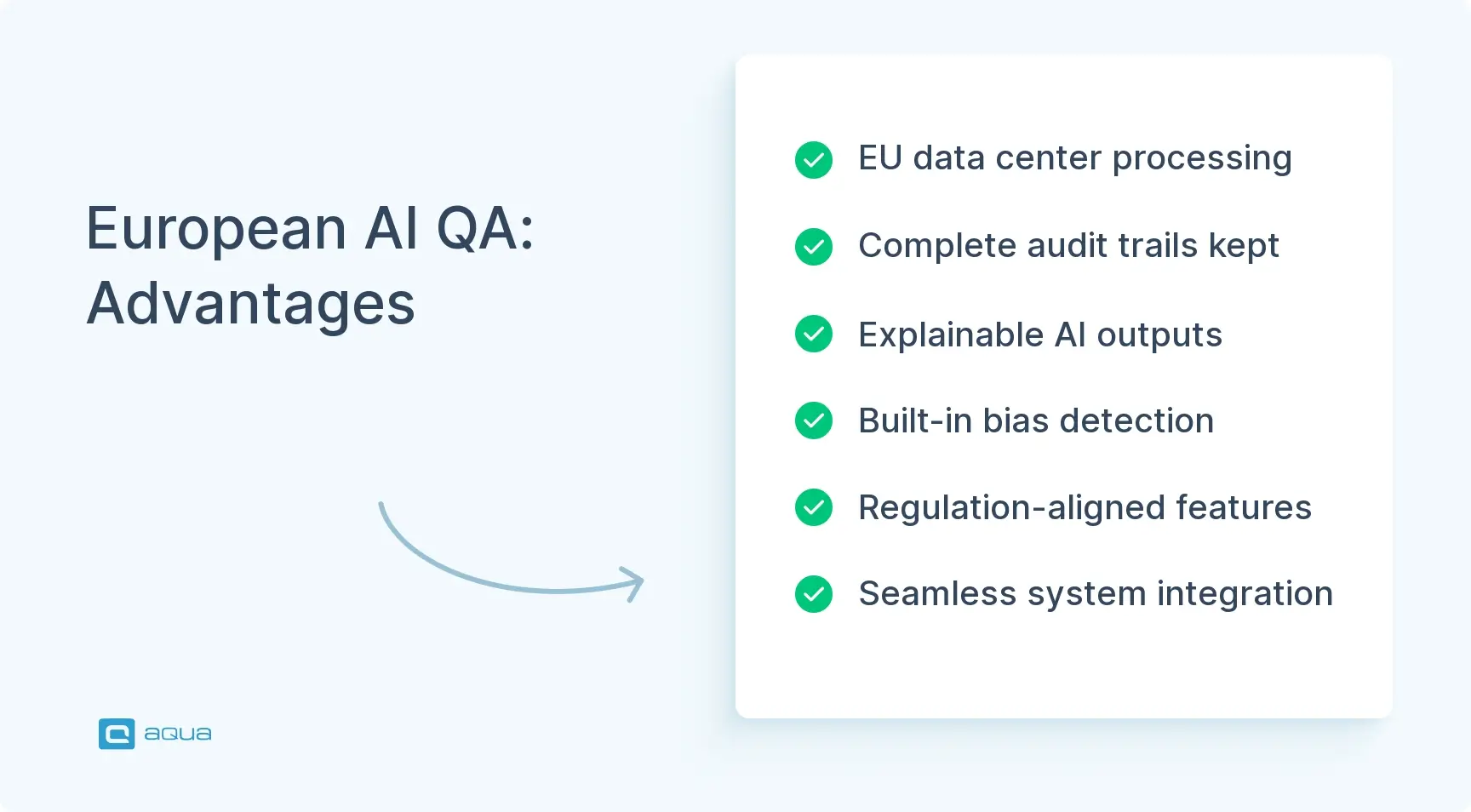
Data sovereignty and privacy protection. European AI vendors provide EU data center processing with explicit contractual assurances that customer data won’t be used for model training. For your teams handling production-like data, this prevents GDPR violations and data breach exposure. According to Gartner, test data generation must address data privacy issues while enabling organizations to use production-like data in lower environments.
Built-in audit trail and traceability. Platforms are architected from inception to maintain comprehensive audit trails. Every AI-generated test case includes provenance documentation showing inputs and model versions. These records also capture human approvals. European AI platforms address this gap by making traceability a core feature. What does it mean exactly? Given successful implementation, your team will be spending less time on manual documentation.
Explainability and transparency. European solutions prioritize explainable AI capabilities, which allow your QA professionals to grasp the reasoning behind recommendations. Rather than black-box outputs, your teams gain visibility into risk factors and decision inputs. This transparency enables better human oversight and helps your team members trust the AI assistant recommendations they receive.
Ethical AI and bias detection. Platforms developed under European data protection principles include features for monitoring model fairness and flagging potential discrimination patterns. These built-in capabilities save your organization from developing bias detection tools from scratch. It’s particularly important when your teams need to evaluate model quality and document safety testing procedures.
Regulatory alignment and compliance support. European AI solutions are designed by vendors who navigate the same regulatory environment as their customers. This creates natural alignment where product features directly support compliance obligations. As a result, your compliance team spends less time chasing documentation.
Integration with quality management systems. European AI platforms fit naturally into quality management systems already designed around documentation and traceability. Rather than forcing you to redesign entire QA approaches, solutions extend existing workflows with AI capabilities. This compatibility means faster implementation and less disruption.
Comparison: European vs Non-European AI for QA
To make informed platform decisions, you need to grasp the practical differences between European and non-European AI solutions. The comparison shows architectural differences that lies in the regulatory environment philosophy. These distinctions matter when you’re evaluating vendors and planning your AI adoption in Europe workplace policies:
Factor
European AI for QA (Based on aqua cloud)
Non-European AI for QA (Based on Testim, Katalon, Mabl)
Data Processing Location
EU data centers with data sovereignty guarantees; no training on customer data
Global data centers; data may be processed across multiple jurisdictions; some vendors use customer data for model improvement
Regulatory Compliance
Built-in GDPR, EU AI Act, DORA, ISO 27001 compliance; compliance-first architecture
Compliance features added reactively; primary focus on functionality over governance
Audit Trail & Traceability
Complete provenance tracking for all AI outputs; human approval gates; version control for prompts and contexts
Limited audit trails; focus on test results rather than decision documentation
Explainability
Transparent AI reasoning; visible risk factors and decision inputs
Black-box recommendations; limited visibility into AI decision-making process
Human Oversight
Mandatory human-in-the-loop patterns; copilot model with accountability structures
Autonomous execution emphasis; human review optional
Contract Terms
Clear data processing agreements; explicit subprocessor disclosure; EU-based legal jurisdiction
Complex vendor agreements; multiple subprocessors; often US-based legal terms
European AI solutions show measurable value across regulated industries. It happens mostly where governance requirements and compliance obligations historically are making technology adoption slower. These implementation patterns reveal how organizations balance innovation with regulatory obligations while delivering tangible business outcomes.
Organizations in heavily regulated sectors find European AI particularly valuable because these platforms anticipate regulatory scrutiny rather than retrofitting governance after problems emerge. Take a pharmaceutical company that uses European AI for requirements intelligence as an example. The company can generate acceptance criteria suggestions while maintaining GxP validation compliance throughout the process. Similarly, financial services firms employ AI-driven test prioritization without triggering data residency violations. They also avoid creating unexplainable gaps in audit documentation. The benefit also applies to guardrails designed from inception to support heavily regulated operations.
Sector
Use Case
European AI Advantage
Healthcare
Requirements refinement for medical device software
Built-in data protection controls aligned with GDPR and Medical Device Regulation expectations
Financial Services
Risk-based regression optimization for banking platforms
Audit trail preservation and explainability features that satisfy ECB supervisory expectations
Public Sector
Test case generation for citizen-facing digital services
Sovereign cloud deployment options and transparency documentation
Challenges with European AI in QA
Adopting European AI for QA comes with challenges that stem from regulatory requirements. Gartner’s Strategic Roadmap shows that building AI capabilities into applications is one of the top pain points for software engineering leaders in 2025. When you grasp these challenges upfront, you enable better planning and realistic implementation timelines for your organization:
Compliance complexity and multi-framework navigation. The EU AI Act’s risk-based framework requires legal interpretation to determine whether your test automation platforms count as “high-risk AI systems.” Beyond the EU AI Act, sector-specific regulations like GDPR and NIS2 create additional layers. GxP requirements and PCI-DSS standards add further complexity. This creates a regulatory stack where each layer introduces additional requirements. Your compliance team faces the daunting task of maintaining alignment across all these frameworks simultaneously.
Data handling and classification overhead. QA artifacts inherently contain risky data that requires careful handling. Test logs with stack traces need protection, as do screenshots with personal information. Synthetic test data realistic enough to accidentally be real also requires careful management. European AI governance demands data flow classification and redaction rule implementation. It also requires processing location control. For your QA organization, this means building new workflows around data handling that may slow initial testing velocity.
Talent and skills readiness gaps. You need QA professionals who grasp both testing fundamentals and AI capabilities. They also require regulatory literacy to recognize compliance exposure. Building this competence takes time, and the market for “QA leads with AI governance experience” remains intensely competitive. Your hiring team faces challenges in finding candidates with this rare combination of skills.
Automation debt and maintenance burden. AI generates test cases at a rapid pace, creating risk if not managed properly. Without disciplined risk-based selection, your organization can accumulate unmaintainable test estates. Without proper portfolio management, the same problem occurs. These test suites become expensive to execute and impossible to keep relevant. European requirements for human approval gates help control this, but mean “tests generated per day” metrics won’t match vendor marketing claims. Your team needs strategies for managing this balance.
Addressing Challenges Through Trusted Provider Selection
The complexity of European AI for QA makes the selection of a vendor critical. Organizations succeed when they partner with trusted providers who have already solved the governance puzzle. This approach works better than retrofitting compliance onto tools built for different regulatory environments. This choice determines whether your implementation proceeds smoothly or becomes a prolonged struggle.
A trusted European AI provider should offer comprehensive data processing agreements with clear jurisdiction. They should also provide transparent subprocessor disclosure and contractual commitments about data usage. Aside from contracts, they should provide built-in capabilities for audit trail preservation and human oversight workflows. Explainability features should be included rather than requiring custom development. Most importantly, they should demonstrate their own compliance with European frameworks through third-party certifications and public documentation. When evaluating vendors, your procurement team should verify these credentials before making commitments.
Future of European AI in Quality Assurance and Management
The trajectory for European AI in QA centers on governed automation, where AI acts as a force multiplier. These systems maintain the evidence discipline that regulators demand. By 2027, organizations that treat AI adoption as a governance challenge first will own a significant competitive advantage in regulated sectors. Emerging patterns push QA beyond traditional pre-release gates into continuous feedback loops. In these workflows, AI manages complexity while maintaining control planes for administrators. European AI platforms position strongly in this evolution because they’re built around documentation requirements and traceability obligations from inception rather than adding governance later.
aqua cloud as the Future of European AI for QA
aqua cloud represents the convergence of AI-powered efficiency and European regulatory compliance in a unified test management platform. Built specifically for organizations that navigate complex governance requirements while seeking to accelerate QA processes, aqua delivers AI capabilities within a compliance-first architecture aligned with recommended patterns for enterprise AI adoption. Your organization gets both innovation and governance in a single platform.
Unlike testing automation tools that focus solely on execution, aqua cloud provides comprehensive test management. It centralizes requirements traceability and test case management. The platform also handles defect tracking and collaboration features. The platform’s AI capabilities are designed to enhance rather than replace human judgment, fitting naturally into European regulatory expectations around human oversight and accountability. This design philosophy means your team members work more efficiently without losing control over quality decisions.
aqua’s AI capabilities:
AI-powered test case generation
Intelligent edge case suggestion
Automated test maintenance support
Risk-based test prioritization
Requirements intelligence
Defect clustering and pattern recognition
aqua’s compliance and governance features:
ISO 27001 certified security
DORA compliance for financial services
EU data center processing
Complete audit trail preservation
Granular access controls
Data processing agreements
Requirements-to-defect traceability
Customizable approval workflows
Integration with compliance frameworks
European AI in quality assurance delivers both innovation and compliance without compromise. aqua cloud, a European AI-driven test platform with integrated requirement management, embodies this balanced approach with capabilities designed for today’s regulated environment. aqua cloud’s architecture reflects European principles around responsible AI: transparency in how AI makes recommendations and human accountability for decisions. It also ensures data sovereignty guarantees and maintains comprehensive evidence trails. For your organization in healthcare or financial services, aqua provides the governance scaffolding necessary to adopt AI confidently while meeting regulatory obligations. The platform serves public sector organizations equally well, along with any heavily regulated industry. The platform gives you both innovation and compliance as core features rather than competing priorities. With native integrations to Jira, Azure DevOps, and Jenkins, aqua cloud integrates into your workflow easily. It also connects with GitHub, GitLab, and 12+ other essential development tools you might already be using. The platform fits seamlessly into your existing infrastructure.
European AI for quality assurance represents a response where quality and compliance have become inseparable. Accountability is equally essential in this framework. The regulatory environment, led by the EU AI Act, channels innovation toward solutions you can trust. These solutions allow you to audit operations and defend your decisions. For your QA teams, European AI platforms offer the controls and transparency necessary for regulated environments. They also provide the evidence discipline these sectors demand. These tools help your organization avoid the “AI cliff” where hyped technologies drop into the Trough of Disillusionment without proper governance, protecting both your investment and your reputation.
What is the main approach the EU AI Act uses to regulate AI systems?
The EU AI Act uses a risk-based regulatory approach that categorizes AI systems into four levels: unacceptable risk (prohibited), high risk (strict requirements), limited risk (transparency obligations), and minimal risk (no specific requirements). High-risk systems face stringent requirements, including risk management and data governance. These systems also require documentation, transparency, human oversight, and accuracy standards before deployment.
What are the 4 levels of the EU AI Act?
The four risk categories are: Unacceptable risk (prohibited systems posing clear threats like government social scoring); High risk (critical domains like healthcare or law enforcement requiring strict compliance); Limited risk (systems like chatbots needing transparency); and Minimal or no risk (most AI applications with no specific legal requirements beyond general consumer protection).
How can European AI solutions enhance quality assurance processes in highly regulated industries?
European AI solutions enhance QA through built-in audit trails and data sovereignty guarantees. They also provide explainable AI capabilities that align with compliance requirements. These platforms maintain complete provenance documentation for AI-generated test cases. They process data within EU jurisdictions to satisfy GDPR and integrate human oversight mechanisms that regulatory frameworks demand. As a result, your organization captures AI efficiency while avoiding compliance liabilities.
What are the key compliance challenges when integrating European AI tools into QA and management workflows?
Key challenges include navigating multi-framework compliance across EU AI Act and GDPR. You must also address NIS2 requirements and sector-specific regulations. Additional challenges involve implementing data classification for sensitive test artifacts and applying redaction where needed. Other obstacles include addressing talent gaps that require both QA expertise and AI governance knowledge. You’ll also face vendor due diligence requirements, audit trail provenance maintenance, and managing automation debt from AI-generated tests.
Which EU country is leading in AI?
France is generally considered the EU leader based on investment and research output. Policy initiatives also factor into this assessment. The country committed significant public funding through its national AI strategy. France hosts leading research institutions and is home to successful AI startups. Major corporate research labs also operate there. Germany follows with strong industrial AI applications, while the Netherlands excels in specific domains. Sweden and Finland also stand out in areas like healthcare AI and ethical AI frameworks.
What is the European AI strategy?
The European AI strategy, outlined in the 2018 “Artificial Intelligence for Europe” communication and updated in 2021, aims to position Europe as a global leader in trustworthy AI. The strategy rests on three pillars: increasing investment in AI research and innovation; preparing for socioeconomic changes by upskilling workers; and ensuring an appropriate ethical framework through regulations like the EU AI Act. It also emphasizes establishing a legal framework, with particular focus on “human-centric” AI that respects fundamental rights.
Home » Testing with AI » Why You Should Consider European AI for QA and Management
Do you love testing as we do?
Join our community of enthusiastic experts! Get new posts from the aqua blog directly in your inbox. QA trends, community discussion overviews, insightful tips — you’ll love it!
We're committed to your privacy. Aqua uses the information you provide to us to contact you about our relevant content, products, and services. You may unsubscribe from these communications at any time. For more information, check out our Privacy policy.
X
🤖 Exciting new updates to aqua AI Assistant are now available! 🎉
We use cookies and third-party services that store or retrieve information on the end device of our visitors. This data is processed and used to optimize our website and continuously improve it. We require your consent fro the storage, retrieval, and processing of this data. You can revoke your consent at any time by clicking on a link in the bottom section of our website.
For more information, please see our Privacy Policy.
This website uses cookies to improve your experience while you navigate through the website. Out of these, the cookies that are categorized as necessary are stored on your browser as they are essential for the working of basic functionalities of the website. We also use third-party cookies that help us analyze and understand how you use this website. These cookies will be stored in your browser only with your consent. You also have the option to opt-out of these cookies. But opting out of some of these cookies may affect your browsing experience.
Necessary cookies are absolutely essential for the website to function properly. These cookies ensure basic functionalities and security features of the website, anonymously.
Cookie
Duration
Description
cookielawinfo-checkbox-analytics
11 months
This cookie is set by GDPR Cookie Consent plugin. The cookie is used to store the user consent for the cookies in the category "Analytics".
cookielawinfo-checkbox-functional
11 months
The cookie is set by GDPR cookie consent to record the user consent for the cookies in the category "Functional".
cookielawinfo-checkbox-necessary
11 months
This cookie is set by GDPR Cookie Consent plugin. The cookies is used to store the user consent for the cookies in the category "Necessary".
cookielawinfo-checkbox-others
11 months
This cookie is set by GDPR Cookie Consent plugin. The cookie is used to store the user consent for the cookies in the category "Other.
cookielawinfo-checkbox-performance
11 months
This cookie is set by GDPR Cookie Consent plugin. The cookie is used to store the user consent for the cookies in the category "Performance".
viewed_cookie_policy
11 months
The cookie is set by the GDPR Cookie Consent plugin and is used to store whether or not user has consented to the use of cookies. It does not store any personal data.
Functional cookies help to perform certain functionalities like sharing the content of the website on social media platforms, collect feedbacks, and other third-party features.
Performance cookies are used to understand and analyze the key performance indexes of the website which helps in delivering a better user experience for the visitors.
Analytical cookies are used to understand how visitors interact with the website. These cookies help provide information on metrics the number of visitors, bounce rate, traffic source, etc.
Advertisement cookies are used to provide visitors with relevant ads and marketing campaigns. These cookies track visitors across websites and collect information to provide customized ads.






 Bankingaqua ALM helps banks increase testing productivity by over 50%