Almost everyone in quality assurance has heard of the popular concept of bottlenecks. It occurs when a specific point in a process slows down the entire system. Specifically in software testing, bottlenecks can result in disasters: frustrating user experiences, increased load times, and lost revenue (sometimes huge revenue) for your business. But where do these bottlenecks come from? How do you deal with them? This guide will comprehensively address the main concerns you might have.
Bottleneck testing pinpoints the exact component causing a slowdown, going deeper than load or stress testing, which only measure how much a system can handle.
A one-second delay in page load time can cut conversions by up to 7%, making bottleneck performance testing a direct revenue concern, not just a technical one.
Bottlenecks fall into distinct categories: CPU, memory, database, network, and application-level, each requiring a different diagnostic approach.
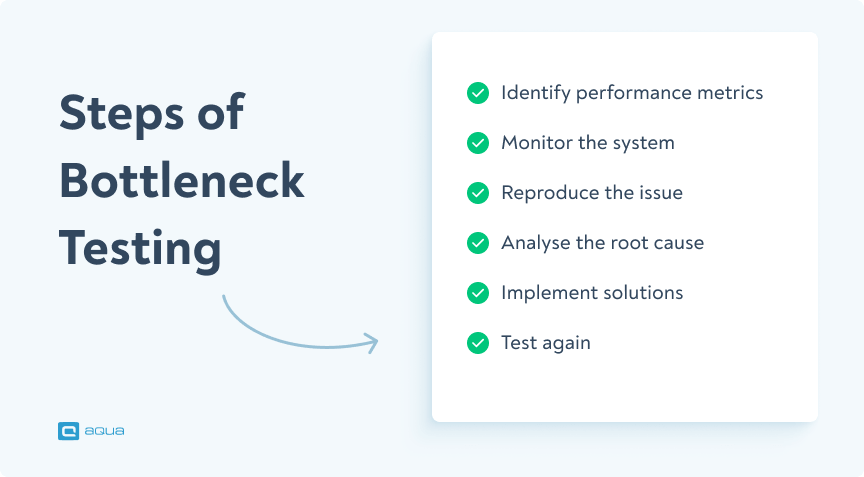
The six-step bottleneck testing process moves from identifying metrics to monitoring, reproducing, analyzing root cause, fixing, and retesting.
Tools like aqua centralize test tracking and traceability, while specialized tools like JMeter and Dynatrace handle the load simulation and monitoring work.
Here is everything your team needs to find and fix bottlenecks before they cost you users or revenue 👇
What is Bottleneck Testing?
Bottleneck in software testing is the process of identifying the exact points in a system where performance slows down or stalls. In simple terms, it’s like finding the weakest link in a chain. This is where your application struggles to keep up, and has delays that affect the whole process.
In software testing, bottleneck testing is essential for pinpointing the areas where your application’s speed or stability worsens under stress. This happens especially when handling high loads or complex operations.
Let me give you an example. A well-known study from Fleexy found that a mere one-second delay in page load times can reduce conversions by up to 7%, while a 3 3-second delay results in 53% of mobile users leaving the page. This showcases the massive impact bottlenecks can have on user satisfaction and business outcomes. Sometimes seemingly little problems will cost you a lot, and you won’t even feel it unless you carry out a complete bottleneck testing.
However, bottleneck testing is not just about load testing or stress testing. While those approaches focus on how much your system can handle, bottleneck testing also drills down into why and where the slowdowns happen. As a result, you can target and fix specific problem areas rather than throwing resources at the entire system.
But how does this process benefit you? Let’s break them down in the following section.
Types of Bottlenecks
Not every slowdown comes from the same place. Knowing which category you are dealing with narrows your search dramatically before you touch a single line of code.
CPU bottlenecks happen when a process demands more processing power than the server can deliver. Symptoms include high CPU utilization sitting near 100% during load, slow response times across the board, and requests queuing up faster than they get processed. Complex calculations, poorly optimized algorithms, and inefficient loops are common culprits.
Memory bottlenecks occur when an application runs out of available RAM or leaks memory over time. Watch for gradually increasing memory usage that never drops back down, frequent garbage collection pauses, and application crashes under sustained load. Memory leaks in long-running processes are a frequent cause, especially in applications that never get restarted between deployments.
Database bottlenecks are among the most common causes of application slowdowns. Unindexed queries, table locks, and connection pool exhaustion all fall into this category. A single unoptimized query joining several large tables can single-handedly drag down an otherwise healthy system. Database bottlenecks tend to worsen disproportionately as data volume grows, which is why they often surface only after an application has been in production for months.
Network bottlenecks show up as latency between services, especially in distributed or microservices architectures. Bandwidth limitations, DNS resolution delays, and poorly configured load balancers all contribute here. These bottlenecks are notoriously hard to reproduce in testing environments that do not mirror production network conditions.
Application-level bottlenecks live in the code itself: inefficient algorithms, synchronous operations that should be asynchronous, and poor caching strategies. These are often the hardest to spot because they do not show up clearly in infrastructure monitoring. They require code-level profiling to isolate.
Most real-world performance issues involve more than one category at once. A database bottleneck under heavy load can trigger a cascading CPU bottleneck as the application retries failed queries. Bottleneck testing that only checks one layer misses these compound failures.
I say an hour lost at a bottleneck is an hour out of the entire system. I say an hour saved at a non-bottleneck is worthless.
Eliyahu M. Goldratt
business professional
Benefits of Bottleneck Testing
bottleneck performance testing offers powerful advantages that directly impact your application’s (or website’s) success. Let’s break down each one so you can see how it all fits into your testing strategy:
Improves user experience – Imagine a user tries to navigate your app (or a system), but key features like search or checkout take forever to respond. Frustrating, right? Bottleneck testing helps eliminate those long load times. This results in smoother, faster interactions, which keeps users engaged and satisfied.
Reduces system downtime – System crashes or slowdowns can hit at the worst times, like during peak traffic or crucial events. By identifying and fixing bottlenecks early, you reduce the risk of downtime. This way, you ensure your system runs smoothly even under pressure.
Increases scalability – As your user base grows, your system needs to keep up. Bottleneck testing allows you to see how your app or website behaves under increasing loads. For example, if your server is struggling when traffic doubles, bottleneck testing helps you find the issue and scale up before it becomes a real problem.
Saves money – Performance issues can lead to expensive fixes or lost revenue. For instance, if an e-commerce site is too slow, customers might abandon their carts. Bottleneck testing prevents these losses by catching issues early, saving you money and protecting your bottom line.
Boosts performance under pressure – Think of major sales events like Black Friday. During peak traffic, your system is pushed to its limits. Bottleneck testing prepares your app to handle these high-pressure moments, so it stays fast and reliable when it counts the most.
So bottleneck testing is essential for identifying slow points in your system, helping you optimise performance and avoid costly delays. But pinpointing these bottlenecks in software testing is only part of the equation—what comes next is just as crucial. To truly capitalise on bottleneck testing, you need a robust Test Management System (TMS) that integrates seamlessly with your software testing efforts.
That is where aqua cloud steps in. With aqua, bottleneck testing becomes more than just identifying performance issues—it’s about addressing them with precision and speed. aqua’s centralised repository combines your manual and automated efforts together, and every team member gains access to real-time data for swift resolution. aqua’s AI helps you generate test cases, test data, and requirements in just 3 clicks, helping you focus on bottlenecks more effectively. Also, aqua’s 100% traceability and visibility provide you full transparency and the opportunity to track every requirement to its source. Plus, with KPI alerts, you’ll be able to prioritise and resolve the bottlenecks faster than ever. aqua’s 1-click bug-recording integration Capture will complete your detective work, identifying the bugs and having visual proof for each one of them, effortlessly.
Carry out efficient bottleneck testing with 100% AI-powered TMS
Now, let’s walk through the process of bottleneck testing step by step. Each one is designed to help you track down and fix performance issues.
Identify performance metrics – First, you need to know what you’re testing for. Are you measuring response time? Throughput? Resource usage? Set clear, specific goals so you can measure how well your system is performing and what success looks like.
Monitor the system – This is where tools come in handy. Use performance monitoring software to continuously track your application’s behaviour. Keep an eye on key areas like CPU usage, memory, and network traffic. Monitoring gives you a snapshot of where the bottlenecks might be forming.
Reproduce the issue – Once you’ve spotted a slowdown, try to recreate the conditions that caused it. Maybe it’s a spike in traffic or a resource-heavy task. Reproducing the issue helps you understand the exact circumstances that lead to the bottleneck.
Analyse the root cause – Now it’s time to dig deeper. Is your database query taking too long? Is there a server that’s overloaded? This is where you pinpoint the exact cause of the problem. For example, if your database query is taking 5 seconds to return, you’ve found a critical bottleneck.
Implement solutions – With the cause identified, you can now fix the issue. This could mean optimising inefficient code, upgrading hardware, or adjusting configurations. Let’s say your server’s CPU is maxing out during traffic spikes; you might need to add more servers to distribute the load.
Test again – Once you’ve applied a solution, it’s crucial to test again. Run the same load or conditions to make sure the bottleneck is really gone. If it’s resolved, great! If not, you might need to go back and adjust your solution.
Ready to carry out this process? Now let’s look at the best solutions you can have to complete the process perfectly.
In most organisations, the bottleneck is at the top of the bottle
Peter Drucker
management consultant
Ever wondered how a single slow component can bring down your entire system? This interactive pipe simulator lets you create bottlenecks with a simple slider and watch in real-time as data requests pile up, performance crashes, and your system goes from smooth operation to complete failure.
🔧 System Bottleneck Simulator (Click to open)
Squeeze the pipe and watch your system performance collapse
🔽
🎯 Simple Challenge: Drag the slider to squeeze your system pipe → Watch data requests pile up → See performance crash in real-time!
⚡
100
Requests/sec
📊
100%
Pipe Capacity
🚫
0
Blocked Requests
DATA FLOW →
No Bottleneck
🟢 System Status: OPTIMAL PERFORMANCE
Your system is running smoothly with no bottlenecks detected.
Bottleneck Testing vs Load Testing vs Stress Testing
Need to prioritize which bottleneck to fix first? Use aqua's capabilities
These three testing types get confused constantly, partly because they overlap and partly because teams often run them together. Each answers a different question.
Load testing asks: does the system perform acceptably under expected traffic? It applies a realistic, predictable load, such as the number of concurrent users you expect during a typical business day, and measures response times, throughput, and resource usage against that baseline. Load testing tells you whether your system meets its performance targets under normal conditions.
Stress testing asks: what happens when the system exceeds its expected capacity? It pushes load well beyond normal levels, often until something breaks, to find the system’s absolute limits and observe how it fails. Does it degrade gracefully, or does it crash outright? Stress testing reveals your system’s breaking point, not the cause of any particular slowdown.
Bottleneck testing asks a different question entirely: where exactly is the system struggling, and why? Rather than measuring overall capacity, it isolates the specific component, query, or process responsible for a slowdown. Bottleneck testing often uses load or stress testing as a trigger. You apply load to surface the problem, then use monitoring and profiling tools to trace the slowdown back to its root cause.
Here is how the three compare in practice:
Testing Type
Primary Question
Typical Output
Load Testing
Does the system handle expected traffic?
Pass/fail against performance targets
Stress Testing
Where is the system’s breaking point?
Maximum capacity and failure behavior
Bottleneck Testing
What specific component is causing the slowdown?
Root cause identification and fix
In practice, most performance testing strategies use all three together. Load testing establishes the baseline, stress testing finds the ceiling, and bottleneck testing explains what happens in between when performance starts to degrade before the system fully fails.
Best Tools and Software for Bottleneck Testing
The right tool for bottleneck performance testing depends on what you are diagnosing. Load simulators like JMeter stress the system, while monitoring platforms like Dynatrace watch it in real time. But we start the list with a tool that goes beyond this, streamlining your whole testing efforts and still being the bottleneck testing ally.
aqua: While aqua isn’t specifically designed for performance testing, it plays a crucial role in identifying bottlenecks through its comprehensive TMS. Its centralised platform combines both manual and automated tests, giving your team full visibility over the testing process. aqua’s 100% traceability helps you track issues back to their source, making it easier to pinpoint where slowdowns occur. aqua’s KPI alerts and 1-click bug-recording integration, Capture, allow you to quickly document and address bottlenecks with visual evidence, keeping your app running smoothly. aqua also has an amazing AI Copilot, helping you deal with the mentioned bottlenecks. Speaking of AI, 97% time saving is no longer a dream: you’ll automate generating requirements, test cases, and test data, and as a result, you will have more availability to identify bottlenecks and root causes in your systems. So what are you waiting for?
Apache JMeter A widely-used open-source performance testing tool, Apache JMeter specialises in performance and load testing. It enables you to simulate heavy traffic on your servers or applications. Its ability to generate detailed reports on system behaviour under stress makes it a go-to for spotting performance bottlenecks, particularly in web apps and databases.
New Relic New Relic offers real-time application performance monitoring (APM), making it easy to track down bottlenecks within your infrastructure. By visualising performance metrics across your entire stack—from backend to frontend—it provides detailed insights to help you resolve slowdowns, improve user experience, and optimise system performance.
Dynatrace Known for its AI-powered analytics, Dynatrace monitors your entire application environment to automatically identify bottlenecks and root causes. Its AI continuously analyses data, alerting you to performance issues before they affect your users. Whether it’s infrastructure problems or inefficient code, Dynatrace helps you stay proactive in fixing bottlenecks.
LoadRunner LoadRunner is perfect for stress-testing your application under heavy loads. It simulates thousands of virtual users interacting with your system, allowing you to identify bottlenecks in high-traffic scenarios. LoadRunner’s detailed reporting provides insights into where your system might falter, helping you improve performance before issues impact your users.
Equipped with these solutions, you can confidently tackle performance issues and eliminate bottlenecks before they impact your users. But if you need to go beyond performance issues and maximise the power of software testing throughout your whole software development lifecycle, you should definitely opt for solutions like aqua.
Conclusion
Let’s wrap it up this way: bottlenecks, when not addressed properly, can turn into huge headaches. The benefits bottleneck testing brings go far beyond fixing performance or load issues. It is a systematic approach that requires strategic planning, prioritisation, and careful evaluation. And of course, you need the right solutions beside you, like aqua cloud. If you are ready to streamline your software testing efforts, not only performance issues, just contact us and let us deal with it.
Bottleneck testing is the process of identifying specific points in a system where performance slows down or stalls, affecting the overall efficiency and user experience. It helps pinpoint weaknesses in the application under various load conditions.
What are performance bottlenecks in performance testing?
Performance bottlenecks are limitations within a system that prevent optimal performance, causing delays or slowdowns. These can occur due to inadequate resources, inefficient code, slow database queries, or network latency, impacting the user experience and system stability.
How to check performance bottlenecks?
To check for performance bottlenecks, you can:
Identify performance metrics: Define what you’re measuring (e.g., response time, throughput).
Monitor the system: Use performance monitoring tools to track key metrics like CPU and memory usage.
Reproduce issues: Simulate the conditions that caused slowdowns to identify triggers.
Analyse root causes: Investigate specific components, like databases or servers, to pinpoint issues.
Test solutions: Apply fixes and retest to ensure bottlenecks are resolved.
What's the difference between bottleneck testing and load/stress testing?
Load and stress testing measure capacity: how much traffic your system can handle before performance degrades or the system fails outright. Bottleneck testing goes a layer deeper. Instead of just confirming that a slowdown exists under a given load, it identifies exactly which component, query, or process is responsible. Load and stress testing typically come first, applying pressure to the system, while bottleneck testing follows to diagnose the specific cause once a slowdown surfaces.
What are the most common types and causes of performance bottlenecks?
The five main categories are CPU, memory, database, network, and application-level bottlenecks. CPU bottlenecks come from processing demands exceeding server capacity. Memory bottlenecks stem from leaks or insufficient RAM allocation. Database bottlenecks, among the most common in production systems, usually trace back to unindexed queries, table locks, or connection pool exhaustion. Network bottlenecks show up as latency in distributed systems, often from bandwidth limits or misconfigured load balancers. Application-level bottlenecks hide in inefficient code, such as synchronous operations that should run asynchronously, and typically require code profiling rather than infrastructure monitoring to catch.
Stefan is an entrepreneur who deeply believes in technology. With his company, andagon Group, he’s been empowering businesses around the world to build better software through their quality assurance services and products since 2001. Stefan has cultivated a knack for tailoring aqua to seamlessly integrate…
Nurlan, a QA Coordinator & Quality Standards Officer, takes pride in orchestrating seamless QA operations. His expertise in coordinating QA-focused projects and integrating QA solutions has consistently yielded top-tier client satisfaction. Aside from a full-time QA coordinator, Nurlan's role involves creating compelling content that educates…
Home » Best practices » Bottleneck Testing: Techniques and Best Practices
Do you love testing as we do?
Join our community of enthusiastic experts! Get new posts from the aqua blog directly in your inbox. QA trends, community discussion overviews, insightful tips — you’ll love it!
We're committed to your privacy. Aqua uses the information you provide to us to contact you about our relevant content, products, and services. You may unsubscribe from these communications at any time. For more information, check out our Privacy policy.
X
🤖 Exciting new updates to aqua Intelligence are now available! 🎉