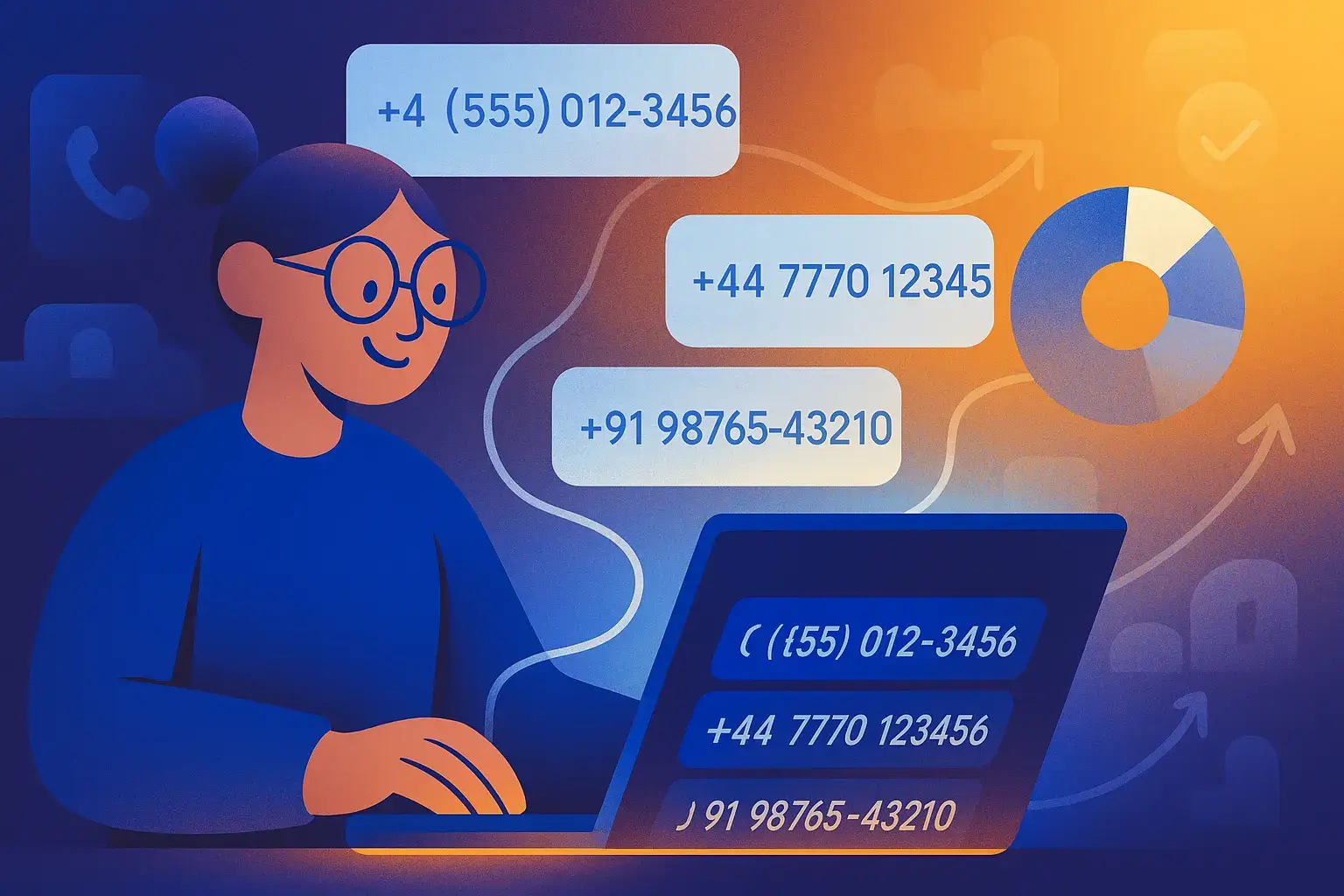
Phone number testing requires realistic data without privacy risks. This random phone number generator creates synthetic numbers that follow international formatting standards and regional numbering plans. You can generate test data instantly for app development, form validation, and database testing. The tool produces numbers that look authentic and pass format checks. It helps you maintain GDPR compliance and protects real user information.
This tool generates random phone numbers for testing purposes. These numbers are selected randomly from available number pools and may be either real or fake. They should not be used for actual calls or any official purposes. You can generate up to 100 numbers at once.
Step 1: Select your input
Step 2: Generate output
Generated Phone Numbers:
▼
How to Use the Phone Number Generator:
Step 1. Select your country from the dropdown menu.
Step 2. Enter the number of phone numbers you want to generate (1-100).
Step 3. Click the “Generate Phone Numbers” button.
Step 4. Click “Copy All Numbers” to copy all generated phone numbers at once.
All generated phone numbers are intended for testing purposes only and should not be used for actual calls.
You can actually complete the entire QA process inside aqua.
Ready to use it in a real project? Check available plans on thepricing page.
Generating and managing test phone numbers for QA environments is one of many processes QAs are involved in. You need realistic, compliant data at scale while protecting privacy. More than that, you need a unified environment to centralize all your QA efforts. This is where aqua cloud, an AI-driven test and requirement management platform, stands out. With aqua’s you can create test data that’s not only realistic but directly relevant to your application’s requirements. The platform’s unified test management approach gets you complete traceability without exposing sensitive information. With environment controls, you can ensure test data remains consistent across development, staging, and production. aqua integrates directly with Jira, Azure DevOps, and other tools your team already uses, so synthetic test data flows naturally through your existing workflows.
Use a single template to boost your testing efforts
"*" indicates required fields
What is a Random Phone Number Generator?
A random phone number generator is software that creates phone numbers on demand using algorithms designed to mimic real numbering schemes. It doesn’t pull from a live telecom database or assign working lines. Instead, it builds digit sequences that look legit and match the length, prefixes, and structure of numbers you’d find in the US, UK, France, and all other countries.
Most generators lean on the E.164 international numbering plan, the ITU standard that governs how phone numbers get formatted worldwide. The generator picks a country code, grabs that region’s rules, and spits out a random national number that fits the pattern. Many tools run the result through Google’s libphonenumber library to ensure the output is “possible” and ideally “valid.” The result? Synthetic numbers that won’t bounce during import tests or trigger your CRM’s format validator, but also won’t dial a real person’s phone.
Use Cases for Random Phone Numbers for Software Testing and Development
App & Website Testing
Developers need contact data that won’t leak customer info or trigger compliance alarms, but still behaves like the real thing. Random phone number generators let you populate test databases, staging CRMs, and QA environments with thousands of realistic entries in minutes. You can validate form inputs and stress-test imports without touching production data. Every number looks legitimate, but nobody’s device will ring.
Privacy Protection
Temporary phone number services like Burner or SMS-Activate allocate random virtual numbers you can use to receive SMS verification codes, then discard. You shield your primary SIM from spam, harassment, and data brokers who love reselling contact lists. Some platforms use number masking to give you a proxy digit that routes calls without exposing your real one. Ride-hailing and delivery apps do this constantly.
Educational Purposes
Tutorials, training sims, and onboarding materials need realistic examples. Sales teams use them for role-playing cold calls, letting reps practice objection handling without accidentally dialing prospects. Call-center trainers populate mock IVR flows with synthetic numbers so agents can rehearse scenarios in a safe sandbox.
Marketing & Sales Demos
You’re pitching a new CRM to a prospect and need a polished demo environment. Fake phone numbers help you build realistic customer profiles, call logs, and analytics dashboards without exposing actual client data or violating NDAs. Random generators let you populate sample records with geography-specific formatting so the demo feels native to the buyer’s market.
Creative Projects
Writers, filmmakers, and content creators sometimes need phone numbers for scripts, fake social-media profiles, or world-building. Random generators give you plausible digits that won’t accidentally match a real person’s number.
How to Use an aqua Random Phone Number Generator in Software Development and Testing
Step 1: Choose Your Country or Region
Start by selecting the geography you need. Most generators offer a dropdown with common countries, each tied to its own numbering plan. This step ensures your generated numbers match the structure your system expects.
Step 2: Generate the Numbers
Hit the “Generate” button. Most tools spit out one number per click, but bulk generators let you create batches of 10, 100, or even 1,000 numbers at once. The output typically includes multiple formats: E.164, international, and national/local styles with parentheses or dashes.
Step 3: Copy the Numbers
You can copy individual numbers to your clipboard, download a CSV/TXT file, or integrate via API. Bulk export is essential for large-scale testing.
Step 4: Use Them Responsibly
Use generated numbers only in controlled environments: dev, staging, anonymization pipelines, or internal demos. Don’t dial them for real outreach. You’ll hit random people or invalid lines and potentially violate anti-spam laws like the TCPA or GDPR.
Benefits of Using Random Phone Number Generators as QA Tester & Developer
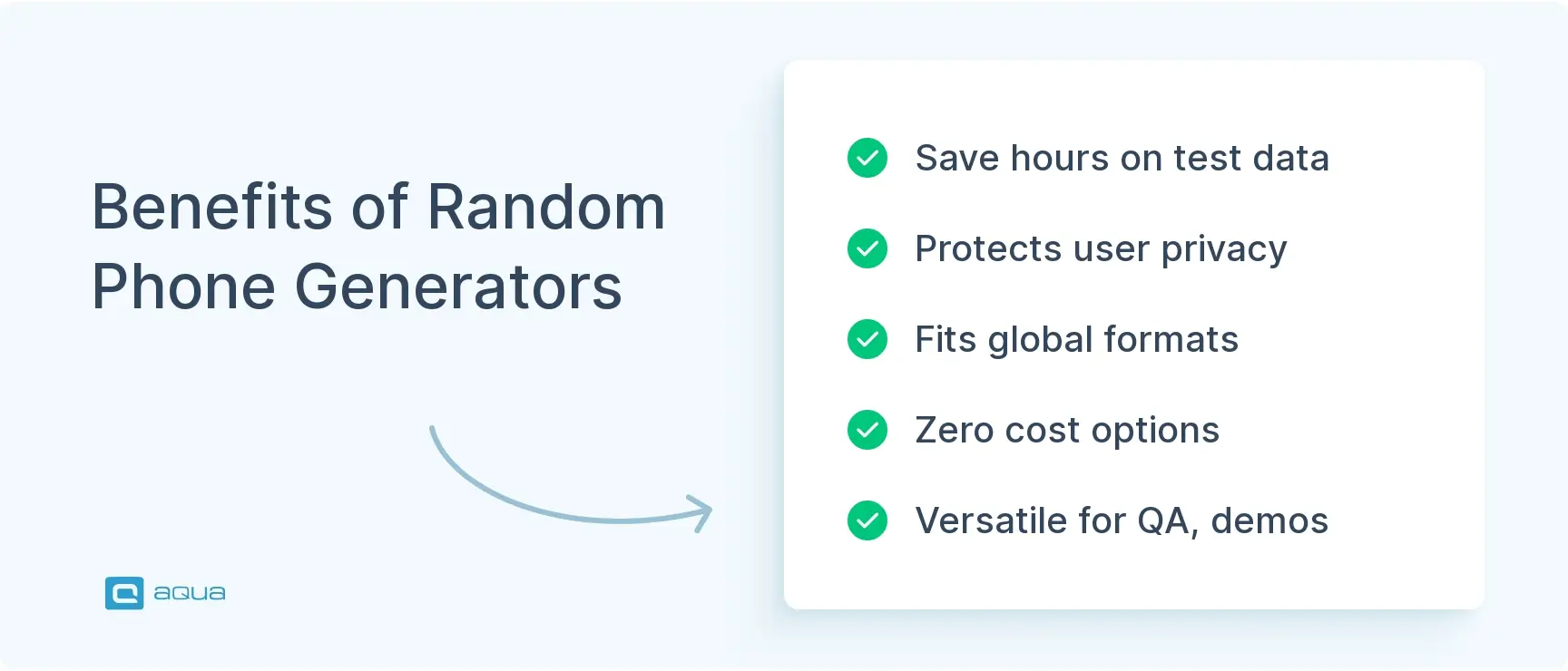
Time Savings
Need 1,000 phone numbers for a bulk import test? A generator spits them out in seconds. You set your parameters, hit generate, and move on.
Privacy Protection
Generators replace real phone numbers with synthetic placeholders. This breaks the link between contact data and actual people. That’s critical for GDPR/CCPA compliance when you’re feeding datasets into analytics tools or third-party services. You keep your data’s structural integrity without exposing real identifiers.
Versatility Across Applications
You can use random phone numbers in dev environments, QA pipelines, marketing demos, training sims, and creative projects. Need to test geo-segmentation? Generate numbers from many different countries and watch your CRM tag them correctly.
Realistic Data Without Risk
Generated numbers follow real formatting rules. E.164 compliance, country-specific lengths, valid area codes. Your systems treat them like production data. Your validation logic won’t choke, your import scripts won’t fail, and your UI won’t break on edge cases.
Cost Efficiency
Most random phone number generators are free or dirt cheap. You’re not paying telecom providers for number allocation, SMS credits, or API calls. For pure test data, you can generate unlimited batches at zero cost.
Safety and Ethical Guidelines of Using Phone Number Generator for testers or developers
Treat Phone Numbers as Regulated Data
Under GDPR, CCPA, and similar privacy laws, phone numbers are personal data if they can be linked to a real person. If you’re generating numbers for testing, you’re usually fine. Non-production environments get some leeway. But if you store, share, or transmit those numbers outside controlled sandboxes, you need a lawful basis and appropriate security measures.
Never Use Random Numbers for Outreach
Using a random phone number generator to build cold-call lists or SMS blasts is illegal in most jurisdictions. The TCPA requires prior express consent before sending marketing texts or autodialed calls. Violations can cost you $500 to $1,500 per message. Random numbers lack consent by definition. Dialing or texting them is spam.
Respect Opt-Out & Do-Not-Call Lists
Even with consent, you must honor “STOP” requests immediately and scrub your lists against national DNC registries. If you’re tempted to use random numbers for live contact, you’re already violating this principle.
Use Non-Routable Ranges for Pure Testing
If you’re generating numbers purely for internal testing or anonymization, prefer non-routable ranges or clearly fictional patterns. This eliminates the risk of accidental contact and strengthens your compliance posture.
Document Your Processes
If you’re using random phone number generators in a professional context, keep a clear record. Document how and where you generate numbers, where those numbers are used, and how you ensure they’re never used for live outreach. This documentation protects you during audits.
Test data generation solves one challenge, but teams need comprehensive visibility across the entire testing lifecycle. To maximize the benefits described in this article, you need a test management system that supports modern QA approaches. aqua cloud, an AI-driven requirement and test management solution, excels in complex testing environments. It offers powerful features that complement your data generation and privacy protection strategy. aqua gives you complete visibility across the lifecycle. The domain-trained AI Copilot sets aqua apart. It learns from your project’s documentation to generate relevant test cases and data. You get context-aware, project-specific outputs rather than generic AI suggestions. Combined with real-time dashboards that track test coverage across environments, aqua changes how teams collaborate on quality. Through automation integrations with tools like Selenium and JMeter, along with custom workflow capabilities via REST API, aqua helps teams adopt best QA practices with minimal friction.
Reduce test data creation time by 97% while maintaining complete privacy compliance
Random phone number generators let you populate staging environments with realistic contacts, shield your personal digits from spam, and build credible demos without exposing real people. When you need to quickly verify accounts without using your personal information, a random phone number for verification proves invaluable. These fake phone number tools are built for sandboxes, not live campaigns. Use them to test, protect, and simulate but never to spam or sidestep consent rules.
Absolutely. Random phone number generators create synthetic numbers that follow real formatting rules without pulling from live telecom databases. They’re perfect for testing, demos, and privacy protection, but they’re not verified opt-ins. Don’t use them for outreach.
What is a 0909 phone number?
“0909” isn’t a standard prefix in most major numbering plans. If you’ve seen this in a specific context like premium-rate services in some countries, it’s likely a local pattern. Random generators typically focus on standard mobile/landline ranges, not specialty prefixes.
What is a dummy phone number?
A dummy phone number is a synthetic placeholder. It looks real and follows formatting rules, but isn’t assigned to anyone. Random generators create these for dev/QA work, anonymization, and demos. They’re “dummy” in the sense that they won’t dial a real person, making them safe for non-production use.
Join our community of enthusiastic experts! Get new posts from the aqua blog directly in your inbox. QA trends, community discussion overviews, insightful tips — you’ll love it!
We're committed to your privacy. Aqua uses the information you provide to us to contact you about our relevant content, products, and services. You may unsubscribe from these communications at any time. For more information, check out our Privacy policy.
X
🤖 Exciting new updates to aqua AI Assistant are now available! 🎉
We use cookies and third-party services that store or retrieve information on the end device of our visitors. This data is processed and used to optimize our website and continuously improve it. We require your consent fro the storage, retrieval, and processing of this data. You can revoke your consent at any time by clicking on a link in the bottom section of our website.
For more information, please see our Privacy Policy.
This website uses cookies to improve your experience while you navigate through the website. Out of these, the cookies that are categorized as necessary are stored on your browser as they are essential for the working of basic functionalities of the website. We also use third-party cookies that help us analyze and understand how you use this website. These cookies will be stored in your browser only with your consent. You also have the option to opt-out of these cookies. But opting out of some of these cookies may affect your browsing experience.
Necessary cookies are absolutely essential for the website to function properly. These cookies ensure basic functionalities and security features of the website, anonymously.
Cookie
Duration
Description
cookielawinfo-checkbox-analytics
11 months
This cookie is set by GDPR Cookie Consent plugin. The cookie is used to store the user consent for the cookies in the category "Analytics".
cookielawinfo-checkbox-functional
11 months
The cookie is set by GDPR cookie consent to record the user consent for the cookies in the category "Functional".
cookielawinfo-checkbox-necessary
11 months
This cookie is set by GDPR Cookie Consent plugin. The cookies is used to store the user consent for the cookies in the category "Necessary".
cookielawinfo-checkbox-others
11 months
This cookie is set by GDPR Cookie Consent plugin. The cookie is used to store the user consent for the cookies in the category "Other.
cookielawinfo-checkbox-performance
11 months
This cookie is set by GDPR Cookie Consent plugin. The cookie is used to store the user consent for the cookies in the category "Performance".
viewed_cookie_policy
11 months
The cookie is set by the GDPR Cookie Consent plugin and is used to store whether or not user has consented to the use of cookies. It does not store any personal data.
Functional cookies help to perform certain functionalities like sharing the content of the website on social media platforms, collect feedbacks, and other third-party features.
Performance cookies are used to understand and analyze the key performance indexes of the website which helps in delivering a better user experience for the visitors.
Analytical cookies are used to understand how visitors interact with the website. These cookies help provide information on metrics the number of visitors, bounce rate, traffic source, etc.
Advertisement cookies are used to provide visitors with relevant ads and marketing campaigns. These cookies track visitors across websites and collect information to provide customized ads.