The True Impact of AI on QA Testing: Facts and Myths
In today's tech buzz, AI's role in Quality Assurance (QA) testing is like a futuristic magic trick—everyone's talking about it. But what's real, and what's just smoke and mirrors? This article isn't pulling any tricks; it's here to reveal the actual powers and bust the myths of AI in QA testing. So buckle up because we're diving into the real deal, separating fact from fiction, and giving you the inside scoop on how AI truly rocks the QA world.
Myths about Artificial Intelligence in Software Testing
Let’s start with some AI QA myths, shall we? These are the phrases or statements you hear almost every day, and as the old saying goes, “Repeat a lie often enough, and it becomes the truth”. In the internet era, where almost everyone has strong opinions, this situation is really dangerous. But hold on; we will help you distinguish myths from truths. Below are some of the most common misconceptions about AI in QA:
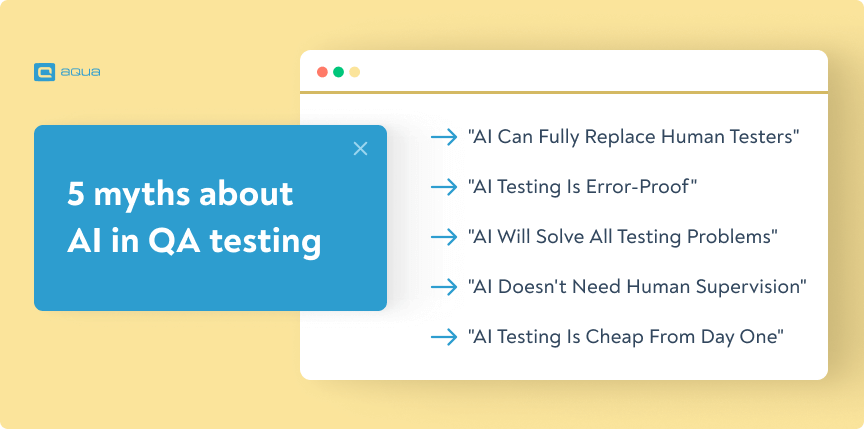
Myth 1: "AI Can Fully Replace Human Testers"
Although studies suggest that 42% of AI test cases require no extra human input, the belief that AI can entirely replace human testers is misleading. This statistic might indicate a significant level of automation, but it’s crucial to note that testing encompasses various complexities beyond repetitive tasks. Human testers bring contextual understanding, intuition, and adaptability that AI can’t replicate. The misconception arises when this statistic is misinterpreted to imply that AI alone can comprehensively handle all testing requirements without human involvement.
Myth 2: "AI Testing Is Error-Proof"
There’s a misconception that AI testing guarantees flawless results every time. The truth? AI is only as good as the data it’s trained on. Sometimes, biased or inadequate data can lead to erroneous conclusions. Watch out for promises of absolute perfection in testing without acknowledging data quality limitations.
Myth 3: "AI Will Instantly Solve All Testing Problems"
It’s tempting to believe AI is a magic wand that can instantly fix all testing woes. But, spoiler alert: it’s not. This myth ignores the time and effort required to train AI models effectively. Beware of claims that oversell AI’s capabilities without addressing the investment and iterative process needed for optimal performance.
Myth 4: "AI Doesn't Need Human Supervision"
Some claim that once AI is set loose, it doesn’t need any human oversight. However, AI in testing still demands human guidance and interpretation. Detect this myth by recognising statements that undermine the necessity of human expertise and intervention in AI-driven testing processes.
Myth 5: "AI Testing Is Cost-Effective From Day One"
There’s a belief that adopting AI in testing immediately slashes costs. The reality? Initial implementation and training phases often involve substantial investment. Be cautious of assertions highlighting immediate cost reductions without acknowledging the upfront expenses and the time required for cost-saving benefits to materialise.
However, it does not mean AI is just a buzzword in software testing—it’s the secret weapon reshaping how we ensure quality. Despite swirling myths, AI is a game-changer in QA. Its ability to streamline complex testing processes and enhance precision is undeniable. And to use the benefits of AI in software testing to the fullest, you need a perfect solution that seamlessly integrates its capabilities into your QA workflow.
Introducing you aqua cloud – the revolutionary solution that brought AI to QA first. With aqua’s AI Copilot, creating entire test cases from requirements becomes effortless, ensuring a smoother transition from conceptualising to execution. Need to spot duplicates? A quick aqua AI check does the trick, saving you time by removing identical tests in a snap. Updating tests and expanding requirements? The AI Copilot handles it seamlessly, saving each tester valuable hours weekly. The QA-tuned chatbot is your speedy ally, offering prompt validation, suggestions, and lightning-fast test case completion. Dive into software testing tool aqua and experience the game-changer your QA process deserves!
Take away the pain of testing with the first AI-powered solution
The Human Side of AI QA: Where People Still Matter Most
Human testers have become more valuable, not less. Sure, AI crushes the repetitive stuff and spots obvious bugs faster than you can blink. But throw it a curvature ball requiring creativity or ethical thinking? That’s where things get interesting.
Your role as a QA professional has shifted into something way more strategic. You’re now the one deciding what deserves testing attention, reading between the lines of AI reports, and catching those subtle biases that automated systems miss entirely.
Next time you review AI test results, spend 20% of your analysis time asking ‘What would confuse a real user here?’ That question alone uncovers the gaps that pure automation leaves behind. The future isn’t about humans vs. machines; it’s about humans guiding machines toward better outcomes.
Facts about AI in QA testing
Now that you’ve navigated through the fog of myths, let’s illuminate some AI QA facts—where its true potential shines. Despite all the backlash from the public, AI is still a powerhouse that revolutionises testing efficiency, empowering human testers and enhancing the overall QA process. With AI, mundane tasks transform into automated wonders, allowing you to focus on nuanced, complex challenges that demand creativity and intuition.
Below are some significant facts about AI in QA:
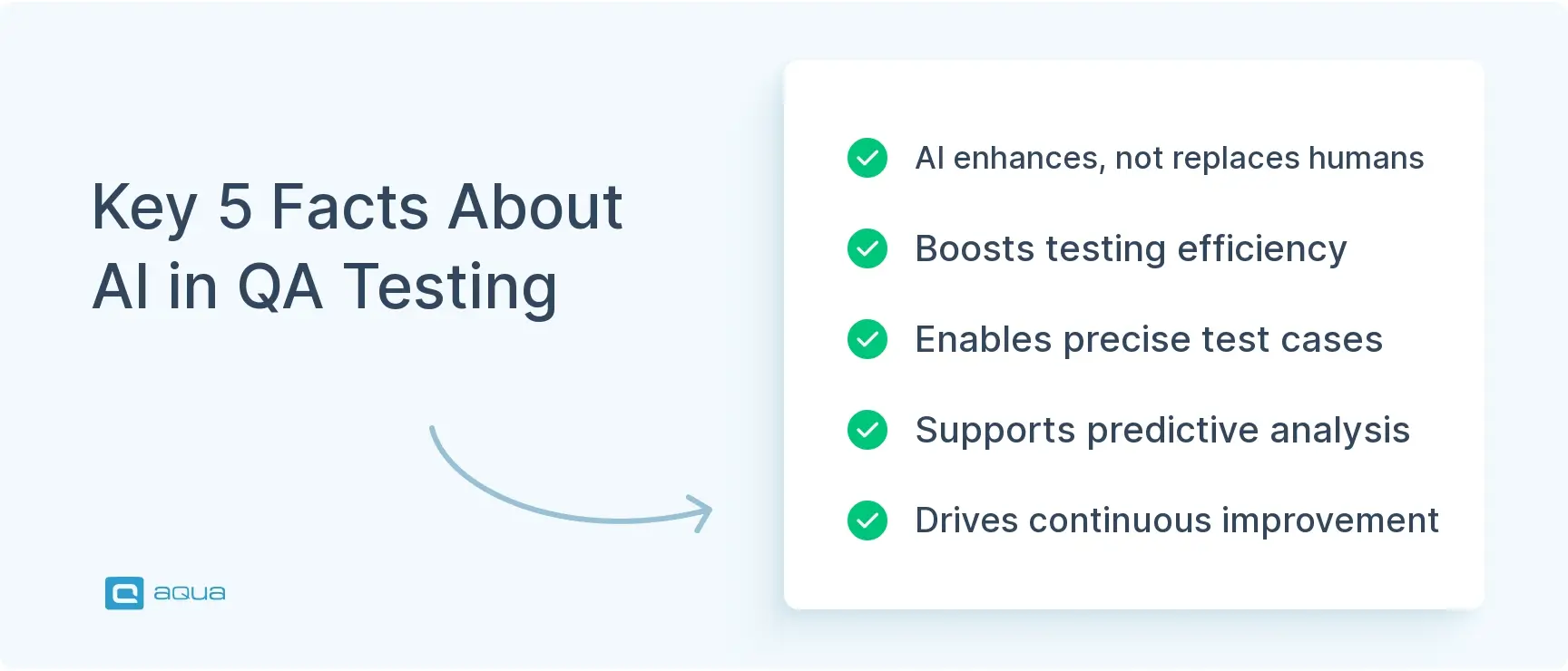
Fact 1: "AI Augments, Not Replaces, Human Testers"
Contrary to the fear of job displacement, AI complements human testers. It helps you handle repetitive tasks, freeing human resources to tackle intricate scenarios demanding cognitive reasoning and adaptability. By collaborating with AI, you can delve deeper into problem-solving, improving overall software quality and user experience. As the saying goes, “AI will not replace you, but the person who uses AI will”.
Fact 2: "AI Enhances Testing Efficiency"
One of the benefits of AI in testing is that it catalyses your testing efficiency. It expedites test case generation, detects defects more accurately, and speeds up the overall testing cycle. This translates to quicker turnaround times, faster releases, and improved software quality. Embracing AI means optimising resources and delivering products to market faster without compromising quality.
Self-Healing and Resilient Test Automation: Minimising Maintenance Headaches
AI-powered self-healing automation is changing how teams handle test maintenance. Your traditional test scripts break the moment someone tweaks a button colour or shifts a form field. But newer AI systems are smarter than that: they analyse visual patterns, text content, and layout structures simultaneously. When a locator breaks, the AI doesn’t panic. It adapts the script in real-time, finding the element through alternative means and keeping your tests running.
Start by implementing self-healing on your most frequently failing UI tests first. Track your ‘test repair frequency’ as a key metric. When that number starts dropping, you’ll know the AI is doing its job and your delivery pipeline stays smooth.
Fact 3: "AI Facilitates Precise Test Case Generation"
The precision AI brings to your test case generation directly from requirements is a game-changer. AI tools now read your everyday English user stories and turn them into proper test cases. Here’s the game-changer: these systems actually suggest scenarios you might miss, like edge cases that trip up most teams. You’ll typically see it generate 3-5 test scenarios automatically with the AI testing tool: positive flows, failure cases, and those tricky boundary conditions that usually surface during production. This precision reduces your chances of overlooking critical test scenarios, resulting in more robust and reliable software.
The precision AI brings to your test case generation directly from requirements is a game-changer. This precision reduces your chances of overlooking critical test scenarios, resulting in more robust and reliable software.
Eric J. Larsson, author of “The Myth of Artificial Intelligence”
Fact 4: "AI Enables Predictive Analysis in Testing"
The next AI QA benefit is its predictive prowess, which empowers you to foresee potential issues before they escalate. AI can scan your code changes and CI/CD patterns. It spots risky areas, throws quality scores at potential problem zones, and suggests where to focus your testing efforts, all happening automatically before merge time. This proactive approach minimises risks and significantly enhances the software’s resilience.
Fact 5: "AI Unlocks Insights for Continuous Improvement"
AI doesn’t just stop at running tests—it offers insights for ongoing enhancement. By analysing vast testing data, AI-based automation tools provide you with invaluable feedback for refining testing strategies. These insights help you chase continuous improvement, ensuring that each of your software iterations is better than the last.
Now, how to use these AI QA advantages in your favour? Armed with these testing revelations, let’s introduce aqua cloud—a dynamic solution aligned with these benefits. Imagine aqua’s AI Copilot as your testing co-pilot, automating mundane tasks and enabling precise test case generation from requirements. It embodies the efficiency boost of AI by accelerating your test processes without compromising quality. With aqua, predictive analysis becomes a reality, empowering proactive measures to fortify your software. And don’t forget the insights—using AI-driven analytics, aqua cloud doesn’t just run tests; it guides your strategies for continuous improvement, making your testing journey not just efficient but transformative. Ready to harness these benefits in your QA process?
Reduce at least 42% of humanly work with aqua cloud
Wrapping up, you’ve learned some myths and real strengths about AI in testing. Misconceptions said it might replace humans or solve everything instantly, but the facts showed it’s more about helping humans, making things faster, and pointing us toward making better software. Yet, amidst these advancements, one question remains: How will further AI innovations shape the future software testing landscape?
Home » Best practices » The True Impact of AI on QA Testing: Facts and Myths
Do you love testing as we do?
Join our community of enthusiastic experts! Get new posts from the aqua blog directly in your inbox. QA trends, community discussion overviews, insightful tips — you’ll love it!
We're committed to your privacy. Aqua uses the information you provide to us to contact you about our relevant content, products, and services. You may unsubscribe from these communications at any time. For more information, check out our Privacy policy.
X
🤖 Exciting new updates to aqua AI Assistant are now available! 🎉