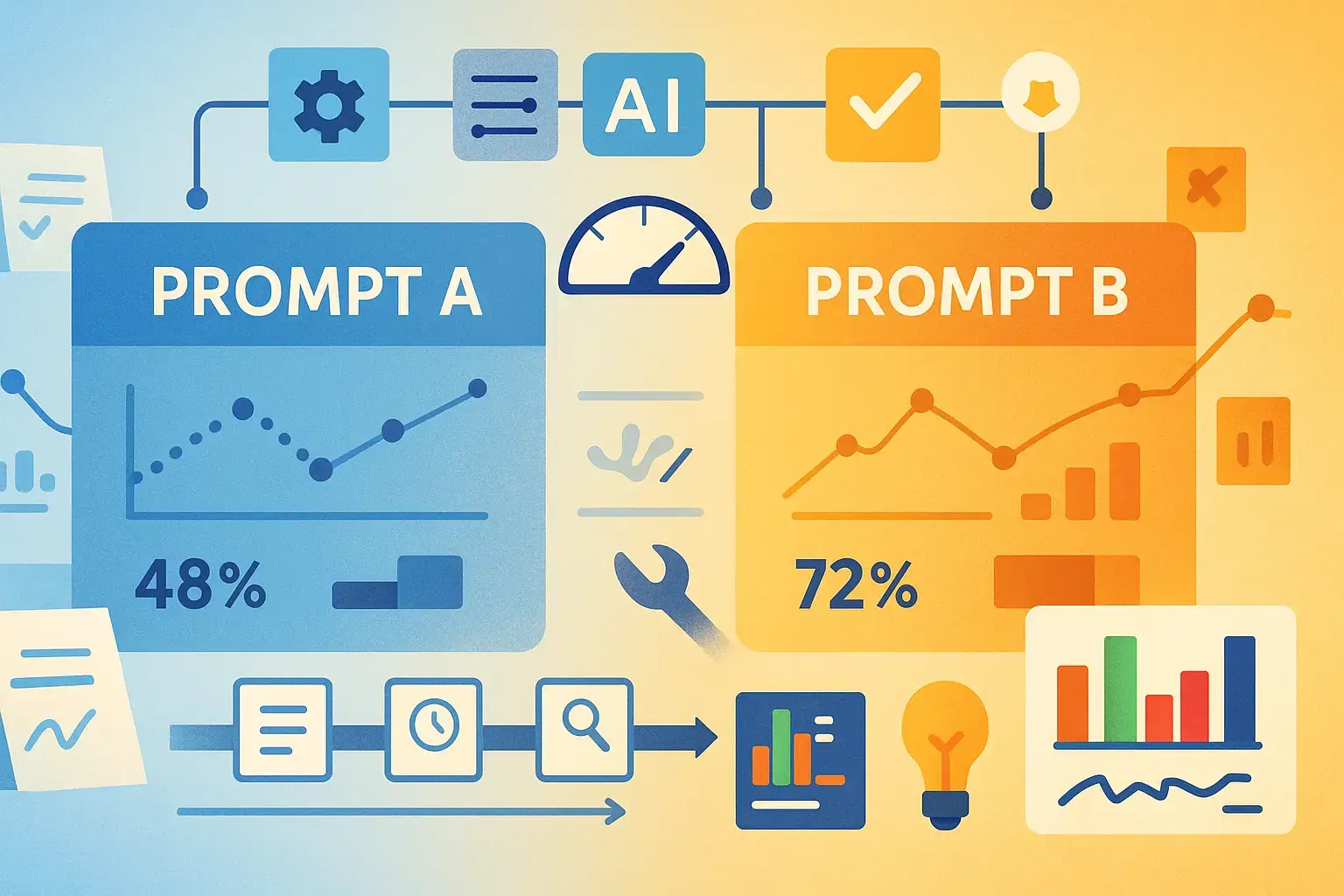
You tweak your LLM prompts, hoping for better responses. Sometimes they improve. Sometimes they get worse. You never really know why because you're changing multiple things at once and relying on gut feeling instead of data. A/B testing prompts means running structured experiments where you test one prompt variation against another, measure actual performance differences, and let the numbers decide what works. QA teams already know how to test software systematically. The same discipline applies to testing AI model prompts. This guide shows you how to set up A/B tests for LLM prompts, what metrics actually matter, and how to automate the process so you stop guessing and start knowing which prompts perform better.
A/B testing AI model prompts allows teams to systematically compare different prompt variations and let data determine which performs better across metrics like accuracy and response time.
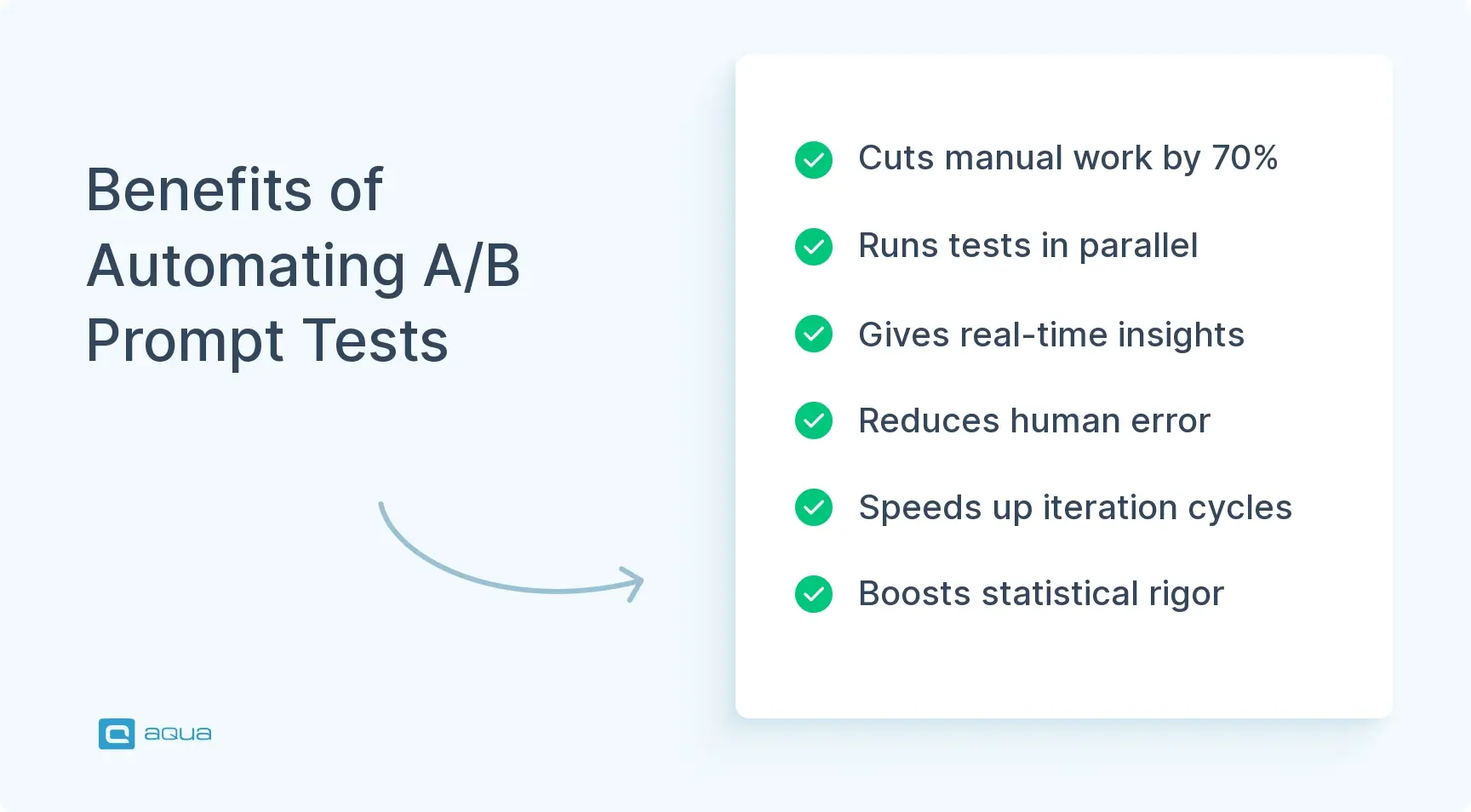
Automation reduces manual work by 70%, ensures test consistency, and enables parallel testing of multiple prompt variations simultaneously while providing real-time performance insights.
Effective prompt variants can test structural approaches (question vs. instruction-based), tone modulation, specificity levels, context types, and parameter settings like temperature.
The optimal testing workflow includes a test orchestration layer, execution engine for routing traffic, and analysis pipeline using techniques like Multi-Armed Bandit algorithms for dynamic traffic allocation.
Success metrics must reflect actual user value through automated scoring (response time, error rates) combined with human evaluation for ambiguous or edge case responses.
Stop treating prompt engineering like an art project and start approaching it as a systematic optimization problem backed by data. See how to build your first automated A/B testing pipeline for AI prompts 👇
Why Automate the A/B Testing Process?
Manual A/B testing for prompts means tracking dozens of variables by hand. Your test results live in scattered spreadsheets. Version control becomes messy. Comparing statistical significance requires calculations nobody wants to do. This approach doesn’t scale.
Automation makes this manageable. You save time on manual work. More importantly, you build reproducibility into your testing framework. Every experiment runs under identical conditions. You eliminate those moments where someone changed a parameter and invalidated weeks of work. Automated systems catch subtle performance differences that only emerge across hundreds of test iterations.
Automation gives you consistency at scale. Run parallel tests across multiple prompt variations simultaneously. Get real-time insights from automated dashboards that surface performance metrics instantly. Reduce human error from copy-paste mistakes or forgotten baseline measurements. Speed up iteration cycles from weeks to hours. Your competitors aren’t waiting around. Built-in significance testing and confidence intervals mean you make decisions based on data instead of hunches.
Once you automate your A/B testing pipeline, adding new experiments becomes straightforward. Your team shifts from reacting to random issues to strategically optimizing the prompts that matter most.
Why Automate the A/B Testing Process?
Manual A/B testing for prompts means tracking dozens of variables by hand. Your test results live in scattered spreadsheets. Version control becomes messy. Comparing statistical significance requires calculations nobody wants to do. This approach doesn’t scale.
Automation makes this manageable. You save time on manual work. More importantly, you build reproducibility into your testing framework. Every experiment runs under identical conditions. You eliminate those moments where someone changed a parameter and invalidated weeks of work. Automated systems catch subtle performance differences that only emerge across hundreds of test iterations.
Here’s why automation matters:
Consistency at scale. Run parallel tests across multiple prompt variations simultaneously. Something physically impossible with manual workflows.
Real-time insights. Automated dashboards surface performance metrics instantly. You can pivot strategies before burning through your API quota.
Reduced human error. No more copy-paste mistakes or forgotten baseline measurements that tank your experimental validity.
Faster iteration cycles. Deploy, test, analyze, and redeploy in hours instead of weeks. Your competitors aren’t waiting around.
Better statistical rigor. Built-in significance testing and confidence intervals mean you make decisions based on math instead of hunches.
Once you automate your A/B testing pipeline, adding new experiments becomes straightforward. Your team shifts from reacting to random issues to strategically optimizing the prompts that matter most.
Feeling overwhelmed by manual A/B testing of your prompts? While optimizing LLM prompts is crucial, manually tracking and analyzing results across spreadsheets quickly becomes unsustainable. Especially when you are testing at scale, you need an AI-powered TMS by your side. aqua cloud offers a structured solution to bring order to your testing chaos. With its comprehensive test management capabilities, you can organize your A/B test scenarios as individual test cases, track execution history across variants, and visualize results through customizable dashboards. What’s more, aqua’s domain-trained AI Copilot, which learns from your project’s own documentation, can generate contextually relevant test variations in seconds, reducing the time spent on prompt engineering by up to 97%. It’s beyond generic AI producing generic results; it’s an intelligence that truly understands your project’s specific needs and terminology.
Transform your A/B testing workflow with aqua's automated, context-aware approach to test management
Prompts are the interface between your intentions and an LLM’s output. When you A/B test LLM prompts, you experiment with how different instruction phrasings, context structures, or parameter tweaks affect model behavior. Version A asks for “a detailed code review.” Version B specifies “identify security vulnerabilities and performance bottlenecks.” Same goal, different approach. The results can vary significantly.
LLMs are probabilistic. Unlike traditional software where inputs produce consistent outputs, the same prompt can yield different results based on temperature settings, model versions, or server load. That unpredictability means A/B testing AI prompts focuses on discovering which variations consistently perform better across your specific use cases. You build a statistical picture of reliability instead of finding one perfect prompt.
The variables you can test stack up. Word choice, sentence structure, tone. System-level factors like max tokens, top-p sampling, whether you use few-shot examples. Each tweak creates a new hypothesis to validate. Does adding three example outputs actually improve accuracy for your test case generation workflow? Or does it just waste tokens and slow response times? You won’t know until you test both versions with real traffic.
Prompt A/B testing works naturally for QA teams. You already understand test design, control groups, and measuring outcomes. Applying those skills to LLM optimization means reframing prompts as testable inputs. Your success metrics might shift. Instead of pass/fail rates, you track response relevance, factual accuracy, or alignment with expected output formats. The core methodology stays the same. Rigorous validation applied to a probabilistic system.
Best Practices for A/B Testing AI Model Prompts
Effective A/B testing LLM prompts target different phases of your experimentation process. Some help you generate test ideas when you’re staring at a blank roadmap. Others structure your experiment design so you’re not throwing random variations at the wall. The key is matching the right prompt type to your current bottleneck. Whether that’s ideation, execution, or making sense of results that contradict your expectations.
The prompts below cover the full lifecycle of experimentation. From initial brainstorming through final analysis. Think of them as starter templates you’ll customize based on your LLM application, user base, and the metrics that matter to your team.
Prompts for Test Idea Generation
These prompts jumpstart your experimentation pipeline when you’re stuck on what to test. Use them to uncover optimization opportunities you hadn’t considered:
Broad Discovery Prompt
“Analyze this prompt: [your current prompt]. Suggest five specific variations that could improve [metric: accuracy/speed/relevance]. For each suggestion, explain the hypothesis and expected outcome.”
User Behavior Analysis
“Based on this usage data [paste sample interactions], identify three prompt modifications that could better align with how users actually phrase their requests. Include examples of current mismatches.”
Competitive Benchmarking
“Compare this prompt approach [your version] against this alternative structure [competitor/industry standard]. What are three testable hypotheses for why one might outperform the other in [specific context]?”
Edge Case Mining
“Given this prompt [current version], generate ten edge cases where it might fail or produce unexpected results. For each edge case, propose a prompt variation that could handle it better.”
Metric-Driven Ideation
“Our current prompt achieves [X% success rate] on [specific task]. Propose three experiments that could push this metric to [target %], explaining the logical reasoning behind each test.”
Multi-Objective Optimization
“This prompt prioritizes [metric A] but we also need to improve [metric B] without sacrificing [metric C]. Suggest variants that balance these competing goals and how to measure trade-offs.”
Prompts for Variant Creation
Once you’ve locked in your test idea, these prompts help you generate meaningful variations instead of random tweaks that don’t test any real hypothesis:
Structural Variation
“Rewrite this prompt in three distinct formats: 1) Question-based, 2) Instruction-based, 3) Example-based. Keep the core intent identical but vary the structural approach.”
Tone Modulation
“Create four versions of this prompt with different tones: formal/technical, conversational/friendly, directive/commanding, and collaborative/suggestive. Maintain semantic equivalence.”
Specificity Spectrum
“Generate variants of this prompt ranging from highly specific (including 3+ constraints) to broadly open-ended (minimal guidance). Create five steps along this spectrum.”
Context Injection
“Take this base prompt and create three variants that add different types of context: 1) User role/persona, 2) Technical constraints, 3) Business objectives. Show how each changes the likely output.”
Parameter Play
“For this prompt, suggest three variants that would pair well with different temperature settings: one optimized for temp 0.2 (deterministic), one for 0.7 (balanced), and one for 0.9 (creative).”
Length Optimization
“Condense this verbose prompt into a minimal version (under 50 words) that preserves core functionality. Then create an expanded version (150+ words) with additional guardrails. Compare expected trade-offs.”
Prompts for Hypothesis Formulation
Strong hypotheses prevent you from running tests that don’t actually answer anything. These prompts force clarity before you burn through API credits:
If-Then Structure
“Convert this test idea into a formal hypothesis: If [specific prompt change], then [predicted outcome] because [logical mechanism]. Include the null hypothesis.”
Metric Specification
“For this proposed A/B test, define: 1) Primary success metric with target threshold, 2) Two secondary metrics to monitor, 3) Guardrail metrics that would invalidate the test if they degrade.”
Sample Size Calculator
“Given a baseline conversion rate of [X%], expected lift of [Y%], and confidence level of [Z%], what’s the minimum sample size needed? How long will this test need to run at [current traffic volume]?”
Causal Mechanism
“Explain the causal chain for this hypothesis: [proposed prompt change] → [intermediate effect] → [measured outcome]. Identify potential confounding variables.”
Risk Assessment
“What could go wrong with this test? List three ways this prompt variant might underperform unexpectedly, and propose pre-test checks to validate assumptions.”
Segmentation Strategy
“Should this test run across all users or specific segments? Define user segments most likely to show different responses, and justify why segmented analysis matters here.”
Prompts for Data Analysis
Raw numbers don’t mean much until you’ve interrogated them properly. These prompts help you extract insights from test results:
Statistical Significance Check
“Given these test results [paste data], calculate statistical significance using a two-tailed t-test. Is the difference between variant A and B meaningful at 95% confidence? Show your work.”
Cohort Breakdown
“Analyze this A/B test data across these user segments: [list segments]. Which segments showed the strongest response to variant B? Are there segments where the test failed?”
Time-Series Patterns
“Plot this test data over time [paste daily results]. Identify any trends, day-of-week effects, or anomalies that might indicate external factors influencing results.”
Multi-Metric Dashboard
“Summarize this A/B test across all tracked metrics in a table format. For each metric, show: variant A performance, variant B performance, percentage change, and whether the change is statistically significant.”
Outlier Detection
“Review this test data for outliers that might skew results. Flag data points that fall outside [2 standard deviations] and assess whether removing them changes the conclusion.”
Cost-Benefit Analysis
“Variant B improved [metric] by [X%] but increased token usage by [Y%]. Given our cost per thousand tokens of [$Z], calculate the ROI and break-even point for deploying variant B.”
Prompts for Result Interpretation
Numbers tell you what happened. Interpretation tells you what it means and what to do next:
Decision Framework
“Based on these test results [paste summary], provide a clear recommendation: Deploy variant B, stick with variant A, or run an extended test. Justify your recommendation with three supporting data points.”
Unexpected Outcomes
“This A/B test showed [unexpected result] instead of [hypothesis prediction]. Generate three alternative explanations for why this happened, ranked by plausibility.”
Learning Extraction
“What are the top three learnings from this test that should inform our next round of experiments? Include both successful tactics and approaches that failed.”
Scaling Implications
“If we deploy the winning variant to 100% of users, what are the projected impacts on: 1) API costs, 2) Response latency, 3) User satisfaction scores? Include confidence intervals.”
Follow-Up Hypotheses
“Based on these test results, propose two follow-up experiments that could build on the winning approach or explore the mechanisms behind the observed lift.”
Executive Summary
“Distill this A/B test into a three-paragraph executive summary covering: 1) What we tested and why, 2) Key results with primary metric impact, 3) Recommended next steps and expected business value.”
These prompt collections give you a framework. Not a script. The best A/B testing workflows blend these templates with your domain knowledge. You know what good looks like for your specific application. Tweak the variables, adjust the metrics, and run experiments that actually move the needle on problems your users care about.
How to Automate A/B Testing with AI Prompts
Automating A/B testing for prompts means building a system that handles the grunt work. Running experiments, collecting data, flagging significant results. You focus on strategy. The core architecture involves three components. A test orchestration layer that manages experiment variants. An execution engine that routes traffic and captures responses. An analysis pipeline that crunches numbers and surfaces insights. Think continuous integration for your prompts, but instead of catching bugs, you’re catching suboptimal performance.
Start with tools that already speak your language. Platforms like aqua cloud and similar solutions offer structured workflows for prompt experimentation. You define variants, set traffic splits, and monitor metrics through dashboards instead of spreadsheet chaos. These platforms typically integrate with your existing LLM provider. OpenAI, Anthropic, whoever you’re running. They act as a middleware layer that intercepts requests, applies the correct prompt variant based on user assignment, and logs everything for later analysis.
Your automation pipeline should answer three questions automatically. Which variant is winning right now? Is that win statistically significant? Should I stop this test or let it run longer? Multi-Armed Bandit algorithms shine here because they dynamically allocate more traffic to better-performing variants while still exploring alternatives. Unlike fixed 50/50 splits that waste traffic on obvious losers, bandits optimize in real-time. You maximize collective performance even during the testing phase. Tools implementing Thompson Sampling or Upper Confidence Bound strategies give you this adaptive behavior without manual intervention.
A practical automation workflow: You define your prompt variants in a config file or UI. Specify your success metrics like response accuracy, user satisfaction, task completion rate. Set your traffic allocation rules. The system randomly assigns incoming requests to variants, executes the appropriate prompt, and logs both input and output alongside metadata like response time and token count. Behind the scenes, your analysis pipeline runs periodic significance checks. Hourly, daily, whatever cadence makes sense for your traffic volume. It triggers alerts when a winner emerges or when something’s broken. You review the analysis, make a deployment decision, and the cycle repeats.
The trickiest part? Defining metrics that actually reflect user value. You can’t A/B test what you can’t measure. LLM outputs are hard to quantify. Some teams use automated scoring like semantic similarity to reference answers or sentiment analysis. Others sample outputs for human evaluation. Hybrid approaches work well. Automate the obvious stuff like response time, error rates, structural compliance. Human-review edge cases or ambiguous responses. Your automation should flag low-confidence results for manual inspection rather than auto-deploying changes that might tank user experience in subtle ways your metrics missed. Using a test management solution helps track these experiments systematically and ensures proper bug reporting when issues surface during testing.
Conclusion
A/B testing prompts builds a feedback loop that makes your AI systems measurably better with each iteration. You have the frameworks now. Prompts that generate ideas, structure variants, formulate testable hypotheses, and extract meaning from data. The real work starts when you treat prompt engineering like the systematic optimization problem it is instead of guessing what works. Automation handles the repetitive work, so you focus on strategic decisions. Your users won’t care that you ran dozens of experiments to get there. They’ll just notice your system finally understands what they’re asking for. Start with one test that addresses your biggest prompt reliability issue and build from there.
As you’ve seen, effective A/B testing of AI prompts requires systematic experimentation, consistent measurement, and reliable analysis – all challenges that are exponentially harder to manage manually. aqua cloud provides the ideal environment to streamline this entire process. By centralizing your test assets, automating execution workflows, and providing real-time analytics dashboards, you can move from scattered experiments to strategic optimization. The platform’s AI Copilot, powered by Retrieval-Augmented Generation (RAG) technology, doesn’t just create generic prompt variations – it generates project-specific tests grounded in your own documentation and standards. This means your A/B tests benefit from context-aware intelligence that speaks your project’s language. Whether you’re comparing structural variations, tone adjustments, or specificity levels in your prompts, aqua gives you the infrastructure to measure what matters with statistical rigor. And with integrations across your development ecosystem, including Jira and CI/CD pipelines, your optimization insights translate directly into actionable improvements.
Save 97% of your testing time with AI that understands your project's unique context and requirements
What are AI prompts and how do they help automate A/B testing?
AI prompts are structured instructions you feed to language models to get specific outputs. They automate A/B testing by letting you systematically compare different instruction variations. Like testing two landing page designs, but for AI behavior. Instead of manually trying random prompt tweaks and eyeballing results, you define variants, route traffic, collect performance metrics, and let statistical analysis tell you which version actually works better. The automation comes from platforms that handle variant selection, logging, and significance testing without you babysitting spreadsheets.
Can AI prompts replace manual A/B testing analysis?
Not entirely, but they get you 80% of the way there. AI prompts can automate data collection, run statistical significance checks, and even generate preliminary interpretations of results. What they can’t replace is human judgment on whether those results actually matter for your business goals or if there are confounding factors your metrics missed. Think of prompt-driven analysis as your first-pass filter. It surfaces patterns and flags anomalies, but you still need domain expertise to decide which winning variant is worth deploying and which statistically significant result is actually just noise.
What types of A/B tests can be automated using prompts?
Pretty much any prompt variation you can imagine. From simple word-choice tweaks to complete structural overhauls of how you frame requests. Common test types include instruction format like question versus command, specificity levels from detailed constraints to open-ended, tone modulation between formal and casual, context injection adding user personas or technical requirements, and parameter combinations with different temperature or max token settings. You can also automate meta-tests like comparing few-shot examples against zero-shot prompts, or testing whether breaking complex tasks into multi-step chains improves output quality.
What are the best practices for A/B testing AI model prompts?
The best practices for A/B testing AI model prompts include establishing clear metrics before testing, creating truly distinct prompt variants rather than minor variations, running tests with sufficient sample sizes, testing one variable at a time, documenting everything meticulously, and implementing a continuous testing culture. You should ensure your prompt tests use consistent model parameters, establish both baseline and guardrail metrics, and validate results across different user segments. When selecting tools for your testing infrastructure, choose beta testing tool platforms that support automated A/B testing workflows. Additionally, consider using a test management solution to streamline the process and maintain statistical rigor throughout your experimentation.
Join our community of enthusiastic experts! Get new posts from the aqua blog directly in your inbox. QA trends, community discussion overviews, insightful tips — you’ll love it!
We're committed to your privacy. Aqua uses the information you provide to us to contact you about our relevant content, products, and services. You may unsubscribe from these communications at any time. For more information, check out our Privacy policy.
X
🤖 Exciting new updates to aqua AI Assistant are now available! 🎉
We use cookies and third-party services that store or retrieve information on the end device of our visitors. This data is processed and used to optimize our website and continuously improve it. We require your consent fro the storage, retrieval, and processing of this data. You can revoke your consent at any time by clicking on a link in the bottom section of our website.
For more information, please see our Privacy Policy.
This website uses cookies to improve your experience while you navigate through the website. Out of these, the cookies that are categorized as necessary are stored on your browser as they are essential for the working of basic functionalities of the website. We also use third-party cookies that help us analyze and understand how you use this website. These cookies will be stored in your browser only with your consent. You also have the option to opt-out of these cookies. But opting out of some of these cookies may affect your browsing experience.
Necessary cookies are absolutely essential for the website to function properly. These cookies ensure basic functionalities and security features of the website, anonymously.
Cookie
Duration
Description
cookielawinfo-checkbox-analytics
11 months
This cookie is set by GDPR Cookie Consent plugin. The cookie is used to store the user consent for the cookies in the category "Analytics".
cookielawinfo-checkbox-functional
11 months
The cookie is set by GDPR cookie consent to record the user consent for the cookies in the category "Functional".
cookielawinfo-checkbox-necessary
11 months
This cookie is set by GDPR Cookie Consent plugin. The cookies is used to store the user consent for the cookies in the category "Necessary".
cookielawinfo-checkbox-others
11 months
This cookie is set by GDPR Cookie Consent plugin. The cookie is used to store the user consent for the cookies in the category "Other.
cookielawinfo-checkbox-performance
11 months
This cookie is set by GDPR Cookie Consent plugin. The cookie is used to store the user consent for the cookies in the category "Performance".
viewed_cookie_policy
11 months
The cookie is set by the GDPR Cookie Consent plugin and is used to store whether or not user has consented to the use of cookies. It does not store any personal data.
Functional cookies help to perform certain functionalities like sharing the content of the website on social media platforms, collect feedbacks, and other third-party features.
Performance cookies are used to understand and analyze the key performance indexes of the website which helps in delivering a better user experience for the visitors.
Analytical cookies are used to understand how visitors interact with the website. These cookies help provide information on metrics the number of visitors, bounce rate, traffic source, etc.
Advertisement cookies are used to provide visitors with relevant ads and marketing campaigns. These cookies track visitors across websites and collect information to provide customized ads.






 Bankingaqua ALM helps banks increase testing productivity by over 50%