Exploratory testing is a method in software testing that has shown its effectiveness in finding different defects. Unlike following a strict script, it allows testers to explore and interact with the software in a more natural way to identify issues. It uses the tester's intuition and knowledge to uncover any hidden software flaws. You'll find exploratory testing thrives in agile setups because it gets your team actually using the software while discovering issues on the fly. 90-minute focused sessions using SBTM help teams find nearly twice as many critical bugs this way. So you need to keep your charter simple (one clear mission per session) and resist the urge to over-document everything. Your success metric: aim for at least 3 actionable insights per testing session. So, to help you get a better grasp of it, and how to track and report it, we put together this article.
Exploratory testing in software QA is like an adventure where testers explore the software without a predefined script or test plan. It focuses on the curiosity and adaptability of the tester. Instead of following a strict set of steps, testers use their creativity and experience to find defects or issues in the software. This method closely mirrors how end-users interact with software, without a strict path, and often driven by individual choice.
Exploratory testing, an adaptable method of software evaluation, offers valuable insight into user interactions without rigid predefined scripts. The absence of scripted steps allows testers to detect defects overlooked in structured testing methods, significantly impacting user acceptance testing.
Charters, Threads, and Sessions
When approaching exploratory software testing, you will inevitably encounter these three concepts that you should know: a test charter, a thread and a session. By leveraging charters, threads, and sessions, organisations can maximise the advantages of exploratory testing, making it a more measurable activity while preserving the main essence of discovery and intuition-driven exploration.
At its essence, a test charter provides a defined mission or objective for a specific testing activity, ensuring that the tester has a clear direction while retaining the flexibility exploratory testing offers. It often outlines areas to test, potential risks, references to existing documentation, and the testing technique.
You’ll want to think of threads as your investigation roadmaps during testing sessions. Each thread tackles one specific area; maybe you’re poking around the login flow in one thread, then switch to testing password recovery in another.
Label your notes with thread names as you go. When you circle back later (or hand off findings to someone else), you’ll know exactly which path uncovered what issues. Teams using this approach need no more hunting through scattered observations, trying to piece together the story.
Start with just two threads per session. Any more and you’ll lose focus.
On the other hand, sessions are designated, uninterrupted periods allocated for the execution of tests, with each session focusing on a specific charter. In most cases, sessions help organise the testing effort, making it manageable and trackable. Typically time-boxed, these sessions can range between 60 to 120 minutes, ensuring a balance between comprehensive testing and maintaining the tester’s focus. Testers often create and execute test scenarios within these sessions, documenting their progress.
What is the Mission of Exploratory Testing?
As we mentioned in the exploratory testing definition, it is about discovery and understanding, aiming to assess software quality from an end-user’s perspective. The mission is to mimic how users interact with a software product, uncovering unique and unforeseen issues. And to provide a platform for testers to employ their creativity, knowledge, and expertise without the confinement of rigid test scripts.
Highlighting the mission’s effectiveness, a study by Software Testing Metrics Incorporated (STMI) found that 78% of software defects detected in post-production environments were uncovered through exploratory testing methods. Additionally, when companies adopted structured exploratory testing sessions, there was a 23% increase in user satisfaction rates. These figures underscore the important role that exploratory testing plays in delivering a product that meets its functional requirements and resonates with its users’ diverse behaviours and expectations.
When (and When Not) to Use Exploratory Testing
Exploratory testing shines during development sprints, early builds, or when you need quick insights about fresh features. It’s your go-to for spotting edge cases and UX problems that scripted tests often miss entirely.
Imagine a team testing a new mobile checkout flow that discovered, through exploration, that users consistently struggled with the payment selection dropdown on smaller screens. It’s something their automated scripts never caught because they focused on functional completion, not user friction.
For mission-critical systems or regulated environments, though? You’ll want to blend approaches. While exploratory sessions can surface unexpected risks, compliance testing demands strict checklist adherence.
Dedicate 20% of your testing time to exploration alongside your structured approach. Using this ratio will nearly double issue detection rates compared to script-only testing. The sweet spot lies in pairing creative discovery with formal coverage – giving you both the ‘what if’ scenarios and the regulatory safety net your product needs.
"Exploratory testers rely on their skill and intuition, empowered by a deep understanding of the product, to find defects.”
Elizabeth Hendrickson, Agile enabler
How to Track Your Exploratory Tests
The ability to conduct testing guided by intuition and not following scripted steps allows testers to find defects they would miss by strictly adhering to test case steps. However, the absence of a predefined plan often raises questions about how to track exploratory testing activities efficiently. Here’s a guide to understand this process:
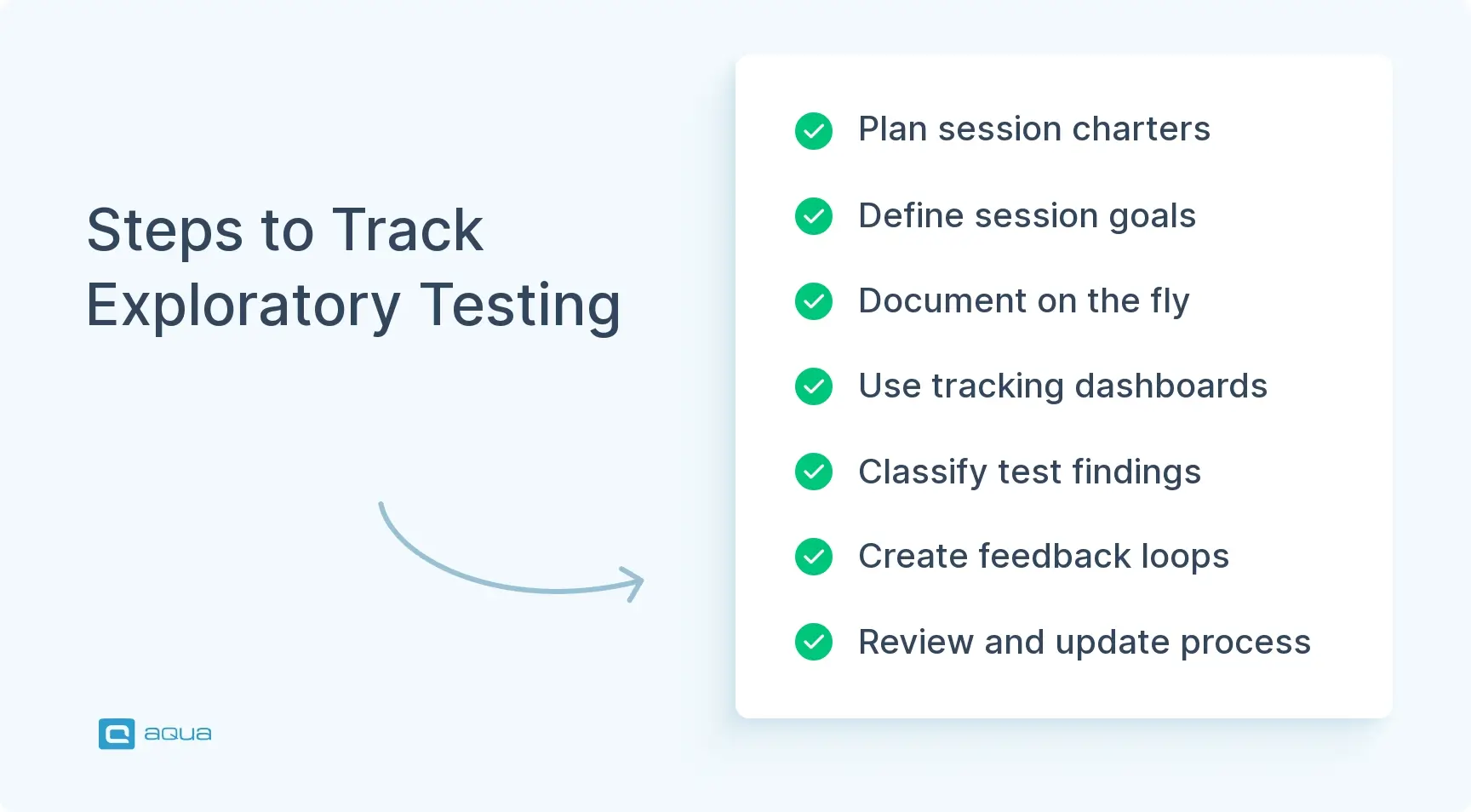
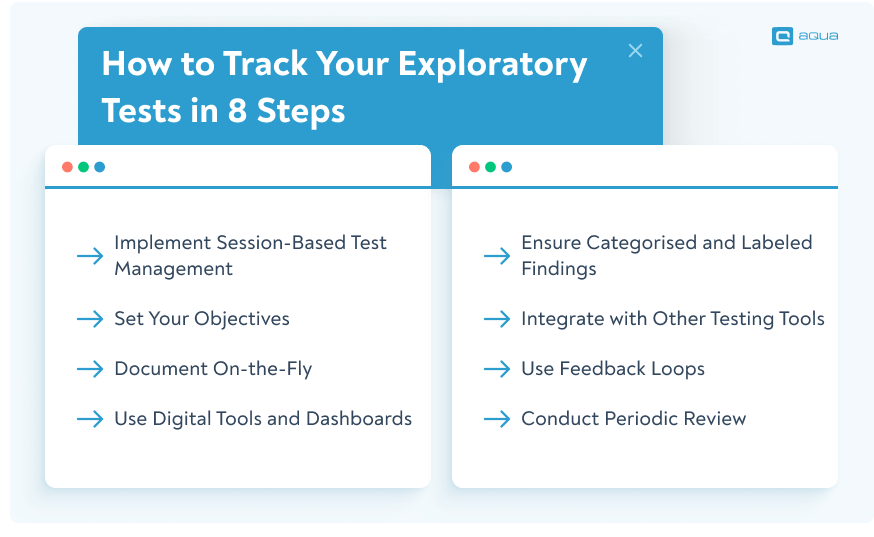
Implement Session-Based Test Management (SBTM): SBTM is a popular technique that organizes exploratory testing into focused sessions. Each session has a charter or mission, providing direction while allowing for spontaneity. These sessions are time-boxed, typically ranging from 60 to 120 minutes. SBTM offers a structured approach to track what’s tested, the issues found, and the progress of the testing cycle. It’s a crucial aspect of any reliable application testing tool.
Set Your Objectives: To bring structure to exploratory testing, start by defining clear objectives for each testing session. Using test charters, you can break down your testing goals, specify the areas to be tested, identify potential risks, and refer to relevant documentation. This step provides testers with a roadmap for their activities and findings, ensuring a more organised testing process.
Document On-the-Fly: Exploratory testing involves real-time decision-making. Equip testers with tools that allow them to document findings immediately. Whether it’s a simple notepad, voice memos, or advanced test management tools, immediate documentation ensures no insights are lost.
Utilise Digital Tools and Dashboards: Use exploratory test management tools with real-time tracking and dashboards. These tools can automate the tracking process, provide visual representations of progress, and store historical data for future reference. Examples of such tools could be those that support recording and playback functionalities.
Ensure Findings Are Categorised and Labeled: To streamline tracking, instruct testers to classify their findings like ‘Bugs’, ‘Issues’, or ‘Notes’. This will not only aid in tracking but also in prioritising the resolution process.
Use Feedback Loops: Establish a feedback mechanism where testers can regularly report their findings to the team. Scheduled debriefing sessions post exploratory testing rounds can offer insights into areas covered, issues found, and potential areas of interest for future sessions.
Integrate with Other Testing Tools: If using other testing tools for structured tests, ensure your exploratory testing tracking tools can integrate. This provides a holistic view of the testing process, making comparing the effectiveness of different testing methodologies easier.
Conduct Periodic Review: Organise periodic review sessions to evaluate the tracking methods. Given the adaptive nature of exploratory testing, the tracking methods might also need occasional tweaking to suit the team’s requirements better.
While exploratory testing gives testers the freedom to approach software in an unscripted manner, managing and documenting the process can be cumbersome. This is exactly where aqua Test Management System comes to the rescue. aqua’s bug recording solution, Capture, empowers you to explore software and easily document your findings. Capture records all your actions if you encounter a defect. With just one click, you’ll have a comprehensive video recording of your actions, a detailed event history, environment data, session details, and more. It creates the perfect bug report ready to be sent to developers. And this is just one of aqua’s many solutions and benefits.
Create highly visual bug reports 90% faster with Capture
Best Practices for Collaborative Debrief and Reporting
Here’s where exploratory testing really pays off; the debrief session right after you wrap up. This quick chat with developers or product owners can nearly double the impact of your discoveries.
Try the PROOF framework to keep things focused: Past (what you tested), Results (what you found), Obstacles (what blocked you), Outlook (what’s next), and Feelings (gut reactions about the product). Don’t just dump everything, though.
Visual coverage maps work way better than walls of text, and prefixing your notes with ‘BUG:’, ‘IDEA:’, or ‘Q:’ helps people scan faster. Even if you’re testing solo, scheduling these debriefs even with yourself forces you to crystallise insights that might otherwise get lost. Teams that do immediate debriefs see feedback cycles shrink from days to hours, which means bugs get squashed while the code’s still fresh in everyone’s mind.
Reporting of Exploratory Tests
Despite its ad-hoc nature, reporting in exploratory testing is pivotal in enhancing the software’s overall quality. A robust reporting mechanism ensures that every anomaly, observation, and insight is meticulously documented and effectively communicated to the relevant stakeholders. To correctly report exploratory test, we highly recommend you follow these steps:
Your first fundamental step would be implementing a standardised reporting template for all testers. The nature of exploratory tests is inherently unpredictable, making it essential to have a consistent reporting format to ensure clear and effective communication of the testing process and findings. This standardised approach guarantees that every stakeholder, whether a developer, tester, or project manager, comprehends the findings irrespective of who conducted the test, thus maintaining a uniform understanding and interpretation of the results across the team.
When reporting, it’s essential to highlight critical findings. Defects or potential risks that could significantly impact the software’s functionality or user experience should be indicated, ensuring they gain immediate attention.
Incorporating visualassets aids into the report can significantly improve its clarity. Screenshots, video recordings, or even simple diagrams can offer a clearer depiction of an issue than words alone, especially when pointing out UI/UX contradictions.
Every reported issue should be contextualised. Providing brief information about the testing environment, the steps taken leading up to the issue, and contrasting the expected outcome with the actual result can offer invaluable insights.
Taking advantage of automated logging tools will be beneficial. Modern testing tools like Capture, which automatically log session data and record user actions along with system responses, can significantly minimise the need for manual effort in this process, almost reducing it to zero.”
Feedback plays a significant role in refining reports. If provided, the report can lead to clarifications or even assist in prioritising the reported issues. Furthermore, maintaining version histories in reports ensures that findings align with specific software builds, which is essential for regression testing and tracking changes over time.
Classifying reports is another strategy that can be deployed. Segmenting findings into categories like ‘Functional Bugs’ or ‘Performance Problems’ can significantly boost the troubleshooting process, directing issues to the respective teams or specialists.
Timeliness in distributing these reports is also important when it comes to exploratory testing. It ensures that the development cycle remains unaffected and promptly addresses potential issues. Organising regular review meetings to discuss these reports fosters collaborative problem-solving and keeps everyone updated on the product’s quality status.
Conclusion
Exploratory testing doesn’t solve every problem but it is a valuable tool. Testers can apply their intuition, and managers can detect bugs that might go unnoticed when relying solely on test cases. However, it’s crucial to maintain order in this process. The key is to keep things organised so they don’t become messy. When you pair exploratory testing with strong management and reporting and equip your team with the right tools, you’ll discover a new testing efficiency level. Companies that achieved it reported having already uncovered 23% more defects.
Robert has several years of experience in process optimisation and test management. He is an expert in defining and implementing workflows by adapting aqua to the clients’ processes.
Nurlan, a QA Coordinator & Quality Standards Officer, takes pride in orchestrating seamless QA operations. His expertise in coordinating QA-focused projects and integrating QA solutions has consistently yielded top-tier client satisfaction. Aside from a full-time QA coordinator, Nurlan's role involves creating compelling content that educates…
Join our community of enthusiastic experts! Get new posts from the aqua blog directly in your inbox. QA trends, community discussion overviews, insightful tips — you’ll love it!
We're committed to your privacy. Aqua uses the information you provide to us to contact you about our relevant content, products, and services. You may unsubscribe from these communications at any time. For more information, check out our Privacy policy.
X
🤖 Exciting new updates to aqua Intelligence are now available! 🎉