Mastering Enterprise Project Management (EPM): A Strategic Approach for Business Success
Have you ever run too many projects and processes simultaneously without clear prioritization? If so, you are likely delivering individual initiatives while losing sight of broader business goals. Enterprise project management changes this dynamic by managing hundreds of processes and bits of documentation across your organization. This post will delve into the characteristics of EPM, the structure of EPM, as well as steps for effective management and best practices.
The Enterprise Project Manager operates at a higher level than traditional PMs, working within an EPMO to manage portfolio health, resource allocation, and cross-program dependencies.
EPM frameworks include four core components: strategic intake, delivery model selection, risk analysis with dependency management, and benefits realization tracking.
Organizations implementing EPM report improvements in resource utilization by getting rid of low-value work and concentrating capacity on strategic initiatives.
Successful EPM implementation requires executive sponsorship, clear governance structures, and phased rollout with continuous refinement.
Enterprise project management gives you the strategic framework for planning and prioritization to bring business impact. See how to transform your project management approach 👇
What is Enterprise Project Management?
Project management for enterprise is the framework that transforms how organizations select and govern initiatives at scale. Traditional project management treats each project as isolated work. EPM treats your entire portfolio as a unified system aligned to corporate strategy instead.
Key characteristics that define EPM:
Portfolio-level optimization: All initiatives function as a unified system rather than isolated projects
Strategic alignment enforcement: Every project directly advances corporate objectives
Centralized resource allocation: Capacity distribution based on strategic priorities across the organization
Benefits realization focus: Tracking whether initiatives deliver measurable business value beyond completion
Cross-program governance: Management of dependencies and risks that span multiple workstreams
EPM sits above project execution and includes portfolio management: the process of selecting and funding the right work. It also creates governance structures for decision rights and risk oversight. The framework standardizes delivery practices and tracks benefits realization so you know which initiatives create real impact. The difference is that traditional PM measures launch dates, while EPM measures whether the work advanced your strategic objectives.
Companies like Spotify and ING Bank coordinate hundreds of Agile teams while maintaining strategic alignment through enterprise project management solutions. They orchestrate value streams and balance portfolio risk. At the same time, they optimize the flow of resources based on priorities.
The Role of the Enterprise Project Manager
The Enterprise Project Manager works at a higher level than traditional project leads. They connect C-suite strategy to frontline execution and translate your business objectives into funded work. Besides, they spot systemic risks that your individual project teams can’t recognize.
Enterprise PMs work within an Enterprise Project Management Office (EPMO). In practice, this means balancing demands and resolving conflicts that span multiple initiatives across your organization.
Key responsibilities that define the Enterprise PM role:
Portfolio intake and prioritization. Managing the demand pipeline, running business case reviews, and recommending which initiatives get funded based on strategic alignment and capacity constraints
Cross-portfolio governance. Chairing stage-gate reviews, escalation forums, and portfolio steering committees where go/no-go decisions happen
Resource and capacity management. Allocating scarce talent across competing initiatives and enforcing work-in-progress limits at the portfolio level
Risk and dependency orchestration. Identifying integration points, data dependencies, and resource conflicts that individual projects can’t see or solve alone
Benefits realization tracking. Ensuring initiatives have defined value hypotheses, benefits owners, and post-launch measurement cadences
Skills that separate Enterprise PMs from traditional project managers:
Strategic acumen for translating executive objectives into executable roadmaps
Portfolio-level thinking that optimizes across initiatives rather than within them
Financial literacy covering CapEx/OpEx trade-offs and ROI modeling
Stakeholder orchestration that influences without authority across business units
Data-driven decision-making using portfolio analytics to surface insights and drive prioritization
Change leadership for managing organizational resistance at scale beyond team-level adoption
When managing complex projects across an enterprise, the right tools in place become mission-critical for your teams’ success. Your testing strategy needs aqua cloud, the perfect, AI-driven test and requirement management solution. With aqua’s centralized test management platform, your teams gain portfolio-wide visibility for testing. This function mirrors what EPM delivers for projects through a single source of truth for all test artifacts, dependencies, and execution results. aqua’s domain-trained AI Copilot transforms how your teams create and maintain test cases. It can generate project-specific documentation in seconds while maintaining context from your own requirements, chats, or even voice notes. aqua’s powerful reporting and analytics capabilities provide the insights your executives need for confident decision-making about quality investments. The platform integrates with Jira, Azure DevOps, GitHub, GitLab, and multiple other tools.
Achieve 100% transparent testing analytics with enterprise-grade test management
The Enterprise PMO serves as the strategic command center for organizational change. It needs fundamentally different capabilities and authority levels compared to a traditional project office. Most mature EPMOs organize around three core tiers of capability that serve distinct functions in portfolio governance and execution.
Choose your task management tool or tools (different teams prefer different tools), but connect them all together with a scalable PPM solution.
This tier handles intake and prioritization. It runs the funding machinery that decides which ideas become funded initiatives. Business case development evaluates proposals against strategic criteria. Portfolio managers enforce trade-offs and capacity constraints.
2. Program and Delivery Governance Tier
This oversight layer tracks work in progress and manages dependencies. Enterprise project managers run stage gates and dependency reviews. They resolve resource conflicts and track risks that span multiple workstreams.
3. Standards and Tools Tier
This operational backbone keeps delivery consistent and builds institutional knowledge. Methodology development creates hybrid delivery playbooks. Your tooling strategy maintains a single source of truth for portfolios. Performance analytics track portfolio health metrics.
Organizational structure varies based on your company culture, so there’s no universal blueprint. Some organizations centralize delivery authority within the EPMO. Others federate by embedding EPMO capabilities into business units. The ISO 21502 standard recognizes this variability.
Effective EPMOs enable better decisions through insight. They surface trade-offs, terminate low-value projects, and spot integration risks months before go-live.
Comparing Traditional Project Management and EPM
Traditional project management and enterprise project management share vocabulary but serve fundamentally different purposes. This creates confusion when organizations try to scale without understanding the distinction. The difference matters because you can scale PM practices to an enterprise level. However, without shifting your operating model, you just create activity without meaningful impact.
Traditional PM treats each project as standalone work with a clear beginning and end. Launch on time and on budget, and you’re green. Enterprise project management asks harder questions about business advancement and portfolio composition. It examines whether your capacity investment returns justify the resources you’re spending. Traditional PM optimizes individual projects. EPM optimizes your entire portfolio through strategic trade-offs across competing initiatives.
Team structure reveals the operational differences between these two approaches. Traditional projects use dedicated teams with clear accountability for specific deliverables. EPM operates in matrix or product-model environments where people contribute across multiple initiatives simultaneously. Resources face constant competition, and dependencies between workstreams require active management that goes beyond simple task tracking.
Traditional PM governance runs stage gates for single projects. EPM governance, on the other hand, encompasses portfolio steering and integrated planning across programs. It also includes organization-wide risk oversight.
Here’s how the differences break down in practice:
Dimension
Traditional Project Management
Enterprise Project Management
Scope
Single project or deliverable
Entire portfolio of strategic initiatives
Primary Focus
On-time, on-budget delivery of defined scope
Strategic alignment, value realization, portfolio optimization
Team Structure
Dedicated project team with clear boundaries
Matrix or product model; shared resources across initiatives
Decision Authority
Project manager owns delivery decisions within scope
EPMO and portfolio leaders make funding, prioritization, and resource allocation decisions
Traditional PM delivers execution discipline that keeps individual projects on track. Enterprise software project management provides strategic orchestration across your entire change portfolio. Both matter because you need solid delivery practices and portfolio-level alignment.
When you coordinate initiatives across large organizations with only traditional PM methods, you get many projects. However, they often fail to advance your business objectives because nobody manages the strategic connections. What is enterprise project management software designed for? It’s a solution that connects execution to strategy and enables smarter trade-offs about where your constrained capacity actually goes.
Benefits of Implementing Enterprise Project Management
Organizations that shift to EPM rewire how strategic work gets funded and prioritized across business units. Benefits compound over time as portfolio discipline replaces ad-hoc decision-making. Your executives gain real visibility into change portfolios instead of receiving status reports months after issues emerge.
Strategic and operational benefits EPM delivers:
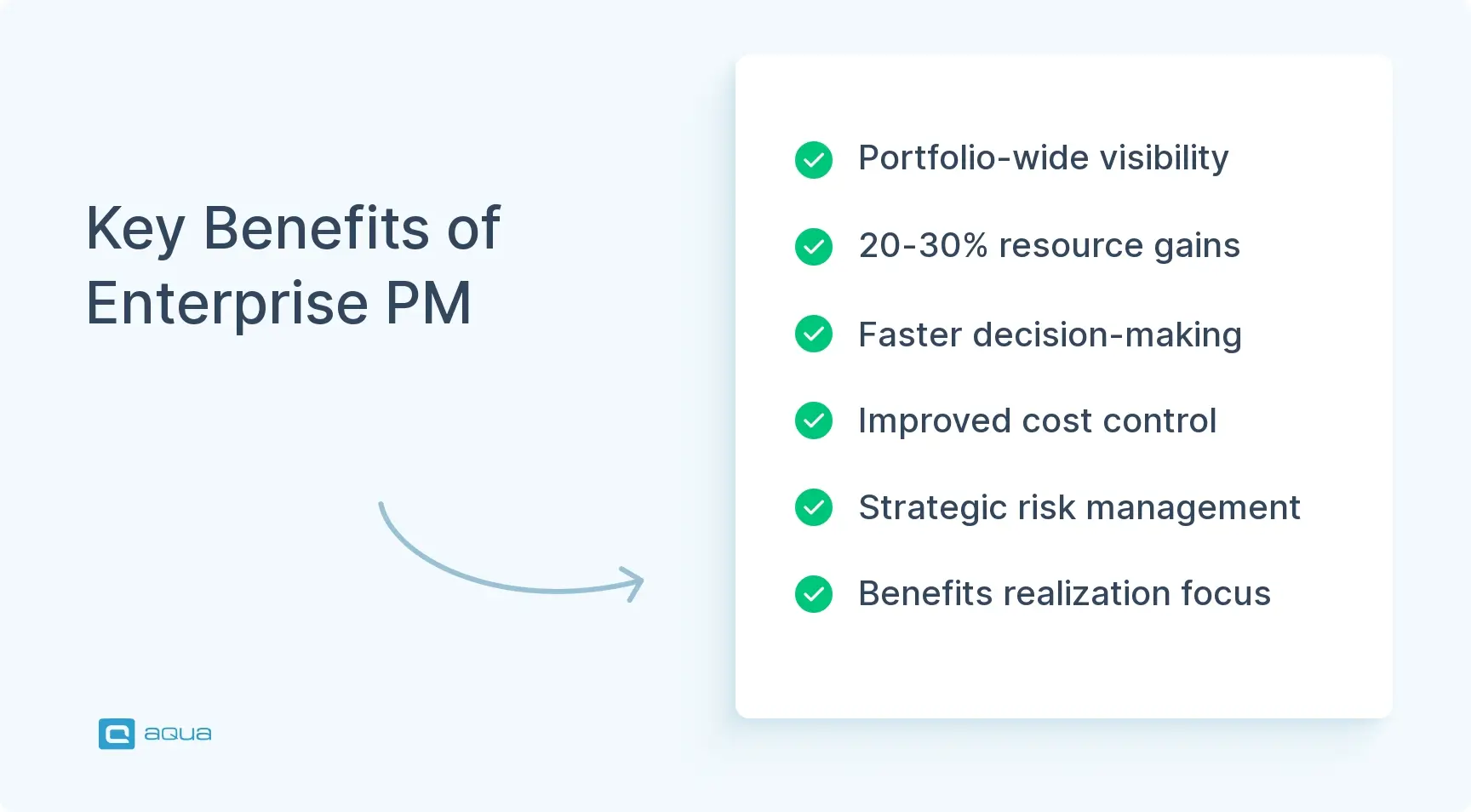
Portfolio-wide visibility. A single source of truth for all strategic initiatives shows their interdependencies and combined demand on your organizational capacity. This enables your executives to spot bottlenecks and integration risks before multiple initiatives fail
Strategic resource optimization. Organizations achieve 20-30% improvements in resource utilization by terminating low-value work. They concentrate capacity on strategic bets while balancing portfolio risk and managing work-in-progress limits
Improved cost control. Smarter funding decisions through portfolio-level visibility of combined burn rates. Stage-gate rigor terminates non-performing initiatives early before they drain additional budget
Effective risk management. Portfolio-level exposure management and systemic dependency tracking catch issues that individual PMs miss. This creates escalation paths for risks that span multiple initiatives
Strategic alignment enforcement. Funding and capacity flow to initiatives that advance corporate objectives rather than urgent requests from vocal stakeholders
Benefits realization discipline. Every initiative requires explicit value hypotheses and benefits owners who remain accountable beyond launch. Post-launch tracking measures actual outcome delivery at regular intervals
Faster decision-making. Clear governance structures and portfolio visibility enable your leadership to make trade-off decisions in days instead of months spent in committee meetings
Reduced delivery risk. Active management of dependencies and integration points prevents discovery during UAT when fixes become exponentially more expensive. Resource conflicts get resolved before they impact your timelines
Organizational learning.Testing workflow in enterprises analytics reveal patterns about initiative success and effective delivery approaches. They also identify capability gaps that require attention
Enhanced change capacity. Better sequencing of initiatives based on organizational absorption capacity prevents change fatigue that leads your teams to resist new projects
The compounding effect delivers the real payoff that justifies your EPM investment. Organizations with mature EPM capabilities deliver more value per dollar of change spend rather than just churning out more projects. They make faster and better-informed investment decisions. They build institutional muscle around strategic execution that becomes a genuine competitive advantage in their markets.
The EPM Model: Framework and Best Practices
The EPM model provides your playbook for systematic governance and execution. You get interconnected practices and decision forums that ensure initiatives get selected for sound reasons. They also get executed with appropriate rigor and tracked for value delivery beyond completion metrics.
The Four-Component EPM Framework:
Component 1: Strategic Intake and Portfolio Prioritization
This mechanism captures demand and runs business case reviews. Decisions rely on strategic alignment and value potential based on your current capacity constraints. Trade-offs happen here. In fact, saying “no” to low-value work matters just as much as saying “yes” to strategic priorities.
Business case review and approval process
Strategic alignment scoring methodology
Portfolio capacity planning and work-in-progress limits
Funding allocation and budget governance
Component 2: Delivery Model Selection and Governance
Different work types need different management styles. For instance, high-certainty work might run predictive approaches with detailed upfront planning. In contrast, exploratory bets might run Agile sprints that adapt as you learn. Meanwhile, complex transformations need hybrid approaches with integrated planning across workstreams.
Lifecycle model selection criteria covering predictive and Agile approaches
Consistent governance touchpoints across delivery models
Stage-gate reviews and decision forums
Quality gates and delivery assurance
Component 3: Risk Analysis and Dependency Management
Structured risk reviews at the portfolio level surface systemic risks your individual project teams can’t see. This includes shared technical dependencies and regulatory constraints. At the same time, resource bottlenecks limit how much transformation your company can absorb at once.
Portfolio-level risk assessment and escalation
Cross-program dependency mapping
Integration point identification and management
Capacity and resource conflict resolution
Component 4: Performance Tracking and Benefits Realization
Project management enterprise software doesn’t automatically generate business value. Each initiative needs explicit hypotheses and benefits owners from your business units. These owners stay accountable for results. Post-launch measurement occurs at 90-day intervals to track whether promised benefits materialized.
Benefits hypothesis definition and validation
Value tracking and measurement frameworks
Portfolio performance dashboards and KPIs
Lessons learned and continuous improvement
Best practices for EPM implementation:
Start with governance design. Define decision rights and escalation paths before you standardize delivery practices because governance drives outcomes more than methodology. Portfolio steering forums need a clear authority
Enforce capacity constraints. Implement work-in-progress limits at the portfolio level to ensure your teams can deliver quality work instead of spreading themselves too thin
Create a hybrid delivery playbook. Build guidance on which lifecycle models fit which initiative types without mandating universal processes that ignore the reality of different work types
Invest in a single source of truth. Centralized tooling for initiatives and dependencies eliminates the spreadsheet chaos that makes portfolio management impossible. Capacity and reporting also require centralization
Measure value beyond activity. Track benefits realization rates and strategic alignment percentages instead of just counting completed projects. Portfolio ROI provides the complete picture
Build feedback loops. Run retrospectives at the portfolio level to identify patterns and effective approaches across multiple projects. Capability gaps become visible only through this systematic analysis
For me, the backbones for PMO should be with: 1) people, 2) process, and 3) tools. Since people are the most important one, I try to have the most focus on this one. Quite often, PMOs focus way too much on procedures.
Organizations that succeed with EPM implementation treat it like any significant change initiative. They establish clear objectives and secure executive sponsorship. They roll out in phases and maintain relentless focus on adoption. This approach prevents drowning your teams in documentation that nobody reads.
Step 1: Identify Strategic Objectives and Portfolio Scope
Input: Current organizational pain points, strategic priorities, and change portfolio inventory
Clarify the problem before building processes or buying tools. Strategic alignment issues need different solutions compared to those intended for cases of project failures. Define which initiatives need EPM oversight based on impact and strategic importance. Strategic transformations require comprehensive governance. IT projects need lighter oversight. Major CapEx demands full rigor because financial stakes justify it. Governing everything creates overhead. Governing too little hides problems until a crisis hits.
Output: Defined EPM objectives, success criteria, and clear boundaries for portfolio scope
Step 2: Secure Executive Sponsorship and Stakeholder Buy-In
Input: Business case for EPM, stakeholder analysis, and governance authority requirements
EPM requires real decision authority. You need a C-level sponsor who backs the EPMO when it terminates projects that influential stakeholders want to keep. Resource reallocation between units demands executive support because leaders resist giving up resources. Secure buy-in from portfolio leaders and finance teams who control budgets. Business unit heads must participate in governance forums and respect the decisions made there.
Output: C-level sponsor commitment, signed governance charter, and stakeholder coalition
Step 3: Establish EPMO Structure and Governance Model
Input: Organizational structure, decision-making patterns, and current governance gaps
Design decision rights that clarify who makes what decisions at which level. Create escalation paths so issues get addressed without constantly pulling executives into tactical details. Define who approves initiatives and allocates portfolio resources. Project termination requires clear ownership because killing projects creates political friction. This way, your governance model defines roles, forums that make binding decisions, and standardized artifacts. Start lean and add rigor only where problems demand it.
Output: EPMO organizational design, governance charter with decision rights, and forum calendar
Step 4: Define Delivery Framework and Standards
Input: Current delivery practices, initiative types, and team maturity levels
Build a lightweight EPM policy covering lifecycle models that match different work types. Define minimum artifacts so teams know what governance requires. Set clear quality gate criteria to prevent subjective readiness debates. Then, give teams flexibility while maintaining governance touchpoints for visibility. Don’t forget to include delivery model selection guidance and dependency management practices. PMI guidance and best practices for test management provide useful blueprints.
Output: EPM policy document, delivery playbooks, and quality gate definitions
Step 5: Select and Implement Your Toolchain
Input: Current tool infrastructure, integration requirements, and budget constraints
You need a single source of truth for portfolios that everyone trusts and uses. Centralize dependencies and reporting because spreadsheet chaos kills portfolio management. Ensure portfolio planning shows where bottlenecks emerge. Platforms like Planview or ServiceNow SPM work for many organizations. Microsoft Project for the Web offers another option. Integration with financial systems remains critical because funding decisions depend on cost data. Consistent adoption matters more than which tool you pick.
Output: Selected EPM platform, integration architecture, and migration plan
Step 6: Train and Build Capabilities
Input: Skill gap analysis, role definitions, and training budget
EPM fundamentally changes how people work and requires new skills. Project managers need portfolio-level thinking beyond individual deliverables. Executives must make trade-offs instead of funding everything proposed. Teams must work within capacity constraints. Train Enterprise PMs and portfolio managers leading the transformation. Build governance forum capabilities for effective decisions. Create communities of practice and playbooks that make adoption easy.
Output: Training curriculum, certified practitioners, and communities of practice
Step 7: Phased Rollout and Continuous Refinement
Input: Pilot portfolio selection criteria, success metrics, and rollout schedule
Start with one business unit or initiative cluster where you can prove value quickly. Learn from friction points that reveal design flaws. Expand systematically after refining the approach. EPM never finishes because you constantly adjust governance and capacity allocation as priorities shift. Portfolio retrospectives reveal which practices add value versus create bureaucracy.
Output: Proven EPM model, lessons learned, and expansion roadmap
Step 8: Measure and Communicate Value
Input: Baseline metrics, stakeholder communication plan, and reporting schedule
Track portfolio KPIs from day one. Strategic alignment percentage and benefits realization rate prove that you deliver business value. Resource utilization shows whether capacity decisions work. Portfolio health and decision velocity reveal risk exposure and adaptation speed. Broadcast wins broadly. When EPM prevents a $2M write-off, tell that story to stakeholders who see EPM as overhead. When prioritization frees 20% of engineering capacity for innovation, celebrate it. Proving value sustains transformation momentum.
Output: Portfolio KPI dashboard, value realization stories, and stakeholder reports
Organizations that succeed with EPM treat it as strategic capability-building rather than compliance. They focus on adoption over unread documentation. They give the EPMO real authority to make binding decisions. They measure outcomes instead of activity metrics that don’t correlate with results.
As you implement enterprise project management methodology, don’t overlook the critical role of quality assurance in strategic execution. aqua cloud, an AI-powered test and requirement management solution, provides the missing enterprise testing component that aligns perfectly with your EPM framework. With aqua’s enterprise-ready platform, you’ll gain the same benefits for testing that EPM brings to project delivery: portfolio-wide visibility and strategic resource optimization. You also get improved cost control and effective risk management that prevents quality issues from derailing delivery. The platform’s AI Copilot, trained specifically on your project’s documentation, generates contextually relevant test cases in seconds. It saves your teams up to 97% of their testing time while maintaining the governance and traceability that enterprise organizations demand from their tooling. The platform integrates with your existing project management tools like Jira and Azure DevOps, Selenium, and a number of other external software from your tech stack.
EPM separates strategic intent from strategic execution for large organizations trying to deliver meaningful change. Traditional project management delivers disciplined execution on individual initiatives. aqua cloud enterprise project management solutions provide portfolio-level orchestration. Organizations face mounting pressure to accomplish more with constrained resources while proving ROI on every change initiative. Companies that master portfolio governance deliver more value per dollar of change spend while building institutional muscle around execution.
What is the difference between project management and enterprise project management?
Traditional project management delivers individual projects on time and within budget. Enterprise project management operates at the portfolio level and orchestrates multiple initiatives for strategic alignment. Project managers own single deliverables. Enterprise PMs manage portfolio health and capacity constraints. They also handle strategic trade-offs across your organization.
What is an EPM project?
An EPM project is any initiative subject to portfolio-level governance and benefits realization tracking. Funding gets allocated based on strategic value rather than individual approvals. Projects include explicit benefits, hypotheses, and defined dependencies. They also receive centralized Enterprise PMO oversight.
How can enterprise project management software improve cross-department collaboration?
Enterprise project management system creates a single source of truth and makes dependencies visible. Resource conflicts become apparent. It enables centralized capacity planning and provides portfolio dashboards for cross-functional visibility. Dependency mapping highlights collaboration needs. Integrated planning ensures alignment.
What are the common challenges in scaling project management practices to an enterprise level?
Organizations face executive resistance to trade-offs and cultural barriers from siloed ownership. Visibility gaps from inadequate tooling create problems. Unclear governance structures complicate decision-making. Without executive sponsorship, EPMOs lack the authority to enforce constraints. This reduces EPM to bureaucracy.
Home » Best practices » Mastering Enterprise Project Management (EPM): A Strategic Approach for Business Success
Do you love testing as we do?
Join our community of enthusiastic experts! Get new posts from the aqua blog directly in your inbox. QA trends, community discussion overviews, insightful tips — you’ll love it!
We're committed to your privacy. Aqua uses the information you provide to us to contact you about our relevant content, products, and services. You may unsubscribe from these communications at any time. For more information, check out our Privacy policy.