Regression Testing in Agile: Ultimate Guide with Best Practices
You pushed a quick bug fix last sprint. This sprint, three features stopped working. Relatable and problematic, right? Regression testing in agile prevents exactly this nightmare. Agile development moves fast, with sprints flying by and features dropping weekly, and speed without quality creates expensive problems.
Regression testing in Agile verifies that new code changes haven’t broken previously working functionality, acting as a safety net during rapid sprint cycles and frequent releases.
Effective regression testing strategy requires smart prioritization of critical features, risk-based test case selection, and a balanced mix of automation and manual testing.
Timing is crucial for regression tests, with key moments being after each user story completion, following code integration, before sprint demos, prior to production releases, and after bug fixes.
Resource constraints, growing test maintenance burden, and rapidly changing requirements create significant challenges for Agile teams implementing regression testing.
Successful implementation includes shifting testing left in the development process, strategic automation of stable tests, cross-functional collaboration, and treating test code with the same rigor as application code.
Balancing speed with quality is the perpetual challenge in Agile, with teams finding that catching bugs early can save exponential costs compared to post-release fixes. Discover how to implement regression testing strategies that won’t make your developers flip desks 👇
What is Regression Testing in Agile?
Regression testing in Agile means re-running your existing test cases after code changes. You verify that previously working functionality still works. Every time someone pushes new code, updates a feature, or patches a bug, you check that nothing broke. Traditional development does this once before a major release. In Agile, you do this constantly because your software never stops evolving.
The Agile methodology changes everything about regression testing. You don’t have long development cycles anymore. Two-week sprints, continuous integration, and stakeholders expecting working software immediately mean your regression testing strategy can’t be some monolithic test suite taking three days to run. It needs to be lean, targeted, and automated where it makes sense, giving you confidence that your latest sprint additions won’t break everything you built last month.
What makes agile regression testing different is how it evolves with your product. Each sprint builds on the last, so your test suite grows alongside your codebase. You constantly refine which tests matter most, which can be automated, and which edge cases deserve manual attention. Understanding what is regression testing in agile helps you build this adaptive approach from the start, treating it as a living part of your development cycle rather than a one-time setup.
The Importance of Regression Testing in Agile Development
Agile teams face unique pressure: deliver value fast without breaking what already works. Shipping code every couple of weeks makes this challenging. Regression testing in Agile methodology acts as your guardrail. Without it, you’re hoping nothing catches fire, which isn’t sustainable.
The preventive power of regression testing saves time, money, and sanity. Every bug that sneaks through costs exponentially more to fix later. User trust takes a hit when features randomly stop working. In regression testing in agile development, where changes happen rapidly and frequently, the risk of introducing defects multiplies. Catching these issues early means fixing them when they’re still cheap and easy to handle.
Customer satisfaction depends on consistency. Users don’t care about your sprint velocity or story points. They care that the product works reliably, and when regression testing in an Agile environment is done right, it maintains that consistency across releases. Your users get new features without sacrificing the stability they expect. That’s how you build trust over time.
Key benefits include:
Risk mitigation: Catches defects before they compound into bigger issues
Faster release cycles: Quality confidence lets you ship more frequently
Cost efficiency: Early bug detection is significantly cheaper than post-release fixes
Team morale: Fewer production fires means happier developers and QA engineers
Looking at regression testing challenges in Agile, it’s clear that striking the right balance between speed and quality becomes increasingly difficult as your codebase evolves. This is where a specialized test management platform can transform your approach. With aqua cloud, regression testing becomes seamlessly integrated into your Agile workflow instead of being a bottleneck. The platform’s centralized test repository allows you to organize, prioritize, and reuse test cases across sprints, significantly reducing maintenance overhead. You can easily link tests to requirements and track changes through comprehensive traceability, ensuring nothing falls through the cracks during your fast-paced development cycles. What’s more, aqua’s automation capabilities and integration with CI/CD pipelines enable you to shift left and catch regression issues earlier when they’re still inexpensive to fix.
Cut regression testing time by 60% while improving coverage with aqua's intelligent test management
Timing matters. Run regression tests too early and you’re wasting cycles on unstable code. Wait too long and you’re discovering critical bugs when there’s no time to fix them. The sweet spot in Agile regression testing best practices involves strategic placement throughout your sprint cycle, weaving testing into continuous delivery rather than treating it as a distinct phase.
The most obvious trigger is after any code change that touches existing functionality. New feature implementations, refactoring efforts, and bug fixes that modify production code all introduce risk that previously working features might break. Automated regression testing in an Agile environment works well here because your CI/CD pipeline can kick off relevant test suites automatically whenever code hits your main branch. This continuous feedback loop catches integration issues within hours, not days.
Before sprint reviews or releases, comprehensive regression testing becomes non-negotiable. You wouldn’t demo potentially broken software to stakeholders, and you definitely shouldn’t release it to users. This is when you run your full regression suite, or at least the critical path tests covering your most important user journeys. Bug fixes deserve special attention too. Fixing one bug and creating two others happens more often than anyone wants to admit. Running targeted regression tests around bug fix areas helps prevent this domino effect.
Key timing scenarios:
After completing each user story or feature
Following integration of new code into the main branch
Before sprint demos to stakeholders
Prior to production releases or deployments
After bug fixes that modify existing code
When refactoring affects multiple components
Developing an Effective Regression Testing Strategy
Building a solid regression testing strategy in Agile is more than testing everything all the time. That’s a fast track to bottlenecks and frustrated developers. Smart prioritization means knowing where to focus your efforts. Start by identifying your critical features: the login flow, payment processing, core user journeys that absolutely cannot break. These high-priority areas form the backbone of your regression suite and deserve both automated coverage and periodic manual validation.
Test case prioritization becomes your advantage when time is tight, which is always. Not all tests carry equal weight. A test covering a niche edge case affecting 0.1% of users doesn’t deserve the same attention as one validating your main checkout flow. Risk-based prioritization helps here by considering factors like feature usage, business impact, and historical defect density. Features that break frequently or carry high business value should dominate your regression testing efforts, maximizing quality assurance impact without burning through resources.
The automation versus manual testing debate isn’t actually a debate. You need both, just applied intelligently. Building a regression test suite with the best regression testing tools for agile teams handles repetitive, predictable scenarios that don’t change much sprint to sprint. Think smoke tests, API validations, and stable UI workflows. Manual regression testing in agile works better for exploratory testing, usability checks, and areas where human judgment matters. New features often start with manual tests until they stabilize, then graduate to automation. The key is building this progression into your strategy from day one.
Your regression test suite should mirror your product’s architecture. Group tests by feature area, user journey, or technical component, whatever makes sense for your context. This organization makes it easier to run targeted regression suites when changes affect specific areas. A database schema update doesn’t require re-testing your entire front-end. Maintaining clear test documentation helps too, especially when team members need to understand what each test validates and why it matters.
Challenges in Agile Regression Testing
Resource constraints hit Agile teams hard. Limited time within each sprint, limited team members who can write and execute tests, and limited infrastructure to run those tests on create brutal math. More features mean more tests, but your team size stays the same. This tension between comprehensive testing and practical limitations forces tough decisions about test coverage. How do you do regression testing in agile when there’s never enough hours in the sprint?
Test maintenance becomes its own problem. Every sprint adds new features, which means new tests joining your regression suite. But old tests don’t automatically stay relevant. UI changes break selectors, API endpoints evolve, and business logic changes. Before you know it, you’re spending more time fixing flaky tests than actually finding bugs. This technical debt in your test suite slowly erodes confidence and slows down feedback loops. Tests that fail randomly lose their signal value. People start ignoring failures, and that’s when real bugs slip through.
Frequent changes in an Agile environment create a moving target for testing. Requirements evolve mid-sprint, designs get tweaked based on user feedback, and priorities change as business needs demand. Your regression test suite needs to adapt just as quickly, but updating tests takes time. There’s always lag between code changes and test updates, creating temporary gaps in coverage. Teams struggle to balance keeping tests current while also adding coverage for new functionality.
Challenge
Impact
Mitigation Strategy
Limited time per sprint
Incomplete test coverage
Prioritize critical paths; automate stable tests
Test suite maintenance
Increasing technical debt
Regular refactoring; remove obsolete tests
Rapid requirement changes
Test relevance decay
Continuous test review; flexible test design
Tool integration complexity
Delayed feedback loops
Invest in CI/CD pipeline setup; standardize tools
Growing test execution time
Sprint bottlenecks
Parallel execution; cloud-based test infrastructure
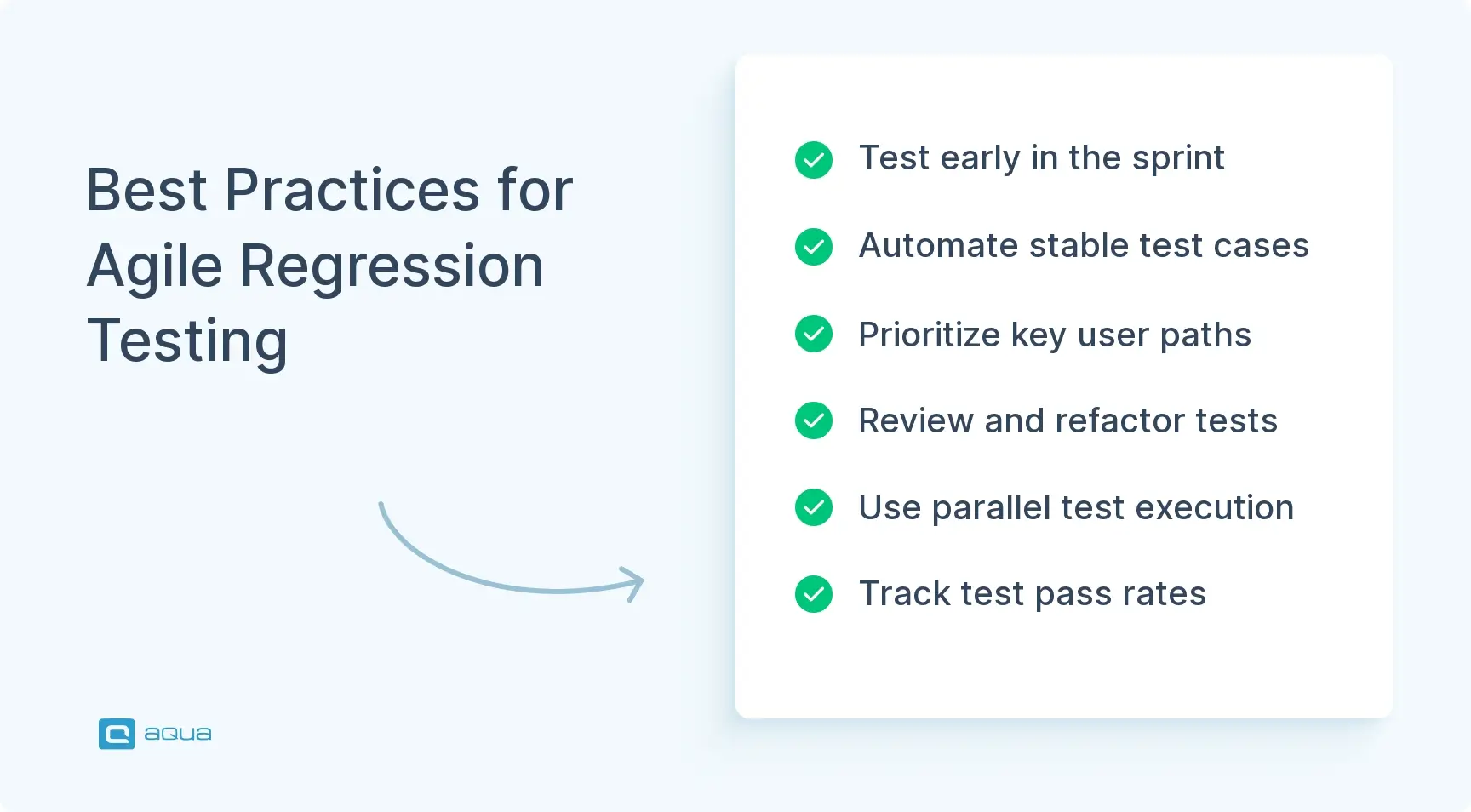
Best Practices for Regression Testing in Agile
Start testing earlier in your process. Don’t wait until the end of the sprint to think about regression testing. Bake it into your definition of done. When developers commit code, automated tests should run immediately through your CI/CD pipeline. This early integration catches problems when they’re fresh in everyone’s mind and cheap to fix. Developers haven’t context-switched to another task yet, and the code change is still isolated and manageable. The faster you get feedback, the faster you can course-correct.
Automation should be strategic, not zealous. Yes, automated regression testing in agile environment is crucial, but automating everything is neither practical nor smart. Start with your smoke tests, the absolute must-work scenarios that validate basic functionality. Then expand to critical user paths and frequently used features. Focus on tests that run repeatedly and don’t require much human judgment. Leave the complex edge cases, exploratory testing, and usability validation to manual testing where human intuition adds value. The 80/20 rule applies: automate the 20% of tests that give you 80% of your coverage value.
Cross-functional collaboration transforms regression testing from a QA bottleneck into a team responsibility. Developers should write unit and integration tests as they code. QA engineers focus on end-to-end scenarios and edge cases. Product owners help prioritize which features need the most coverage. When everyone shares ownership of quality, regression testing becomes distributed across the team instead of piling up on one person’s plate. Daily standups should include test status updates, not just development progress.
Version control your test code with the same rigor as your application code. Tests are code too and deserve proper reviews, branching strategies, and documentation. This practice prevents tests from becoming a second-class citizen in your codebase and ensures changes are trackable and reversible. When a test breaks, you can trace back through commits to understand why.
Core practices to adopt:
Implement continuous integration with automated test triggers
Maintain a lean, focused regression suite focused on quality over quantity
Review and refactor tests regularly to remove dead weight
Use parallel test execution to speed up feedback cycles
Track test metrics like pass rate, execution time, and defect detection to improve continuously
Keep test data realistic but separate from production data
As we’ve seen throughout this guide, effective regression testing is the foundation that enables you to move quickly without sacrificing quality. However, implementing these best practices requires the right tool. aqua cloud is specifically designed to address the challenges of regression testing in Agile environments, offering AI-powered test case generation that can create comprehensive regression scenarios in seconds. With aqua’s domain-trained AI Copilot, your test creation is fast, contextually intelligent, learning from your project’s own documentation to generate tests that truly reflect your application’s needs. The platform seamlessly integrates with your existing tools (Jira, Azure DevOps, Jenkins, and more) and provides unified dashboards that give you real-time visibility into test coverage and quality metrics. Whether you’re running automated regression suites or performing targeted manual testing, aqua brings everything together in one cohesive workflow that adapts to your team’s Agile rhythm, not the other way around.
Transform regression testing from a sprint bottleneck to a competitive advantage with aqua cloud
Picture an e-commerce platform running two-week sprints. The team just added a new payment gateway integration, pretty standard stuff. But payment processing touches multiple systems, so before releasing, they run their core regression suite covering existing payment methods, order processing, and inventory updates. Automated tests validate that old payment gateways like credit cards and PayPal still work correctly alongside the new option. Manual testing checks the user experience across different scenarios: failed payments, partial refunds, and multi-currency transactions. This layered approach catches a critical bug where the new integration accidentally cleared shopping carts when users canceled at the payment screen.
Consider a SaaS product with a mobile app and web interface. Each sprint introduces features on one platform or the other, but both share backend APIs. Their regression testing strategy includes API contract tests that run on every code commit, catching breaking changes before they reach either interface. UI regression tests run nightly for both platforms, validating critical workflows like user registration, data syncing, and notification delivery. When they refactored their authentication system for better security, comprehensive regression testing revealed that the new token refresh logic broke the mobile app’s offline mode, something unit tests missed because they tested components in isolation.
Conclusion
Regression testing in Agile separates teams shipping quality software from teams constantly firefighting production bugs. Start small with your most critical paths, automate strategically, and build testing into your sprint rhythm rather than treating it as an afterthought. Tools like aqua cloud help teams manage regression testing at scale without slowing down delivery. When your regression suite gives you confidence to ship faster, you’ve got it right.
What is regression testing in Agile and why is it essential for continuous delivery?
Regression testing in Agile verifies that recent code changes haven’t broken existing functionality. It’s essential for continuous delivery because you’re shipping code frequently, often multiple times per week. Without regression testing, you can’t confidently deploy changes knowing they won’t break production features users rely on. The regression testing definition in agile focuses on continuous validation throughout iterative development cycles rather than testing only at release time. This constant verification creates the safety net continuous delivery demands, catching integration issues before they reach users. Teams practicing continuous delivery run automated regression tests on every commit, getting immediate feedback when something breaks. This tight feedback loop prevents small issues from compounding into major problems that block releases.
How often should regression testing be performed during Agile sprints?
Run regression tests continuously throughout your sprint, not just at the end. Automated regression tests should trigger on every code commit to your main branch through your CI/CD pipeline. This catches issues within hours while the code is fresh in everyone’s mind. Before sprint demos and releases, run your full regression suite or at least critical path tests covering major user journeys. After completing each user story, run targeted regression tests for affected areas. Bug fixes deserve their own regression testing pass since fixing one issue often creates another. The frequency depends on your sprint length and deployment cadence, but the principle stays constant: test early and test often rather than saving all regression testing for sprint end.
What are the best practices for effective regression testing in Agile projects?
Start with test automation for repetitive scenarios that don’t require human judgment. Build your regression suite around critical user paths and high-risk features first, then expand coverage gradually. Prioritize tests based on business impact and defect history rather than trying to test everything equally. Integrate regression testing into your CI/CD pipeline so tests run automatically on code commits. Keep your test suite maintainable by regularly removing obsolete tests and refactoring flaky ones. Use parallel test execution to speed up feedback cycles when your suite grows large. Make testing a team responsibility, not just QA’s job, with developers writing unit and integration tests alongside their code. Track metrics like pass rates and execution time to identify bottlenecks and improve continuously. Version control your test code with the same discipline as application code.
How can automation improve regression testing efficiency in Agile workflows?
Automation eliminates the manual effort of repeatedly testing the same scenarios sprint after sprint. Automated tests run faster than manual testing, often completing in minutes what would take hours manually. They provide consistent results without human error or fatigue affecting outcomes. AI in regression testing and modern test automation tools integrate directly with CI/CD pipelines, giving instant feedback when code breaks existing functionality. This speed lets teams catch and fix issues while the code change is still fresh. Automation frees up QA engineers to focus on exploratory testing, usability checks, and complex scenarios where human judgment adds real value. The efficiency gain compounds over time as your automated suite handles routine validation while your team tackles more strategic testing challenges.
What are the common challenges of regression testing in Agile and how can teams overcome them?
Limited time within sprints creates pressure to skip thorough regression testing. Overcome this by automating stable test cases and prioritizing critical paths over comprehensive coverage. Test maintenance becomes overwhelming as your suite grows with each sprint. Combat this by scheduling regular refactoring sessions to remove obsolete tests and fix flaky ones before they erode confidence. Frequent requirement changes make tests obsolete quickly. Build flexibility into test design and schedule continuous test reviews alongside code reviews. Growing test execution time slows down feedback loops. Use parallel test execution and cloud-based infrastructure to scale your testing capacity without buying more hardware. Integration complexity between multiple tools delays pipeline setup. Invest upfront in standardizing your toolchain and getting CI/CD properly configured, as this pays dividends throughout the project lifecycle.
Home » Test Automation » Regression Testing in Agile: Ultimate Guide with Best Practices
Do you love testing as we do?
Join our community of enthusiastic experts! Get new posts from the aqua blog directly in your inbox. QA trends, community discussion overviews, insightful tips — you’ll love it!
We're committed to your privacy. Aqua uses the information you provide to us to contact you about our relevant content, products, and services. You may unsubscribe from these communications at any time. For more information, check out our Privacy policy.
X
🤖 Exciting new updates to aqua AI Assistant are now available! 🎉
We use cookies and third-party services that store or retrieve information on the end device of our visitors. This data is processed and used to optimize our website and continuously improve it. We require your consent fro the storage, retrieval, and processing of this data. You can revoke your consent at any time by clicking on a link in the bottom section of our website.
For more information, please see our Privacy Policy.
This website uses cookies to improve your experience while you navigate through the website. Out of these, the cookies that are categorized as necessary are stored on your browser as they are essential for the working of basic functionalities of the website. We also use third-party cookies that help us analyze and understand how you use this website. These cookies will be stored in your browser only with your consent. You also have the option to opt-out of these cookies. But opting out of some of these cookies may affect your browsing experience.
Necessary cookies are absolutely essential for the website to function properly. These cookies ensure basic functionalities and security features of the website, anonymously.
Cookie
Duration
Description
cookielawinfo-checkbox-analytics
11 months
This cookie is set by GDPR Cookie Consent plugin. The cookie is used to store the user consent for the cookies in the category "Analytics".
cookielawinfo-checkbox-functional
11 months
The cookie is set by GDPR cookie consent to record the user consent for the cookies in the category "Functional".
cookielawinfo-checkbox-necessary
11 months
This cookie is set by GDPR Cookie Consent plugin. The cookies is used to store the user consent for the cookies in the category "Necessary".
cookielawinfo-checkbox-others
11 months
This cookie is set by GDPR Cookie Consent plugin. The cookie is used to store the user consent for the cookies in the category "Other.
cookielawinfo-checkbox-performance
11 months
This cookie is set by GDPR Cookie Consent plugin. The cookie is used to store the user consent for the cookies in the category "Performance".
viewed_cookie_policy
11 months
The cookie is set by the GDPR Cookie Consent plugin and is used to store whether or not user has consented to the use of cookies. It does not store any personal data.
Functional cookies help to perform certain functionalities like sharing the content of the website on social media platforms, collect feedbacks, and other third-party features.
Performance cookies are used to understand and analyze the key performance indexes of the website which helps in delivering a better user experience for the visitors.
Analytical cookies are used to understand how visitors interact with the website. These cookies help provide information on metrics the number of visitors, bounce rate, traffic source, etc.
Advertisement cookies are used to provide visitors with relevant ads and marketing campaigns. These cookies track visitors across websites and collect information to provide customized ads.