Top 12 Software Testing Trends to Watch for in 2026
Software testing is progressing faster than ever, which is both a challenge and an opportunity. Because of that, your team may be struggling to comply with the practices or follow trends. This guide will introduce you to the key 12 software testing trends for 2026 to keep you updated with the latest shifts. It will also provide actionable insights and summaries for you to strategize upon.
AI testing systems now autonomously design tests using reinforcement learning to identify risks, generate test scenarios, and prioritize coverage without human micromanagement.
Quality assurance has evolved beyond pre-release gates to a continuous process combining shift-left testing during design with shift-right monitoring of production data.
API and contract testing have become essential as microservices architectures require validation that services maintain their interfaces before integration.
QA professionals are transitioning from test execution to strategic roles focused on risk analysis, test prioritization, and interpreting quality metrics for stakeholders.
Want to know if your QA skills will still be relevant when machines write the test cases? Discover how the testing landscape is transforming in the full article below 👇
1. AI-Powered Autonomous Testing
Autonomous AI agents are changing how you approach test creation and execution. Unlike traditional automation that differs with every UI change, these systems use AI testing automation with reinforcement learning. They design, execute, and refine tests independently. This represents one of the most significant software testing trends 2026 will bring to organizations.
Key capabilities of autonomous testing:
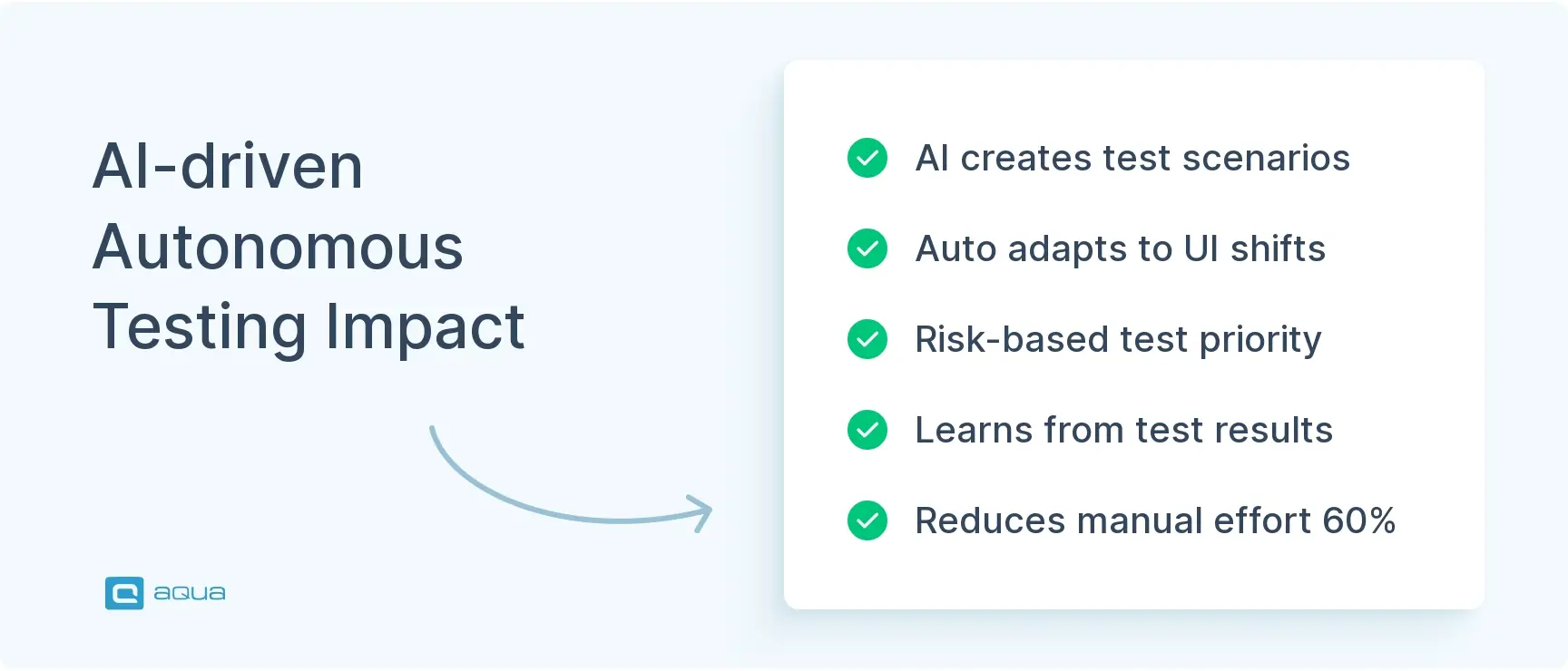
Self-generating test scenarios – AI analyzes codebases to identify risky areas and creates comprehensive test coverage without manual scripting
Adaptive test maintenance – Systems automatically adjust when UI elements shift, eliminating the constant maintenance burden
Risk-based prioritization – AI determines which tests matter most based on code changes and historical failure patterns
Continuous improvement loops – Each test execution feeds machine learning models that enhance future test effectiveness
Real-world impact: Early adopters report 40-60% reductions in manual test authoring time while catching 25% more bugs pre-release. Furthermore, IBM research indicates that by 2026, AI testing systems will shift from individual task automation to orchestrating entire testing workflows.
Your role: Instead of writing every test, you now teach AI what matters. Additionally, you review its suggestions and make strategic judgment calls about risk tolerance and coverage priorities.
2. Testing AI-Generated Code
AI coding assistants are producing functions and features at unprecedented speeds. However, this code requires specialized validation from your team. According to recent industry analysis, testing AI-generated code is emerging as a specialty for 2026. It’s becoming one of the most important new trends in software testing.
Critical validation requirements:
Prompt traceability – Understanding which AI model and prompt generated specific code segments
Business logic verification – Ensuring AI-interpreted requirements match actual business needs
Edge case coverage – Validating behavior under scenarios the AI might not have considered
Emerging practices:
Building AI code validation pipelines that automatically flag high-risk outputs
Creating prompt libraries with proven patterns for generating testable code
Implementing dual-review processes where both code quality and test coverage are assessed
Developing metrics for AI-generated code reliability across different complexity levels
Example workflow: A fintech team now traces every AI-generated function back to its originating prompt. Following that, they run complexity analysis and require 80% test coverage before code review. This catches issues that traditional review processes miss.
AI-powered autonomous testing and strategic QA represent the next phase of software quality. This is where aqua cloud, an AI-driven test and requirement management platform, delivers real value. With its domain-trained AI Copilot, aqua generates comprehensive test cases directly from requirements in seconds. You save up to 97% of your test design time. Unlike generic AI tools, aqua’s AI is grounded in your project’s own documentation. Every suggestion is contextually relevant and specific to your unique testing environment. The platform integrates test case design, execution, defect tracking, and reporting in one unified ecosystem. This addresses the tool sprawl challenge directly. For teams transforming QA professionals into quality strategists, aqua provides the foundation that handles tactical work while elevating strategic capabilities. Plus, with native integrations including Jira, Azure DevOps, Jenkins, GitHub, GitLab, Selenium, along with other external software and REST API support.
AI in 2026 goes beyond running tests. In fact, it makes strategic decisions about testing priorities. The software testing market, estimated at $57.73 billion in 2026, is being transformed by AI’s shift from execution tool to strategic partner. This evolution represents the future trends in software testing that will define the next decade.
Strategic AI capabilities:
Test suite optimization – AI recommends which tests to run based on code changes, production telemetry, and historical patterns
Coverage gap identification – Systems analyze test suites to highlight areas with insufficient validation
Risk scoring algorithms – Automated assessment of deployment risk based on code churn, dependency changes, and user impact
Remediation suggestions – AI proposes specific fixes when tests fail, accelerating resolution time
Business impact: Your teams report 50% reduction in test execution time while maintaining or improving defect detection rates. Moreover, Gartner predicts that AI-augmented testing tools will become standard across 70% of DevOps-driven organizations by 2026.
Strategic workflow example: Instead of manually planning sprint testing, you review AI-generated test plans and adjust based on business priorities. Consequently, this frees you to focus on areas where human judgment adds unique value. These areas include user experience impact and compliance requirements.
The biggest shift I'm seeing isn't really about new tools but about how we're finally getting past the "AI will solve everything" hype that dominated 2023-2024. The tools that are actually sticking around are the ones that solve boring, practical problems without trying to reinvent testing entirely.
The shift-left versus shift-right debate has ended. Successful organizations now do both. Research from IBM indicates that fixing a bug after release costs 15x more than catching it during development. As a result, this drives the bidirectional quality approach that defines software testing automation trends.
Shift-left implementation:
Collaborating with developers during feature design phases
Writing acceptance criteria that automatically generate test cases
Integrating validation checks into CI pipelines before code merges
Conducting early security and performance assessments
Shift-right practices:
Monitoring production crashes and performance regressions in real-time
Analyzing actual user behavior patterns to identify test coverage gaps
Using production telemetry to inform pre-release test priorities
Implementing canary deployments with automated rollback triggers
Integration example: A SaaS company feeds production failure data back into their test generators. Subsequently, this creates regression tests for real-world issues within hours of detection. Their pre-release tests now mirror actual usage patterns, reducing production incidents by 67%.
Tooling evolution: Observability platforms now feed real-world data directly into test generation systems. Meanwhile, CI/CD pipelines trigger targeted test suites based on deployment risk profiles. This gives your team immediate feedback on quality across all stages.
5. Non-Negotiable API and Contract Testing Rules
Microservices architectures have made API testing essential for survival. With services communicating through defined contracts, any interface change can cascade failures throughout your system. This represents one of the latest software testing trends your teams must address.
Why API testing matters:
Decoupled testing – Validate Service A behavior without spinning up Services B through Z
Faster feedback loops – API tests execute in seconds versus minutes for full UI test suites
Clear ownership – Each team validates its service’s contract compliance independently
Contract testing framework:
Define contracts early in the development process
Automate validation in CI pipelines with tools such as Pact or Spring Cloud Contract
Use stubs and simulators to test in isolation
Treat interface stability as a key quality metric alongside functionality
Industry adoption:According to market research, API testing represents a growing segment of the testing market as microservices become standard architecture. Notably, this trend shows no signs of slowing down.
Implementation tip: Start with your most important integrations, like payment processing or authentication. Then expand coverage as the practice matures within your team.
6. Security Testing as a Part of Daily Pipeline
Security has transformed from a periodic audit to continuous validation embedded in every pipeline run. The EU AI Act, expected to take effect in 2026, will require new standards for testing and documenting AI-driven systems. Consequently, security integration becomes even more important among popular software testing trends.
Automated security practices:
Vulnerability scanning – Automated checks for known security issues with every code commit
Dependency analysis – Continuous monitoring of third-party libraries for exploits
Compliance validation – Automated verification against security standards and regulations
DevSecOps integration:
Security checks block merges when issues surface
Automated prioritization of vulnerabilities based on exploitability and impact
Integration of security metrics into quality dashboards
Regular penetration testing integrated into release cycles
QA responsibility evolution: Security bugs are quality bugs. Your teams are learning to interpret security reports, prioritize remediation, and advocate for security-first design patterns from the earliest stages.
Real-world requirement: PwC estimates that 70% of companies deploying AI applications in Europe will need to adapt their QA processes for compliance with new regulations. This requirement is changing software testing services trends across the continent.
7. Real-Time Performance and Resilience Testing
Performance monitoring has evolved from pre-release load tests to continuous, real-time validation across all environments. In parallel, organizations are implementing chaos engineering to proactively test system resilience. This represents one of the key trends in software testing for 2026.
Real-time performance monitoring:
Continuous telemetry – Tracking response times, error rates, and resource usage across environments
Automated alerting – Surfacing bottlenecks before users notice degradation
Baseline comparison – Automated detection of performance regressions against historical norms
Cross-environment visibility – Unified dashboards showing performance across dev, staging, and production
Resilience testing practices:
Chaos engineering – Deliberately injecting failures to validate recovery mechanisms
Load simulation – Testing system behavior under realistic traffic spikes
Dependency degradation – Validating graceful handling when third-party services fail
Geographic distribution testing – Assessing performance across different regions and network conditions
Skills evolution: Your teams are expanding beyond “does it work?” to “how well does it work under stress?” This means interpreting telemetry data, setting meaningful performance benchmarks, and collaborating with SRE teams on reliability targets.
Example implementation: An e-commerce platform runs hourly chaos experiments in staging. Specifically, they deliberately fail payment gateways, databases, and CDN services. This ensures checkout flows degrade gracefully rather than failing completely.
8. Automated Compliance and Regulatory Testing
Regulatory compliance is no longer a manual audit. Your teams now build automated validation into every deployment. This becomes particularly important in healthcare, finance, and automotive sectors where compliance directly impacts business viability. Indeed, this represents one of the most urgent current trends in software testing.
Automated compliance capabilities:
Data privacy validation – Automated checks for GDPR, CCPA, and HIPAA compliance with each deployment
Audit trail verification – Ensuring complete traceability of all changes and test executions
Regulatory requirement mapping – Linking test cases directly to compliance criteria
Automated documentation – Generating compliance reports that satisfy audit requirements
Implementation approach:
Failed compliance checks block deployments like failed unit tests
Test cases explicitly map to regulatory requirements for traceability
Automated generation of compliance documentation for audits
Regular compliance test reviews to ensure coverage of evolving regulations
Why automation matters: Manual compliance checks don’t scale when shipping multiple times daily. Industry research shows that 82% of enterprises are investing in QA services to ensure compliance alongside functionality. This trend will only accelerate.
QA’s expanded role: Your teams now ensure tests cover regulatory requirements and maintain traceability matrices. Additionally, they position QA as a compliance partner rather than just a quality function.
9. QA Professionals Become Quality Strategists
The QA role is fundamentally evolving. If your main job is manual test execution, automation is coming for it. However, if you’re deciding what to test, why, and how much risk to accept, you’re more valuable than ever. This transformation defines the career trajectory within upcoming trends in software testing.
Strategic QA responsibilities:
Risk analysis and prioritization – Determining where to invest testing effort based on business impact
AI oversight and guidance – Teaching AI systems what matters in your specific context
Quality advocacy – Ensuring testability is considered from initial design phases
Metrics interpretation – Translating quality data into business-relevant insights for stakeholders
Test strategy development – Creating comprehensive approaches that balance speed, coverage, and risk
Skills for strategic QA:
Data analysis and visualization
Risk assessment frameworks
Stakeholder communication and influence
AI tool collaboration and oversight
Business domain expertise
Industry validation: The World Quality Report 2025 shows that 58% of enterprises are upskilling QA teams in AI tools, cloud testing, and security. This recognizes that strategic skills are the future.
Career trajectory: Test executors are becoming quality strategists. They make informed decisions about shipping despite known issues. Furthermore, they advocate for long-term quality investments that protect the business.
10. Everyone Is QA: New Approach in Practice
Low-code testing tools and AI-assisted test generation are democratizing quality ownership. As a result, non-technical stakeholders can now contribute to testing in meaningful ways. Generative AI in software testing is making this democratization possible at scale. This represents a significant shift in AI in software testing trends.
Democratization enablers:
Low-code test tools – Allowing product managers to define acceptance criteria that auto-generate tests
AI-powered test creation – Business analysts validating workflows without writing code
Natural language testing – Describing test scenarios in plain English that tools convert to executable tests
Visual test builders – Drag-and-drop interfaces for creating test flows
Benefits of distributed quality:
Earlier defect detection through broader testing participation
Reduced QA bottlenecks in development workflows
Better alignment between business expectations and technical validation
Increased quality awareness across the entire team
Governance challenges:
Preventing duplicate or conflicting test scenarios
Maintaining test quality standards across contributors
Managing test maintenance when created by non-specialists
Ensuring proper integration with existing test suites
QA’s coaching role: Your teams set standards and provide templates. Moreover, they ensure crowd-sourced testing maintains rigor. Think of it as quality coaching: empowering others while maintaining consistency and effectiveness.
11. Synthetic Test Data and Observability Drive Testing
Real production data is often too sensitive or unwieldy for testing environments. Consequently, synthetic data generation and observability-driven testing are becoming standard practices rather than workarounds. This shift addresses one of the most persistent challenges in the software testing market trends.
Synthetic data advantages:
Privacy preservation – Testing with realistic data that doesn’t expose sensitive information
Scalable volume testing – Generating millions of test records for load scenarios
Edge case simulation – Creating rare conditions that would take years to occur naturally
Compliance-safe testing – Meeting GDPR and HIPAA requirements without data scrubbing headaches
Observability-driven QA:
Real user behavior analysis – Understanding actual feature usage patterns and navigation flows
Production error mining – Converting real-world failures into pre-release test cases
Performance baseline establishment – Using production telemetry to set realistic performance targets
Feature usage prioritization – Focusing testing on capabilities users actually depend on
Implementation example: A healthcare platform uses AI to generate synthetic patient data that mirrors real population demographics without exposing any actual patient information. This approach enables comprehensive testing while maintaining HIPAA compliance.
Feedback loop benefits: Production insights improve pre-release testing accuracy. Meanwhile, better pre-release testing reduces production incidents. This creates a virtuous cycle of quality improvement that benefits your entire organization.
12. Unified QA Platforms and Self-Healing Tests
Tool sprawl creates coordination nightmares: one tool for UI tests, another for APIs, a third for performance, a fourth for security. Unified platforms are consolidating these capabilities while adding self-healing features that dramatically reduce maintenance overhead. Aqua cloud exemplifies this consolidation trend.
Unified platform benefits:
Integrated dashboards – Single view across functional, performance, and security testing
Reduced context switching – Your teams work in one environment rather than juggling multiple tools
Cross-functional insights – Connecting test results to identify patterns across testing types
Simplified tool management – One integration point rather than dozens of tool connections
Adoption impact: Early adopters report 60-70% reductions in test maintenance time. Consequently, this allows your teams to focus on expanding coverage rather than fixing broken tests.
Platform evaluation considerations:
Does a single tool meet your diverse testing needs?
Can the platform integrate with your existing CI/CD pipeline?
What’s the total cost including implementation and training?
How well does it scale as your test suite grows?
Trend validation: The software testing market is seeing consolidation as organizations seek to reduce fragmentation and improve cross-functional visibility. This consolidation represents one of the most transformative software testing trends today.
What These Trends Mean for Your Organization
These twelve software testing latest trends reveal a fundamental shift in how quality functions within software delivery. QA is no longer a bottleneck before release but a continuous intelligence layer that informs decisions from design through production. The transformation extends beyond technical implementation. It requires rethinking how your organization values and invests in quality capabilities.
I think a lot of what QA does today that feels exhausting is going to fade into the background by 2026. Writing and maintaining repetitive test cases, chasing requirement changes, manually triaging failures, and keeping test artifacts in sync are all areas where AI already helps and will probably become table stakes. That work does not disappear, but it becomes less manual and less time-consuming.
While these trends show where the industry is headed by 2026, forward-thinking teams are implementing these approaches today with the right tools. aqua cloud, an AI-powered test and requirement management platform, addresses multiple trends simultaneously. AI-powered test generation, comprehensive dashboards, and self-healing test capabilities all in one platform. With aqua’s domain-trained AI Copilot, you gain a testing assistant that understands your project’s context, documentation, and requirements. It generates project-specific test cases, scenarios, and data in seconds rather than hours. The platform integrates seamlessly with your development ecosystem through native connections to Jira with bidirectional sync, Azure DevOps, Confluence, Jenkins, GitHub, GitLab, Selenium, and Ranorex. It supports 12+ leading tool, with REST API support for any custom integrations your team needs.
Software testing in 2026 centers on orchestrating quality across the entire delivery lifecycle. AI handles repetitive tasks, security validates continuously, and quality ownership extends across your organization. Your value lies in strategic guidance, data interpretation, and informed decisions about risk and coverage. The tools are increasingly intelligent, but they need someone who understands the product, the users, and what “good enough” actually means in your context.
No, QA is evolving rather than being replaced. AI excels at automating repetitive tasks such as test execution and data generation. However, it cannot replace human judgment on business context, user experience, and strategic risk decisions. The IBM Institute of Business Value found that 61% of employees expect AI to make their jobs less mundane and more strategic, not obsolete.
Is QA a good career in 2026?
Absolutely. QA remains a strong career path in 2026, especially for professionals who evolve beyond manual test execution into strategic roles. With the software testing market projected to reach $99.79 billion by 2035, demand for skilled QA professionals continues growing. Focus on developing strategic skills like risk analysis, AI tool oversight, and quality advocacy to remain highly valuable.
What is the future of QA testing?
The future of QA testing is strategic, automated, and continuous. QA professionals will focus on test strategy, risk prioritization, and AI oversight rather than manual test execution. Industry research indicates that by 2026, 70% of DevOps organizations will adopt hybrid quality models combining shift-left prevention with shift-right validation. This makes QA central to the entire delivery pipeline.
How is AI changing software testing in 2026?
AI is transforming software testing from tactical execution to strategic orchestration. AI systems now autonomously generate tests, prioritize coverage based on risk, and self-heal when UI elements change. They also provide intelligent recommendations for test optimization. According to IBM research, AI in 2026 focuses on orchestration: combining models, tools, and workflows rather than just individual task automation. This fundamentally changes how testing teams operate.
Home » Testing with AI » Top 12 Software Testing Trends to Watch for in 2026
Do you love testing as we do?
Join our community of enthusiastic experts! Get new posts from the aqua blog directly in your inbox. QA trends, community discussion overviews, insightful tips — you’ll love it!
We're committed to your privacy. Aqua uses the information you provide to us to contact you about our relevant content, products, and services. You may unsubscribe from these communications at any time. For more information, check out our Privacy policy.
X
🤖 Exciting new updates to aqua AI Assistant are now available! 🎉
We use cookies and third-party services that store or retrieve information on the end device of our visitors. This data is processed and used to optimize our website and continuously improve it. We require your consent fro the storage, retrieval, and processing of this data. You can revoke your consent at any time by clicking on a link in the bottom section of our website.
For more information, please see our Privacy Policy.
This website uses cookies to improve your experience while you navigate through the website. Out of these, the cookies that are categorized as necessary are stored on your browser as they are essential for the working of basic functionalities of the website. We also use third-party cookies that help us analyze and understand how you use this website. These cookies will be stored in your browser only with your consent. You also have the option to opt-out of these cookies. But opting out of some of these cookies may affect your browsing experience.
Necessary cookies are absolutely essential for the website to function properly. These cookies ensure basic functionalities and security features of the website, anonymously.
Cookie
Duration
Description
cookielawinfo-checkbox-analytics
11 months
This cookie is set by GDPR Cookie Consent plugin. The cookie is used to store the user consent for the cookies in the category "Analytics".
cookielawinfo-checkbox-functional
11 months
The cookie is set by GDPR cookie consent to record the user consent for the cookies in the category "Functional".
cookielawinfo-checkbox-necessary
11 months
This cookie is set by GDPR Cookie Consent plugin. The cookies is used to store the user consent for the cookies in the category "Necessary".
cookielawinfo-checkbox-others
11 months
This cookie is set by GDPR Cookie Consent plugin. The cookie is used to store the user consent for the cookies in the category "Other.
cookielawinfo-checkbox-performance
11 months
This cookie is set by GDPR Cookie Consent plugin. The cookie is used to store the user consent for the cookies in the category "Performance".
viewed_cookie_policy
11 months
The cookie is set by the GDPR Cookie Consent plugin and is used to store whether or not user has consented to the use of cookies. It does not store any personal data.
Functional cookies help to perform certain functionalities like sharing the content of the website on social media platforms, collect feedbacks, and other third-party features.
Performance cookies are used to understand and analyze the key performance indexes of the website which helps in delivering a better user experience for the visitors.
Analytical cookies are used to understand how visitors interact with the website. These cookies help provide information on metrics the number of visitors, bounce rate, traffic source, etc.
Advertisement cookies are used to provide visitors with relevant ads and marketing campaigns. These cookies track visitors across websites and collect information to provide customized ads.