Continuous Testing in SAP: Enhancing Quality Assurance
SAP upgrades keep coming. Your regression backlog keeps growing. Every release adds more risk to processes you cannot afford to break. Manual testing does not scale when S/4HANA programs, ERP migrations, and integrations all move at once. SAP continuous testing gives you a way out. It changes the quality into something that runs with every change. Issues surface early, when fixes are still manageable. You stop fighting after go-live and regain control over release cycles. This article breaks down what continuous testing in SAP really means, why it matters now, and how you can apply it without drowning in automation complexity.
SAP continuous testing embeds automated quality verification throughout the application lifecycle, reducing manual testing effort by 30-80% and significantly decreasing production incidents.
The approach implements a layered testing strategy covering unit, integration, and end-to-end tests, using risk-based selection to run only impacted tests rather than the entire suite.
SAP Enterprise Continuous Testing (ECT) provides model-based automation with pre-delivered content for S/4HANA Cloud, enabling business experts to design tests without coding.
SAP Cloud ALM serves as the strategic orchestration hub for test management, while third-party tools like Tricentis Tosca offer no-code automation options for complex SAP landscapes.
Successful implementation requires upfront investment in tools and skilled personnel, with experts noting SAP continuous testing success is “20% tools, 80% people and process.”
Tired of your SAP upgrade testing eating entire quarters while your team pulls all-nighters? Continuous testing transforms quality from a bottleneck into a strategic capability that enables faster innovation without sacrificing reliability. See exactly how to implement it in your organization 👇
What is Continuous Testing in SAP?
Continuous testing in SAP means automated checks run whenever something changes. A transport moves. Configuration updates or custom code lands. Tests follow right away instead of piling up before going live. You see problems while the context is still fresh and the fix is still simple. That’s the core idea behind SAP Continuous testing.
This approach replaces long testing phases with frequent validation. Unit tests run during ABAP changes. Integration checks trigger when transports hit QA. End-to-end flows run after each sprint. You no longer wait for UAT to find that Procure to Pay broke weeks ago. Continuous testing in SAP supports fast delivery without gambling on core business processes.
SAP enterprise continuous testing also has to deal with the complexity that most stacks don’t have. GUI, Fiori, S/4HANA, SuccessFactors, Ariba, BW, and dozens of integrations all move together. Business flows span multiple systems and external partners. Continuous testing focuses on what matters most by rerunning only impacted scenarios. When SAP pushes a cloud update or you migrate from another ERP to SAP, you validate critical paths early instead of testing everything at the end.
While dealing with SAP testing, a critical question appears: how do you effectively manage the complexity of continuous testing while still maintaining comprehensive visibility?
This is where aqua cloud’s centralized test management platform becomes invaluable for SAP teams facing quarterly updates and integration challenges. With aqua, you can orchestrate both manual and automated test cases across your entire SAP and integrate seamlessly with your CI/CD pipelines for true continuous testing. The platform’s risk-based approach ensures you focus automation efforts on business-critical processes first, like Order-to-Cash or Financial Close. It is similar to the best practices we will mention below. What’s more, aqua’s domain-trained AI Copilot can generate test cases directly from your SAP requirements, accelerating test creation by up to 97% while ensuring the AI output is grounded in your specific project context and documentation.
Achieve continuous quality assurance with 100% visibility across your SAP landscape
Implementing continuous testing in SAP delivers tangible business value, especially when you’re juggling frequent updates and mission-critical processes. Organizations report 30–80% reductions in manual testing effort once they automate high-risk scenarios and integrate testing into their delivery pipelines. That’s much more sustainable. When your regression cycle shrinks from weeks to days (or hours), you unlock faster time-to-market for SAP innovations like new Fiori apps or localization features. You’re no longer bottlenecked by QA capacity, and business teams can adopt changes confidently.
Risk management improves because defects surface earlier. Catching a faulty GR/IR reconciliation issue during development costs a coffee break to fix. Discovering it post-go-live costs a month-end close crisis and an all-hands fire drill. Continuous testing catches those issues when they’re cheap, not catastrophic. One global pharma company using SAP Enterprise Continuous Testing saw a significant drop in production incidents related to transport moves after automating their regression suite with risk-based selection. They could prove audit compliance with automated test evidence while deploying more frequently.
Collaboration across teams also gets a boost. When developers, Basis admins, functional consultants, and QA share responsibility for quality through integrated pipelines, silos break down. DevOps culture isn’t just a buzzword—it’s how you survive when SAP releases cloud updates quarterly and your business demands agility without chaos.
Core advantages:
Reduced time-to-market: Automated regression enables faster adoption of SAP innovations and shorter release cycles.
Lower defect leakage: Early detection of functional, integration, and performance issues before production.
Improved audit readiness: Consistent, repeatable test logs and evidence for compliance (SOX, GxP, GDPR, etc.).
Enhanced scalability: Cover more scenarios with smaller QA teams through intelligent automation and parallel execution.
Better release confidence: Data-driven dashboards show exactly what’s tested, what’s passing, and where risk remains.
Continuous testing transforms SAP quality into a strategic capability that enables business speed.
Best Practices for Implementing SAP Continuous Testing
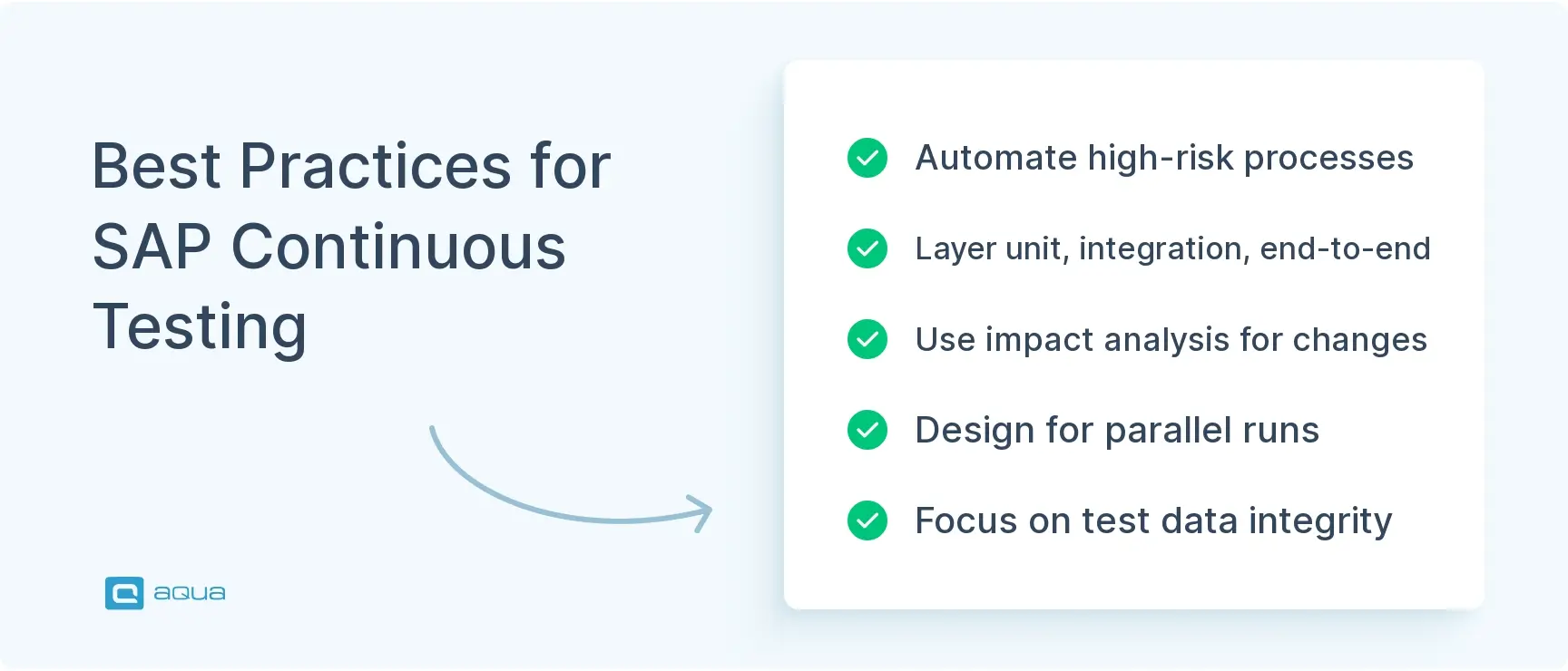
SAP continuous testing works when you treat it as a habit, not a shopping list of tools. Start with the business. Anchor your tests to real processes and real risk using clear SAP test management strategies. If a flow can stop billing, payroll, or close, automate it first. If it only touches a niche report, park it. This focus keeps your effort pointed where failures actually hurt.
Think in layers, not brute force. Let unit checks catch broken logic early. Run integration tests when transports land. Reserve end-to-end coverage for flows that cross systems and teams. You get faster feedback and avoid rerunning thousands of scenarios after a tiny change. Risk-based selection keeps coverage sharp without slowing you down.
Tooling still matters, but only if it understands SAP. Make sure it supports SAP GUI, Fiori, and the cloud apps you live in. Tight integration with Cloud ALM or Solution Manager gives you one place to plan, run, and review. Prebuilt content helps, especially during S/4HANA programs or ERP migrations where speed matters.
Bring people in early. Talk to functional consultants before designs harden. Pull business experts into scenario reviews. Feed production issues back into your tests so the suite stays honest. That loop is what keeps continuous testing alive.
Essential implementation tactics that actually help:
Track progress using best practices in test management so automation stays tied to business risk
Use impact analysis to handle custom code changes without test overload
Treat test data as a real dependency, with cloning, masking, and synthetic data where needed
Design for parallel runs so execution keeps up with release cadence
Build governance that guides teams without slowing them down
SAP enterprise continuous testing grows through repetition. Start small. Prove value fast. Scale what works. Color comes from momentum, not perfection.
Tools and Technologies for Continuous Testing in SAP
SAP continuous testing depends on how well you connect automation, test management, and delivery pipelines. Tools matter, but only when they help you control change instead of adding overhead.
SAP Enterprise Continuous Testing by Tricentis is often used in large SAP programs. It runs as a cloud service and supports end-to-end automation across SAP and connected systems. Model-based design allows functional experts to define tests without scripting. Risk-based execution and impact analysis help you rerun only what changed after a transport or configuration update. Its tight alignment with SAP ALM tools makes it a common choice for SAP-driven programs.
SAP Test Automation by Tricentis focuses on S/4HANA Cloud. It includes prebuilt test content for standard business processes and adapts well to frequent Fiori UI updates. Self-healing reduces maintenance during quarterly releases. This option works best when you rely heavily on SAP cloud services and need fast regression coverage.
Test automation alone is not enough. You also need a strong test management layer. This is where aqua cloud plays a key role. aqua cloud is a fully AI-powered test management system designed for continuous testing at scale. With aqua Copilot, you can generate test cases, requirements, and test data in seconds. Everything stays connected with full traceability between requirements, tests, defects, and releases. Centralised test management gives you clear coverage and risk visibility across SAP processes. Native integrations with Jira, Confluence, Azure DevOps, and CI tools like Jenkins, as well as automation engines such as Ranorex, make aqua cloud a strong control centre for SAP continuous testing.
SAP Cloud ALM Test Management focuses on planning and coordination for cloud-first customers. You can design tests around business processes, track execution, and monitor defects in one place. Integration with SAP automation tools and external engines helps teams keep visibility as releases move faster.
SAP Solution Manager and Focused Build remain relevant for on-premise and hybrid setups. Many organisations still depend on SolMan for process documentation, test planning, and execution. While SAP investment is shifting toward Cloud ALM, SolMan continues to support existing SAP programs.
Beyond SAP tools, third-party automation engines extend coverage. Tricentis Tosca remains widely used for model-based SAP automation. Other tools such as AccelQ, Worksoft, Leapwork, Panaya, Functionize, and Micro Focus UFT focus on no-code automation, fast onboarding, and parallel execution. Most support SAP GUI, Fiori, APIs, and integrations with non-SAP systems.
Tool or Platform
Key Strengths
Best For
SAP Enterprise Continuous Testing
Model-based automation, risk-based execution, SAP ALM integration
On-prem test suite, process documentation, hybrid support
Existing on-prem SAP programs
Tricentis Tosca
Model-based automation, broad SAP technology support
Highly customised SAP systems
Worksoft, AccelQ, Leapwork, Panaya
No-code automation, fast setup, parallel execution
Teams prioritising speed and ease of adoption
The direction is clear. Teams are moving toward cloud execution, AI-assisted maintenance, and tight CI/CD integration. When you combine strong automation with an AI-driven test management platform like aqua cloud, SAP continuous testing becomes predictable, scalable, and far easier to control.
Challenges and Considerations
Continuous testing in SAP sounds straightforward until you try to put it into practice. The first friction point is people and time. You need automation skills, SAP knowledge, and pipeline know-how working together. That rarely exists out of the box. Building the first reliable test assets takes longer than most plans admit, especially when systems keep changing underneath you.
Culture adds another layer of resistance. Many SAP teams still work in handoffs. Dev builds. QA tests later. Basis moves transports. Continuous testing breaks that pattern. Quality becomes shared work. That shift can feel uncomfortable, especially for teams used to clear boundaries. Without support from leadership and a few early wins, progress stalls.
SAP complexity doesn’t help. Custom code, mixed UI technologies, and dense integrations raise the risk of fragile tests. Test data causes constant friction. You need realistic data, privacy controls, and clean resets between runs. Performance adds more pressure. Functional checks alone won’t save you if batch jobs slow down close or payroll.
The safest way forward is controlled scope. Start with processes that matter most. Train the people involved. Reuse standard content where possible. Choose tools that understand SAP metadata and support change impact analysis. Keep feedback tight and review results often. Continuous testing improves through iteration, not big-bang rollouts. Insights from evolving practices like these agile testing trends often help teams reset expectations and move forward with less friction.
Conclusion
SAP release cycles are not slowing down. S/4HANA programs, cloud updates, and ERP migrations keep pressure on core processes. Continuous testing gives you a way to stay in control without relying on last-minute checks. Automated verification runs alongside change, not after it. Problems surface earlier. Fixes stay smaller. Risk becomes easier to manage. Success depends less on tooling choices and more on how you work. Focus on the processes that move money, data, and compliance. Automate with intent. Keep visibility across requirements, tests, and results. Review outcomes often and adjust. Continuous testing in SAP works when it supports how you actually deliver software. Done right, it stops quality from becoming a bottleneck and turns it into part of everyday delivery.
Having the right test management foundation makes all the difference. aqua cloud provides the centralized hub your SAP testing initiatives need. It connects your requirements, test cases, and defects with bidirectional traceability that supports compliance and audit readiness. Unlike generic tools, aqua’s flexible architecture integrates with your existing SAP automation frameworks via robust APIs and CI/CD connectors, while its intelligent dashboards give you real-time visibility into test coverage, execution progress, and risk areas. The platform’s reusable test components and nested test cases are particularly valuable for SAP’s modular processes, allowing you to build maintainable test suites that evolve alongside your SAP landscape. Most importantly, with aqua’s domain-trained AI Copilot, your test assets become smarter. It generates new tests, maintains existing ones, and provides insights all grounded in your project’s specific documentation and context, not generic AI guesses.
Transform your SAP quality assurance with AI-powered continuous testing that cuts regression time by up to 80%
SAP continuous testing means running automated checks whenever something changes in your SAP systems. Tests trigger after code updates, configuration changes, or transports move between environments. This approach helps you spot issues early instead of discovering them during late UAT cycles. Continuous testing in SAP focuses on protecting critical business processes while supporting faster release rhythms. It often combines automation, impact analysis, and strong sap test management strategies to keep coverage aligned with risk.
What are the different types of testing in SAP?
SAP testing covers several layers. Unit testing validates custom ABAP or extension logic. Integration testing checks how modules and external systems interact. End-to-end testing verifies full business flows like Order to Cash or Record to Report. Performance and security testing add confidence under load and compliance pressure. SAP enterprise continuous testing connects these layers so they run continuously instead of in isolated phases. This is closely tied to modern approaches in continuous testing.
How can automated continuous testing improve SAP deployment efficiency?
Automation reduces the time spent on repetitive regression cycles. Tests run in parallel, rerun only where changes occurred, and provide faster feedback. This is especially useful during S/4HANA upgrades and ERP migrations where changes stack up quickly. When combined with SAP test automation, automated sap continuous testing helps you release more often without increasing risk.
What are the common challenges faced during SAP continuous testing and how to overcome them?
Teams often struggle with skill gaps, test maintenance, and complex SAP customisations. Test data management and cultural resistance can slow progress. The most effective way forward is to start with high-risk processes, invest in training, and rely on impact analysis instead of full regression runs. Clear governance and alignment with best practices in test management also help. Many teams refine their approach over time by learning from real delivery patterns and broader agile testing trends.
Embodying the essence of a QA Coordination Maestro, Paul has excelled in curating and implementing quality strategies tailored to the nuances of each project. His expertise in the market of QA and Test Management solutions has contributed to a vast portfolio of successfully managed TMS…
Nurlan, a QA Coordinator & Quality Standards Officer, takes pride in orchestrating seamless QA operations. His expertise in coordinating QA-focused projects and integrating QA solutions has consistently yielded top-tier client satisfaction. Aside from a full-time QA coordinator, Nurlan's role involves creating compelling content that educates…
Home » Test Automation » Continuous Testing in SAP: Enhancing Quality Assurance
Do you love testing as we do?
Join our community of enthusiastic experts! Get new posts from the aqua blog directly in your inbox. QA trends, community discussion overviews, insightful tips — you’ll love it!
We're committed to your privacy. Aqua uses the information you provide to us to contact you about our relevant content, products, and services. You may unsubscribe from these communications at any time. For more information, check out our Privacy policy.
X
🤖 Exciting new updates to aqua Intelligence are now available! 🎉