Key Takeaways
- Scrum works best in enterprises when used as a delivery framework within existing structures, not as a replacement for the entire project management system.
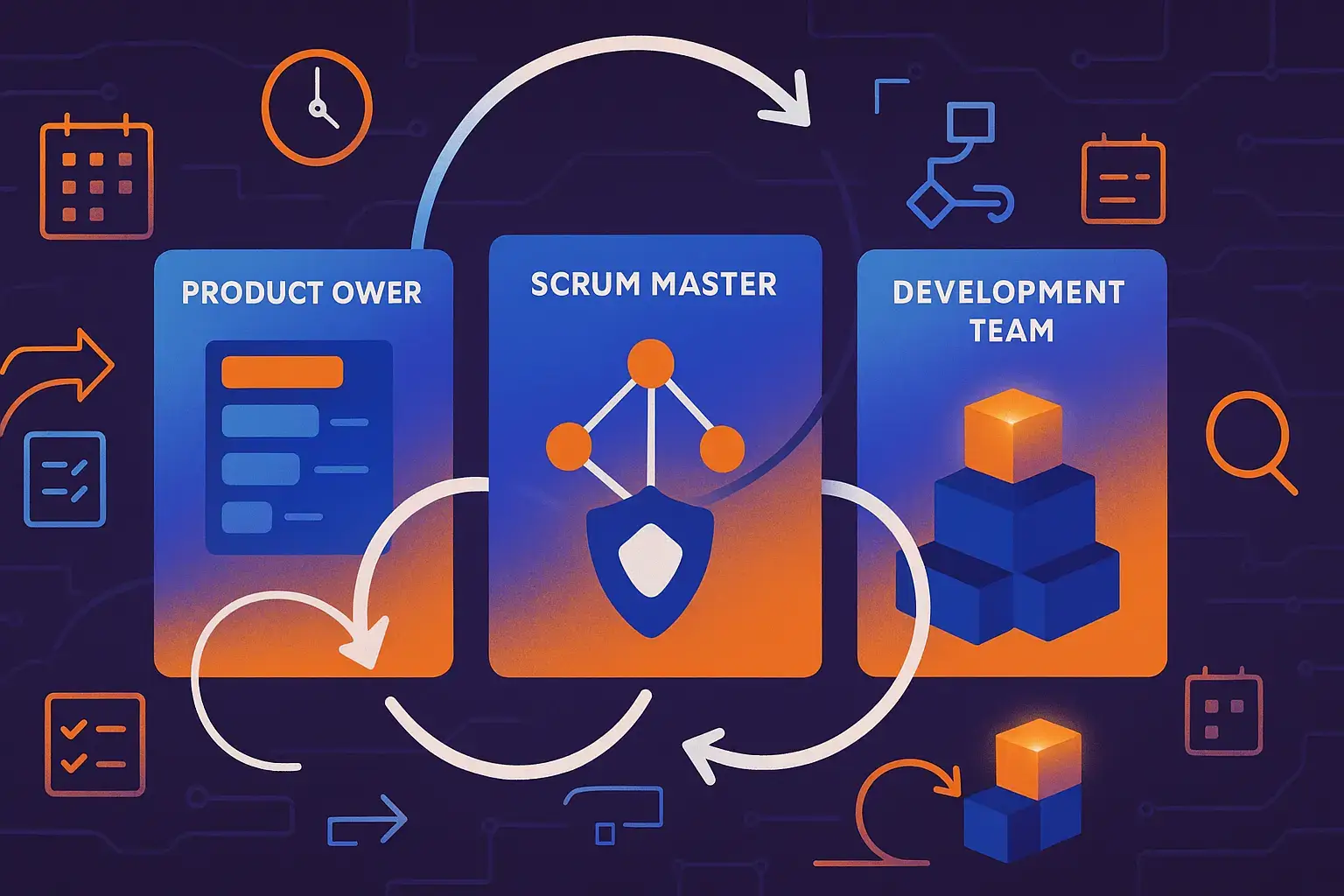
- The framework consists of three core roles: Product Owner, who prioritizes work, Scrum Master, who removes obstacles, and a Development Team that builds working increments.
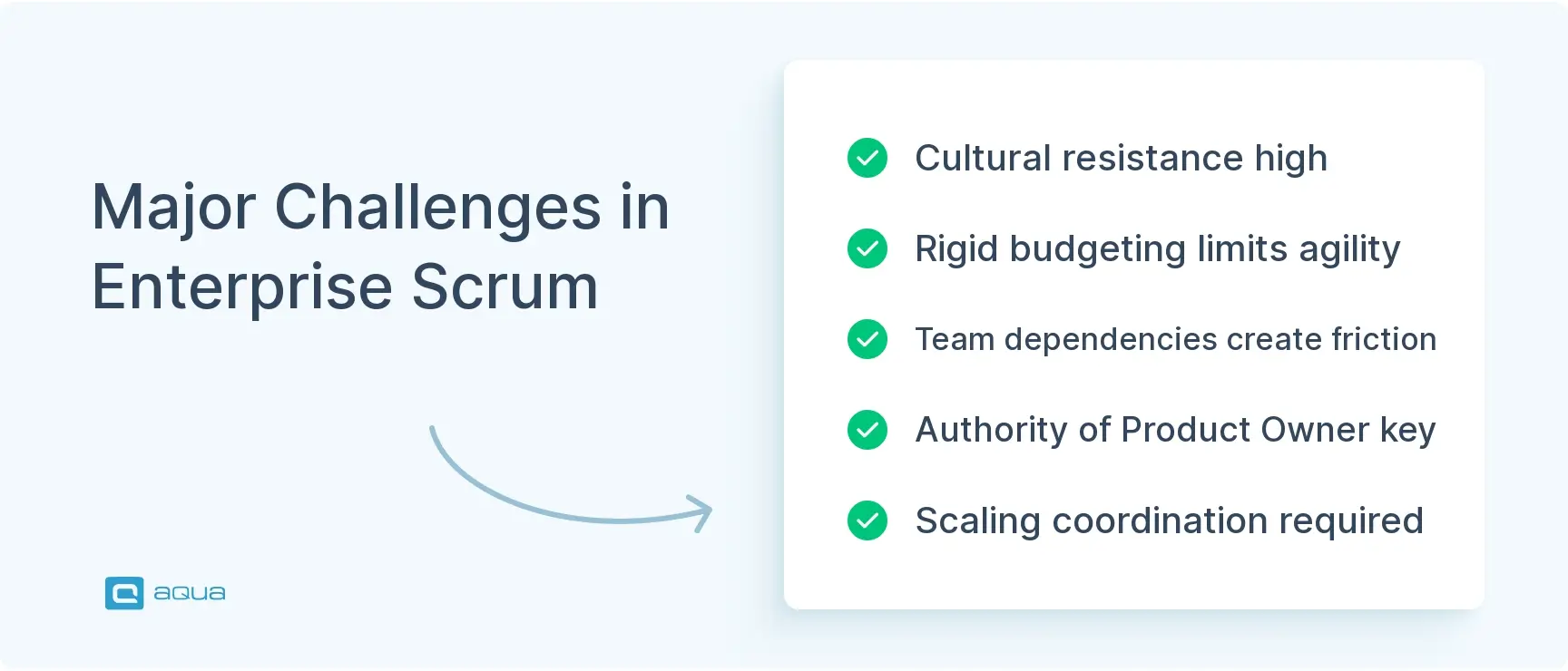
- Enterprise Scrum implementation faces key challenges, including cultural resistance, incompatible funding models, and dependency management across interconnected teams.
- Successful enterprise adoption requires product-centric funding rather than project-based budgeting.
Most enterprise Scrum implementations fail because organizations adopt the processes without embracing the fundamental mindset shift. Discover the Scrum management paradigm in detail 👇
What is Scrum Project Management?
Scrum project management is a team-level framework that helps you deliver work in short cycles called sprints. These sprints typically last two weeks. Basically, Scrum assumes things will change and helps you plan short-term, while strategizing long-term. Consequently, you work in iterations, inspect what you’ve built, adapt based on feedback, and repeat the cycle.
The core framework consists of three essential components working together. First, you have three defined roles: Product Owner prioritizes what needs building, Scrum Master removes roadblocks, and Development Team builds the product. Additionally, structured events create the rhythm through sprint planning, daily stand-ups, sprint reviews, and retrospectives. Finally, key artifacts maintain alignment, with the product backlog serving as the master wish list, the sprint backlog showing current commitments, and the increment representing working deliverables.
What separates Scrum from generic agile approaches is its structure. Specifically, the events create predictable touchpoints while artifacts keep everyone aligned. This design surfaces problems fast, which means you won’t discover in month five that your assumptions from month one were completely off.
Testing within Scrum adapts to these fast cycles, as shown in Scrum in agile testing. Here’s where enterprises face an important distinction. Scrum doesn’t care about your company’s strategic themes, budget cycles, or compliance frameworks. Instead, it focuses on one thing: helping your team deliver value iteratively.
That focus is both a strength and a weakness at scale. When enterprises try using Scrum to replace their entire project management structure, they crash. On the other hand, when they use it as the delivery engine inside a proper enterprise operating model, transformation happens. The distinction matters: Scrum handles “how we build” while enterprise project management handles “what we fund, why it matters, and how it all connects.” Most organizations miss this separation entirely.
Implementing Scrum in enterprise settings requires the right Scrum project management tool to bridge team-level agility with enterprise governance needs. This is where aqua cloud, an AI-driven test and requirement management solution, shines, as it’s designed with Scrum practices in mind. With aqua’s intuitive Scrum and Planning Boards, your teams can visualize sprint progress and manage backlogs efficiently. Additionally, they can track velocity through real-time burndown charts. These elements support the sprint rhythm your teams need. The platform’s AI-powered Copilot can generate test cases from requirements, documentation, or even voice notes in seconds, which helps your QA teams keep pace with the rapid iterations Scrum demands. aqua provides customizable workflows that adapt to your enterprise’s compliance needs without sacrificing flexibility. Plus, aqua connects with your existing tools like Jira and Azure DevOps, along with Slack and dozens of other platforms, to fit naturally into your workflow.
Generate test cases 97% faster with aqua’s AI
The Differences Between Scrum and Traditional Project Management
Understanding how Scrum differs from traditional project management helps you choose the right approach for your work. To illustrate this difference, consider how traditional project management treats work like building a house. You need blueprints and permits, along with a fixed timeline and a contractor who promises completion by June. In contrast, Scrum treats work like exploring unmapped territory. You know the general direction, yet you adjust course based on what you discover.
The traditional approach follows a linear path: requirements lead to design, design to build, build to test, and test to deploy. Each phase gates the next. As a result, you don’t start building until design locks. Similarly, you don’t test until the building is complete. This works well when you know exactly what you’re building and nothing will change.
The Scrum methodology in project management takes a different approach. You’re building, testing, and gathering feedback constantly. Moreover, requirements aren’t set upfront. For instance, a feature that seemed necessary in January might get scrapped in March because user testing showed nobody needs it. While traditional PM fights change through change control boards and impact analyses, Scrum welcomes it.
The Product Owner can reprioritize the backlog between sprints based on new information. That flexibility becomes valuable when you’re dealing with evolving regulations or shifting market conditions. Furthermore, this agile adaptability contrasts sharply with agile vs traditional testing, where feedback and iteration speeds differ greatly.
| Aspect |
Traditional PM |
Scrum PM |
| Planning horizon |
Entire project upfront, 6-18 months |
Sprint-by-sprint, 2-4 weeks |
| Change handling |
Formal change requests, impact analysis |
Backlog reprioritization between sprints |
| Progress measurement |
Percentage complete against baseline plan |
Working increments delivered each sprint |
| Team structure |
Functional silos, handoffs between departments |
Cross-functional, self-organizing teams |
| Customer involvement |
Requirements phase and final delivery only |
Every sprint review, every 2 weeks |
| Risk approach |
Upfront risk assessment, mitigation plans |
Continuous risk discovery and adaptation |
| Documentation |
Comprehensive upfront, change-controlled |
Just enough, evolving with product |
| Success criteria |
On-time, on-budget, on-scope delivery |
Value delivered, stakeholder satisfaction |
| Flexibility |
Low, resists change after planning |
High, expects and accommodates change |
Neither approach wins universally. If you’re upgrading a compliant financial system with locked regulatory requirements, traditional methods might save headaches. Conversely, if you’re building a new testing platform where user needs are still emerging, Scrum becomes your friend. Smart enterprises don’t pick one. Instead, they match the method to the work’s uncertainty level and adapt accordingly.
The Core Roles in Scrum
Scrum runs on three roles that define accountability structures, not job titles. You can have one person wearing multiple hats in small setups, but the accountabilities stay distinct. Mix them up, and you’re running “Scrum-ish,” which usually means you kept the meetings but ditched the parts that actually work.
1. Product Owner
This person owns the what and why of your product. They maintain the product backlog, prioritize work based on value, and make trade-off decisions when your team can’t build everything. In enterprise reality, the Product Owner needs actual authority beyond just backlog grooming skills. If they can’t say no to stakeholders or shift priorities without three approval layers, the role collapses.
The best enterprise Product Owners balance customer needs with regulatory constraints and technical debt. Additionally, they maintain strategic alignment while keeping a backlog that your team can actually execute against.
Key responsibilities:
- Maintain and prioritize the product backlog based on business value
- Define clear acceptance criteria for backlog items
- Make trade-off decisions between competing priorities
- Ensure your team understands backlog items sufficiently
- Accept or reject completed work based on the Definition of Done
- Engage with stakeholders and communicate product vision
2. Scrum Master
Think of this as your team’s organizational immune system. The Scrum Master doesn’t manage the team or assign tasks. Instead, they remove impediments, coach people on Scrum practices, and shield your team from interference. In large organizations, effective Scrum Masters spend as much time outside the team as inside.
They negotiate with other departments and fix broken processes. Beyond that, they help the organization understand a fundamental truth: you can’t have sprint commitments and constantly changing priorities. They’re change agents first and meeting facilitators second.
Key responsibilities:
- Facilitate Scrum events and ensure they’re productive
- Remove impediments blocking your team’s progress
- Coach your team on Scrum principles and self-organization
- Shield your team from external interruptions during sprints
- Help the organization understand and adopt agile practices
- Foster continuous improvement through retrospectives
3. Development Team
These are the people who turn backlog items into working increments. Cross-functional means your team has everyone needed to deliver without constant external dependencies. In QA-heavy environments, collaboration in QA planning becomes essential. This involves testers in sprint planning and refining acceptance criteria. Furthermore, it includes pairing with developers from day one.
Your team self-organizes around how to do the work, yet they’re collectively accountable for hitting the sprint goal. Everyone contributes to getting items to done.
Key responsibilities:
- Commit to sprint goals and deliver working increments
- Self-organize to determine how to accomplish work
- Maintain quality standards and Definition of Done
- Collaborate daily to overcome obstacles and dependencies
- Participate actively in all Scrum events
- Continuously improve technical practices and team dynamics
I feel like a PM moving toward a product owner role would be more beneficial than being a developer. And no one says scrum teams need to work in a bubble. You're supposed to involve stakeholders. I don't see why a PM can't be a stakeholder.
In enterprises, these roles often bump against existing structures. You’ve got functional managers and project managers, along with architects and business analysts, wondering where they fit. Scrum doesn’t get rid of those roles. Instead, managers focus on capability building and strategic allocation. Similarly, architects set guardrails but don’t dictate designs.
The mistake is trying to cram traditional command-and-control into Scrum’s collaborative model. That creates Scrum Masters who are really just project admins tracking status. Likewise, it produces Product Owners who need sign-off for every backlog tweak. That’s where implementations fail.
The Scrum Process: Artifacts and Events
Scrum’s rhythm centers on the sprint, which is a fixed timebox where your team commits to delivering a potentially shippable increment. Every sprint follows the same pattern, thereby creating predictability in an otherwise adaptive process. The artifacts and events create transparency and opportunities for inspection and adaptation.
Scrum Artifacts
The artifacts keep everyone grounded in reality. They provide visibility into what needs building, along with what’s in progress and what’s been completed.
Product Backlog
Your evolving list of everything that might need building: features and fixes, technical debt and compliance work. The Product Owner prioritizes it based on value and risk, considering dependencies throughout.
Example: A backlog for a banking app might include Enable mobile check deposit and Fix login timeout bug, along with Upgrade security encryption.
Sprint Backlog
What your team commits to delivering this sprint, pulled from the product backlog during sprint planning.
Example: Your team selects Enable mobile check deposit and breaks it into tasks. These tasks include designing UI mockup and implementing camera integration. Additionally, they cover building image processing logic and creating automated tests.
Increment
The sum of all completed backlog items by the end of the sprint, meeting your Definition of Done. In regulated industries, the Definition of Done includes audit trails and test coverage. Moreover, it encompasses security scans and whatever compliance demands. No shortcuts.
Example: The mobile check deposit feature fis ully coded and tested, integrated and documented, ready for production deployment.
Scrum Events
The events create the cadence that drives your team forward. Scrum refers to these as events rather than ceremonies, emphasizing their purpose in inspection and adaptation.
1. Sprint Planning
Sprint Planning kicks off each sprint with your team. The team discusses the sprint goal and selects backlog items. Following that, they break those items into tasks. The Product Owner doesn’t dictate a to-do list. Instead, your team forecasts what’s achievable given their capacity and the work complexity.
Example: Your team examines the top backlog items and estimates effort. Subsequently, they discuss technical approaches and commit to delivering 5 user stories totaling 34 story points.
2. Daily Scrum
A 15-minute sync where your team coordinates for the next 24 hours. Your team members figure out how to hit the sprint goal together. Each person typically shares what they completed and what they’re tackling next. In addition, they mention any blockers they’re facing.
Example: A member shares something along the lines of: Yesterday I completed the payment API integration, today I’m tackling the error handling, and I’m blocked on accessing the test database credentials.
3. Sprint Review
Happens at sprint’s end when your team demonstrates working increments to stakeholders and gathers feedback. This is where stakeholders see tangible progress. Changes to the backlog happen here based on what’s learned. As a result, stakeholders might request new features or clarify requirements. They may also adjust priorities for upcoming sprints.
Example: Your team demos the new reporting dashboard live. Stakeholders request adding export to Excel functionality, which consequently gets added to the product backlog for future sprints.
4. Sprint Retrospective
Closes the loop as your team reflects on their process and identifies improvements. Following that, they commit to trying something different next sprint. Skip retrospectives, and your team runs in place. This event focuses on continuous improvement of how your team works together, not what they built.
Example: Your team identifies that unclear acceptance criteria caused rework. Accordingly, they agree to have the Product Owner join daily refinement sessions to clarify requirements earlier.
The flow creates a predictable cycle: sprint planning sets direction while Daily Scrums maintain alignment. Meanwhile, the sprint review validates that you built the right thing, and the retrospective improves how you build. Enterprises often try adding extra checkpoints or approval gates between these events. Resist that urge. The framework already provides tight feedback loops. Adding friction just slows down what makes Scrum valuable.
The Benefits of Using Scrum in Enterprise Project Management
When Scrum works in large organizations, it delivers benefits that traditional approaches struggle to match. These advantages become particularly apparent when your teams work on complex projects with evolving requirements.
1. Faster Feedback Loops and Early Course Correction
Instead of waiting months to discover your solution misses the mark, you’re getting stakeholder input every two weeks. That early course correction saves money and preserves sanity. In QA contexts, testing happens throughout the sprint rather than as a phase-gate bottleneck. Consequently, bugs get caught and fixed while the code’s fresh, not six weeks later when the developer’s moved to another project. This rapid feedback cycle reduces rework and ensures your team builds what stakeholders actually need.
2. Radical Transparency and Visibility
Sprint reviews and visible backlogs mean everyone sees what’s happening and what’s next. Additionally, they see what’s blocked. Your team either delivered working software or they haven’t. That visibility helps enterprise leadership make informed decisions about investment and pivots. Furthermore, it aids resource allocation. When a strategic initiative isn’t gaining traction, you know after a few sprints, not after burning through half the budget. As a result, executives can redirect resources quickly based on real data.
3. Enhanced Cross-Functional Collaboration
Scrum requires cross-functional teams to work together effectively. Developers and testers aren’t throwing work over walls to designers and business analysts. Instead, they’re huddling daily to solve problems together. Dependencies that used to take weeks to resolve get handled in hours because the right people are in the same room or Slack channel. For enterprises drowning in silos, that shift transforms how work flows. Consequently, teams develop shared ownership of outcomes rather than narrow functional responsibilities.
4. Proactive Risk Management
Traditional projects hide risk until it explodes. In contrast, Scrum surfaces problems immediately through daily impediments and sprint retrospectives. Can’t integrate with the legacy system? That’s day three of sprint one, not week twelve of the project plan. Your teams adapt or escalate fast, thereby preventing small issues from becoming serious disasters. This continuous risk discovery helps your organization address problems when they’re still manageable and inexpensive to fix.
5. Improved Adaptability to Change
Markets shift while regulations change and competitors innovate. Scrum allows your teams to pivot rapidly without derailing entire initiatives. The Product Owner can reprioritize the backlog between sprints based on new information, which ensures your team always works on the highest-value items. This flexibility proves invaluable when you’re dealing with evolving regulations or shifting market conditions. Moreover, it helps when technology moves faster than your approval process. Your organization can respond to change rather than fight it.
6. Predictable Delivery Cadence
Despite its adaptive nature, Scrum creates predictability through consistent sprint rhythms. Stakeholders know exactly when to expect working software. Additionally, they know when they’ll have opportunities to provide input. This regular cadence supports better planning at the portfolio level while maintaining flexibility at the delivery level. As a result, leadership can forecast releases more accurately and plan dependent initiatives with greater confidence.
A financial services company switched their compliance reporting system from waterfall to Scrum. The traditional approach had them delivering a full system after 18 months, right when regulations changed. By contrast, agile project management with Scrum delivered baseline reporting in three months. Subsequently, they iterated based on regulatory updates and user feedback. When rules shifted mid-year, they adapted in two sprints instead of restarting the entire project.
I have seen cases where it would have been helpful if someone had assisted the PO in the coordination of the Scrum and another 3rd party team. But in my environment, that doesn't really happen very often. Also Scrum isn't for projects, it's for products.
Challenges in Implementing Scrum and Overcoming Them
Scrum adoption struggles most when enterprises treat it as a plug-and-play solution instead of a fundamental shift. The biggest challenges aren’t technical. Rather, they’re cultural and structural, requiring sustained effort to overcome.
- Cultural Resistance and Organizational InertiaPeople who’ve spent careers mastering waterfall methodologies don’t pivot overnight. Managers worry about losing control while traditional project managers wonder if they’re being replaced. The solution isn’t forced adoption. Instead, start with pilot teams on genuinely uncertain work. Let success stories spread organically. Bring skeptics to sprint reviews to see working software. Invest in coaching beyond just two-day certifications. Scrum Masters need ongoing support to navigate organizational resistance and help your teams internalize agile principles.
- Incompatible Funding and Budget ModelsAnnual project-based budgeting forces your teams to commit to scope a year in advance, which defeats adaptive planning’s purpose. The fix requires shifting to product-centric funding where stable teams receive ongoing investment against strategic themes. Instead of funding, for example, a Project Billing Upgrade Q3, you fund a Billing Platform Team that continuously improves the system based on evolving needs. This single change predicts Scrum success better than any other factor. Align budget reviews with quarterly business outcomes and give Product Owners financial authority to make meaningful trade-offs without triggering full budget reforecasts.
- Dependency Management and Scaling ComplexityWhen one team’s sprint depends on another team’s API changes, coordination becomes necessary. Map dependencies upfront and create Scrum of Scrums coordination forums where representatives from multiple teams synchronize work. Use release-level planning for integration points and implement lightweight architectural governance that provides guardrails without micromanaging. The key is balancing team autonomy with necessary coordination. You can’t have fully independent teams when building integrated enterprise systems, but you can minimize handoffs and align sprint boundaries to reduce friction.
Additional strategies drive successful implementation. Protect Scrum’s core mechanics while adapting thoughtfully for your context. Build lightweight governance around Scrum rather than injecting it into sprints. Equip Product Owners with actual authority and decision rights. Start small with high-uncertainty work, prove value, then expand gradually. Address tooling and infrastructure gaps that slow your teams down.
Teams that fail treat Scrum like a process change. On the other hand, the ones that succeed treat it like an operating model evolution. That takes executive sponsorship and persistent coaching. Beyond that, it requires a willingness to confront uncomfortable truths about how work really flows through your organization. To support this transformation, many organizations benefit from implementing quality assurance management solutions that align with agile principles and Scrum practices.
Successful Scrum adoption in enterprises requires balancing team-level adaptability with organizational governance. Here, aqua cloud, an AI-driven test and requirement platform can deliver exceptional value. The platform integrates into your existing enterprise project management framework while enhancing your teams’ Scrum implementation with visual planning boards and automated test case generation. With aqua’s domain-trained AI Copilot, your teams can transform requirements, documentation, or voice notes, into comprehensive test coverage in seconds. This addresses the faster feedback loops and proactive risk management benefits mentioned in this guide. The platform’s enterprise-grade scalability supports multiple teams working in parallel with full visibility across projects. Whether you’re just beginning your Scrum journey or scaling existing agile practices, aqua helps bridge the gap between adaptive delivery and enterprise oversight. With native integrations to Jira and Azure DevOps, along with TestRail and dozens of other tools, aqua fits naturally into your existing ecosystem.
Achieve 100% test coverage with aqua’s smart capabilities
Conclusion
Scrum operates best inside a strong enterprise operating model. Companies that succeed with Scrum in project management at scale keep team-level discipline intact while building lightweight governance around it. They fund products rather than projects. Moreover, they measure value delivered rather than activity performed. The ceremonies and artifacts are straightforward. However, the mindset shift from controlling how teams work to enabling what they deliver is where the real work happens. For organizations tired of discovering they built the wrong thing six months too late, that shift determines whether you survive or thrive.