Key Takeaways
- Project management coordinates people, resources, and timelines within defined constraints to achieve specific goals.
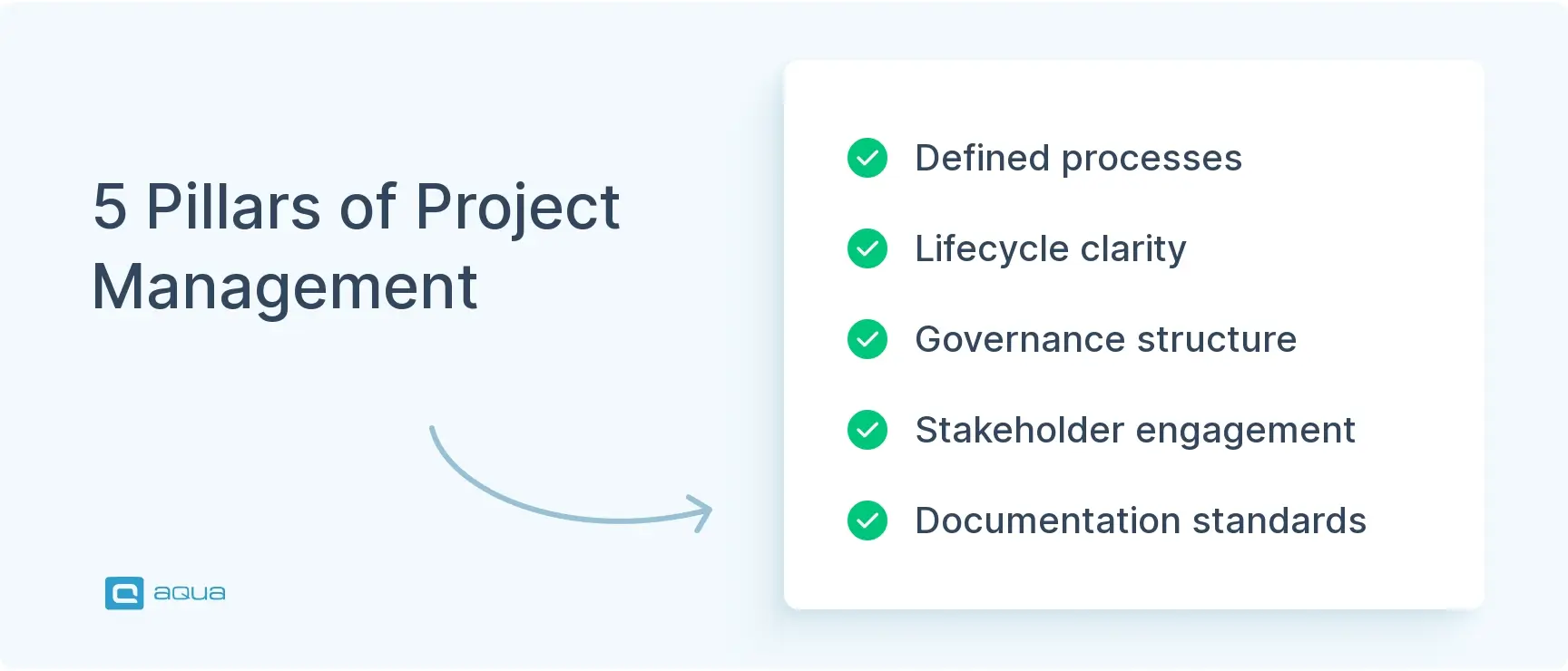
- Successful project management requires five key components: defined processes, lifecycle clarity, governance structure, stakeholder engagement models, and documentation standards.
- Project managers serve as strategic translators who align execution with objectives, unblock teams, manage stakeholder expectations, and make difficult trade-off decisions.
- Project management software provides transparency, task management, and progress tracking, but only amplifies proper processes rather than fixing suboptimal ones.
Project failures rarely arise from missing analytics or the occasional lack of communication. The actual issue lies on multiple other levels. Discover 15 tested principles to improve your PM system in place👇
What is Project Management?
Project management is the practice of planning work to achieve specific goals within defined constraints like time, budget, and resources. It focuses on taking an idea or objective and turning it into a completed outcome through structured coordination. At its core, project management involves several key activities: defining what needs to be accomplished.
The essential elements you’ll work with include:
- Defining success criteria and measurable outcomes
- Allocating scarce resources efficiently
- Managing dependencies between teams and tasks
- Course-correcting when reality diverges from your plan
The scope varies wildly depending on your context. A construction company managing a hospital build deals with permits and materials procurement alongside safety regulations. Meanwhile, a software team launching a mobile app focuses on sprint planning and API integrations. A marketing agency coordinating a product launch juggles creative approvals and media buys.
What connects these scenarios? Each one requires someone on your team to make smart trade-offs under pressure. That’s project management in action.
When implementing PM principles, the right tech stack is half the battle. aqua cloud, an AI-driven test and requirement management solution, embodies these principles through its unified test management solution. With aqua, teams gain accountability through customizable Agile boards and user administration that establishes ownership. The platform’s real-time dashboards and comprehensive reporting tools help to boost stakeholder engagement. Moreover, integrated analytics provides visibility into project health and progress to all parties invovled. What truly sets aqua apart is its domain-trained AI Copilot, which can be used to enforce automation in your project’s actual documentation and context. It’s doing so by making every generated test case or requirement relevant to your specific work using your chats, documentation, and even voice notes. Besides, aqua has integrations with Jira, Jenkins, and multiple other software tools you definitely have in your tech stack.
Boost testing efficiency by 80% with aqua's AI
Key Components of Project Management
Effective project management rests on five foundational pillars that determine whether your initiative succeeds or collapses. These are the concrete frameworks you’ll use daily. Weakness in any single area derails even the strongest execution.
1. Defined Processes
These are your standardized workflows that specify exactly how work moves through your organization. Think of processes as the repeatable paths for getting approvals, setting priorities, executing tasks, and conducting reviews. Without them, your team reinvents the wheel every time someone asks how to handle a scope change or escalate a risk.
Practical process elements include:
- Approval workflows that route scope changes through the right stakeholders
- Risk review cadences that catch issues before they become crises
- Change request procedures with clear criteria for acceptance or rejection
- Decision documentation that captures why choices were made
2. Lifecycle Clarity
Your project lifecycle defines which phases you’ll move through and what happens in each one. This component answers whether you’re running a predictive approach that plans everything upfront, an agile method that iterates in short cycles, or a hybrid model. Each phase brings different requirements:
- Initiation establishes the business case and high-level scope
- Planning develops detailed schedules, budgets, and resource allocations
- Execution delivers the actual work products
- Monitoring tracks progress against your baseline
- Closure formalizes acceptance and captures lessons learned
3. Governance Structure
Governance specifies the decision-making authority across your project. This component defines who can approve budget increases, who owns specific deliverables, and how information flows between teams. It prevents the chaos of unclear accountability.
Your governance structure includes:
- Decision rights that specify approval thresholds at each level
- Authority levels that determine who can change scope or reallocate budget
- Approval hierarchies that route requests through appropriate channels
- Meeting cadences that ensure stakeholders stay informed
Consider a retail chain rolling out new point-of-sale systems across 200 stores. Without structured governance, you’ll end up with rogue implementations at individual locations. Regional pilot phases and clear escalation pathways prevent this chaos. The technical work might be solid, but governance ensures coordinated execution.
4. Stakeholder Engagement Model
This component maps out your communication strategy with everyone who influences or is affected by your project. It specifies who gets consulted during planning, who must approve specific decisions, and who simply needs to be informed of progress. The model prevents surprise objections at go-live by ensuring continuous validation.
Your engagement model should outline:
- Consultation points where you gather stakeholder input
- Approval gates where specific stakeholders must sign off
- Information sharing that keeps peripheral stakeholders updated
- Feedback mechanisms like prototypes and pilot programs
5. Documentation Standards
Documentation captures decisions, rationale, and context so your project can survive team changes. This component establishes what gets recorded, where it lives, and who maintains it. The goal is institutional memory without bureaucracy. Following effective requirements management practices ensures your documentation serves its purpose.
Effective documentation standards cover:
- Decision logs that explain why you chose specific approaches
- Change histories that track how the scope evolved over time
- Risk registers that document identified threats and mitigation plans
- Lessons learned that inform future project planning
Weak governance combined with strong execution still derails your project when priorities shift, and no one has the authority to make the call. Similarly, strong processes mean nothing if your lifecycle doesn’t match how volatile your project actually is.
Start with a blank page and document all processes end to end from soup to nuts… verify the process maps with the people who are at the coalface, you will miss things or capture processes incorrectly first time round.
The Role of a Project Manager
The project manager keeps strategy, execution, and reality aligned throughout your initiative. Your PM’s job starts with translating vague executive mandates into concrete deliverables with clear acceptance criteria and resource plans. Then comes the harder part: unblocking your team and making trade-off calls when scope creeps or budgets tighten.
Leadership separates good PMs from mediocre ones. This means creating psychological safety so your engineers escalate risks early instead of hiding them. It means running interference when marketing wants feature X but your development team lacks capacity. It keeps morale up when the fifth scope change lands on a Friday afternoon. Similar to test manager skills and responsibilities, project managers need strong communication and organizational capabilities.
Certifications like PMP signal that your PM understands risk quantification and earned value management alongside stakeholder mapping. However, certification without sound judgment becomes just expensive wallpaper.
Day-to-day responsibilities your PM handles include:
- Team coordination through daily standups and dependency tracking alongside retrospectives
- Communication hygiene with status reports that executives actually read
- Conflict resolution by mediating between competing priorities when resources run thin
- Risk management through identifying what could go sideways and building contingency before it does
- Scope control by saying no to good ideas that would derail your timelines
Think of your PM as the project’s central nervous system. Developers write code while designers create mockups and analysts crunch data. But your PM ensures those efforts converge into something shippable instead of scattering into isolated work streams. When a dependency breaks or a key person quits, your PM absorbs the chaos, reworks the plan, and keeps everyone focused on what still matters.
15 Core Project Management Principles
Project management relies on durable principles that work across industries and delivery models. PMI’s PMBOK 7 framework emphasizes 12 principles while PRINCE2 adds governance-focused guardrails. Agile layers in adaptability. The synthesis below gives you a practical set of project management key principles that works whether you’re running waterfall, scrum, or a hybrid inherited from three reorganizations.
1. Stewardship
What it is: Stewardship means acting as a responsible caretaker of organizational resources, maintaining full transparency about how money, time, and effort are allocated and spent. It requires providing decision-makers with honest visibility into both progress and risks, including the willingness to recommend ending projects that no longer deliver value.
In practice: Your status reports highlight both successes and setbacks with clear audit trails for resource allocation. You’ll proactively flag underperforming initiatives even when politically awkward and recommend project cancellation when value evaporates.
Abstract example: A pharmaceutical company auditing clinical trial spending realized that one program was burning budget without hitting enrollment targets. The PM flagged it early and recommended redeploying resources to a higher-performing trial, saving six months of wasted effort.
2. Deliver Value
What it is: Value delivery focuses on creating measurable business outcomes rather than simply completing tasks or producing deliverables. This principle ensures projects exist to achieve specific organizational goals like revenue growth, cost reduction, or improved operational capabilities, not just to check off work items.
In practice: Success gets defined in business terms from day one. Your team continuously measures progress toward those outcomes and pivots or stops when data shows you’re off track. You’ll validate assumptions with real users early and prioritize work based on business impact.
Abstract example: A logistics firm rebuilt its route optimization tool but discovered drivers weren’t using it. The PM shifted focus from adding features to improving UI adoption, which actually moved the needle on delivery times.
3. Stakeholder Engagement
What it is: Stakeholder engagement treats everyone who influences or is affected by your project as active partners in co-creating success. This principle emphasizes continuous involvement through validation cycles, feedback loops, and collaborative decision-making rather than periodic status updates.
In practice: You’ll conduct regular check-ins to share progress and gather input. Stakeholders contribute to decision-making throughout your project lifecycle through workshops and design reviews. Show early versions even when rough and adjust based on feedback.
Abstract example: A government IT project failed because end users saw the system for the first time during training. Early engagement would’ve surfaced usability issues before millions were spent on development.
4. Team Accountability
What it is: Team accountability establishes clear roles and ownership boundaries so everyone understands their responsibilities and the limits of their authority. This prevents critical work from being overlooked because team members assumed someone else would handle it.
In practice: Everyone on your team knows their swim lane through RACI matrices that specify who is Responsible, Accountable, Consulted, and Informed. Documentation clarifies who owns backlog prioritization, approves scope changes, and escalates blockers.
Abstract example: A retail tech rollout stalled because store ops, IT, and procurement kept passing the buck. One structured kickoff, defining ownership and decision rights, addresses most of the issues.
5. Systems Thinking
What it is: Systems thinking recognizes that your project operates within a larger ecosystem and organizational dynamics. This holistic perspective helps identify how changes in one area create ripple effects elsewhere and reveals dependencies that aren’t immediately obvious.
In practice: You’ll map technical integrations, vendor timelines, and organizational change management alongside your core work. Dependency maps visualize relationships across multiple projects while architecture reviews consider how new components integrate with existing systems.
Abstract example: A bank’s mobile app rewrite ignored the core banking platform’s API limitations until integration testing. Systems thinking upfront would’ve surfaced that constraint during design.
6. Leadership
What it is: Leadership in project management means creating an environment where your team feels safe to voice concerns, take calculated risks, and maintain quality standards. This principle prioritizes the human elements that drive project success over purely administrative task management.
In practice: This helps you coach junior members and shield your team from organizational churn. Remove blockers like stuck approvals rather than micromanaging how people execute their work.
Abstract example: A manufacturing automation project succeeded because the PM spent half their time removing blockers like vendor delays instead of micromanaging developers. Your team delivered ahead of schedule with full autonomy.
7. Tailor Rigor to Risk
What it is: Tailoring rigor to risk means adjusting your documentation requirements and governance structures based on what could actually go wrong. This principle acknowledges that different projects carry different risk profiles and therefore warrant different levels of oversight and control. This represents one of the basic project management principles that applies across all methodologies.
In practice: Low-risk internal tools don’t need monthly steering committees. High-stakes regulatory compliance demands documented approvals at each gate. Cadence matches consequence, so review frequency scales with risk exposure.
Abstract example: A SaaS startup applied enterprise change management to a marketing website redesign and lost two months to pointless approvals. Right-sizing the governance would’ve shipped faster without meaningful risk.
8. Quality Standards
What it is: Quality standards mean building testing and review activities into every project phase rather than treating them as final checkpoints. This principle recognizes that defects become exponentially more expensive to fix as they progress through your development lifecycle, making early detection critical.
In practice: Clear acceptance criteria define what “done” means before work begins. Quality gates at phase boundaries ensure deliverables meet standards before moving forward. Your team writes automated tests alongside features and validates requirements before development starts.
Abstract example: A healthcare provider’s patient portal launched with major bugs because quality checks were skipped to hit a deadline. Post-launch firefighting cost triple what proper QA would’ve.
9. Complexity Awareness
What it is: Complexity awareness distinguishes between projects with many predictable parts and projects with unknown variables. This principle requires matching your management approach to the project’s actual nature rather than applying a one-size-fits-all methodology.
In practice: Complicated work suits detailed upfront planning with thorough requirements. Complex work needs iterative discovery with frequent validation loops. You’ll run experiments and prototypes when facing unknowns rather than pretending you can plan everything perfectly.
Abstract example: A fintech company tried to waterfall-plan a machine learning credit model and wasted months. Switching to iterative two-week cycles unlocked progress immediately.
10. Risk Management
What it is: Risk management means systematically identifying threats that could derail your project and developing specific countermeasures. This principle encompasses technical risks, vendor dependencies, resource constraints, and political factors that could withdraw support or funding.
In practice: You’ll quantify risk probability and impact, then invest in mitigation for high-impact threats. Building contingency means adding timeline buffers, establishing backup vendor relationships, and maintaining plan B.
Abstract example: An infrastructure project hedged against supply chain delays by pre-ordering critical components six months early. Competitors who didn’t face six-month slippages when shortages hit.
11. Adaptability and Resiliency
What it is: Adaptability and resiliency bring an understanding that any project requires adjustment when conditions change, rather than fixed commitments. This principle builds organizational capacity to absorb shocks like priority shifts, budget cuts, or personnel changes without complete project failure. This is central to the principles of Agile project management.
In practice: Build slack into schedules by planning to 80% capacity. Cross-train team members so that losing one person doesn’t create a crisis. Document decisions thoroughly so new people can get up to speed quickly when changes happen.
Abstract example: A retail project survived a surprise executive departure because the PM had documented decisions thoroughly. The new executive got up to speed in weeks, preventing restart-from-scratch chaos.
12. Manage by Exception
What it is: Managing by exception determines when issues require escalation versus when your team can resolve them independently. This principle creates a balance between autonomous decision-making and ensuring serious problems receive appropriate management.
In practice: Small variances get handled at the team level without escalation. Budget overruns above defined percentages escalate to leadership. Tolerance bands empower your team to make routine decisions while flagging genuine issues.
Abstract example: A construction firm set tolerance bands of plus or minus 5% schedule and plus or minus 7% cost. Small weather delays got absorbed at the site level while threshold breaches escalated automatically.
13. Learn Continuously
What it is: Continuous learning captures insights from project experiences and makes them an institutional knowledge. This principle requires reflection on what worked and what failed. It also demands documenting those lessons in formats that future project teams can actually find and apply.
In practice: Regular retrospectives ask what went well, what broke, and what you’d do differently. Insights get documented in searchable formats that future teams can reference during planning to avoid repeating mistakes.
Abstract example: A software company maintained a searchable lessons database from past projects, cutting new project planning time by 30% by reusing what worked.
14. Continued Business Justification
What it is: Continued business justification requires periodically revalidating whether your project still makes financial and operational sense rather than assuming completion is mandatory once work begins. This principle acknowledges that market conditions, organizational priorities, and competitive dynamics shift, potentially invalidating the original business case.
In practice: Quarterly business reviews examine whether your ROI projections still hold and whether organizational priorities have shifted. You’ll present honest assessments that include recommendations to pause or cancel when appropriate.
Abstract example: A media company canceled a content platform eight months into development when priorities shifted. Painful, but better than wasting another year on something obsolete.
15. Sustainable Pace
What it is: Sustainable pace means working at a consistent, manageable speed that your team can maintain long-term without burnout. This principle ensures productivity and quality remain high over months or years rather than relying on short bursts of intense overtime that ultimately harm both output and team morale.
In practice: If your team constantly crunches, you identify and fix the root cause rather than accepting it as normal. Plan to 80% capacity to accommodate reality and build a buffer into schedules for unexpected issues.
Abstract example: An e-commerce platform learned this the hard way after two death marches led to attrition of their best engineers. Switching to sustainable sprints improved both retention and velocity.
These core principles of project management prevent the most common failure modes that derail projects. Apply them situationally based on your context, and you’ll make better calls under pressure. Understanding what are project management principles helps you establish project management principles and practices that work for your specific situation.
Implementing Project Management Systems
Project management software doesn’t fix bad processes, but it scales good ones across your organization. The right tools provide transparency so everyone sees status, task management that clarifies who owns what by when, and progress tracking that reveals whether you’re on track or at risk. Additionally, these systems replace endless email threads and scattered spreadsheets with a single source of truth. Modern project management tools with AI capabilities can further enhance efficiency through intelligent automation.
Step 1: Assess Your Needs
Evaluate your team size, delivery methodology, integration requirements, and complexity level before selecting tools. Software development teams need different capabilities than marketing campaigns or construction projects. Start by documenting your current pain points and workflow bottlenecks. Talk to your team about what frustrates them most in existing processes.
Step 2: Select the Right Tool
Choose based on adoption potential rather than feature count. A simple tool your team actually uses beats a complex one they ignore. Popular options include:
- Jira for software development with agile workflows and deep dev tool integration
- Microsoft Project for complex schedules and enterprise portfolio management
- Asana for cross-functional campaigns with simple task dependencies
- Smartsheet for hybrid teams wanting spreadsheet familiarity with project rigor
- Notion for startups needing flexible wikis and lightweight tracking
The biggest problem won't be the software itself but to get people to abandon their own preexisting workflows. It's EXTREMELY hard and basically needs every manager to be 100% onboard. It doesn't matter if the new, central solution is clearly superior and beneficial.
BinturongHoarder
Posted in
Reddit
Step 3: Configure for Your Workflow
Set up templates, approval workflows, and communication plans that match your existing processes rather than forcing your team to adapt to the tool’s defaults. Customize fields, statuses, and automation rules before rolling out to your teams. This preparation prevents confusion during adoption and increases the likelihood your team will embrace the new system.
Step 4: Integrate with Existing Tools
Connect your project management system to Slack, email, calendar, and other tools your team already uses daily. This reduces friction and prevents the system from feeling like extra work on top of their existing responsibilities. Integration drives adoption because people can stay in their preferred tools while still contributing project data.
Step 5: Train Your Team
Provide targeted onboarding on key features like custom fields, automations, and reporting that your team will actually use. A tool with 200 capabilities that your team ignores creates no value. As per the Pareto principle, for example, an abstract tech company’s ClickUp adoption may jump 80% after they invest in proper training focused on the 20% of features that solved 80% of problems.
Step 6: Build Automation
Configure status reports that generate themselves from ticket data so you’re not manually compiling updates every week. Set up alerts when budgets hit thresholds or deadlines approach without progress. Create dependency visualizations that flag conflicts before they cascade into schedule delays. Automation handles repetitive tasks, so your team can focus on work that requires human judgment.
Step 7: Monitor and Iterate
Track adoption metrics and gather user feedback regularly to understand what’s working and what’s not. Adjust configurations, add integrations, or switch tools if adoption remains low after three months despite your best efforts. Continuous improvement applies to your tools just like everything else in project management.
The real benefit comes from automation that frees up your mental capacity for strategy and problem-solving. These systems don’t replace your judgment but handle repetitive administrative work so you can focus on what matters.
Making these 15 project management principles work in your organization requires the right technology to amplify effectiveness. aqua cloud, an AI-powered test and requirement management solution, is a comprehensive platform that addresses most of the challenges you may face when redesigning your PM system in place. Its unified platform gets rid of the scattered tools problem by centralizing test management, requirements, and defect tracking in one place. With aqua’s AI Copilot, uniquely trained on your project’s own documentation and voice notes, teams can generate test cases and requirements in seconds. Most importantly, aqua’s customizable dashboards and reports deliver the real-time insights needed for data-driven decision making, helping you identify risks early. Another advantage of aqua is that it integrates with 14+ tools like Jira or Jenkins via REST APIs, so you can combine it with most of your tech stack natively.
Save up to 97% of manual QA effort
Conclusion
Project management principles and best practices prevent complex work from collapsing into chaos. When you anchor decisions in value delivery, stakeholder engagement, and adaptive learning, you stop chasing arbitrary deadlines and start shipping outcomes that matter. The 15 agile project management principles covered here give you a lens for making smarter trade-offs under pressure. Tools amplify your effectiveness, but they can’t replace clarity on what success looks like or the judgment to pivot when assumptions break. Master these IT project management principles and practices, tailor them to your context, and you’ll build the track record that earns trust from everyone counting on you to deliver.






 Bankingaqua ALM helps banks increase testing productivity by over 50%