Effective Requirements Management: Principles and Best Practices
Poor requirements kill more projects than bad code ever will. Teams build the wrong thing because nobody agreed on what to build in the first place. Stakeholders remember critical features three sprints too late. Requirements go undocumented. Miscommunications compound and projects take longer than intended. But proper requirements management principles and practices prevent this mess. This guide shows you how.
Requirements management creates an early detection system for errors, with research showing bugs caught during design cost five times less than those found after release.
Business requirements define why a project exists, user requirements capture what stakeholders need to accomplish, and system requirements detail what you’re building and how it performs.
Effective requirements management follows four key principles: stakeholder-centric collaboration, transparency through documentation, traceability with validation, and structured change management.
Scope creep affects 34% of projects globally according to PMI research, making it one of the leading causes of project failure.
Modern AI tools can increase team efficiency by 80% for requirements authoring and improve review speed by 90% through automated extraction and generation.
Poor requirements lead to expensive rework, missed deadlines, and solutions that technically work but don’t solve actual problems. Discover the practical approaches that transform chaos into clarity before writing a single line of code 👇
What is Requirements Management?
The importance of requirements management comes down to one fact: it is the only systematic way to connect what stakeholders need with what your team actually builds, tests, and ships. It’s the thread connecting a business leader saying “we need better performance” to a QA engineer writing test cases that verify 200ms response times under load.
Why it matters
Fixing a bug after release costs roughly five times more than catching it during design. Requirements management creates the early detection system that prevents expensive fixes later. When a BA documents that users need “real time notifications,” good requirements work forces the conversation: real time as in milliseconds? Sub second? Within five seconds? Those clarifications prevent rework cycles that burn time and morale.
Get requirements management right and you avoid late surprises, keep stakeholders aligned, and deliver what was actually needed. Get it wrong and communication breaks down, and your testing team can’t figure out what “done” means. A requirements management guide shows teams how to keep everyone aligned through systematic approaches.
Types of Requirements
Understanding the types of requirements your team works with is the foundation of effective requirements management, because each type serves a different purpose and demands a different level of detail. Each serves a distinct purpose in your project. Understanding these categories helps you organize information logically and ensures nothing falls through cracks during elicitation and analysis.
Business requirements define why you’re building this
Business requirements sit at the highest level. They capture organizational goals and outcomes: increase customer retention by 15%, reduce support ticket volume, enter a new market segment. These typically come from executives, product owners, or clients. When a VP says “we need to modernize our checkout experience,” that’s a business requirement. It explains the destination but not the route. Business requirements drive decision-making throughout the project. If a proposed feature doesn’t support the core objective, you can question whether it belongs in scope.
User requirements capture what stakeholders need to accomplish
User requirements zoom in on what specific people need to do with your solution. These capture the perspective of actual humans interacting with your system: end users, administrators, third-party integrators. A user requirement might state “customer service reps need to view a customer’s complete order history within two clicks” or “mobile users need offline access to core features.” User requirements bridge the gap between high level business goals and technical implementation. They’re essential for creating user stories in agile environments and help teams prioritize features based on actual user value.
System requirements specify what you’re building and how it performs
System requirements get into specifics. These split into two categories every QA professional needs to understand deeply.
Functional requirements describe what the system does: specific behaviors and operations it must support. Authentication flows, data validation rules, calculation logic, API endpoints, reporting capabilities. “The system shall send a password reset email within 60 seconds of a valid request” is a functional requirement. These requirements map directly to test cases. If it’s documented as a functional requirement, you write tests to verify it works as specified.
Nonfunctional requirements define how the system performs its functions: quality attributes and constraints that shape user experience even though they’re not visible as discrete features. Performance requirements specify response times and throughput. Security requirements mandate encryption standards and access controls. Usability requirements set expectations for learning curves and task completion times. Reliability requirements establish acceptable uptime and failure rates. Scalability requirements determine how the system handles growth. A nonfunctional requirement might state “the API shall handle 10,000 concurrent requests with 99.9% uptime” or “all sensitive data shall be encrypted using AES-256.”
Understanding these categories from the start prevents confusion later. When everyone knows the difference between why you’re building this, what users need to do, and how the system must behave, you have a shared language. Requirements conversations stay grounded and productive. These distinctions set the foundation for the principles that make requirements management actually work.
aqua cloud takes the pain out of requirements management by turning scattered documentation into a single, intelligent workspace. Its domain-trained AI Copilot can instantly turn a voice note, user story, or even a screenshot into complete, context-aware requirements and matching test cases, all grounded in your real project data. You get 100% traceability, visibility, and coverage across requirements, test cases, and defects, visualized through intuitive dependency maps. Integration with Jira and Confluence supercharges your requirements management, while Azure DevOps integration keeps development and QA in sync. Version control and change tracking make adapting to new inputs effortless. Teams using aqua save more than 12 hours per week per specialist and ship releases up to 60% faster, thanks to a workflow that finally connects clarity, speed, and collaboration.
Turn your requirements management process into a breeze with 100% AI-powered solution
The benefits of requirements management only materialize when your team follows principles that turn requirements into practical tools, not archived documents. Good requirements management turns them into practical tools your team actually uses. These principles make that happen.
Stakeholder Collaboration
Strong requirements come from collaboration. Work with business sponsors, end users, developers, QA engineers, and compliance experts from the start. Keep everyone involved throughout the process, not just in the first meeting.
When people take part in defining what success means, the team avoids false assumptions and wasted effort. A QA lead who joins early sessions can raise testing concerns before development even starts. Regular discussions help you keep requirements clear as things change.
Clear and Accessible Documentation
Documentation should be easy to use. You don’t need giant specification files. What matters is clarity and accessibility.
Whether your team works in Jira, Azure DevOps, Confluence, or a dedicated tool like aqua cloud, make sure the information is simple to find and understand. Clear documentation keeps everyone aligned. When acceptance criteria are visible and current, QA knows what to test, and developers know what to build.
Traceability and Validation
Traceability connects every step of delivery. It links business goals to design, design to implementation, and implementation to test cases. This helps you see how each piece fits together.
With full traceability, you can answer key questions:
Which test case checks this requirement?
What happens if this rule changes?
Have we tested every promised feature?
Validation makes sure requirements match what stakeholders actually need. Use reviews, prototypes, and user acceptance testing to confirm understanding. Without validation, you might deliver what was written but not what was truly expected.
Structured Change Management
Requirements always change as new information appears. The goal is to handle it in an organized way.
Set up a clear process for proposing and reviewing changes. A Change Control Board can evaluate how each request affects timelines, resources, and goals. This keeps the project steady while staying flexible.
When someone requests a new feature mid-sprint, structured change management helps you ask:
Does this support our main objectives?
What needs to move to make space for it?
Who will be affected?
This way, you can stay adaptable without losing focus.
Putting It All Together
These principles work best when used together. Collaboration finds the right requirements. Documentation keeps them visible. Traceability connects them to outcomes. Change management keeps them current.
When these elements work in sync, requirements become a solid foundation that guides your project from start to finish.
The Requirements Management Process
The requirements management process turns stakeholder input into structured, testable specifications through a sequence of steps your team can repeat across every project. They take shape through a step-by-step process that turns ideas into clear, usable specifications. Following this structure helps your team stay aligned and avoid missed details.
Planning and preparation come first. Before you collect a single requirement, you need to know what you’re trying to achieve. Do you want better alignment with stakeholders? Fewer last-minute changes? More consistent documentation? Define that first. Then identify who’s involved, the project scope, and the rules for reviewing and approving requirements. Skipping this stage often leads to confusion, unclear roles, and messy documentation later. Good planning gives you a structure that everything else relies on.
Elicitation and gathering is where you collect information from people who matter. That could mean interviews with experts, workshops with teams, or observing users in their daily environment. You might also dig into support tickets, legacy documentation, or send out quick surveys for extra data. Use more than one approach: talking to people alone won’t always reveal hidden issues. Even AI tools can now extract potential requirements from meeting notes and emails, but they still need human review. The goal is a clear picture of user needs, constraints, and expectations.
Analysis and documentation turn all that input into structured, usable requirements. This is where you clean up overlaps, fix contradictions, and group requirements logically. They can be functional, non-functional, or business-related. Write them in a consistent, simple format with fields like ID, description, acceptance criteria, and priority. You just need something clear enough that developers and testers know what to build and why.
Prioritization helps you focus on what truly matters. Not everything can be built at once. One simple method is the MoSCoW approach:
Must Have (critical)
Should Have (important but flexible)
Could Have (nice-to-have)
Won’t Have (out of scope)
You can also use frameworks like RICE or value vs. effort analysis. The point is to make smart tradeoffs that bring the most value within your limits.
Validation and verification check that what’s written down actually makes sense. Validation means confirming that requirements reflect real needs. Verification checks that they’re technically doable. You can use prototypes, feasibility reviews, or test case drafts to catch problems early. Finding out a requirement isn’t realistic before development starts saves time, money, and frustration.
Traceability connects each requirement to design, code, and tests. A Requirements Traceability Matrix helps you see how everything fits together and what’s affected by changes. Modern tools can automate these links, so you always know if something was missed or duplicated.
Change management keeps evolving requirements under control. When someone requests a change, you log it, assess its impact, and decide whether it’s worth it. Once approved, you document it and update all related materials. This keeps your project stable while allowing genuine improvements.
Continuous improvement means you never stop refining your process. After each project, review what went well and what didn’t. Track metrics like how often requirements changed or how many late-stage fixes were needed. Use that data to make your next project smoother.
Good requirements management keeps projects grounded and teams aligned. It’s what turns ideas into deliverable work.
aqua cloud, you can literally generate test cases with requirements by saying a few words. It is that effortless
A requirement that cannot be tested is not a requirement. It is a wish. The importance of requirements management depends on the quality of the individual requirements that make up your specification, and quality has specific, measurable criteria.
The core quality criteria for requirements:
Unambiguous. A requirement is unambiguous when every reader arrives at the same interpretation without needing to ask questions. If two developers read the same requirement and plan different implementations, it fails this criterion. Replace relative terms like “fast,” “secure,” or “user-friendly” with specific, measurable thresholds.
Testable. Every requirement needs at least one test case that can confirm it is met or not met. If you cannot write a pass/fail test for a requirement, rewrite the requirement until you can. “The system shall process payment requests” is not testable. “The system shall process payment requests within 3 seconds for 95% of transactions under normal load” is.
Complete. A complete requirement includes all the information a developer needs to implement it and a tester needs to verify it: the condition, the action, the expected result, and any exceptions. Missing any of these creates gaps that surface as rework later.
Consistent. Requirements should not contradict each other. Inconsistencies often hide in large specification documents where different sections were written by different authors at different times. A traceability review before approval catches most of these conflicts.
Traceable. Every requirement should link back to a business objective and forward to at least one test case. Without this chain, you cannot answer whether a given feature is necessary or whether it has been verified.
Feasible. A requirement that cannot be implemented within your technical constraints and timeline is not a valid requirement. Feasibility reviews during elicitation prevent scope from being set based on assumptions that engineering never validated.
Prioritized. Every requirement needs a priority level so your team knows what to build first and what can wait. Unprioritized backlogs create the conditions for scope creep.
Use this checklist before approving any requirement:
Is the requirement written in clear, plain language with no jargon that could be interpreted differently by different readers?
Does it include a specific, measurable acceptance criterion?
Can your QA team write at least one test case directly from this requirement?
Is it consistent with every other requirement currently in scope?
Is it linked to a business objective or user need?
Has a developer confirmed it is technically feasible within current constraints?
Has it been assigned a priority level?
Is it free of implementation detail that constrains how the requirement gets met?
Running requirements through this checklist before sprint planning catches the majority of quality issues that would otherwise become defects, rework cycles, or missed features in production.
aqua AI Copilot turns voice notes, user stories, and meeting notes into structured requirements automatically.
A Requirements Traceability Matrix (RTM) maps every requirement to its origin, its implementation, and its verification. The importance of requirements management at scale depends on this artifact: without it, teams cannot confirm that every promised feature has been built and tested.
What an RTM tracks:
At minimum, your RTM should connect four things for each requirement:
The business objective or user need that originated it
The specific requirement ID and description
The design or implementation artifact that addresses it
The test case or cases that verify it
A simplified RTM example:
Req ID
Description
Business Objective
Test Case ID
Status
REQ-001
System processes payment within 3 seconds for 95% of transactions
Reduce checkout abandonment
TC-045, TC-046
Verified
REQ-002
Users receive email confirmation within 60 seconds of order placement
Improve post-purchase experience
TC-089
In progress
REQ-003
Admin users can export order data in CSV format
Support operations reporting
TC-112, TC-113
Not started
REQ-004
All sensitive data encrypted using AES-256
Meet security compliance
TC-201
Verified
When your team should use an RTM:
The RTM is not a document you create once and archive. It is a living reference that your team should consult at four specific points in the project lifecycle.
During sprint planning, confirm that every requirement entering the sprint has at least one test case assigned. Requirements without test cases should not enter development.
During impact assessment, when a requirement changes, use the RTM to identify every test case, design artifact, and downstream dependency affected. This is where the benefits of requirements management become most visible: a single lookup replaces hours of manual investigation.
During test execution, use the RTM to confirm coverage. Every requirement in scope should have a test result by the end of the testing cycle. Any requirement without a completed test case is a gap that needs resolution before release.
During audit or compliance review, the RTM provides the documented chain from business need to verified implementation that auditors and stakeholders require. Without it, compliance claims are assertions without evidence.
Modern test management tools like aqua automate RTM maintenance. When a requirement changes, linked test cases update their status automatically. Coverage gaps appear in dashboards rather than being discovered during release reviews. The manual version in a spreadsheet works for small projects but becomes unreliable at scale. Invest in connected tooling before your RTM grows large enough to make manual maintenance a compliance risk.
Common Challenges in Requirements Management
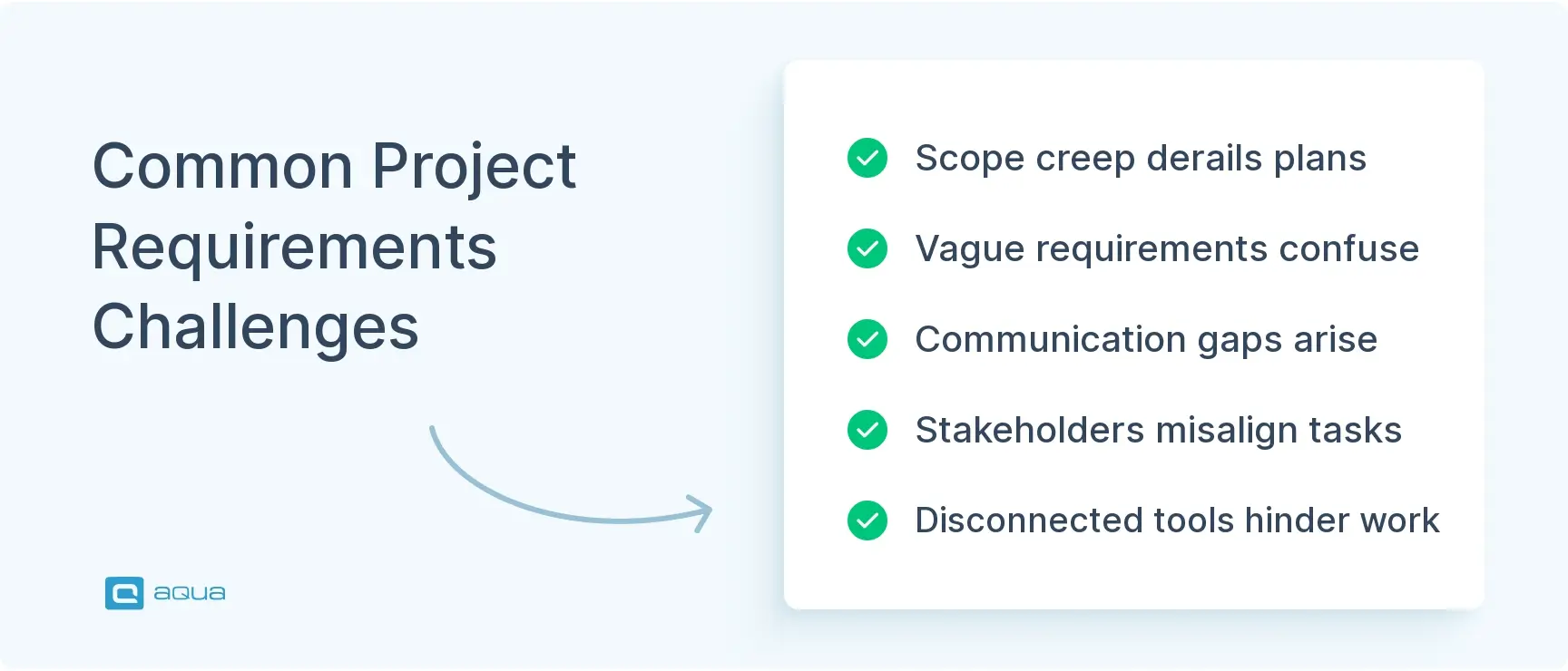
The most common requirements management challenges appear gradually, not all at once, which is why teams that recognize the early signs contain problems before they compound. These problems don’t always announce themselves; they creep in quietly and spread fast if no one’s watching.
Scope creep
It begins with good intentions. Someone suggests a small improvement, then another stakeholder adds a “must-have,” and soon the project feels like it’s growing legs. PMI reports that roughly one-third of all projects suffer from it. The reasons are familiar: unclear boundaries, soft change control, and a habit of saying yes before measuring the cost. The fix is consistency. Define scope precisely, discuss trade-offs openly, and use formal change reviews to make sure new requests are worth what they’ll cost in time and focus.
Unclear or incomplete requirements
Few things sink progress faster than half-baked inputs. When stakeholders say “make it faster” or “improve security” without explaining what success looks like, development turns into guesswork. Ambiguity multiplies until no one’s sure what’s being built. The best defense is structure. Run detailed elicitation sessions, combine interviews with observation, and always translate fuzzy ideas into measurable outcomes. Every vague statement you clarify early saves weeks of correction later.
Communication gaps
Distributed teams often suffer from too much talk in too many places. Messages scatter across chats, spreadsheets, and inboxes until no one knows which version is current. Context fades, and assumptions start to drive decisions. Centralized documentation tools like Confluence, or integrated setups that connect Slack and Microsoft Teams to your requirements platform, keep conversations traceable. Shared visibility is what turns collaboration into alignment.
Stakeholder misalignment
It’s common for teams to believe they’re working toward the same target while aiming at slightly different versions of it. Marketing may expect analytics features that engineering never scoped, while operations anticipates performance fixes that didn’t make the cut. The cure is early and frequent engagement. Bring every key function into requirements discussions and keep them informed through transparent progress updates. Clear documentation of who approved what prevents surprises later.
Lack of visibility and disconnected tools
When information lives in isolated systems, managing requirements becomes detective work. You can’t trace which test covers which feature or what changed since last sprint. Using connected platforms like aqua cloud, Jira, or Azure DevOps creates one source of truth. With full traceability, version control, and coverage tracking, teams regain confidence in what’s done, what’s pending, and where risks hide.
Requirements volatility and resistance to change
Requirements evolve as markets shift and users learn more about what they need. Too much volatility, though, destabilizes plans, while rigid resistance blocks healthy adaptation. The balance lies in process. Establish clear change requests, measure impact before approval, and keep communication open so no one feels blindsided. Teams that handle change calmly deliver better outcomes even when the ground keeps moving.
These challenges never disappear completely, but they stop being threats once you know how to read the early signs. The real advantage comes from awareness. It means spotting trouble before it snowballs and steering the project back to clarity.
Requirements Management Best Practices
The benefits of requirements management depend entirely on how consistently your team applies a core set of practices that keep clarity, traceability, and collaboration in place across every sprint. These best practices for requirements management make the process less about paperwork and more about building shared understanding.
Start with clear goals. Every successful project begins with knowing exactly what it’s trying to achieve. Goals should be measurable and concrete. Instead of saying “improve customer satisfaction”, define something you can track, like “reduce checkout abandonment from 35% to 20% in six months.” Clear direction helps everyone decide what truly matters and which requests can wait.
Involve stakeholders from day one. Projects fail when people are left out of the conversation. Bring business sponsors, developers, QA teams, compliance officers, and end users together early. Listen to their concerns and ideas. Keep them engaged through the whole cycle with workshops, reviews, and shared updates. The more aligned they are, the fewer surprises you’ll face later.
Use different elicitation methods. One method won’t capture everything. Interviews dig deep into details, workshops uncover conflicts, and surveys reveal patterns. Observation helps you understand how people actually work. Combining these techniques gives you a balanced picture instead of a one-sided view.
Listen carefully and question assumptions. Don’t take vague statements at face value. If someone says “make it faster,” ask what “faster” really means. Is it about response time, fewer clicks, or a better interface? Listening closely and confirming understanding early saves time that would otherwise be spent fixing miscommunication later.
Prioritize based on business value. It’s easy for every feature to feel important, but not all of them move the needle. Use frameworks like RICE or MoSCoW to rank work by impact and effort. When priorities are visible and agreed upon, teams can focus on what delivers the biggest results instead of arguing about what to build first.
Keep documentation simple and accessible. Good documentation doesn’t have to be long. It just needs to be clear and consistent. Write enough for others to act without asking for clarification. Use tools that everyone already works with, like Jira, Azure DevOps, or Confluence, or adopt a dedicated platform like aqua cloud. Centralized and transparent documentation keeps everyone aligned and avoids version chaos.
Reuse what already works. Many projects repeat the same requirements: login processes, data privacy rules, or standard performance targets. Create a shared library where teams can reuse proven requirements instead of writing them again. It saves time, improves quality, and keeps standards consistent across projects.
Validate continuously. Don’t wait until the end to check if requirements make sense. Review them often, test them with prototypes, and create early test cases. Feedback from real users and QA at each step keeps the project grounded in reality. Continuous validation helps teams adapt quickly before small issues grow into blockers.
Accept change and improve over time. No project runs perfectly, and that’s fine. Treat requirements as living documents that evolve with what you learn. Agile approaches work best when teams stay flexible and open to refining details instead of clinging to early drafts.
Use modern tools to automate and connect your work. Platforms like aqua cloud, integrated with Jira, Azure DevOps, and Confluence, give full visibility, traceability, and collaboration in one place. You can link requirements with test cases, track coverage, and get real-time updates on progress. Automation reduces manual work and helps teams focus on decisions instead of admin tasks.
Bringing these agile requirements management best practices together builds a workflow that feels organized but never rigid. It keeps teams communicating, decisions transparent, and projects aligned from idea to delivery.
Tools and Techniques for Requirements Management
The right tools determine whether requirements management adds overhead or becomes a genuine competitive advantage for your team. What used to be a manual documentation routine is now a connected, collaborative process where clarity, traceability, and automation define success.
Leading requirements management platforms bring structure to complex workflows.
Visure Requirements ALM Platform offers end-to-end lifecycle management with AI support, strong traceability, custom configurations, and integrations with tools like Jira and Azure DevOps. It’s often preferred by organizations in regulated industries that must comply with standards such as ISO 26262 or DO-178C.
AI-powered tools are changing the way teams create and refine requirements.
Aqua cloud connects directly with Jira and Confluence, automatically extracting structured requirements from raw inputs and creating use cases. Studies show these tools can boost authoring efficiency by up to 80% and accelerate reviews by 90%.
Notion AI turns messy meeting notes into categorized, structured requirements and helps summarize long discussions for quick alignment.
AI-driven impact analysis tools go a step further, predicting how requirement changes will ripple through the project, reducing surprises later in development.
Agile methodologies treat requirements as evolving artifacts.
Instead of locking everything down at the start, agile teams write user stories such as “As a [actor], I want [goal], so that [benefit].” These stories live in backlogs, refined through regular reviews and tied directly to sprints. Testing happens alongside development, keeping validation continuous. This flexible approach turns change into an advantage rather than a disruption.
DevOps integrations bridge the gap between planning and execution.
Platforms like Modern Requirements4DevOps, Codebeamer, and Azure DevOps integrations help synchronize requirements with implementation. Product managers define and approve, developers act, and everyone stays connected to the same context. This reduces handovers, prevents data loss, and keeps every feature linked back to a clear business goal.
Collaboration and visualization techniques make requirements easier to understand.
Mind maps show relationships at a glance.
Process models expose workflow gaps.
Prototypes and mockups give stakeholders something real to react to.
Virtual whiteboards bring distributed teams together, helping them refine ideas in real time.
These visual approaches turn discussions into decisions and improve both engagement and accuracy.
Choosing the right setup depends on your project scale, industry, and team maturity. Smaller agile teams might focus on lightweight tools, while enterprises working under compliance pressure need platforms with robust audit trails. The best tools enhance already good practices; they don’t replace them.
What if we told you there’s a solution that combines it all?
aqua brings modern requirements management and testing under one roof. Its AI can turn a voice note into a structured requirement in seconds, then generate test cases and test data from it instantly. aqua integrates directly with Jira and Confluence, keeping teams aligned from planning to delivery. With full traceability, visibility, and coverage, it gives you the confidence that every requirement is tested, tracked, and connected to measurable outcomes. You can also visualize end-to-end traceability between requirements, test cases, and defects through interactive dependency graphs and direct links. What truly sets aqua apart is its domain-trained AI Copilot with RAG grounding, which doesn’t just generate generic content but creates project-specific requirements and test cases by using your actual documentation and context. Teams using aqua report saving over 12 hours per week per specialist while accelerating time-to-market by up to 60% for digital applications.
Transform your requirements management from documentation overhead to strategic advantage with AI that truly understands your project
Requirements management keeps projects organized, teams aligned, and goals realistic. It connects the big picture with daily work, turning ideas into something that can actually be built and tested. The methods might differ across agile, waterfall, or hybrid workflows, but the essentials stay the same: involve stakeholders early, document clearly, review often, and keep everything traceable. Teams that treat this as a continuous process rather than a checkbox avoid confusion, reduce wasted effort, and deliver what stakeholders truly need. Tools and AI will keep evolving, but clarity, structure, and communication will always define successful requirements management.
Requirement management is the systematic process of capturing, documenting, tracking, and controlling requirements throughout a project lifecycle. It ensures stakeholders agree on what needs to be built, translates those needs into actionable specifications, and maintains alignment as requirements evolve. A requirements engineering tool helps teams organize requirements, track changes, and maintain traceability from initial capture through final delivery.
What are the types of requirements?
Requirements fall into three main categories. Business requirements define organizational goals and outcomes like increasing customer retention or entering new markets. User requirements capture what specific stakeholders need to accomplish, like customer service reps viewing order history within two clicks. System requirements specify what you’re building, split into functional requirements that describe what the system does and nonfunctional requirements that define how it performs, covering performance, security, usability, and reliability.
What are the phases of requirement management?
Requirement management follows several key phases. Elicitation gathers requirements from stakeholders through interviews, workshops, and observation. Analysis evaluates requirements for completeness, consistency, and feasibility while resolving conflicts. Documentation records requirements in clear, structured formats. Validation confirms requirements reflect stakeholder intentions and can be implemented. Tracking monitors requirements throughout development. Change management handles modifications as project conditions evolve.
What makes a requirement testable?
A requirement is testable when your QA team can write a specific pass/fail test case directly from it, without needing to make assumptions. Testable requirements include a clear condition, a specific action, a measurable expected result, and defined exceptions. “The system shall be fast” is not testable. “The system shall return search results within 2 seconds for queries under 100 characters, measured at the 95th percentile under normal load” is testable. The importance of requirements management includes enforcing this standard before requirements enter development, because untestable requirements always become rework later.
How do you measure the quality of requirements management?
The benefits of requirements management are visible in measurable outcomes. Track defect origin: what percentage of production bugs are traceable back to unclear, incomplete, or missing requirements? Track requirements stability: how often do requirements change after approval? High instability signals weak elicitation or validation. Track coverage: what percentage of requirements have linked, executed test cases at release? Track rework rate: how many development hours are spent correcting work caused by requirements misunderstandings? These four metrics give your team an objective picture of whether requirements management is adding value or creating overhead.
What is a Requirements Traceability Matrix and when should teams use it?
A Requirements Traceability Matrix is a document that links every requirement to its business origin, its implementation, and its verification test cases. Teams should use it continuously, not just at the end of a project. It matters most during impact assessment when requirements change, during test execution to confirm coverage, and during audits to demonstrate that every promised feature has been built and verified. The benefits of requirements management at scale depend on maintaining a current RTM: without it, teams cannot confirm completeness, regulators cannot verify compliance, and stakeholders cannot trust that what was agreed has been delivered.
As a former QA Automation Engineer, Kirill has a deep curiosity about how systems work and how they can be crushed. He kept this approach when switching to product management and later, top management at aqua. Automation and everything related to it is his biggest…
Enhancement of the aqua product is Martin’s main responsibility and biggest mission. His expertise covers ITIL Process Consulting, Change Management, Quality Assurance, Quality Management, and Requirements Management. Martin works in QA services for regulated industries for more than 18 years being an irreplaceable leader at…
Nurlan, a QA Coordinator & Quality Standards Officer, takes pride in orchestrating seamless QA operations. His expertise in coordinating QA-focused projects and integrating QA solutions has consistently yielded top-tier client satisfaction. Aside from a full-time QA coordinator, Nurlan's role involves creating compelling content that educates…
Home » Best practices » Effective Requirements Management: Principles and Best Practices
Do you love testing as we do?
Join our community of enthusiastic experts! Get new posts from the aqua blog directly in your inbox. QA trends, community discussion overviews, insightful tips — you’ll love it!
We're committed to your privacy. Aqua uses the information you provide to us to contact you about our relevant content, products, and services. You may unsubscribe from these communications at any time. For more information, check out our Privacy policy.
X
🤖 Exciting new updates to aqua Intelligence are now available! 🎉