Shift-Left and Shift-Right Testing in Agile: Comparison of Strategies & When to Use Each
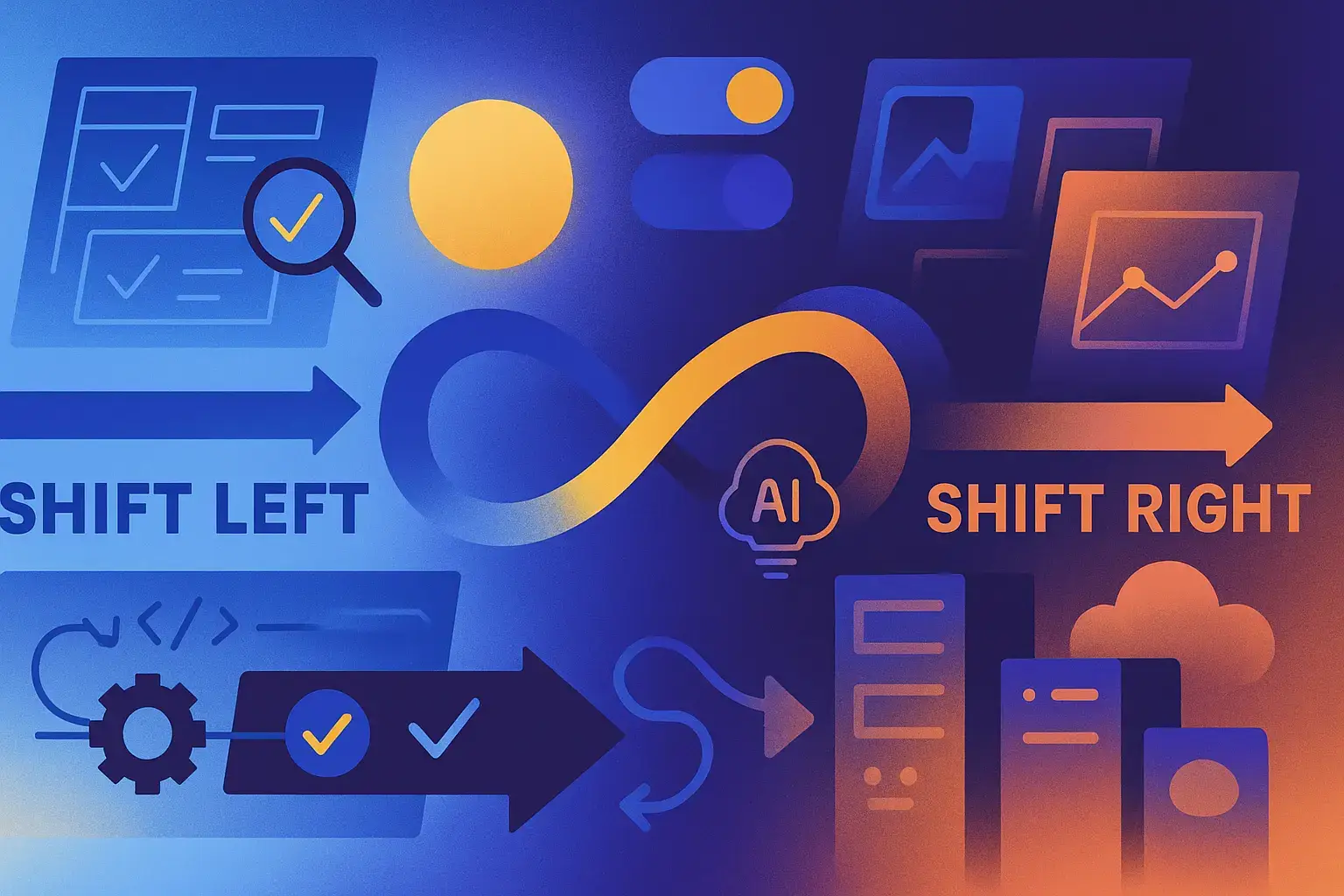
You can easily invest three sprints into development when QA discovers a fundamental requirement misunderstanding. Now you're facing days of rework and broken dependencies. Traditional testing happened too late to prevent defects. It also stopped too early to catch real-world failures. Shift-left testing pulls quality validation earlier into your development cycle, preventing this exact problem. Shift-right extends validation into production environments where actual users interact with your software. This guide breaks down both approaches and shows you when to use each.
Shift-left testing moves quality assurance earlier in the development cycle, focusing on preventing defects when they’re cheapest to fix through requirements validation and design reviews.
Shift-right testing extends validation into production environments, using feature flags and canary releases to observe how software actually behaves with real users.
The fundamental difference is timing and risk focus: shift-left targets predictable defects during development while shift-right addresses unpredictable failures in production.
Effective quality strategies implement both approaches together, with shift-left preventing known issues and shift-right discovering unknown failure modes.
Most teams make the mistake of picking one testing approach over the other. Learn how to balance both shift left and shift right strategies for continuous quality without sacrificing speed 👇
What is Shift Left Testing in Agile?
Shift left testing represents a fundamental change in how your team approaches quality assurance throughout the software development lifecycle. Understanding the shift left meaning of Agile is essential for modern development teams.
In practical terms, shift left testing in Agile means moving quality assurance activities earlier in your software development lifecycle. You validate quality from day one rather than waiting until development wraps up to start testing. The name comes from the visual representation of a project timeline: moving quality activities “left” on that timeline means doing them sooner.
The core principle is straightforward: catch problems when they’re cheap and easy to fix. A misunderstood requirement caught during a planning session costs you fifteen minutes of discussion. That same misunderstanding discovered three sprints later costs you days of rework and broken dependencies. The shift left testing approach in Agile emphasizes prevention over detection. This turns your entire team into quality advocates rather than leaving QA to play defense at the end.
Key characteristics of shift left testing include:
Early involvement: QA participates from requirements gathering and sprint planning
Preventive focus: Emphasis on stopping defects before they’re coded, not just finding them
Developer-centric testing: Unit tests and TDD become part of the daily development workflow
Collaborative quality: Three Amigos sessions align developers and testers before coding begins
Continuous validation: Automated tests run with every code commit in CI/CD pipelines
What does this look like in practice? You’ll see Three Amigos sessions where developers and testers hash out acceptance criteria before anyone writes code. Threat modeling sessions identify security risks during design reviews. Developers write unit tests alongside their implementation and get immediate feedback about whether their code does what they think it does. For instance, a payments platform team discovered requirement gaps during story refinement that would’ve caused calculation errors affecting thousands of transactions. The team caught these gaps before a single line of production code existed.
When you implement shift-left and shift-right strategies, you often find yourself struggling with disconnected tools that slow down your feedback loops. This is where aqua cloud, an AI-powered test and requirement management platform, shines as the ideal solution for modern Agile testing approaches. Unlike traditional test management tools, aqua cloud supports both shift-left and shift-right methodologies simultaneously. You catch defects early during development while validating software in real-world conditions. With aqua’s AI Copilot, powered by domain-trained models with RAG grounding, you can instantly generate test cases from requirements. This accelerates your shift-left efforts by up to 80%. With aqua, test case generation is based on your project’s actual documentation and reflects your specific domain knowledge. As you build quality from day one, aqua’s integrations with Jira, Azure DevOps, and 12+ other tools help you create the continuous feedback loop essential for both testing approaches.
Organizations adopt shift left testing Agile practices because late defect discovery is expensive and demoralizing. Research from IBM and Forrester consistently shows that defects caught during requirements cost 10-100 times less to fix than those discovered after release.
1. Significant cost reduction
When you find a bug in production, you’re not just fixing code. You’re investigating root causes and coordinating emergency deployments. Beyond that, you’re managing customer complaints and potentially dealing with data corruption. Shift-left testing dramatically reduces the defects that matter most to your business.
2. Faster development cycles
Your development cycles accelerate because your team stops constantly backtracking to fix foundational issues. For example, one e-commerce team cut their regression testing time by 40% after implementing shift-left practices. The improvement came because they stopped shipping features with obvious gaps that required extensive validation cycles.
3. Improved engineering discipline
Your team develops stronger engineering habits when quality activities happen early. Writing testable code becomes second nature. As a result, developers get fast feedback about whether they’re building the right thing correctly.
4. Enhanced cross-functional collaboration
Developers and testers work together from sprint planning onward. They build shared context about what you’re building and why. This collaboration breaks down silos and creates shared quality ownership across your team.
5. Higher team morale
Teams practicing shift left testing principles report higher morale and less finger-pointing during incident reviews. The cumulative effect transforms how your team approaches software delivery and makes quality feel achievable.
Principles of Agile Shift Left Testing
The shift left approach in Agile embodies several core principles that distinguish it from traditional testing models. Understanding what is the meaning of shift left Agile helps teams implement these principles effectively.
Principle 1. Testing begins with requirements, not code
Before implementation starts, your team uses example-driven development to validate shared understanding. You also define acceptance criteria that everyone agrees upon. This principle prevents the classic problem where developers and testers all think they agree but are actually envisioning different outcomes.
Key practices include:
Writing concrete examples of expected feature behavior during planning
Defining acceptance criteria using Given-When-Then format
Conducting specification workshops before coding begins
Validating requirements against business rules
Principle 2. Automation serves developers first
Fast, deterministic automated checks run close to the code. These include unit tests and component tests that give developers immediate feedback during implementation. The goal centers on enabling developers to refactor confidently and catch regressions before they escape their local environment.
Key practices include:
Writing unit tests that execute in milliseconds
Implementing test-driven development workflows
Creating component tests for integration validation
Building fast feedback loops in local development environments
Principle 3. Quality is a team sport, not a QA handoff
Shift left in Agile breaks down the traditional model where developers “throw code over the wall” to testers. Instead, developers participate in test design while testers contribute to architecture discussions. Meanwhile, product owners define testable acceptance criteria.
Key practices include:
Holding Three Amigos sessions for every user story
Including testers in design reviews
Pairing developers with testers during implementation
Sharing quality metrics across the entire team
Principle 4. Early risk identification and mitigation
Proactive risk assessment happens during planning phases, not after code is written. Your team identifies technical risks and security vulnerabilities before they become embedded in the codebase.
Key practices include:
Conducting threat modeling sessions during design
Reviewing testability during architecture planning
Identifying dependencies early in the process
Creating spike solutions for high-risk technical unknowns
When to Use Shift Left Testing in Agile Projects
Shift left testing works best when you’re dealing with predictable, preventable risks that stem from misunderstandings or design flaws rather than unpredictable runtime behavior.
Best fit scenarios:
Complex business logic: Calculation engines and pricing systems where you can specify behavior upfront
Regulated industries: Healthcare or finance where compliance violations in production trigger penalties
Complex data models: Systems with intricate state management that become exponentially harder to untangle in production
High-risk technical decisions: Architecture choices that are expensive to reverse once implemented
When to be cautious:
Teams new to Agile often focus exclusively on shift-left testing because it feels more familiar and controllable. However, that approach leaves critical gaps in your quality strategy. Some risks only reveal themselves when real users interact with real systems under real load conditions.
Illustrative Examples
Example 1: Healthcare Compliance System
Your healthcare platform team uses shift-left testing to validate HIPAA compliance requirements during design reviews. This approach prevents violations that would’ve triggered regulatory penalties and damaged patient trust. Specifically, threat modeling sessions reveal data exposure risks in your proposed API design. These findings lead to architecture changes before implementation begins, protecting both your patients and your organization.
Example 2: Financial Services API
Your fintech team discovers during design review that the proposed API would make integration testing nearly impossible. By including QA engineers in the architecture discussion, you redesign the API with testability in mind. You create clear contracts and predictable error handling. This conversation saves your team weeks of painful test automation work and results in a more maintainable system overall.
Shifting right gives you a virtual guarantee that your testing is guided by what the business (i.e. the CEO) cares about. Shift left can exist without shift right, but in my opinion you'll be left with a missing puzzle piece: one that you may not even realize has been missing until you inquire about it.
Shift right testing complements shift left practices by extending quality validation beyond pre-release environments into the real world where users actually interact with your software.
Shift right testing extends quality validation into production environments where you observe how software actually behaves under real-world conditions. While shift left testing prevents predictable failures before deployment, Agile shift right testing catches the unpredictable ones. These include edge cases you didn’t anticipate and user behaviors you couldn’t simulate. Performance characteristics that only emerge at scale also fall into this category.
Shift-right practices focus on running controlled, observable experiments in production with safety nets like feature flags. You also use staged releases and monitoring systems. The goal is learning from reality rather than making perfect predictions in test environments.
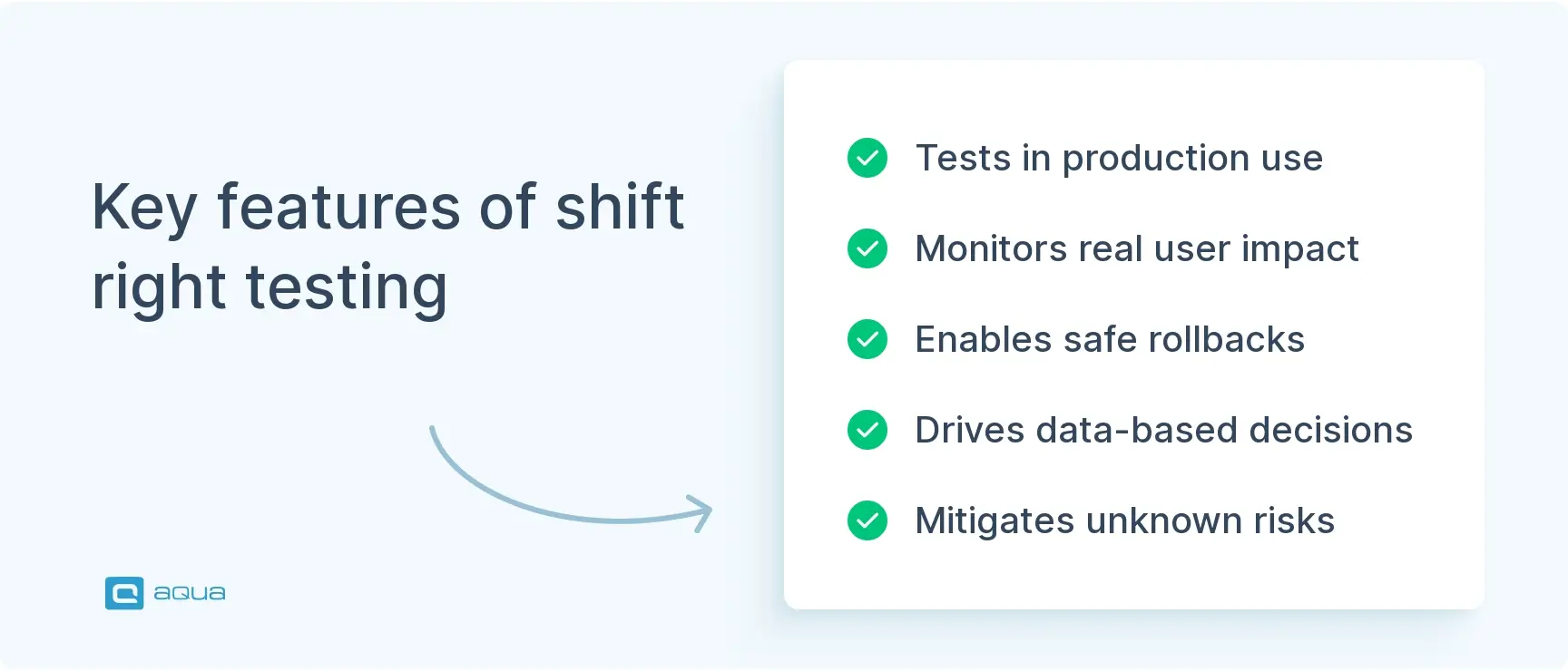
Key characteristics of shift right testing include:
Production validation: Verifying software works for real users in real scenarios, not just synthetic tests
Continuous monitoring: Proactive health checks through metrics and logs that detect anomalies
Progressive delivery: Incremental feature releases with monitoring at each stage
Hypothesis-driven experiments: Each deployment tests specific assumptions about behavior
Observable and reversible: Feature flags and instant rollback minimize risk
Core principles behind shift right testing include production validation. This means verifying that what you deployed actually works for real users in real scenarios. You measure actual user success rates and transaction completion under genuine load patterns. For instance, one streaming media platform used staged releases to test a new recommendation algorithm. They discovered it caused 15% higher latency for mobile users. Load testing completely missed this issue because it didn’t account for specific device constraints and network variability that actual users experienced.
Advantages of Shift Right Testing in Agile
The primary advantage of shift right testing in Agile is reality testing. You validate assumptions against actual conditions instead of simulated ones.
1. Reality testing and assumption validation
Your staging environment doesn’t perfectly mirror production. User behavior is also messier than your test scenarios. A/B testing reveals which features actually improve user outcomes versus which ones seemed promising in planning but fall flat in practice.
2. Rich observability and data-driven decisions
Modern shift-right testing generates rich telemetry about system behavior and performance bottlenecks. For example, one SaaS platform discovered through production monitoring that 80% of their database load came from a single poorly optimized query. Staging environment metrics never revealed this pattern because test data didn’t match production usage.
3. Effective risk mitigation
By deploying incrementally with kill switches, you limit blast radius when things go wrong. You also use automated rollback to respond quickly. Instead of binary success-or-failure releases, you get graduated exposure with learning opportunities at each stage.
4. Product validation before scaling
Product teams validate whether features deliver promised value before investing in scaling them. This prevents wasted engineering effort on features that don’t resonate with users.
5. Improved system resilience
Regular chaos engineering keeps your team practiced at handling incidents. Failure testing also helps identify weak points before they cause outages.
Principles of Agile Shift-Right Testing
Principle 1. Hypothesis-driven experimentation
You test assumptions about user behavior and system performance with each deployment. Business outcomes also get validated through real-world data. Each deployment becomes an experiment with clear hypotheses that you measure and validate.
Key practices include:
Defining measurable hypotheses before each release
Establishing success criteria upfront
Running controlled experiments with comparison groups
Documenting learnings for future reference
Principle 2. Controlled exposure with safety mechanisms
Feature flags let you activate functionality for specific user segments without redeploying code. Meanwhile, staged releases expose new versions to tiny percentages of traffic while monitoring for anomalies.
Key practices include:
Implementing feature flag systems for gradual rollouts
Using staged deployments with 1% and 5% traffic patterns
Setting up circuit breakers for dependency failures
Creating automated rollback triggers based on error thresholds
Principle 3. Comprehensive observability
You can’t test what you can’t see. Shift-right requires instrumentation that provides visibility into system behavior and user actions.
Key practices include:
Implementing structured logging across all services
Setting up distributed tracing for request flows
Creating dashboards for key health metrics
Establishing alerts for anomaly detection
Principle 4. Blameless learning from failures
When production incidents occur, your team treats them as learning opportunities rather than occasions for finger-pointing. Postmortems focus on systemic improvements.
Key practices include:
Conducting blameless postmortems after incidents
Documenting failure patterns for future reference
Practicing incident response through game days
Building organizational memory of failure modes
When to Use Shift Right Testing in Agile
Best fit scenarios:
You should deploy shift right testing when dealing with unknowable risks. These are scenarios where pre-production testing can’t give you confidence because real-world conditions are too complex to simulate accurately.
Distributed systems with many moving parts present unpredictable interactions.
Third-party integrations connecting to APIs you don’t control have variable reliability.
User behavior uncertainty means adoption patterns are unknown.
Performance at scale varies wildly based on real usage patterns.
Complex product hypotheses require validation before scaling investment.
When to be cautious:
Teams often ask what is shift left approach in Agile versus shift-right as if they’re choosing one. The real question is how to balance both strategies based on your risk profile. Don’t attempt shift-right testing without solid shift-left foundations. You’ll end up using production to catch basic quality issues rather than learning about emergent system behaviors.
Illustrative Examples
Example 1: E-commerce Personalization Engine
Your e-commerce team tests a complex personalization engine with 5% of users through feature flags. Production metrics reveal users find recommendations irrelevant, which doesn’t move the needle on purchasing behavior. You discover this before investing six months scaling the feature. This prompts a pivot to a simpler algorithm that actually improves conversions. Your team validates business assumptions before committing significant engineering resources.
Example 2: Streaming Media Algorithm
Your streaming media platform uses staged releases to test a new recommendation algorithm. You discover it causes 15% higher latency for mobile users. Load testing completely missed this issue because it didn’t account for specific device constraints your actual users experienced. You roll back immediately and optimize before wider release, preventing a poor user experience for your entire mobile user base.
Shift Left vs. Shift Right in Agile Environment: Key Differences
Understanding the strategic differences between shift left and shift right testing helps you determine the right balance for your specific context. These approaches represent two complementary software testing strategies that work best when implemented together.
The fundamental difference lies in when and where validation happens. Shift-left focuses on pre-deployment quality while shift-right focuses on post-deployment validation. Together, they create comprehensive quality coverage. Shift-left prevents known classes of failure while shift-right discovers unknown failure modes against real-world usage.
Aspect
Shift Left Testing
Shift Right Testing
Primary Focus
Prevention and early detection
Validation and observation
Core Question
“Are we building the right thing correctly?”
“Does what we built actually work for real users?”
Timing
Before and during development
After deployment to production
Environment
Development and staging pipelines
Production with live user traffic
Risk Type
Predictable, specifiable defects
Emergent, unpredictable failures
Feedback Speed
Fast (seconds to minutes)
Slower (hours to days)
Tools & Practices
Unit tests, TDD, acceptance criteria
Monitoring, staged releases, A/B testing
Key Metrics
Code coverage, defect detection rate
User success rate, MTTR, business KPIs
Team Ownership
Development teams, QA collaborating early
SRE, DevOps, product teams
Cultural Requirements
Cross-functional collaboration
Operational maturity with controlled experimentation
Investment Focus
Automation infrastructure
Observability platforms
Best For
Known requirements, complex logic
User behavior validation, performance at scale
These complementary strategies work best when you use them together rather than picking one over the other. If your team focuses only on shift-left, you’ll ship fast but fragile systems. Focus only on shift-right, and you’ll build theoretically correct systems that fail when real users touch them. The real question isn’t which one to choose but how to implement both effectively for your specific situation.
The benefit of shift left is that there are many gaps or mismatches in the requirement which can be identified at an early stage, hence saving cost and time however, it comes at its own cost. Sometimes the meeting drags because of such a discussion, and hence consumes everyone's time.
Successfully combining shift-left and shift-right testing requires a structured approach that builds capabilities incrementally.
Step 1: Map quality risks across your lifecycle
Start by identifying which failures you can prevent through early testing and which only reveal themselves in production. A payment processing system needs a heavy shift-left focus for calculation logic while relying on shift-right for fraud detection under real transaction volumes. This assessment guides where you invest your quality efforts most effectively.
Step 2: Establish shift-left foundations
Build your preventive quality practices first. Define clear acceptance criteria before development begins. Set up automated unit testing in your CI/CD pipeline. Add integration testing and design reviews that include testability considerations. Create threat models during architecture planning. These practices prevent obvious defects from reaching production and make shift-right testing safer.
Step 3: Create cross-functional quality ownership
Break down silos between developers and testers so quality becomes everyone’s responsibility. Implement Three Amigos sessions and design reviews with QA participation. Add collaborative test planning to your workflow. When your entire team owns quality from the first conversation about a feature, you build shared context and prevent handoff delays.
Step 4: Build intelligent test automation
Focus on high-signal tests that catch real problems rather than chasing coverage metrics that create brittle test suites. Create fast feedback loops with unit tests that execute in milliseconds. Add component tests for integration validation. Your automated tests should provide tangible value to your development workflow, not just checkboxes for compliance.
Step 5: Implement observability infrastructure
You can’t practice shift-right testing effectively without knowing what’s happening in production. Start with structured logging that gives visibility into production behavior. Add metrics collection and instrument your applications to answer specific questions about system health. This foundation is essential before you can safely test in production.
Step 6: Add progressive delivery mechanisms
Once observability is in place, implement feature flags that let you control exposure without redeploying code. Set up staged release pipelines that expose new versions to small percentages of traffic. Create automated rollback triggers based on error rate thresholds. These safety nets ensure you can respond quickly when issues arise.
Step 7: Build hypothesis-driven validation
At this stage, you’ll want to develop A/B testing frameworks that measure actual impact of changes on user behavior. Before each release, define success criteria and use data to inform your product decisions. This approach validates whether features deliver promised value before you invest in scaling them, which saves both time and resources.
Step 8: Introduce controlled failure testing
After establishing solid observability and progressive delivery, begin testing system resilience through chaos engineering. Start with controlled experiments in non-production environments to build team confidence. Gradually introduce production chaos experiments during low-traffic periods. Practice disaster recovery procedures regularly so your team stays prepared for real incidents.
Step 9: Feed production insights back to development
Create continuous feedback loops where production learnings inform shift-left practices. If you’re catching performance issues in production, add performance budgets to your shift-left testing. If monitoring reveals user confusion with specific features, improve how you define acceptance criteria. Let each strategy inform the other.
Step 10: Choose tools that support your strategy
Select tools based on your needs rather than letting tools dictate your approach. For shift-left, you need test frameworks appropriate to your stack and CI/CD systems that run checks on every commit. Add static analysis tools for security. For shift-right, choose observability platforms and feature flag services. You also need deployment automation that supports staged releases. AI-enhanced shift left testing tools and AI in software testing capabilities can help both strategies by generating test cases and analyzing production telemetry.
Your team will excel at both strategies when you treat quality as a continuous learning process rather than a checkbox activity. Shift-left to prevent predictable failures efficiently. Then shift-right to discover gaps in your shift-left assumptions. This creates a virtuous cycle where each strategy improves the other, and your overall quality confidence increases without sacrificing delivery speed.
Successful Agile testing requires a balanced approach that combines both shift-left and shift-right strategies. Without the right platform, this balance becomes incredibly challenging to maintain. aqua cloud, an AI-driven test and requirement management solution, covers exactly that by providing comprehensive test management capability. The AI Copilot, which operates on your project’s documentation through RAG technology, can generate precise test cases in seconds. This enables truly effective shift-left testing from day one. For shift-right validation, aqua’s unified test repository works alongside real-time dashboards to help you capture production data. Monitoring integrations also helps you analyze this data effectively. This closes the feedback loop back to development. The platform’s flexible workflows work with tools like Jira, Jenkins, Azure DevOps, Ranorex, and others via REST API. As Agile testing software, aqua supports the complete quality lifecycle. By implementing both strategies through aqua, you’ll catch defects when they’re cheapest to fix while validating your software against real-world conditions.
Implement both shift-left and shift-right testing while cutting QA costs by 50%
Shift left and shift right Agile testing work together as complementary halves of a complete quality strategy. Shift-left prevents predictable failures by catching issues early when fixes are cheap. Shift-right validates assumptions against reality and reveals insights no pre-production testing can deliver. The teams that thrive balance both strategies based on their specific risks. Start by strengthening shift-left foundations and then layer in shift-right capabilities as you grow. Maintain continuous feedback loops between both approaches. Build software that ships fast without breaking things.
What is the difference between Shift-Left and Shift-Right testing in Agile?
Shift-left testing moves quality activities earlier in development and catches defects during requirements when they’re cheap to fix. Shift-right testing validates software in production environments by observing real user behavior under actual conditions. They address different risk types and complement each other for comprehensive quality coverage.
When should an Agile team use Shift-Left testing vs. Shift-Right testing?
Use shift-left for predictable risks like business logic, where behavior can be specified upfront. Also, use it for compliance requirements. Use shift-right for unpredictable risks like performance at scale that only reveal themselves in production environments. The best approach combines both strategies based on your risk profile.
What are the key benefits of adopting Shift-Left testing strategies?
Shift-left testing reduces costs through early defect detection. Research from IBM shows that defects caught during requirements cost 10-100 times less to fix than those found after release. Beyond that, it accelerates development cycles by preventing rework and improving cross-functional collaboration. Teams spend more time building features and less time fixing preventable mistakes.
How does Shift-Right testing improve software quality after release?
Shift-right testing validates assumptions against reality through production monitoring. It catches edge cases that pre-production testing missed. Beyond that, it enables data-driven product decisions via A/B testing and limits risk through progressive delivery. This approach improves system resilience through chaos engineering and makes releases safe experiments.
Can Shift-Left and Shift-Right testing be used together in the same Agile workflow?
Yes, they’re complementary strategies that work best together. Shift-left prevents predictable failures before deployment, while shift-right discovers unknown failure modes in production. Combined, they create continuous feedback loops where production insights inform development practices. As a result, quality confidence increases without sacrificing delivery speed.
Home » Best practices » Shift-Left and Shift-Right Testing in Agile: Comparison of Strategies & When to Use Each
Do you love testing as we do?
Join our community of enthusiastic experts! Get new posts from the aqua blog directly in your inbox. QA trends, community discussion overviews, insightful tips — you’ll love it!
We're committed to your privacy. Aqua uses the information you provide to us to contact you about our relevant content, products, and services. You may unsubscribe from these communications at any time. For more information, check out our Privacy policy.
X
🤖 Exciting new updates to aqua AI Assistant are now available! 🎉






 Bankingaqua ALM helps banks increase testing productivity by over 50%