End-to-End (E2E) vs. Functional Testing: Key Differences Explained
Just imagine a bug slips past your functional tests and makes it to production. Users can't complete checkout. Hopefully, this is just an illustrative scenario. Yet, you might have found yourself in similar situations before when you didn't choose the test scope correctly. [Functional testing](https://aqua-cloud.io/functional-testing/) and [end-to-end testing](https://aqua-cloud.io/end-to-end-testing/) are complementary approaches needed at different layers of your system. This guide will delve into all the differences to help you shape your test strategy, optimize coverage, and keep your build pipeline healthy.
Functional testing validates individual features against requirements, while end-to-end testing confirms complete user workflows across integrated systems. Both approaches are complementary: functional tests catch feature-level bugs quickly, while E2E tests reveal integration issues that slip through isolated checks.
Key Testing Type Differences
Functional Testing Scope – Validates specific features in isolation using unit, integration, system, smoke, and regression tests.
E2E Testing Scope – Simulates real user journeys across the full stack including UI, APIs, databases, and external services.
Speed vs Coverage Trade-off – Functional tests run fast and are easier to debug; E2E tests are slower but catch system-level failures.
Testing Pyramid Balance – Most teams implement more functional tests (middle layer) and fewer E2E tests (top layer) for pipeline efficiency.
Combined Approach – Use functional tests for thorough feature validation and targeted E2E tests for critical business workflows.
aqua cloud unifies functional and E2E testing with centralized test management, AI-generated test cases, and complete requirement traceability. Teams using aqua maintain clear coverage across both testing types while reducing test creation time by 98%.
Functional testing verifies that specific features or functions within your application behave according to requirements. Under the scope of functional testing, your QA checks inputs, outputs, business rules, and interactions at the feature level, without examining how the code works under the hood. Thats the black-box testing scope, where app behavior matters.
The goal is straightforward: ensure each feature performs its intended action. If youre testing a login form, youre confirming that valid credentials grant access, invalid passwords trigger error messages, and locked accounts prevent sign-in. Each test case targets a discrete piece of functionality, making it easier for your team to pinpoint failures when something breaks.
Functional testing covers UI behavior, API endpoints, data processing logic, authentication flows, and error handling. These tests run independently of one another, focusing on isolated features. That isolation makes them quicker to execute and simpler to debug when issues arise.
Functional testing (check that things work according to client's contract) is an intermediate between both of them -and the most important from the "money's point of view").
Unit testing validates individual code components or functions in complete isolation. As a developer, this is the most granular level of testing available to you and the fastest to execute.
What unit testing covers:
Individual functions and methods
Class-level behavior and logic
Boundary conditions and edge cases
Return values and exception handling
Example: Testing a calculateDiscount() function to confirm it returns the correct value for standard, VIP, and invalid customer tiers, without involving a database or UI.
Integration Testing
Integration testing checks how modules or services interact with each other. Where unit tests isolate components, integration tests verify that those components communicate correctly once combined. Your team should run these whenever two or more services need to exchange data.
What integration testing covers:
API contracts between services
Database read/write operations from application logic
Inter-module data flow
Authentication handoffs between components
Example: Testing that your order service correctly calls the inventory service and receives updated stock data after a purchase is placed.
System Testing
System testing confirms that the entire application meets its functional requirements. Your QA team evaluates the assembled product as a whole, before it reaches real users.
What system testing covers:
Full application workflows from a functional standpoint
Compliance with business and technical requirements
Cross-functional feature interactions
Data integrity across the system
Example: Verifying that a user can complete the full account registration process, covering email, password setup, and profile creation, with all data persisting correctly.
Smoke Testing
Smoke testing runs a quick, high-level check after each new build to catch obvious failures before deeper testing begins. Think of it as a go/no-go gate for your test pipeline, something your team can run in minutes.
What smoke testing covers:
Critical paths that must work for the app to function
Core feature availability after deployment
Basic navigation and access
Key integrations that the rest of the test suite depends on
Example: After a deployment, confirming the homepage loads, login works, and the primary dashboard renders without errors.
Regression Testing
Regression testing ensures that new code changes don’t break existing functionality. Your team will run this repeatedly throughout development, and it’s one of the most common candidates for automation. Pairing it with solid testing automation tools keeps execution fast and coverage consistent.
What regression testing covers:
Previously passing test cases after code changes
Features adjacent to recently modified code
Bug fixes that should not recur
Configuration or dependency updates that could affect behavior
Example: After shipping a new payment method, run the full checkout test suite to confirm that existing card and PayPal flows still work correctly.
Speaking of balancing functional and E2E testing strategies, many teams struggle with managing both approaches. This is where aqua cloud stands out as a comprehensive test and requirement management platform. With aqua, you can organize both functional tests for individual features and E2E tests for critical workflows in one centralized repository, maintaining clear traceability between requirements, test cases, and results. The platform’s nested test cases feature allows you to reuse common test steps across different testing types, dramatically reducing maintenance overhead when application changes occur. aqua’s domain-trained actana AI can generate appropriate test cases from your requirements in seconds, creating both feature-level validations and end-to-end scenarios based on your project’s actual documentation. aqua integrates natively with Jira, Jenkins, Selenium, Playwright, and Azure DevOps, and 12+ other software, so your team fits it into the toolchain you already use without replacing anything.
Save 98% of test creation time with a platform built for both functional and E2E testing
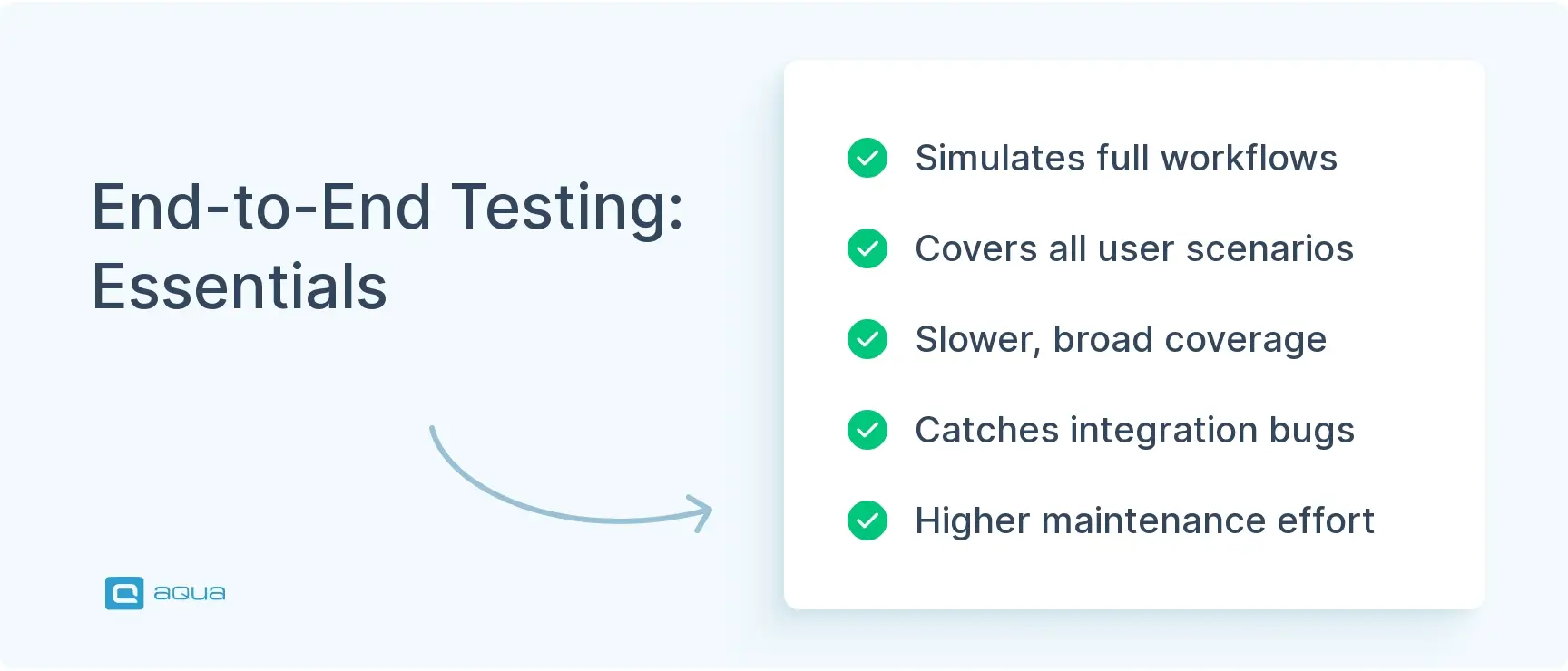
End-to-end testing validates complete application workflows from start to finish, simulating real user behavior across your entire system stack. You’re verifying that everything works together: UI, back-end services, databases, APIs, authentication systems, and external integrations.
The question shifts from “Does this feature work?” to “Does this workflow actually deliver the intended user experience?”
Consider an e-commerce purchase flow. A user visits your site, logs in, searches for a product, adds it to their cart, checks out, enters payment details, and receives an order confirmation. That single workflow touches your front-end, product catalog service, inventory management system, payment gateway, database, email service, and possibly third-party analytics. An E2E test replicates that entire journey. If any link in the chain breaks, the test catches it.
E2E tests are slower, require more infrastructure, and cost more to maintain. But they catch integration bugs that slip through feature-level checks. As a business owner or engineering lead, that trade-off is worth understanding clearly before you decide how many to run.
The more end-to-end, probably the slower and harder to maintain they are, and harder to pinpoint what made them fail. But on the other hand, they're more comprehensive and closer to real usage.
UI E2E testing automates real user interactions through the browser interface. It validates that the front-end and back-end work together as users actually experience them. Your team uses this to confirm that what users see matches what the system does.
What UI E2E testing covers:
Full user journeys across multiple pages and screens
Form submissions and dynamic content rendering
Navigation flows and state persistence
Visual feedback, error messages, and confirmation screens
Example: Automating a login > product search > add to cart > checkout > order confirmation flow using Cypress or Playwright, validating each step produces the expected result.
API End-to-End Testing
API E2E testing validates the full chain of service calls behind a user action, from the initial request through every downstream dependency. For your team, this is especially useful when multiple microservices need to cooperate on a single user-facing operation.
What API E2E testing covers:
Multi-service request chains
Data transformation across service boundaries
Authentication token flows between services
Third-party API response handling
Example: Triggering a fund transfer via API and verifying the request flows correctly through authentication, balance validation, transaction recording, and notification services, then checking the final state of each.
Database End-to-End Testing
Database E2E testing confirms that data is written, read, updated, and deleted correctly as users move through workflows. Your team uses this to ensure persistence and integrity hold up across the full stack.
What database E2E testing covers:
Data state after multi-step user actions
Transaction rollback on failure
Data consistency across related tables or services
Correct handling of concurrent operations
Example: After a user completes a purchase, verify that the orders table, inventory table, and customer activity log all reflect the transaction accurately and consistently.
Cross-Browser and Cross-Device Testing
This type of E2E testing validates that workflows function correctly across different browsers, operating systems, and device types. For your team, it ensures consistent behavior regardless of how users access your application.
What cross-browser/device E2E testing covers:
Browser-specific rendering and JavaScript behavior
Mobile vs. desktop layout and interaction differences
Touch vs. click event handling
Session and cookie management across environments
Example: Running your core checkout workflow across Chrome, Firefox, Safari, and a mobile viewport to confirm no browser-specific bug breaks the user journey.
Performance End-to-End Testing
Performance E2E testing evaluates how the full system behaves under realistic load conditions. As a C-level executive or product owner, this is the test type most directly tied to user experience at scale.
What performance E2E testing covers:
Response times for critical user flows under load
System behavior at peak concurrent usage
Bottlenecks in service chains under stress
Degradation patterns as load increases
Example: Simulating 500 concurrent users completing a hotel booking workflow and validating that search, availability checks, and payment processing all complete within acceptable thresholds.
Comparison of E2E Testing and Functional Testing
aqua cloud experts are well aware of all the key concerns business owners have when allocating funds for one or another software testing type. The table below should provide a great insight into E2E vs functional testing comparison:
Aspect
Functional Testing
End-to-End Testing
Scope
Individual features or components
Complete user workflows across integrated systems
Objective
Verify specific functions meet requirements
Validate entire application flow from user perspective
Infrastructure
Moderate, may use mocks or stubs
Full system stack required (databases, APIs, services)
The table highlights a clear trade-off: functional tests give your team depth on specific features, while E2E tests provide breadth across the entire system. Most teams implement more functional tests and fewer E2E tests, a principle central to best testing strategies. That balance keeps your CI pipeline efficient while still catching critical integration bugs.
When to Use End-to-End Functional Testing
End-to-end functional testing combines the comprehensive flow of E2E testing with the feature validation aspects of functional testing. This approach is particularly valuable when your team needs to verify both the functional correctness of features and their interaction within complete user workflows. Organizations implementing end-to-end functional testing typically focus on critical business processes that span multiple system components.
When weighing functional vs end to end testing, consider that the former focuses on isolated feature validation while the latter examines the entire system flow. End-to-end functional testing bridges this gap by ensuring features not only work individually but also function correctly within real-world user journeys. For your team, this matters most when a single user action depends on several interconnected services working in sync.
When evaluating functional testing vs end to end testing for your pipeline, a good starting point is to map your highest-risk user journeys. Any workflow where a failure would directly impact revenue or user trust is a strong candidate for end-to-end testing vs functional testing coverage at both levels.
Finding the right balance between functional and end-to-end testing is one layer of complexity. But managing this dual approach is another difficulty that requires a proper tech stack. aqua cloud, a test and requirement management platform, unifies your testing activities within a single environment. With aqua, your team can maintain distinct functional test cases while organizing them into end-to-end workflows, all with complete traceability to your requirements. The platform’s actana AI is uniquely trained on testing methodologies and grounded in your project’s documentation. It can instantly generate appropriate test cases for both testing types, dramatically reducing manual effort. Automated reporting dashboards give you real-time visibility into test coverage and execution status across functional and E2E tests, helping your team identify gaps and prioritize efforts. aqua integrates natively with Jira, Jenkins, Selenium, Playwright, Azure DevOps, and GitLab, with REST API access to connect any additional tool your team already relies on.
Save 12.8 hours per tester per week with aqua’s actana AI
Functional testing catches feature-level bugs early with fast, targeted checks. E2E testing confirms your entire system works together under real user conditions. Use functional tests for thorough feature validation and targeted E2E tests for your most critical workflows.
Teams that combine both approaches in automated CI/CD pipelines ship more reliable software, reduce production incidents, and keep build times manageable. Knowing when to apply each is what separates a reactive QA process from a proactive one.
Is functional testing the same as end-to-end testing?
No. Functional testing validates individual features against requirements, focusing on whether specific functions work correctly in isolation. End-to-end testing verifies complete user workflows across your entire application stack, ensuring all integrated components operate together as expected. You need both: functional tests catch feature-level bugs early, while E2E tests confirm that the full system delivers the intended user experience.
How do end-to-end tests improve overall software quality compared to functional tests?
E2E tests reveal integration issues that functional tests miss. They validate data flow between services, confirm that components communicate correctly, and simulate real user behavior across your entire system. While functional tests ensure features work individually, E2E tests prove those features work together in production-like scenarios. That broader coverage catches system-level defects before your users encounter them.
What challenges should be considered when implementing end-to-end testing in a CI/CD pipeline?
E2E tests run slower, require full infrastructure, and often suffer from flakiness. Test results can vary across executions due to timing issues, network delays, or asynchronous rendering. They’re harder to debug when failures span multiple services, and UI changes frequently break test scripts. Keep E2E tests focused on critical workflows, run them in stable environments, and monitor flakiness to maintain pipeline reliability.
Enhancement of the aqua product is Martin’s main responsibility and biggest mission. His expertise covers ITIL Process Consulting, Change Management, Quality Assurance, Quality Management, and Requirements Management. Martin works in QA services for regulated industries for more than 18 years being an irreplaceable leader at…
Pavel, a Quality Assurance Consultant and Author, brings deep expertise to solving complex testing challenges. His background in software development has helped organizations transform their QA practices from reactive to proactive. Beyond consulting, Pavel develops best practice guides and case studies for aqua cloud that…
Home » Test Automation » End-to-End (E2E) vs. Functional Testing: Key Differences Explained
Do you love testing as we do?
Join our community of enthusiastic experts! Get new posts from the aqua blog directly in your inbox. QA trends, community discussion overviews, insightful tips — you’ll love it!
We're committed to your privacy. Aqua uses the information you provide to us to contact you about our relevant content, products, and services. You may unsubscribe from these communications at any time. For more information, check out our Privacy policy.
X
🤖 Exciting new updates to aqua Intelligence are now available! 🎉