EU AI Act Penalties for Non-Compliance: Everything You Need to Know
You're integrating AI fast across your products and workflows without paying much attention to recent changes in the law. Six months later, regulators reach out with unpleasant news. The fine on the table? Up to €35 million or up to 7% or global annual turnover. Under the EU AI Act, if you're using (which also includes building, deploying, or importing) AI systems into the EU market, the EU AI Act penalties for non-compliance are already active for you. This article breaks down how the fine structure works, what drives EU AI Act penalties up or down, and what compliance actually requires before enforcement reaches your door.
The Act uses a three-tier penalty structure with fines scaling from 1% to 7% of turnover based on violation severity, with prohibited AI practices receiving the harshest penalties.
High-risk AI systems face strict compliance requirements, including technical documentation, conformity assessments, risk management systems, and human oversight mechanisms.
Penalty severity factors include duration of violation, intent, financial benefit gained, cooperation with authorities, and number of individuals affected.
General-Purpose AI models operate under special scrutiny with the European Commission directly enforcing transparency about training data and systemic risk mitigation.
Discover the specific strategies to protect your organization from these potentially enterprise-threatening fines 👇
Categories of Violations Under the EU AI Act
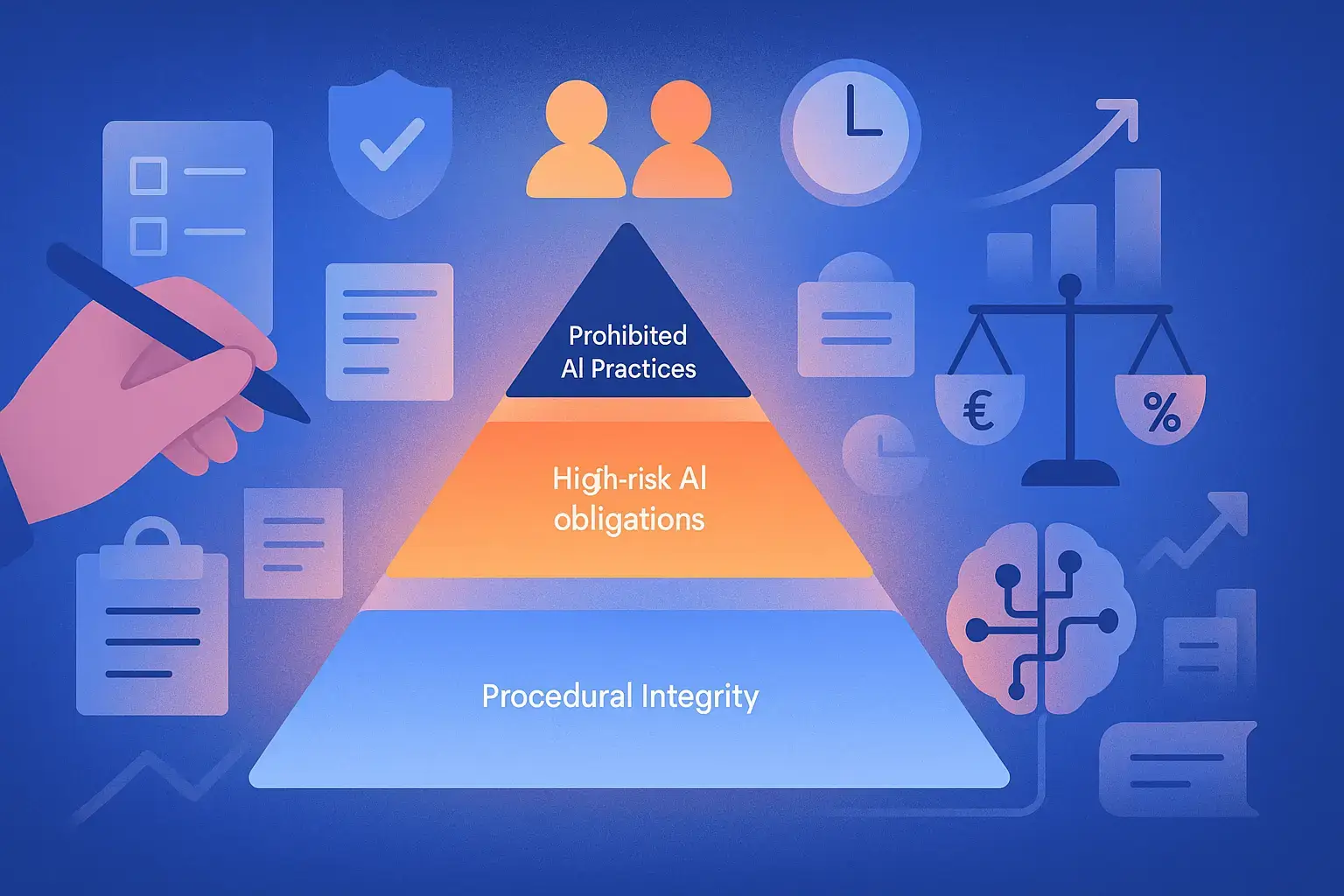
The EU AI Act breaks violations into three core tiers, each tied to a specific risk level. The structure is deliberate: the more dangerous or deceptive the AI system, the steeper the EU AI Act penalties for violations. Understanding where your system sits in this pyramid is the starting point for any real compliance effort.
Prohibited AI practices
At the top sits the hardest line. Article 5 bans certain AI applications outright, and there’s no grey area here. These include:
Social scoring systems that rank citizens based on behavior
AI that manipulates vulnerable groups, such as children or the elderly
Certain biometric surveillance practices in public spaces
AI exploiting subconscious weaknesses to distort behavior
If your product falls into any of these categories, you’re looking at the EU AI Act penalties, a maximum fine with no mitigation available. Full stop.
Obligations for high-risk AI systems
This is where your team will spend most of its compliance energy. High-risk systems cover AI used in hiring, credit scoring, law enforcement, and critical infrastructure. For each of these, the Act sets out concrete legal obligations:
Detailed technical documentation covering model architecture and training data
Conformity assessments completed before market deployment
Human oversight mechanisms that allow review and override of AI decisions
You can easily see that all the gaps in this list are its own legal exposure. A hiring algorithm with no bias testing documentation, a credit model with no audit trail: each one can independently trigger EU AI Act fines penalties.
Transparency and information obligations
This tier is the one that tends to blindside companies, because the violations here are not considered technical failures. By default, your organization must label AI-generated content, disclose when users interact with AI systems, and hand over documentation to regulators on request. Foundation model providers carry additional disclosure requirements around training data sources and systemic risk mitigation, and if you are not provided with such information from, for example, your AI model provider, don’t hesitate to request it.
Refusing to produce documentation during an audit, submitting an incomplete technical file, or declining model access during an inspection: all of these sit in their own violation category under EU AI Act fines and penalties rules.
General-Purpose AI models
GPAI systems, your ChatGPT-class foundation models, operate under a parallel compliance track. Providers must maintain ongoing transparency about training data, implement continuous monitoring, and allow regulatory evaluation access. Large-scale models with systemic risk potential face direct scrutiny from the European Commission, bypassing national authorities entirely. For organizations in this space, solid requirements management needs to account for regulatory scenarios, not only functional ones.
When dealing with the EU AI Act’s penalty regime, having robust documentation and audit trails is essential. This is where aqua cloud, an AI-driven test and requirements management solution, offers a practical advantage. With comprehensive documentation capabilities, aqua helps your organization establish the audit trails and verification processes that regulatory authorities demand during compliance inspections. Unlike conventional solutions, aqua’s platform maintains detailed records of every test scenario, risk assessment, and model validation, providing the transparency and traceability the EU AI Act requires. With aqua’s domain-trained AI Copilot, your team can rapidly generate compliant documentation grounded in your project’s actual data and requirements, creating audit-ready materials that demonstrate due diligence in testing for bias, accuracy, and transparency. And because aqua integrates with the tools your team already uses, such as Jira, Azure DevOps, Selenium, and 12+ other tools from your tech stack, compliance documentation becomes part of your existing workflow.
Ensure 100% traceability for upcoming audit trails with aqua cloud
The EU AI Act penalties, fines, and enforcement mechanisms follow a three-tier structure. Each tier has a fixed cap and a turnover percentage, and the fine that applies is whichever of the two hits harder.
Violation Tier
Applies To
Maximum Fixed Fine
% of Global Turnover
Tier 1
Prohibited AI practices (Article 5)
€35 million
7%
Tier 2
High-risk AI obligations, transparency failures
€15 million
3%
Tier 3
Information violations, procedural non-compliance
€7.5 million
1%
GPAI Models
Foundation model obligations (Article 101)
€15 million
3%
Tier 1: Prohibited practices
The EU AI Act penalties maximum fine here is €35 million or 7% of global annual turnover. That 7% figure deliberately exceeds GDPR’s 4% cap. For a company pulling in €1 billion in revenue, the exposure reaches €70 million. That’s a board-level crisis.
Tier 2: Operational compliance failures
Most violations land here, which makes this tier the one worth understanding in detail. You should not be surprised anymore that missing conformity assessments, lack of human oversight, or failing to label AI-generated content all carry EU AI Act penalties and fines. For a €500 million company, that’s still €15 million on the table.
Tier 3: Procedural integrity
False documentation, withheld information during audits, or misleading enforcement authorities carries EU AI Act fines penalties of up to €7.5 million or 1% of global turnover. This is the smallest tier, and also the easiest to trigger accidentally. A missing log entry or an incomplete technical file can be enough.
SME protections
The EU AI Act penalties percentage of turnover works in favor of smaller organizations. Because the structure applies “up to” the lower of the fixed amount or the percentage cap, a company with €10 million in revenue faces a maximum Tier 1 fine of €700,000, not €35 million. The EU built this in deliberately to avoid wiping out smaller players. Large enterprises get no such buffer and face the full EU AI Act penalties fines percentages calculation. Foundation models fall under a separate enforcement track through Article 101, with EU artificial intelligence Act penalties of up to €15 million or 3% of turnover enforced directly by the European Commission.
Unlike GDPR, AI Act requirements are tiered based on the risk level and the role the company has related to the AI system, so in itself unless you’re deploying at-risk AI systems, you’re mostly expected to have a risk framework in place along with some documentation you should have if you code things properly
Regulators don’t walk in and apply the maximum EU AI Act fines penalties automatically. The final number depends heavily on the specifics of how and why the violation happened. Two companies with identical technical failures can end up with very different outcomes.
1. Severity and duration. A system that ran out of compliance for six months across a large user base is assessed very differently from one caught during internal testing before any real decisions were made. Regulators treat scope and duration as separate compounding factors, and both feed into the final EU AI Act penalties and fines for non-compliance calculation.
2. Intent and negligence. Companies that can show documented good-faith efforts, such as external legal opinions obtained before launch, internal audits conducted proactively, or voluntary disclosure of a gap before any inspection, consistently see reduced EU AI Act penalties for non-compliance. Where the evidence points the other way, where red flags were ignored or legal advice was buried, regulators apply the upper end of the range.
3. Financial benefit from non-compliance. If your AI system generated measurable revenue while operating in violation of transparency or documentation rules, that gain feeds directly into the penalty calculation. The EU AI Act penalties fines enforcement logic here is straightforward: the fine needs to erase the advantage, not just acknowledge the violation.
4. Cooperation with authorities. How your organization responds once regulators start looking matters a great deal. Full access, proactive disclosure, and rapid corrective action give enforcement authorities concrete grounds to reduce the EU AI Act fines and penalties outcome. Restricted access and disputed documentation requests consistently push it in the other direction.
5. Previous violations. A first-time procedural violation leaves some room for flexibility in the EU AI Act penalties overview assessment. A second or third finding against the same organization creates a documented pattern that regulators weigh directly. The leniency available the first time narrows considerably after that.
6. Number of individuals affected and the nature of harm. A credit scoring model that influenced loan denials for protected demographic groups over 18 months sits in a completely different category from a content labeling gap in a low-stakes consumer app. Regulators assess exposure, materiality, and reversibility of harm as separate factors in the EU AI Act penalties for violations calculation.
7. Data sensitivity and the type of AI output. Systems processing health records, financial histories, or biometric data face higher baseline scrutiny under EU Artificial Intelligence Act penalties guidance. When an AI system’s outputs directly control access to employment or credit, rather than serving as one input among many, the regulatory weight increases accordingly.
8. Documentation stated at the time of inspection. A complete, version-controlled audit trail that shows consistent updates over time signals a functioning compliance process. Documentation assembled quickly in the weeks before an inspection does not. Regulators can tell the difference, and it shows up in the final EU AI Act penalties and fines 2026 enforcement outcome.
With the EU’s AI Act amendments now in effect, companies in “high-risk” AI areas urgently need tools to manage governance and risk.
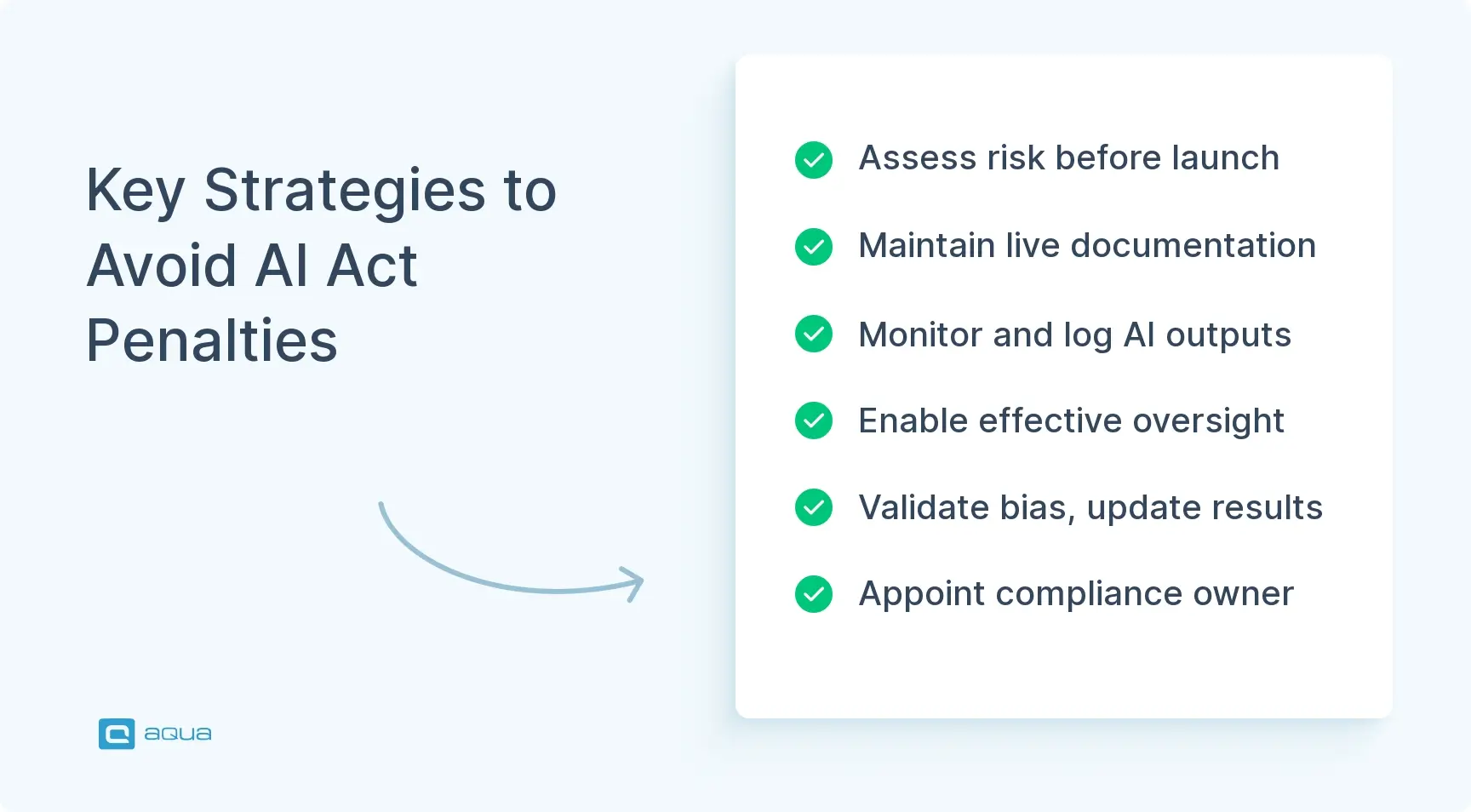
Getting EU AI Act penalties for non-compliance under control comes down to building the right processes. Here’s what that looks like in practice.
1. Risk classification before development begins. The EU AI Act penalties overview makes clear that risk tier determines everything downstream: documentation requirements, testing scope, oversight obligations, and potential fine exposure. When your team classifies a system’s risk level during product planning, with written rationale on record, that decision is defensible during any later enforcement review. Made retroactively, it isn’t.
2. Technical documentation as a continuous record. Regulators expect evidence that your system behaved as described across its entire operational life. Training data provenance, architecture decisions, model update history, bias assessment results, and performance benchmarks all need ongoing logging. Aqua cloud compliance is built specifically to support this kind of longitudinal documentation, keeping test outcomes connected to the regulatory requirements they satisfy over time.
3. Production monitoring with documented thresholds. High-risk AI systems need ongoing performance tracking, not a one-time sign-off at launch. When model behavior drifts, when outputs shift across demographic groups, or when accuracy drops below what your documentation commits to, those changes need to be detected, logged, and acted on. The monitoring system itself, including the thresholds your team sets and the escalation paths it triggers, is part of what regulators review during EU AI Act penalty fines enforcement inspections.
4. Human oversight that works under actual market conditions. What regulators look for is whether reviewers on your team can follow the reasoning behind an AI decision, access the inputs that produced it, and escalate edge cases through a documented path. Oversight that exists on paper but breaks down under normal operating volume doesn’t satisfy the EU AI Act penalties fines percentages risk framework.
5. Bias and performance validation across population subgroups. The Act explicitly requires high-risk systems to be accurate, robust, and non-discriminatory. Performance validation covering protected demographic groups, disparate impact assessments, and revalidation after model updates are what regulators expect to see in your documentation. Good requirements management keeps these testing obligations connected to the specific regulatory requirements they address, so nothing falls through the gap between engineering and compliance.
6. Named compliance ownership. When no one in your organization owns EU AI Act compliance specifically, it tends to drift when engineering cycles get tight. A cross-functional role spanning legal, engineering, and QA gives you a single point of coordination for regulatory changes, documentation gaps, and audit preparation, which is the foundation for managing EU AI Act penalties, fines, and non-compliance risk over time.
7. Internal audits under realistic conditions. Organizations that run internal compliance reviews with the same rigor they’d apply to an external inspection, documenting gaps as findings and tracking remediation, tend to find issues while there’s still time to fix them. Missing timestamps, incomplete bias assessments, and oversight workflows that fail under volume: these surface in internal audits or in regulatory ones. The cost of finding them internally is significantly lower.
8. Early engagement with third-party conformity assessment bodies. For high-risk systems, external validation is a legal requirement. Bringing conformity assessment bodies in during development means your team identifies compliance gaps with time to address them, and the process itself generates a record of proactive diligence that regulators can see when assessing EU AI Act penalties for non-compliance.
As EU AI Act enforcement tightens, organizations need systematic compliance processes. More than that, they need their QA to be built directly into their testing workflows, with documentation your legal team can actually rely on during an inspection. aqua cloud, and an AI-powered test and requirements management platform delivers exactly this. Through its end-to-end test management features, it supports comprehensive documentation, risk assessment, and compliance verification across the full AI development lifecycle. By implementing aqua, your team gains automated audit trails, complete requirements traceability, and AI-powered documentation that reflects your specific project context, not generic templates. The platform’s domain-trained AI Copilot generates test cases and compliance documentation grounded in your actual requirements and derived from documentation, chats, or even voice notes. And with aqua’s integrations across tools like Jira, Selenium, and Azure DevOps, your team’s existing processes feed directly into a compliance record that holds up under regulatory scrutiny.
Reduce your EU AI Act penalty risk with comprehensive, AI-powered test documentation
EU AI Act penalties for non-compliance are set at levels that make cutting corners genuinely unsustainable. Huge assessed against factors like intent, duration, and real-world harm means that treating compliance as something to sort out after deployment is an expensive miscalculation.
For QA and engineering teams, this means compliance validation belongs in the standard delivery process alongside functional testing. Bias assessments, documentation coverage, oversight workflow validation, and production monitoring are core deliverables now. Enforcement is already underway across the EU, and the organizations in the best position are the ones that treated compliance as part of the build from day one.
What is the penalty for non-compliance with the EU AI Act?
EU AI Act penalties for non-compliance range from €7.5 million to €35 million, or 1% to 7% of global annual turnover, depending on violation severity. Prohibited AI practices carry the highest fines at €35M or 7%. Information violations draw the smallest at €7.5M or 1%. The fine applied is whichever is higher: the fixed amount or the turnover percentage.
How can organizations implement compliance monitoring to avoid penalties under the EU AI Act?
Organizations need production monitoring pipelines tracking AI behavior continuously, technical documentation maintained across the model lifecycle, regular internal audits under realistic conditions, and automated alerts for bias and performance drift. Assigning dedicated compliance ownership and integrating regulatory validation into QA workflows from design through deployment are the structural foundations for managing EU AI Act penalties fines non-compliance risk.
What are the differences in penalties between minor and major non-compliance cases in the EU AI Act?
Major violations, such as deploying prohibited AI systems, trigger the EU AI Act penalties maximum fine of €35M or 7% of turnover. Minor violations, such as procedural documentation gaps, result in lower EU AI Act fines penalties at €7.5M or 1% of turnover. Regulators assess severity, intent, duration, and harm caused when determining where a case falls within the EU AI Act penalties fines percentages framework.
Robert has several years of experience in process optimisation and test management. He is an expert in defining and implementing workflows by adapting aqua to the clients’ processes.
Nurlan, a QA Coordinator & Quality Standards Officer, takes pride in orchestrating seamless QA operations. His expertise in coordinating QA-focused projects and integrating QA solutions has consistently yielded top-tier client satisfaction. Aside from a full-time QA coordinator, Nurlan's role involves creating compelling content that educates…
Pavel, a Quality Assurance Consultant and Author, brings deep expertise to solving complex testing challenges. His background in software development has helped organizations transform their QA practices from reactive to proactive. Beyond consulting, Pavel develops best practice guides and case studies for aqua cloud that…
Home » Best practices » EU AI Act Penalties for Non-Compliance: Everything You Need to Know
Do you love testing as we do?
Join our community of enthusiastic experts! Get new posts from the aqua blog directly in your inbox. QA trends, community discussion overviews, insightful tips — you’ll love it!
We're committed to your privacy. Aqua uses the information you provide to us to contact you about our relevant content, products, and services. You may unsubscribe from these communications at any time. For more information, check out our Privacy policy.
X
🤖 Exciting new updates to aqua Intelligence are now available! 🎉