Edge Cases in Software Testing: Importance, Identification & Best Practices
Someone types a 500-character email address. Someone else runs your app at midnight on a leap year. A third person uploads a file named `../../etc/passwd`. These are edge cases, and if your team is not testing for them, you are leaving a category of failure entirely unexamined. Edge cases sit at the boundary of what your software expects. They are the weird inputs, the unusual conditions, the scenarios that do not show up in happy-path testing but absolutely show up in production. For QA teams, knowing how to find and test them systematically is what separates software that survives real-world use from software that breaks at the worst possible moment.
Edge cases test software at boundary conditions where extreme inputs or unusual scenarios occur, revealing weaknesses that standard testing typically misses.
Common edge cases include extreme input values, special character handling, concurrency issues, and empty/null states that can crash systems or corrupt data.
Risk-based prioritization is essential for edge case testing, focusing on scenarios with high business impact and reasonable likelihood of occurrence.
User feedback provides valuable insights into real-world edge cases, creating a continuous improvement cycle that strengthens testing strategy over time.
Automation enables testing thousands of edge scenarios that would be impractical manually, but requires thoughtful implementation and doesn’t replace exploratory testing.
Edge cases aren’t exotic scenarios but the difference between software that survives in production and software that fails spectacularly at 3 AM on a Friday. Learn how to hunt them down systematically before your users do 👇
What Are Edge Cases in Software Testing?
What is an edge case in software testing? An edge case in testing refers to a scenario that occurs at the extreme boundaries of operating parameters. Maximum values, minimum values, empty states, combinations of inputs that push a system to its limits. Edge case testing meaning covers the process of verifying how software handles these boundary scenarios, which may be rare but are potentially catastrophic when they occur.
Unlike standard test cases that verify typical user behaviour, edge cases explore what happens when someone uses your software in ways you did not anticipate but cannot rule out. Edge case definition in software testing refers to these boundary conditions where normal operating parameters end and exceptional circumstances begin.
Edge cases are not bugs waiting to happen. They are features of reality that your code needs to handle. When a user enters 999999999999 into an age field, or tries to schedule a meeting for December 32nd, or attempts to divide by zero, your software needs a response plan. These scenarios sit at the intersection of valid and invalid inputs, where your validation logic faces a real test.
An edge case in testing with example makes this concrete. A normal test case for a login form checks whether john@example.com and Password123 work. An edge case tests what happens with test+filter@subdomain.example.co.uk, a technically valid but uncommon email format, or a password sitting exactly at the maximum character limit, or a thousand login attempts in rapid succession. These are not everyday scenarios, but they will happen in production. When they do, they expose weaknesses in input validation, rate limiting, or character encoding that standard testing misses entirely.
Why Are Edge Cases Important?
Ignoring edge cases is building a house that looks solid but collapses in heavy rain. You pass all your standard tests, and then something unusual happens in production and you are explaining why a thoroughly tested application just lost customer data or crashed during peak hours.
The consequences range from embarrassing to catastrophic depending on the domain. Financial systems that do not handle leap seconds correctly execute trades at wrong timestamps. Healthcare applications that fail on unusual patient data formats delay critical care decisions. E-commerce platforms that break under concurrent checkout scenarios lose revenue and trust. Each of these failures comes from someone assuming a scenario would never happen, right up until it does.
The pattern across industries is consistent. High-frequency trading systems need to handle market data arriving out of order or duplicate transactions during network glitches. Electronic health record systems must process patient names with apostrophes or multiple last names without corrupting data. Shopping carts need to manage inventory correctly when multiple users attempt to purchase the last item simultaneously. Multiplayer games must handle players who disconnect and reconnect rapidly without corrupting game state. Edge case software testing exists precisely because these scenarios are predictable problems that become expensive lessons if you do not test for them proactively.
When it comes to hunting down those edge cases that could break your software in production, having the right test management approach is critical. This is exactly where aqua cloud shines. It’s designed to systematically identify and test those boundary scenarios before your users encounter them. With aqua’s AI Copilot, you can automatically generate test cases that specifically target edge conditions using professional techniques like Boundary Value Analysis and Equivalence Partitioning, the very techniques we discuss in this article. Unlike generic AI tools, aqua’s domain-trained AI Copilot is grounded in your project’s actual documentation, making every generated test case contextually relevant to your specific edge scenarios. Teams using aqua report saving up to 12.8 hours per tester weekly while achieving more comprehensive edge case coverage, turning what was once a tedious manual process into an efficient, systematic approach.
Generate complete edge case coverage in seconds with aqua's domain-aware AI Copilot
Finding edge cases requires a different mindset than writing happy-path tests. You are actively trying to imagine how a feature might break under conditions that seem unlikely but are not impossible. The best testers think like adversaries, combining systematic techniques with healthy paranoia about what could go wrong.
Boundary Value Analysis
Boundary value analysis focuses on testing at the edges of valid input ranges. If a field accepts integers between 1 and 100, this technique tests 0, 1, 100, and 101, not just 50. Off-by-one errors are among the most common programming mistakes, and they only surface when you check exact boundaries.
The technique extends beyond the obvious ranges to technical limits. For a text field limited to 255 characters, test at 254, 255, and 256. For date fields, test leap year dates, month-end dates, and dates at the Unix epoch boundary. For numeric calculations, test the maximum and minimum values your data type can store, because integer overflow is not a theoretical concern. Boundary value analysis exposes where validation logic is too permissive, too restrictive, or inconsistent.
Equivalence Partitioning
Equivalence partitioning divides your input space into groups that should behave the same way, then tests representatives from each group, including the edge cases within those partitions. For an email validation field, partitions might include valid emails, malformed emails, and edge-case-valid emails such as those with plus signs or multiple subdomains. This prevents redundant testing while ensuring you cover categories of input that might break in distinct ways.
The real value comes from identifying partitions you did not initially consider. Phone number fields have obvious partitions for valid and invalid formats, but edge case thinking adds partitions for international formats, extensions, toll-free numbers, and alphanumeric numbers. Each partition potentially exercises different code paths, and testing across partition boundaries reveals assumptions your code makes about input structure that may not hold in practice.
Scenario-Based Testing
Scenario-based testing constructs realistic but unusual user journeys that combine multiple edge conditions. Instead of testing individual boundaries in isolation, you examine what happens when several edge cases collide, because that is often how real failures occur. A user might upload a file at exactly the size limit, during a database backup, while another process holds a lock, from a mobile device on an unstable connection.
Creative approaches include threat modelling, chaos engineering, and analysing production logs for unusual patterns. The scenarios that break your application in production are often visible in your data if you look for anomalies: users who retry operations hundreds of times, sessions that last for days, workflows abandoned at specific steps. These patterns should inform your edge case scenarios, creating tests that reflect actual usage rather than theoretical possibilities. Good test case design techniques integrate all three of these approaches rather than treating them as separate activities.
What Are Common Edge Case Testing Examples?
Certain patterns repeat across applications and domains. Recognizing them helps you search for edge cases systematically rather than hoping to stumble across them.
Extreme input values are among the most overlooked. Your application might handle typical data well but fail when someone enters a billion-character string into a comment field, requests data for the year 9999, or creates an array with a negative number of elements. These are not hypothetical. An e-commerce site that accepted order quantities up to the maximum integer value allowed someone to purchase 2,147,483,647 items, which crashed the inventory system processing the order.
Special character inputs expose encoding and escaping vulnerabilities that standard alphanumeric testing misses entirely. Names with apostrophes, addresses with non-ASCII characters, inputs containing HTML or SQL special characters all test whether your application handles character encoding correctly. A healthcare system once rejected a patient named Null because the database treated the string as a null value, an edge case that seems absurd until it prevents someone from receiving care. Testing with emoji, right-to-left text markers, and zero-width characters reveals assumptions about what text means to your application.
Concurrency issues emerge when multiple operations interact unexpectedly. Two users editing the same record, rapid-fire API calls hitting the same endpoint, background processes conflicting with user actions. A banking application might handle individual transactions correctly but fail when processing simultaneous deposits and withdrawals to the same account, creating overdrafts or duplicate credits. These edge cases are particularly difficult because they are timing-dependent and rarely reproducible, appearing only under production load.
Empty and null states test how your application handles absence of data. A search function might work well with query terms but crash on an empty search. A report generator might display data correctly but break when generating a report with no records. Code often assumes data exists, and the no-data path gets less attention than the happy path. Users will submit empty forms, either by accident or curiosity, and your application needs a plan for when they do.
What Are the Best Practices for Edge Case Testing?
Testing edge cases effectively requires a systematic approach that covers the scenarios that matter most without disappearing into an infinite list of possibilities. The goal is not to test every conceivable edge case but to intelligently focus on those with real impact on reliability and security.
Risk-based prioritization should drive the strategy. An edge case that could corrupt financial data or expose user information warrants more attention than one that might slightly misalign a UI element. Consider both technical risk and business risk. A payment processing system should prioritize edge cases around transaction handling over edge cases in the marketing email component, because the consequences of failure differ dramatically. Applying best practices in risk-based testing to edge case selection is what keeps testing effort proportionate to actual risk rather than distributed uniformly.
Documentation creates institutional memory. When you discover an edge case through testing, production issues, or user reports, document the specific scenario, the expected behaviour, the actual behaviour if it was a bug, related test cases, and affected components. This reference prevents the same issues from recurring and helps new team members understand where the application is fragile.
Integration into standard test suites matters more than treating edge cases as special runs. Your CI/CD pipeline should catch edge case regressions just like any other bug. If edge case tests only run occasionally, they will miss the regression that slips in between runs.
Collaboration between QA and development during feature design catches edge cases before code is written. Developers know where their logic makes assumptions. Testers know where assumptions typically fail. Regular discussions about what could break here during design reviews or sprint planning address edge cases when they are cheapest to fix. The value of collaboration in QA planning is most visible in the edge cases that never make it to production because someone asked the right question early.
Reviewing production logs regularly for unusual patterns, using property-based testing frameworks that automatically generate edge case inputs, and building domain-specific edge case checklists all compound over time into a progressively stronger testing posture.
How Does Automation Help With Edge Case Testing?
Automation makes it feasible to test thousands of edge scenarios that would be impractical to check manually. Modern test automation tools overview covers tools that generate edge case inputs systematically, run tests continuously, and catch regressions that would slip through manual testing.
The benefits go beyond speed. Consistency means automated tests execute exactly the same way every time, eliminating human variability when checking complex scenarios. Coverage means you can test combinations of edge conditions that would be tedious manually, such as every possible combination of optional parameters or thousands of fuzzed input values. Continuous testing means edge case checks run on every commit, catching regressions immediately rather than weeks later when they are harder to trace.
The challenges are real too. Not all edge cases automate easily, particularly those involving timing, concurrency, or complex user workflows requiring context. Maintaining automated edge case tests takes discipline, because brittle tests break when application behaviour changes legitimately. Automation also creates a risk of false security: ten thousand automated edge case tests does not mean you have covered the edge case that will break in production. Automation should complement exploratory testing and creative edge case thinking, not replace them.
Property-based testing frameworks such as Hypothesis for Python, QuickCheck for Haskell, and fast-check for JavaScript automatically generate edge case inputs based on defined properties. Fuzzing tools systematically generate malformed or extreme inputs to find cases that crash or hang your application. The key is choosing automation that fits your specific edge case testing goals, whether that is comprehensive boundary coverage, stress testing, or security-focused exploration.
How Do You Prioritize Edge Cases?
Not all edge cases are equal, and attempting to test every conceivable scenario leads to paralysis. A prioritization framework that weighs impact, likelihood, and complexity helps focus effort where it delivers real value.
Impact assessment asks: if this edge case fails in production, how bad is it? An edge case that could cause data loss, security breaches, or financial errors outranks one that might display incorrect formatting. A payment processing edge case that rounds currency incorrectly by one cent seems minor until you calculate the aggregate across millions of transactions. Context determines severity.
Frequency of occurrence distinguishes edge cases that are genuinely rare from those that are just unusual. Production data, analytics, and user feedback provide reality checks on which edge cases actually occur versus which are purely theoretical. Low-frequency edge cases can still warrant high priority when their impact is severe enough, which is why security edge cases often sit at the top of the list regardless of how infrequently they might be triggered.
Priority
Impact
Frequency
Testing Approach
Critical
Data loss, security breach, financial error
Any
Automated tests, manual verification, included in smoke tests
High
Degraded functionality, poor user experience
Moderate to high
Automated tests, regular regression testing
Medium
Minor bugs, edge case errors
Low to moderate
Automated where feasible, periodic manual testing
Low
Cosmetic issues, very rare scenarios
Very low
Document and test opportunistically
The framework guides decisions rather than dictating them. A low-priority edge case that takes five minutes to test often gets done because it is easy. A high-priority edge case requiring significant infrastructure gets scheduled carefully. Revisit priorities regularly as usage patterns evolve.
How Does User Feedback Surface Edge Cases?
Your users are testing your edge cases whether you intend them to or not. The scenarios that break in production, the workflows users abandon, the bugs reported from the field: these are signals about edge cases your testing missed. Treating user feedback as an edge case discovery engine turns a reactive problem into a proactive improvement cycle.
User-reported bugs frequently reveal edge cases that seemed too unlikely to test, or combinations of conditions that did not occur to the testing team. A profile picture upload fails only for PNG files larger than 5MB, uploaded from iOS devices on cellular connections. That is an edge case sitting at the intersection of multiple factors, invisible to standard testing but immediately visible to affected users.
When a specific edge case causes a production issue, the right response is not just to fix it but to ask what other edge cases of this type exist and how testing could have caught it. Create test cases covering both the specific scenario and the broader pattern it represents. Track metrics on edge case failures in production to identify areas where coverage needs strengthening.
A SaaS company discovered through user feedback that their application failed when users created tasks with titles over 1,000 characters. No one had tested it because it seemed unrealistic. Someone did it anyway, and it broke not just that feature but affected database indexing performance. After fixing it, the team started testing with extreme-length inputs across all user-generated content fields and discovered several similar edge cases before users encountered them. One piece of user feedback became a systematic improvement in testing strategy.
Edge case testing is not a one-time effort. Users will always find new edge cases because they interact with software in ways that do not match the mental model of the people who built it. Treating their discoveries as data rather than annoyances creates a feedback loop that makes the application progressively more robust.
As we’ve seen, edge case testing isn’t optional; it’s the difference between software that’s truly robust and software that’s just waiting to fail. But implementing a systematic approach to edge cases requires the right tooling. aqua cloud provides exactly what testing teams need: a comprehensive platform where edge cases can be identified, documented, prioritized, and tested efficiently. With aqua’s domain-trained AI Copilot, you can automatically generate test cases using professional techniques like Boundary Value Analysis—creating tests that target precisely those boundary conditions where bugs love to hide. The platform’s traceability features ensure you can link edge case tests directly to requirements, while reusable components make maintaining complex edge case scenarios significantly easier. And with both manual and automated testing managed in one place, you can implement the continuous edge case testing strategy this article recommends. Best of all, aqua’s context-aware AI draws from your own project documentation, ensuring generated tests speak your project’s language and address your specific edge scenarios, not generic test cases that miss what matters.
Transform edge case testing from a liability to a strength with aqua's AI-powered test management
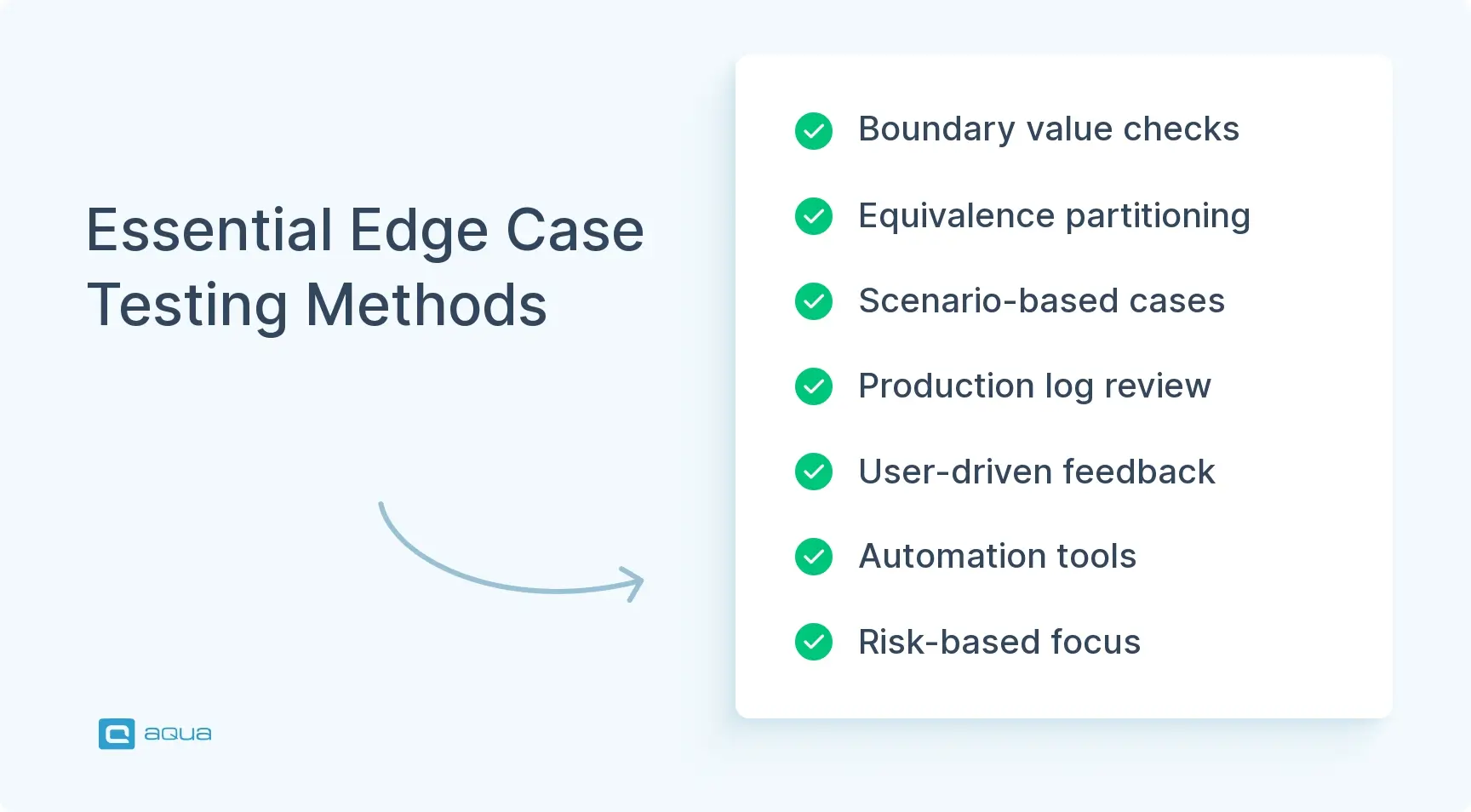
Edge cases are not the exotic scenarios you test when you run out of other work. They are the conditions that determine whether software holds up under real use or fails when something unexpected happens. Boundary value analysis, equivalence partitioning, scenario-based testing, risk-based prioritization, automation, and user feedback loops all contribute to a testing strategy that finds edge cases before production does. The investment in systematic edge case testing is not optional for teams that care about reliability. Your software will encounter these conditions regardless of whether you tested for them. The only question is whether your team finds them first or your users do.
An edge test case checks software behaviour at the extreme boundaries of valid inputs or operating conditions. It is the test that verifies what happens at a text field’s maximum character limit, not somewhere in the middle of the range. It checks the last item in an array, the first day of a month, or zero as a quantity when the system expects a positive number. These tests matter because bugs concentrate at boundaries. Code that handles typical inputs correctly often fails at the edges, and edge test cases are designed to find those failures before users do.
What is edge case testing?
Edge case testing is the practice of deliberately targeting boundary conditions, extreme inputs, and unusual operating scenarios to find failures that standard tests miss. Where typical testing confirms the system works under normal conditions, edge case testing asks what happens when inputs hit their limits, when data is empty or at maximum size, or when multiple unusual conditions occur simultaneously. As a discipline within what is edge case in software testing more broadly, it is most valuable when applied early in development and repeated whenever behaviour at the boundaries changes.
What is an edge case in testing?
Understanding what is an edge case in testing starts with recognising where standard test cases stop. An edge case in testing is any scenario that sits at the outer boundary of expected inputs or system conditions rather than in the typical operating range. What is edge case in testing practice means accounting for the user who submits a form with a single character, the transaction that processes at midnight on a deadline date, or the API call that sends an empty payload. The edge case definition in software testing is consistent: it is the scenario at the limit, not the middle, of what the system should handle.
What is an edge case in UAT?
In user acceptance testing, an edge case is a scenario that real users might encounter at the extremes of expected usage but that standard UAT scripts typically skip. It is what happens when a user with an unusually long name tries to complete a profile, when someone processes a transaction on the last day of a fiscal year, or when a user imports a file full of special characters. UAT edge cases surface by asking users to attempt tasks outside the documented happy path. They are valuable because UAT is the last checkpoint before production. Edge cases that slip through here become the support tickets and incident reports that follow.
What is the difference between base case and edge case?
A base case is the standard scenario the software is designed to handle. Typical inputs, typical users, normal conditions. An edge case sits at the outer boundary of what the system is expected to handle, where inputs are extreme, unusual, or at the limits of valid ranges. For a file upload, the base case is a standard JPEG at a normal size. The edge case is a file at exactly the maximum size limit, a file with no extension, or an empty file. Base case testing confirms the system works as intended. Edge case testing confirms it does not break when reality deviates from intention.
How do edge cases impact the overall test coverage strategy?
Edge cases force a coverage strategy to account for the full range of possible inputs, not just the ones representing typical usage. Without deliberate edge case testing, coverage metrics can look strong while significant failure modes go untested. A form field might have 90% line coverage but zero coverage of boundary conditions if every test uses mid-range values. Incorporating edge cases into the standard test suite means coverage reflects actual risk rather than just code execution frequency. It also shifts prioritization toward the parts of the codebase that handle boundary conditions, which is where failures are most likely and most consequential.
What techniques can be used to effectively identify and prioritize edge cases during test design?
Boundary value analysis identifies edge cases by testing at the exact limits of valid input ranges and just beyond them. Equivalence partitioning groups inputs into categories that behave the same way, then tests representatives from each group including the unusual ones. Scenario-based testing combines multiple boundary conditions into realistic but unusual user journeys. For prioritization, a risk-impact matrix that weighs severity against likelihood directs effort toward the edge cases that matter most. The most effective approach combines these techniques with production log analysis, user feedback, and developer knowledge of where the code makes assumptions about its inputs.
Nurlan, a QA Coordinator & Quality Standards Officer, takes pride in orchestrating seamless QA operations. His expertise in coordinating QA-focused projects and integrating QA solutions has consistently yielded top-tier client satisfaction. Aside from a full-time QA coordinator, Nurlan's role involves creating compelling content that educates…
Justina's expertise in QA reporting and automation makes her a vital force behind data-driven quality assurance at aqua. As a specialist, Justyna has played a key role in designing scalable automation frameworks and insightful reporting systems that empower aqua's Customers to track, measure, and optimize…
Home » Test Automation » Edge Cases in Software Testing: Importance, Identification & Best Practices
Do you love testing as we do?
Join our community of enthusiastic experts! Get new posts from the aqua blog directly in your inbox. QA trends, community discussion overviews, insightful tips — you’ll love it!
We're committed to your privacy. Aqua uses the information you provide to us to contact you about our relevant content, products, and services. You may unsubscribe from these communications at any time. For more information, check out our Privacy policy.
X
🤖 Exciting new updates to aqua Intelligence are now available! 🎉