System Testing vs Functional Testing: Key Differences Explained
Someone on the team says "we need more functional testing" in the same breath as "system testing isn't done yet." If you have ever wondered whether those two phrases mean the same thing, or which one should happen first, you are not alone. System testing and functional testing sound related, but they operate at different levels and answer different questions. Knowing the difference between system testing and functional testing is what lets you allocate testing effort correctly rather than discovering integration failures the day before a release.
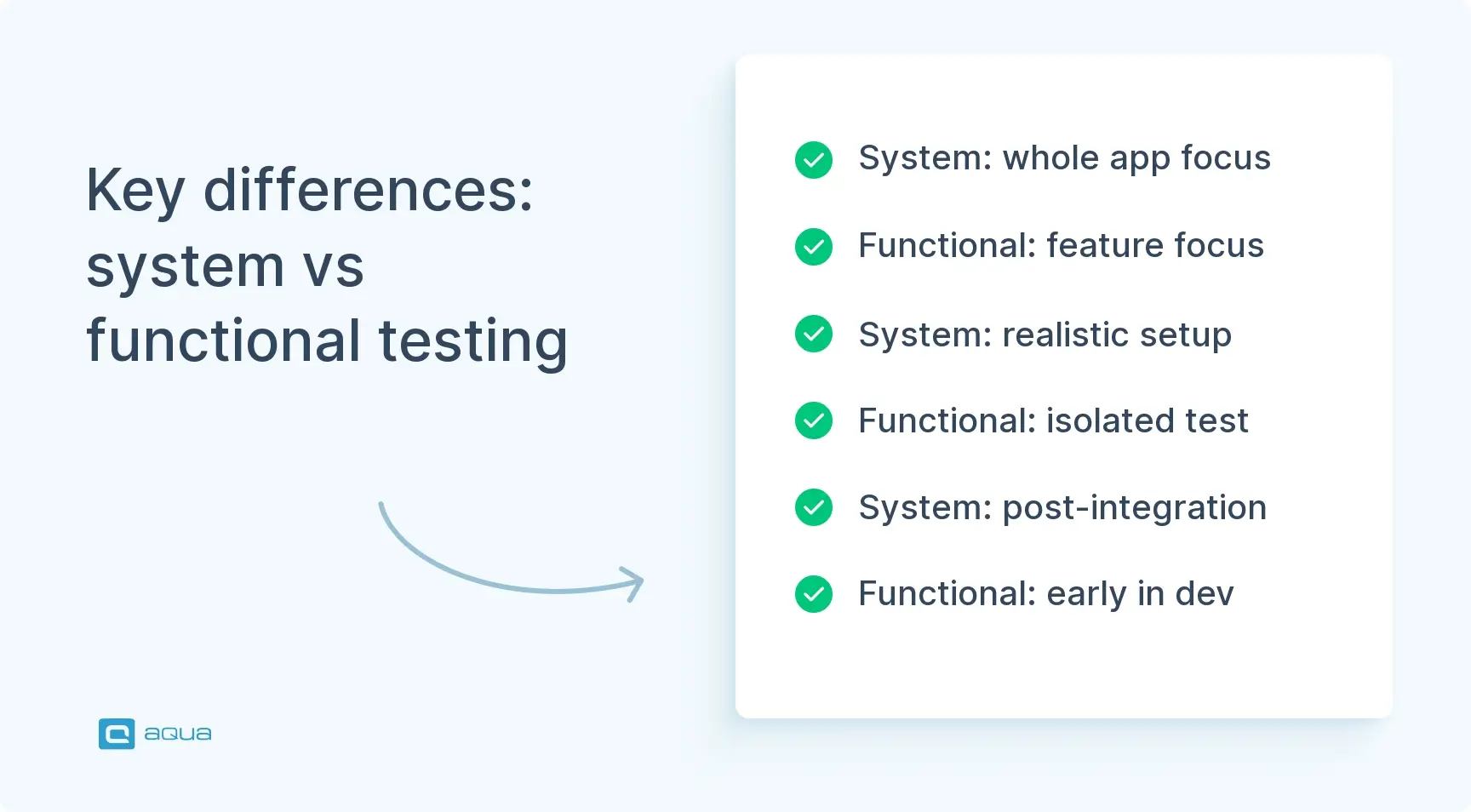
System testing examines the entire application as a unified whole, running end-to-end workflows in production-like environments with live dependencies and third-party integrations.
Functional testing focuses on individual features in isolation, verifying that specific components meet documented requirements regardless of how they integrate with other systems.
System testing typically happens later in development cycles and requires more resources, while functional testing can begin as soon as a feature is ready, providing faster feedback to developers.
Functional testing uses primarily black-box methods focusing on inputs and outputs, while system testing often incorporates gray-box or white-box techniques to analyze performance and security.
Both testing approaches are complementary rather than competing, with functional testing catching feature-specific bugs early and system testing revealing integration issues before release.
Your application might pass every functional test but still fail catastrophically when all components interact in the real world. Discover how to balance these essential testing approaches for a smoother release cycle 👇
What Is System Testing?
System testing evaluates your entire application as a unified whole. Instead of checking individual features in isolation, you verify whether all the pieces cooperate correctly when thrown together under realistic conditions. The goal is to confirm the software behaves correctly across its full stack, from the user interface down to the database and any third-party integrations.
This typically includes performance checks, load simulations, security assessments, and compatibility verifications. You run the application in an environment that mirrors production, then work through end-to-end workflows to confirm nothing breaks under pressure. For an e-commerce platform, system testing means creating an account, browsing products, adding items to a cart, processing a payment, and receiving a confirmation email in one continuous flow. A gateway timeout or misconfigured shipping module surfaces here, not in a unit test.
System integration testing is a specific form of this work, focused on verifying the connections between components and external services. By the time system testing is complete, you should know whether the software can handle real user loads, integrate with external services without errors, and maintain stability when different modules interact simultaneously. It is the closest thing to a dress rehearsal before a live audience.
When managing different types of testing, having the right tool can be the difference between confusion and clarity. aqua cloud stands out as a comprehensive solution that elegantly bridges the gap between system and functional testing approaches. With aqua, you can create, organize, and execute both types of tests within a single unified platform, maintaining full traceability between requirements, test cases, and defects regardless of testing scope. The platform’s flexible configuration allows you to tailor workflows to different testing needs while supporting both manual and automated testing paths. What truly sets aqua apart is its domain-trained AI Copilot with RAG grounding, which learns from your project’s documentation to generate contextually accurate test cases for both functional components and system-level scenarios, ensuring your tests speak your project’s specific language.
Manage all your testing types in one unified platform with aqua cloud
Functional testing zeroes in on specific features to confirm they meet documented requirements. The question being answered is simple: does this feature do what it is supposed to do? Each test case targets a discrete piece of functionality, verifying that specific inputs produce the expected outputs.
This type of testing often happens earlier in the development cycle, sometimes immediately after a feature is coded. You run manual checks or automated scripts that feed data into a form, trigger an action, and compare the result against a predefined outcome. For a password reset flow, you confirm that entering a registered email triggers a reset link, that clicking the link opens a new password page, and that submitting a valid password updates the account. Each step is a standalone verification.
Functional testing does not concern itself with server response times or whether the reset email arrives instantly under heavy traffic. Those are system testing concerns. Functional testing focuses on logical correctness: does the feature behave according to its specification? This granular approach catches errors early, before they compound into larger integration problems. A broken validation rule discovered during functional testing takes minutes to fix. The same issue discovered during system testing, after several other features have been built on top of it, takes significantly longer.
When you create test scenarios from user stories, functional testing is typically what you are designing. Each acceptance criterion maps to a test case, and each test case confirms one specific behaviour.
What Are the Key Differences Between System Testing and Functional Testing?
The most important distinction between functional testing and system testing is scope. Functional testing treats each feature as an independent unit and validates it against its own acceptance criteria. System testing evaluates how those features interact within the broader application. You could pass every functional test and still uncover failures during system testing, because some problems only appear when multiple components are active at the same time.
Timing and environment are also different. Functional tests run in development or staging environments where you can isolate a single feature. You might stub out external APIs or use mock data to keep the test focused. System testing requires a more production-like environment where all dependencies are live. The database, third-party services, and network configurations need to reflect what real users will experience.
The techniques involved differ too. Functional testing relies almost entirely on black-box methods. Testers verify inputs and outputs without needing to understand the underlying code. System testing can use black-box techniques but often incorporates monitoring of server logs, database query performance, and network latency when tracing performance or security issues through the full stack. Functional testing is satisfied once a feature behaves correctly from the user’s perspective. System testing needs the entire workflow to hold together under realistic conditions.
Understanding functional vs regression testing adds another layer of clarity here. Functional testing validates new behaviour against requirements. Regression testing confirms existing behaviour has not broken. System testing sits above both, validating the whole product rather than any individual feature or change.
The three differences worth keeping front of mind:
Scope: Functional testing validates individual features. System and functional testing together validate both isolated behaviour and system-wide integration.
Environment: Functional testing works in isolated or partial environments. System testing requires a realistic, fully integrated setup.
Timing: Functional testing happens throughout development. System testing happens when the application is sufficiently complete to test as a whole.
When Should You Use System Testing and Functional Testing?
Functional testing belongs throughout the development cycle. Every time a developer pushes a new feature, targeted functional tests confirm it works as intended before anything else is built on top of it. This keeps bugs from accumulating and makes them easier to fix while the code is still fresh. It is particularly effective in sprint-based workflows where rapid feedback is essential. Waiting until everything is integrated to discover that password validation logic is broken means wasting time building on a flawed foundation.
System testing belongs at integration milestones and pre-release stages. When feature branches are merged, when a release candidate is prepared, or when a beta launch is approaching, system testing confirms the whole product holds together under realistic conditions. This is when you simulate real user journeys, apply load, and verify that third-party integrations do not create conflicts. If your application relies on a payment processor, an email service, and a cloud storage provider, system testing reveals whether those pieces work together or create timing issues that only appear when all three are active simultaneously.
Budget and timeline factor into the decision. System testing is resource-intensive. It requires a robust test environment, sometimes multiple testers, and time to run comprehensive scenarios. On a tight deadline with limited resources, prioritizing functional testing across critical paths and doing a lighter system testing pass before launch is a reasonable trade-off. A good test management solution helps you track coverage across both testing types and makes that trade-off visible rather than implicit.
Two scenarios illustrate how this plays out. For a fitness tracking application, functional testing covers calorie logging, workout timers, and goal setting as each feature is built. System testing later confirms that syncing data across devices does not corrupt records, push notifications fire correctly, and the application stays responsive under concurrent user load. For a banking platform, functional testing verifies that a money transfer form rejects negative amounts and enforces balance limits. System testing confirms that transferring funds updates both accounts correctly, triggers audit logs, and does not create race conditions when multiple transactions hit the server simultaneously. Functional and system testing are not alternatives. They address different layers of risk at different stages.
As we’ve seen, effective testing requires a strategic blend of both functional and system testing approaches, each serving critical but distinct purposes in your quality assurance process. aqua cloud is designed specifically to excel in this balanced environment, giving you powerful tools to manage both testing types without compromise. The platform’s unified test management system provides seamless integration with your existing tools like Jira and automation frameworks, while offering comprehensive reporting and customizable dashboards to track progress across all testing levels. With aqua’s AI Copilot, powered by project-specific RAG grounding technology, you can automatically generate high-quality test cases for both functional components and system-level workflows, saving up to 12 hours per tester each week. This isn’t generic AI; it’s intelligence that understands your specific project context, creating test cases that truly reflect your application’s unique requirements and terminology. Whether you’re validating individual features or confirming that your entire application works as a coherent whole, aqua provides the structure, insight, and AI-powered assistance to deliver higher quality software with less effort.
Reduce testing time by 42% while improving coverage across both functional and system testing
System testing and functional testing are not competing approaches. They are complementary, each operating at a different level of the software and answering different questions. Functional testing confirms that individual features behave correctly according to their specifications. System testing confirms that those features work together correctly under realistic conditions. Using effective software testing strategies means deploying both at the right time: functional testing throughout development to catch feature-level issues early, and system testing at integration milestones and pre-release stages to catch workflow-level failures before users do. The right balance depends on your project’s timeline, complexity, and risk profile. Understanding what system and functional testing types each cover is what lets you make that call with confidence rather than guesswork.
The three most common are functional system testing, which validates end-to-end workflows against business requirements; performance testing, which evaluates how the system behaves under load; and security testing, which checks for vulnerabilities across the full stack. Beyond these, system and functional testing types at the system level also include compatibility testing across browsers and devices, and recovery testing to verify how the system responds to failures.
How does system testing ensure overall software reliability beyond functional testing?
Functional vs system testing comes down to scope. Functional testing confirms individual features work in isolation. System testing validates how those features interact when the full application runs under realistic conditions. A feature can pass every functional test and still contribute to a system-level failure, for example when two correctly implemented modules send conflicting data to each other. System testing also covers non-functional dimensions that functional testing does not touch, including response times under load, stability over extended periods, and behaviour when external dependencies fail. That broader coverage is the core difference between system and functional testing at the reliability level.
What are common challenges when differentiating system testing from functional testing in a QA process?
The most common challenge is scope creep. Functional testing vs system testing boundaries blur when functional tests gradually expand to cover inter-module behaviour, which creates redundancy and makes coverage tracking unreliable. A second challenge is environment management. Functional testing runs in lightweight, isolated setups. System testing requires a fully integrated environment that mirrors production, which is expensive to maintain. Teams that run system tests against partial or misconfigured environments get unreliable results. A third challenge is timing. When the difference between system and functional testing is not clearly defined in the QA plan, system testing gets deferred until late in the cycle and ends up running under deadline pressure, which limits the team’s ability to act on what it finds.
Nurlan, a QA Coordinator & Quality Standards Officer, takes pride in orchestrating seamless QA operations. His expertise in coordinating QA-focused projects and integrating QA solutions has consistently yielded top-tier client satisfaction. Aside from a full-time QA coordinator, Nurlan's role involves creating compelling content that educates…
Embodying the essence of a QA Coordination Maestro, Paul has excelled in curating and implementing quality strategies tailored to the nuances of each project. His expertise in the market of QA and Test Management solutions has contributed to a vast portfolio of successfully managed TMS…
Home » Best practices » System Testing vs Functional Testing: Key Differences Explained
Do you love testing as we do?
Join our community of enthusiastic experts! Get new posts from the aqua blog directly in your inbox. QA trends, community discussion overviews, insightful tips — you’ll love it!
We're committed to your privacy. Aqua uses the information you provide to us to contact you about our relevant content, products, and services. You may unsubscribe from these communications at any time. For more information, check out our Privacy policy.
X
🤖 Exciting new updates to aqua Intelligence are now available! 🎉