Agile Test Planning Guide: What is a Test Plan in Agile?
Let's say you've shipped clean code on Friday afternoon. Tests passed, and deployment seemed to have succeeded. Then Monday morning hits with production alerts flooding your Slack. Sound familiar? Traditional test planning creates massive documentation overhead, but it still doesn't guarantee quality. Agile takes a completely different approach. With this framework, your test plan gets upgraded with every standup and commit. This guide shows what Agile test planning should look like in practice and how to implement it.
Traditional test planning creates bottlenecks in agile workflows. Modern QA teams need flexible, collaborative approaches that keep pace with rapid development cycles while maintaining quality.
Agile Test Planning Essentials
Continuous Test Design – Build test cases iteratively alongside development, not after.
Risk-Based Prioritization – Focus testing efforts on high-impact features and critical paths.
Automated Regression Suites – Free up QA time by automating repetitive test scenarios.
Cross-Functional Collaboration – Involve developers, QA, and stakeholders in test planning from day one.
Living Documentation – Keep test plans updated in real-time as requirements evolve.
aqua cloud provides agile test management with real-time collaboration, automated test case generation, and integrated planning tools. QA teams reduce planning overhead by 60% while improving test coverage.
An agile test plan is an upgradeable document that outlines the testing strategy and scope for iterative development cycles. Traditional plans comprehensively define every test case upfront. Agile test plans instead focus on risk-based testing priorities that adapt as requirements change throughout sprints.
The core principle centers on layered planning. Your product roadmap defines overarching quality goals like sub-200ms API response times. Release planning establishes gates before production, such as performance baselines and security scans. Sprint planning makes stories more like testable increments with clear acceptance criteria, while daily PR checks maintain tight feedback loops.
Here are a couple of scenarios you might face when implementing a test plan for agile testing:
Illustrative Example #1: Your fintech team is adding card payments. But what happens when a customer clicks “pay” twice and gets charged twice? Or when a slow API loses the sale? Your agile testing plan starts with these risks. First, unit tests block duplicate charges. Then API scenarios verify refunds work. Finally, production metrics show if the system holds up under real traffic.
Illustrative Example #2: Your e-commerce platform launches same-day delivery. However, if the warehouse API reports wrong stock levels, customers order products that aren’t there. So your test plan attacks this risk. Contract tests confirm the API returns trustworthy data. Then, halfway through the sprint, product adds international shipping. In response, you revise the plan and keep moving.
As you are implementing test planning in agile testing within your organization, one question remains: how do you efficiently track the risks and evidence in the QA process? This is where aqua cloud, an AI-driven, Agile-focused test and requirement management platform, steps in. With built-in Scrum boards and AI-powered assistance, aqua lets you visualize your agile testing process while maintaining 100% traceability between requirements, test cases, and defects. What truly sets aqua apart is its domain-trained AI Copilot with RAG grounding that generates test cases directly from your requirements, chats, or even voice notes in seconds. This approach aligns with the article’s emphasis on continuous risk visibility and evidence-driven testing. aqua integrates seamlessly with Jira, Azure DevOps, Jenkins, GitLab, GitHub Actions, and 10+ other tools from your tech stack to fit naturally into your existing workflows.
Boost efficiency of your Agile QA by 80% with aqua
Building an effective agile test plan means finding the balance between structure and flexibility. You need enough rigor to prevent disasters, but not so much documentation that it goes stale before your first standup ends. The key is choosing components that keep risk visible without burying your team in paperwork.
Here are the essential elements every test plan agile template needs:
Quality Goals and Constraints: Define service-level objectives that matter to users, such as 99.9% uptime or accessibility compliance. These benchmarks shape every testing decision that follows. When everyone knows the non-negotiables, release readiness becomes clear.
Lightweight Risk Register: Maintain a backlog-aligned risk register listing top product risks with likelihood and impact. Assign ownership and track mitigation evidence for each risk. Then update it every sprint when priorities shift or production incidents reveal blind spots. A simple spreadsheet works as long as your team reviews it regularly. For more guidance on tracking defects effectively, explore our defect management strategies.
Coverage Map (Evidence Map): Connect risks to actual tests that reduce them. For each risk, document what evidence covers it and where that evidence runs, e.g., PR pipeline, nightly builds, staging gates, production monitoring. This makes gaps visible instead of letting the team assume complete coverage.
Environment and Test Data Strategy: Define environment tiers such as local development, CI, ephemeral staging, and production. Then specify how you’ll seed realistic test data without leaking PII. If your staging environment can’t replicate production load patterns, your performance evidence carries little weight.
Definition of Ready and Done: Codify quality criteria so everyone shares the same understanding. Ready means testable acceptance criteria exist, risks are identified, and dependencies are mapped. Done means agreed evidence is gathered, exploratory charters are complete, monitoring is updated, and the release checklist is satisfied. This prevents scope ambiguity and ensures the whole team owns quality together.
These components create an upgradeable inventory that shows how you’re staying ahead of potential failures. They reflect the continuous nature of agile quality practices rather than one-time documentation exercises. When building test plans in agile methodology, consider starting with an agile test plan template that includes these core elements.
I changed my perception of what is a "test plan" about 20 years ago when Agile stormed the world. To me, it's not a list of test cases. To me, it's a short document explaining how you will test things
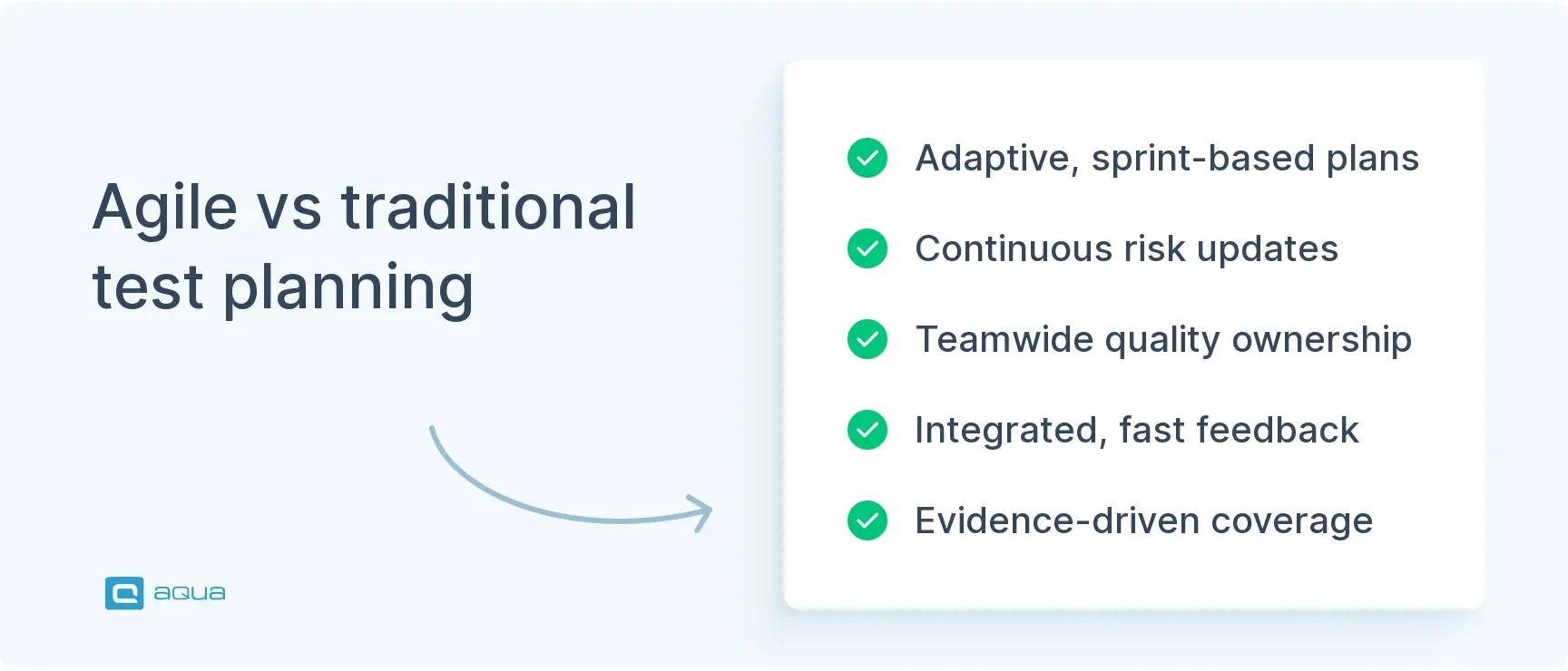
Traditional test planning assumed comprehensive upfront documentation followed by execution during dedicated test phases after development “finished.” That model falls apart when you’re shipping increments every two weeks. Production feedback hits your backlog before sprint planning even ends. Agile planning accepts that requirements evolve and integration happens continuously. Production serves as your ultimate source of truth about what actually works. Learn more about the key differences in our detailed comparison of agile vs traditional testing.
Aspect
Traditional Test Planning
Agile Test Planning
Documentation
Comprehensive upfront plan, detailed test cases
Lightweight, upgradeable plans; acceptance criteria and charters
Flexibility
Change requires formal process
Adjusts every sprint based on risk and feedback
Collaboration
QA works separately after development
Whole team owns quality from story refinement onward
Execution Timing
Dedicated test phase post-development
Continuous testing integrated into every increment
Risk Approach
Risk assessed once at project start
Risk re-evaluated every iteration, informed by production signals
Evidence Focus
Test case coverage metrics
Risk to evidence mapping across pipeline stages
Test Automation
Often inverted pyramid with heavy UI tests
Pyramid-shaped with fast unit tests as foundation
Feedback Loops
Slow, end-of-phase feedback
Continuous, sub-hour feedback at multiple stages
Scope Management
Fixed scope, controlled changes
Adaptive scope prioritized by current risk and value
Quality Ownership
QA team responsibility
Shared across entire development team
Traditional planning optimized for predictability in stable environments. Agile planning optimizes for learning speed where uncertainty represents the default state. This mindset shift, paired with the right tools, amplifies what teams can achieve.
Implementing Agile Test Planning with aqua cloud
aqua cloud aligns naturally with agile test planning by solving core challenges around maintaining continuous risk visibility. The platform creates closed feedback loops that adapt every sprint. When your test plan maps risks to pipeline stages, you need infrastructure that connects quality conversations directly to where teams work.
Step 1: Establish Your Risk-Evidence Framework
Start by using aqua’s requirement management to link user stories directly to risk categories. aqua’s AI Copilot with RAG grounding generates test cases from your requirements in seconds. The Copilot uses your own project documentation to create contextually relevant tests. This ensures your evidence map stays synchronized with upgradeable sprint priorities without manual overhead eating into development time. For comprehensive guidance on test plan management, explore our dedicated resources.
Step 2: Build Your Agile Test Suite Structure
Implement the test automation pyramid within aqua’s test case management system. Organize fast unit tests, integration tests, and critical-path UI tests in a hierarchy that reflects your risk profile. aqua’s built-in Scrum boards let you visualize test coverage against sprint goals clearly. Burn-down charts track progress toward your Definition of Done, giving you real-time insight into release readiness.
Step 3: Integrate Continuous Testing into Your Pipeline
Connect aqua with your CI/CD tools to surface test results exactly where decisions happen. aqua integrates seamlessly with Jenkins, GitLab, Azure DevOps, and GitHub Actions. The platform automatically triggers test execution on commits and displays results in developer workflows. This eliminates context-switching between tools and accelerates feedback loops significantly.
Step 4: Enable Collaborative Quality Ownership
Use aqua’s real-time dashboards to maintain team-wide visibility into test status and coverage gaps. The dashboards also highlight risk areas that need immediate attention. The platform’s defect tracking with built-in Jira integration ensures issues flow bidirectionally between testing and development backlogs. This keeps the entire team aligned on quality priorities without manual synchronization effort. Discover more about effective collaboration in QA planning to maximize team synergy.
Step 5: Apply AI for Adaptive Planning
As your sprints progress, aqua’s AI Copilot helps you refine test coverage by analyzing your project documentation. It suggests additional test scenarios based on patterns it identifies in your codebase and requirements. When requirements change mid-sprint, you get the adaptation speed that agile test planning demands.
You’ll save up to 12.8 hours per week with aqua. The platform’s traceability between requirements, test cases, and defects creates an evidence-driven feedback system. This means you can show stakeholders exactly how your tests connect to risks, and where gaps still exist. When leadership asks if you’re ready to ship, you have concrete evidence instead of gut feelings.
Implementing agile test planning successfully requires more than understanding the theory. You need practical patterns that work when sprints get messy and requirements shift overnight. Production incidents that demand immediate attention test your planning discipline. These practices help teams maintain quality without sacrificing velocity.
Here are the strategies that separate effective agile software test plan template implementation from checkbox exercises:
Treat test planning as whole-team responsibility: Product defines business impact while developers map technical risks. Operations identifies production failure modes, and testers facilitate the conversation that synthesizes these perspectives. If your standup doesn’t surface “we haven’t planned how to test X,” your planning loop has broken down somewhere.
Maintain continuous risk visibility: Keep a lightweight, backlog-aligned risk register that updates when priorities shift. Production incidents that reveal blind spots should trigger immediate register updates. Rank risks by likelihood and impact, then assign mitigation evidence to each. Weekly reviews prevent the trap of automating low-risk paths while ignoring high-stakes edge cases.
Embrace the test automation pyramid: Reserve expensive end-to-end UI tests for thin slices of critical flows. Push most coverage down to fast unit tests and API-level integration tests. Slow tests delay feedback and reduce the number of iterations you can run. Flaky tests erode trust in your entire test suite. Both problems kill sprint velocity, so plan your evidence mix to maximize credibility per dollar spent.
I have found test plans to be incredibly important and can help bake in an extra level of quality. Specifically automated test plans. Manual ones seem to add much less value.
Integrate shift-right thinking early: Don’t stop at “staging gates passed” as your quality bar. Plan explicit production evidence through canary metrics and feature flags for safe rollbacks. Include monitoring alerts tied to SLOs. Add chaos experiments if your team has matured enough to handle controlled failure injection. Some risks only validate credibly under real user load patterns.
Codify quality in your definition of done: Move beyond vague criteria like “all tests green” to specific requirements. Specify concrete evidence, such as “payment flow evidence gathered for duplicate charge risk” and “exploratory charter on error messaging complete.” Add technical criteria and operational readiness checks instead. This forces honest trade-off conversations when time runs short.
Create feedback loops that actually close: Every production defect should feed into the next sprint’s risk assessment with specific mitigation strategies. Every flaky test should trigger a decision: fix it immediately, delete it permanently, or accept the noise cost explicitly. Every slow build should prompt a coverage review to identify redundant or poorly-targeted tests. Agile test planning functions as a system design problem where you architect how quality information flows through your team.
These principles succeed because they’re grounded in how modern software delivery actually operates rather than how project plans pretend it works. For additional insights, check out our guide on best practices for effective test management.
When transitioning to Agile test planning, the right tools can make all the difference. aqua cloud, an AI-powered test and requirement solutions, delivers exactly what Agile teams need: an all-in-one environment for QA activities. With aqua’s real-time dashboards, you can maintain continuous risk visibility across your entire testing system. This means the capability to instantly identify coverage gaps and prioritize high-risk scenarios. The platform’s AI Copilot trains uniquely on your own project documentation through RAG grounding. From backlog prioritization to integrated Jira workflows, aqua connects every aspect of your Agile testing process, creating the closed feedback loop this article emphasizes as crucial. The result? Up to 97% time savings in test creation, 100% requirements coverage, and regulatory compliance. aqua offers native integrations with Jenkins, GitLab, Azure DevOps, GitHub Actions, TestRail, qTest, and other essential development tools to preserve your workflow continuity.
Reduce documentation overhead by 70% with aqua's AI
Agile test planning builds a feedback system that keeps risk visible while evidence flows at sprint speed. Winning teams treat planning as an upgradeable practice through whole-team ownership and risk-driven scope. They maintain pyramid-shaped automation while production signals feed back every sprint. Your test plan should update easily on a daily basis yet remain rigorous enough to prevent Monday morning disasters. The real advantage comes from treating planning itself as testable. When your plan fails to surface the risk that just bit you, update the plan rather than simply adding more tests. Quality in Agile represents a discipline that you practice and improve every sprint.
What is a test plan in Agile and how is it different from traditional test plans?
An Agile test plan is a lightweight, adaptive document focusing on risk-based testing priorities that evolve throughout sprints. Traditional plans comprehensively define all test cases upfront with extensive documentation. Agile emphasizes continuous collaboration and flexible scope adjustments with shared quality ownership and evidence-driven decisions at every iteration.
Do Agile teams still need formal test plans for sprint-based development?
Yes, but Agile test plans differ fundamentally from traditional documentation. Teams need structured approaches to identify risks, define evidence-based strategies, and maintain coverage visibility. These should be upgradeable artifacts that update every sprint. Think of it as a risk register and evidence map combined, not a comprehensive test case library.
What key elements should be included in an Agile test plan?
Essential elements include quality goals and SLOs defining success criteria, a lightweight risk register ranking threats by likelihood and impact, and a coverage map linking risks to test evidence. Document environment and test data strategies, plus clear Definitions of Ready and Done with explicit quality criteria for visibility without bureaucratic overhead.
How is test planning performed during Agile sprints and iterations?
Test planning happens in layers at multiple time scales. Product roadmaps establish quarterly quality goals. Release planning defines production gates. Sprint planning breaks stories into testable increments with acceptance criteria and identifies sprint-specific risks. Daily standups and PR reviews maintain tight feedback loops while risk registers and coverage maps update continuously.
What are the best practices for creating an effective Agile test plan?
Treat planning as whole-team responsibility with cross-functional input. Maintain continuous risk visibility through updated risk registers reflecting production reality. Embrace the test automation pyramid for optimal feedback speed. Integrate production monitoring into evidence strategies. Codify quality explicitly in the Definition of Done and create closed feedback loops where production defects trigger plan refinements.
Home » Best practices » Agile Test Planning Guide: What is a Test Plan in Agile?
Do you love testing as we do?
Join our community of enthusiastic experts! Get new posts from the aqua blog directly in your inbox. QA trends, community discussion overviews, insightful tips — you’ll love it!
We're committed to your privacy. Aqua uses the information you provide to us to contact you about our relevant content, products, and services. You may unsubscribe from these communications at any time. For more information, check out our Privacy policy.
X
🤖 Exciting new updates to aqua AI Assistant are now available! 🎉
We use cookies and third-party services that store or retrieve information on the end device of our visitors. This data is processed and used to optimize our website and continuously improve it. We require your consent fro the storage, retrieval, and processing of this data. You can revoke your consent at any time by clicking on a link in the bottom section of our website.
For more information, please see our Privacy Policy.
This website uses cookies to improve your experience while you navigate through the website. Out of these, the cookies that are categorized as necessary are stored on your browser as they are essential for the working of basic functionalities of the website. We also use third-party cookies that help us analyze and understand how you use this website. These cookies will be stored in your browser only with your consent. You also have the option to opt-out of these cookies. But opting out of some of these cookies may affect your browsing experience.
Necessary cookies are absolutely essential for the website to function properly. These cookies ensure basic functionalities and security features of the website, anonymously.
Cookie
Duration
Description
cookielawinfo-checkbox-analytics
11 months
This cookie is set by GDPR Cookie Consent plugin. The cookie is used to store the user consent for the cookies in the category "Analytics".
cookielawinfo-checkbox-functional
11 months
The cookie is set by GDPR cookie consent to record the user consent for the cookies in the category "Functional".
cookielawinfo-checkbox-necessary
11 months
This cookie is set by GDPR Cookie Consent plugin. The cookies is used to store the user consent for the cookies in the category "Necessary".
cookielawinfo-checkbox-others
11 months
This cookie is set by GDPR Cookie Consent plugin. The cookie is used to store the user consent for the cookies in the category "Other.
cookielawinfo-checkbox-performance
11 months
This cookie is set by GDPR Cookie Consent plugin. The cookie is used to store the user consent for the cookies in the category "Performance".
viewed_cookie_policy
11 months
The cookie is set by the GDPR Cookie Consent plugin and is used to store whether or not user has consented to the use of cookies. It does not store any personal data.
Functional cookies help to perform certain functionalities like sharing the content of the website on social media platforms, collect feedbacks, and other third-party features.
Performance cookies are used to understand and analyze the key performance indexes of the website which helps in delivering a better user experience for the visitors.
Analytical cookies are used to understand how visitors interact with the website. These cookies help provide information on metrics the number of visitors, bounce rate, traffic source, etc.
Advertisement cookies are used to provide visitors with relevant ads and marketing campaigns. These cookies track visitors across websites and collect information to provide customized ads.






 Bankingaqua ALM helps banks increase testing productivity by over 50%