In Agile, efficiency is key. Continuous optimisation ensures smoother workflows and minimises disruptions. After all, Agile thrives on adaptability, even when small issues that could otherwise throw projects off course arise. Another challenge is the time lost to routine tasks—time that could be better spent on innovation. Want to reclaim that time? Want to overcome these challenges for good? The answer might lie in the strategic implementation of AI. In this guide, we’ll show you how.
AI-driven Agile supercharges traditional Agile methodology by automating routine tasks, predicting project timelines, and providing data-driven insights for smarter decision-making.
Organisations implementing AI in their Agile processes have reduced project timelines by up to 30% according to the Journal of Business Research.
AI automation in testing accelerates bug detection and resolution, with tools like aqua cloud offering 100% test coverage and saving 42% of time in test planning.
Effective AI implementation in Agile should focus on routine task automation, automated testing, real-time updates sharing, and customer feedback analysis.
AI tools like Jira Automation, aqua cloud, Azure DevOps, Monday.com, and ClickUp can transform Agile workflows by eliminating bottlenecks and improving team collaboration.
Wondering how much time your team could save with AI-powered Agile? The potential 30% reduction in project timelines is just the beginning of what’s possible when you strategically implement AI in your workflow. Discover the specific tools and implementation strategies below 👇
What is AI-Driven Agile?
To understand AI-driven Agile, it helps to see what each part brings to the table before looking at how they work together.
Agile is a well-established methodology focused on delivering value through collaboration, flexibility, and progress. It helps you have rapid delivery and much better responsiveness by breaking work into smaller chunks and continuously improving. Agile thrives on real-time feedback. You need to adapt quickly and meet customer needs faster, and more effectively. In software development, where every second counts and every mistake could be costly, Agile methodology is especially invaluable.
Now about AI. Most people don’t want to agree that they use AI in their work, for different reasons. But let’s admit, when used to the correct degree, AI is awesome and it should be embraced. This is especially true in Agile.
From my POV AI at this point can be used to create a predictive model based on descriptive (what happened based on available data) analytics.
Short_Ad1984
Reddit
AI-driven Agile takes the foundational principles of Agile and superpowers them through smart algorithms. The possibilities are endless: using these algorithms to predict which tasks will cause delays, or to analyse user feedback for actionable insights in seconds. With AI, your team can also:
Automate routine tasks or spend significantly less time on them
Forecast project timelines with greater accuracy
Adjust priorities based on smart, data-driven insights
This approach elevates your existing workflow, making you more Agile in every sense.
A report from the Journal of Business Research found that organisations using AI in their processes were able to reduce project timelines by up to 30%. This number could be even higher for your projects as each one of them is individual. Use AI effectively and you will kill two birds with one by:
Keeping pace with industry demands
Ensuring smarter decision-making and more efficient project execution at every step
These are the first contributions AI make to your projects. Let’s delve into specific benefits.
Benefits of AI In Agile
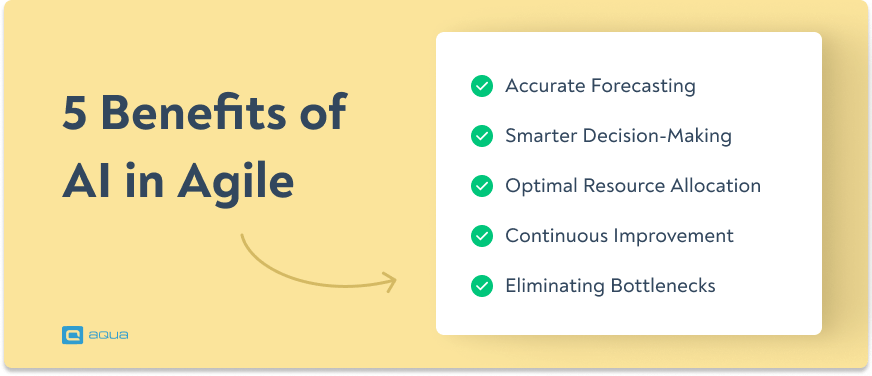
AI for agile development pays off in specific, measurable ways that show up in your sprint metrics, defect rates, and team velocity over time. The degree it can help you is maybe beyond calculation and even comprehension, so let’s focus on the tangible value in 5 bullet points:
Accurate Forecasting When you’re managing a project, predicting delays is no rookie job. AI uses past data to identify patterns (if there are any) and suggest where issues might arise. Having concrete predictions means you can adjust your schedule and avoid surprises.
Smarter Decision-Making Making decisions quickly is crucial in Agile. With AI, you gain access to real-time, data-driven insights. Whether it’s analysing user feedback or team performance, AI helps you make better, faster choices without the guesswork. Also, in a place where data is a leading power, there is almost no room for biases or risky intuitions. You go where data leads you to.
Optimal Resource Allocation Balancing workloads is a constant challenge and you know it. Here, AI also comes to the rescue: it analyses your team’s performance and suggests how to distribute tasks efficiently. This way, no one is overloaded in the team and your resources are used where they’ll have the greatest impact.
Continuous Improvement Continuous improvement is the backbone of Agile. AI can identify which feedback or metrics should be prioritised. Instead of reacting to everything (like we humans are more likely to do), AI guides you to focus on the changes that will drive the most significant improvements.
Eliminating Bottlenecks Bottlenecks are a familiar frustration. AI tracks your workflow and flags potential roadblocks before they become major problems. This way, you resolve issues quickly and keep the project moving forward without unnecessary delays.
As already mentioned, of course, the benefits do not end here and when you start implementing AI into your Agile processes, you will sow even more of them. For this, you need to also know how to implement it effectively, right?
Challenges, Risks, and Limitations of AI in Agile
AI for agile development introduces specific risks that teams rarely discuss openly when evaluating tools. Understanding them upfront helps you avoid the most common implementation mistakes.
Over-automation of judgment-dependent decisions. AI handles rules-based tasks effectively. It struggles with decisions that require context, team history, or awareness of stakeholder relationships. Letting AI prioritise a backlog without human input can surface technically correct priorities that ignore business realities your team understands from experience.
Data quality dependency. AI predictions in Agile are only as reliable as the historical data behind them. New teams, recently reorganised squads, or projects that have pivoted significantly will have data that no longer reflects current conditions. Poor data produces confident-sounding predictions that can steer the team in the wrong direction.
Team resistance and trust deficits. When AI surfaces sprint priorities or flags performance patterns, team members sometimes disengage from the process. They either over-trust the recommendation without questioning it, or reject it without analysis. Both responses reduce the value of AI in the workflow. Managing the human side of adoption is as important as the technical integration.
Tool sprawl and integration complexity. Adding AI tools to an Agile stack that already includes multiple platforms creates integration overhead. Data lives in different systems. Reports conflict. Teams end up reconciling AI outputs instead of acting on them. Choosing tools that connect directly with your existing Jira, DevOps, or CI/CD setup reduces this risk significantly.
Opaque decision logic. Many AI models cannot explain why they made a particular recommendation. In Agile, where retrospectives require teams to understand what went wrong and why, opaque AI decisions create gaps in learning. Favour tools that surface the reasoning behind recommendations, not just the output.
aqua cloud's AI Copilot generates test cases, requirements, and test data in seconds
To integrate AI into Agile processes, you need to understand where automation and data analysis can make the most impact. The approach “Let’s rely on AI in everything and anything” will surely not work. Think about where your team spends the most time and energy. From there, you can start. We give you a few examples below.
Routine Tasks Automation
Agile means speed. But without proper tracking and management, it is just speeding up into darkness. Here is another problem: tracking and updating tasks manually wastes precious time.
AI can take care of these routine actions, for example, updating statuses, managing task assignments, and tracking progress. This gives your team more time to focus on solving complex problems. Also, your work demands more brainstorming and less monotonous tasks – heaven for people who love problem-solving.
So the first point of implementation is routine. Remember: routine is a killer of creativity and in Agile, it is definitely a killer of speed.
Automated testing
In Agile, where releases happen frequently and sprint cycles are short, testing cannot be the step that slows everything else down. Without proper testing, you risk releasing buggy software that could harm the entire project. But manual testing? It’s slow, tedious, and prone to human error.
AI-powered automated testing accelerates the process in several ways. With them, you can identify these costly bugs much faster and deal with them much earlier. You also reduce the likelihood of delays down the line. In the fast-paced world of Agile, automated testing gives you the confidence to push forward, knowing your product is solid.
In this context, AI-powered Test Management Systems (TMS) are invaluable. A great solution will give you confidence in your tight deadlines, help you automate where it is necessary, and enhance communication within different teams. How?
This is what aqua cloud has been doing for years. With aqua cloud, you are getting more than another automation tool—you’re unlocking a powerful hub that centralises both manual and automated testing efforts. aqua delivers 100% test coverage and full traceability to ensure your team never misses a beat. With AI-powered requirements, test cases, and test data creation in seconds, you eliminate routine from your test planning and save 42% time and effort in that stage. One-click bug-reporting integration Capture means better communication between devs and testers, while seamless integrations with Jira and Selenium help you tie test management into your CI/CD pipeline. The result? Faster feedback loops, better communication, and consistent visibility—exactly what Agile demands.
Achieve 200% automation with an AI-powered TMS in Agile development
When team members and stakeholders work from different information, small misalignments become expensive coordination problems that compound across sprints. AI tools can automatically generate progress reports and send them to your team or stakeholders. No more chasing down updates or waiting for status meetings—AI ensures everyone has the latest information when they need it.
Customer Feedback Analysis
Customer feedback generates more data than any team can manually process between sprints. AI closes that gap by surfacing patterns your team can actually act on. By analysing reviews, surveys, and support tickets, AI identifies common pain points and emerging trends (if there are any). This way, you learn about your customer’s preferences and pain points – and know exactly what to fix or focus on in your next releases.
Ever wondered what that 30% timeline reduction from AI in Agile actually looks like in practice? Our interactive sprint dashboard below runs two identical sprints side-by-side – one traditional and one AI-powered – so you can watch in real-time as automated testing, predictive analytics, and smart resource allocation transform sprint delivery. Hit ‘Start Sprint Race’ to see how AI doesn’t replace your Agile process, but supercharges it to deliver faster, higher-quality results:
🏃♂️ Sprint Chaos vs AI-Powered Sprint Simulator (Click to open)▼
Watch two teams tackle the same sprint - one traditional, one AI-enhanced
😰 Traditional Agile Team
PROGRESS
0%
BUGS FOUND
0
STRESS LEVEL
Low
VELOCITY
1.0x
CURRENT ACTIVITY
Team ready for sprint...
Sprint Progress
🤖 AI-Enhanced Agile Team
PROGRESS
0%
BUGS FOUND
0
STRESS LEVEL
Low
VELOCITY
1.0x
CURRENT ACTIVITY
AI analyzing sprint capacity...
Sprint Progress
😰 Traditional Challenges
Manual task tracking
Late bug discovery
Resource allocation guesswork
Reactive problem solving
🤖 AI Advantages
Automated routine tasks
Predictive bug detection
Smart resource optimization
Proactive bottleneck prevention
📊 Key Results
30% faster delivery
60% fewer late bugs
40% better resource utilization
Best Practices and Metrics for Adopting AI in Agile
Successful AI for agile development adoption follows a consistent pattern. Teams that get results start small, measure everything, and expand only after validating that the initial integration is working.
Start with one workflow, not the whole process. Pick the highest-friction part of your current Agile workflow and apply AI there first. If test planning takes the most time, start with AI-powered test case generation. If backlog grooming sessions run long, start with AI-assisted prioritisation. Prove value in one area before expanding.
Define success metrics before you start. Set specific, measurable targets for what AI should improve. Sprint velocity is one option. Mean time to detect bugs is another. Defect leakage rate, test cycle time, and time spent in status meetings all work. Without a baseline, you cannot demonstrate that AI made a meaningful difference.
Useful metrics to track:
Sprint velocity trend before and after AI adoption
Defect detection rate per sprint
Time spent on manual test creation versus AI-assisted creation
Bug resolution time from report to close
Percentage of retrospective findings that generate actual backlog items
Run a parallel sprint before fully switching. Before relying on AI-driven sprint planning, run one sprint with AI recommendations alongside your current process and compare outcomes. This lets your team calibrate trust in the AI’s outputs before the recommendations start influencing delivery.
Review AI outputs in retrospectives. Include AI recommendations and their outcomes as a standing item in sprint retrospectives. If the AI consistently flags the wrong risks or misses the right ones, adjust the inputs before assuming the tool does not work.
Maintain human ownership of decisions. AI surfaces options and patterns. Humans make the call. Keeping this distinction clear prevents the accountability gaps that appear when teams cannot explain why a sprint was planned a certain way.
The key thing to measure is the actual value created in a Sprint; work that creates no value isn't productivity, it is waste. Forecasting based on historical data takes into account all of the variability the team has encountered to date, with known assumptions.
Choosing the right AI tools for agile development depends on where your team loses the most time and which parts of your workflow are already stable enough to benefit from automation. But which tools are worth your attention? Here’s a list of standout AI tools, each designed to improve how you work in Agile:
Jira Automation with AI Integrations Jira is already a staple in Agile, but its AI integrations push it further. With it, you can automate workflows, prioritise tasks, and even predict delays using AI-enhanced plugins. This tool simplifies complex project management, keeping your team focused on delivery.
2. aqua cloud Specifically focused on QA project management,aqua cloud could be your superpower as it seamlessly integrates with Jira and Azure DevOps, creating a single platform where QA and development work hand-in-hand. With aqua AI, you can accelerate your sprint cycles and reduce bottlenecks through AI-powered creation of test cases, requirements, and test data (also save hours each sprint). The centralised repository ensures that manual and automated testing are aligned, providing 100% traceability and enabling quick adaptability to changing requirements—a cornerstone of Agile. The Capture integration streamlines bug reporting, delivering better collaboration and transparency across cross-functional teams. With 100% test coverage and AI Copilot assistant, aqua cloud empowers your Agile team to consistently deliver high-quality software, faster.
3. Azure DevOps Microsoft’s Azure DevOps brings AI to improve code reviews, identify potential risks in deployments, and improve overall pipeline efficiency. It’s a reliable choice for teams looking to integrate AI into their continuous integration and delivery (CI/CD) workflows.
4. Monday.com with AI Assistant Known for its intuitive design, Monday.com’s AI capabilities take the pain out of project tracking. It provides smart suggestions and generates status reports instantly, saving you hours of manual effort.
5. ClickUp with AI Workflows Focused generally on task management and collaboration, ClickUp and its AI are the next pick on the list. With it, you can automate recurring tasks, prioritise urgent items, and generate actionable insights from team activity. It’s perfect for Agile teams managing multiple projects.
By bringing these tools into your Agile workflows, you can settle collaboration problems once and for all, and focus more on delivering exceptional results. The question is, which one will you choose to transform your Agile process?
Conclusion
Rather than just an add-on for Agile, AI is a game-changer. By eliminating or minimising routine, improving automated testing (through solutions like aqua cloud), and analysing customer feedback, AI empowers you to innovate and adapt faster than ever. The possibilities are endless, but the question is: will you choose the solution to bring the power of AI into your Agile practices?
AI in Agile basically means using artificial intelligence to streamline Agile processes. They include automating backlog grooming, prioritising user stories, and predicting sprint risks. With the rise of AI, you can see a positive trend in team velocity, decision-making, and testing efficiency.
Will AI replace Agile?
No, AI won’t replace Agile—or vice versa; it will enhance it. Agile thrives on adaptability and collaboration. AI can assist with automation and data-driven insights, but human judgment and team interactions still stay central to Agile’s success. The future is hybrid.
An AI workflow is the step-by-step process of building and deploying AI models. It includes:
Data collection
Preprocessing
Training
Validation
Integration into real-world systems
The process is often automated to accelerate delivery.
How is AI in Agile different from traditional Agile automation?
Traditional Agile automation handles rule-based, repetitive tasks: moving a ticket from “In Progress” to “Done” when a pull request merges, sending a standup reminder at a set time, or generating a sprint burndown chart from completed story points. These are deterministic actions triggered by predefined conditions. AI for agile development goes further. Instead of executing fixed rules, AI analyses patterns in historical data and generates recommendations: which stories carry the highest delivery risk, where testing coverage is thinnest, or which team member’s workload is trending toward overload before it becomes a problem. The difference is that AI adapts its output based on what the data shows, rather than following a set script. In practice, the two work best together: automation handles the routine, AI handles the analysis, and humans make the final decisions.
Join our community of enthusiastic experts! Get new posts from the aqua blog directly in your inbox. QA trends, community discussion overviews, insightful tips — you’ll love it!
We're committed to your privacy. Aqua uses the information you provide to us to contact you about our relevant content, products, and services. You may unsubscribe from these communications at any time. For more information, check out our Privacy policy.
X
🤖 Exciting new updates to aqua AI Assistant are now available! 🎉






 Bankingaqua ALM helps banks increase testing productivity by over 50%