Key Takeaways
- Continuous testing integrates quality checks directly into the development pipeline at every stage.
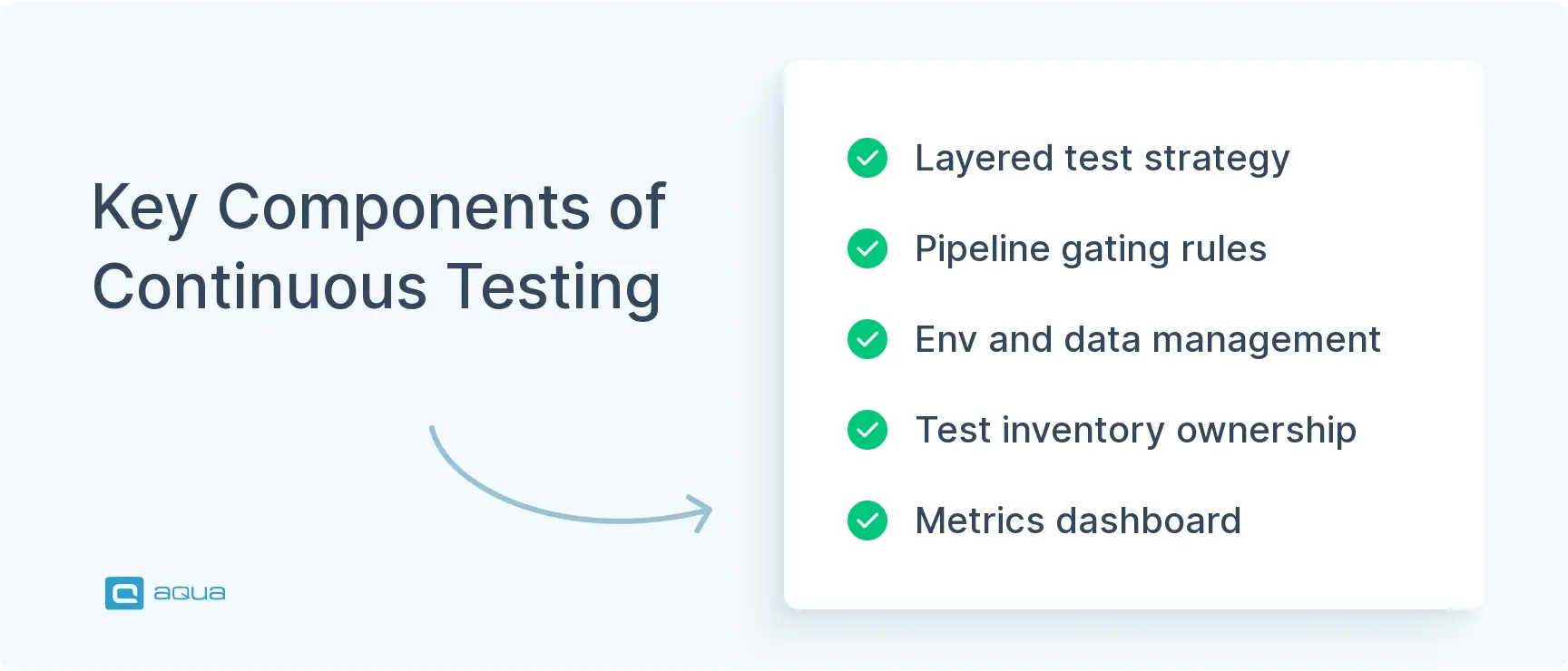
- A comprehensive continuous testing template includes five key components: layered testing strategy, pipeline gating criteria, environment management, test inventory with ownership assignments, and metrics dashboards.
- Unstable tests are the biggest threat to continuous testing success, requiring a zero-tolerance policy with quarantine procedures and ownership assignment for quick resolution.
- Effective implementation requires runtime budgets for each pipeline stage, with PR checks under 5 minutes and main branch builds under 10 minutes.
- The template serves multiple roles, including QA specialists, developers, product managers, and engineering leads, by providing consistent quality standards across teams.
Modern software delivery demands more than end-phase testing, but many teams struggle with slow pipelines and unreliable tests that undermine confidence. See how a structured continuous testing approach can boost your delivery speed and quality 👇
What is the Continuous Testing Template?
Continuous testing is a structured approach to embed quality signals into every phase of your Software Development Lifecycle (SDLC). Think of it as a health monitoring system for your app. Instead of waiting until deployment to discover a broken login flow, you check automatically whenever code changes hands. The core idea is simple: integrate testing into your CI/CD pipeline so you catch security gaps and performance hiccups as well as any potential regressions before they reach users.
A continuous testing template documents your testing approach. It maps out which tests run at each pipeline stage. For example, pull requests trigger certain checks, while main branch builds require others. Beyond that, the template defines quality gates that block or warn on failures. Most importantly, it establishes who owns fixing broken builds.
When a developer opens a pull request, your continuous test template might trigger:
- Unit tests
- Static analysis scans
- Contract tests
All these checks run before code hits the main branch. Subsequently, if those checks pass, the build moves to integration testing with API suites and smoke tests in a staging environment. The template ensures everyone on your teams knows the rules: what gets tested, when it runs, and who fixes failures.
The beauty of a continuous test template is consistency. As a result, new team members can onboard quickly because the testing strategy is documented and automated. This approach provides continuous feedback that accelerates delivery without compromising quality.
As you develop your continuous testing strategy, managing test data, ensuring environment stability requires a unified platform. This is where aqua cloud, an AI-powered test and requirement management solution, shines by providing a centralized ecosystem for both manual and automated testing. aqua integrates seamlessly with your CI/CD workflow. With it, you link test execution directly to Jenkins or GitLab CI/CD through built-in plugins. Alternatively, connect any pipeline via REST API, ensuring tests run automatically at every stage. The platform’s domain-trained AI Copilot helps you generate test cases from your requirements, documentation, or voice notes in seconds, significantly accelerating your continuous testing initiatives across your teams. All test assets remain organized in one repository that maintains full traceability. Plus, aqua integrates with multiple tools, including Jira, Azure DevOps, TestRail, and GitHub Actions, keeping your existing workflow intact.
Cut test creation time by 80% with aqua's AI
Key Components of a Continuous Testing Template
A functioning continuous software testing template rests on several interconnected pieces. Skip one, and your pipeline turns into an unreliable mess. These components build an executable strategy that your teams can follow, sprint after sprint.
Essential template components to include:
- Layered testing strategy. You can’t run every test on every commit without grinding your pipeline to a halt. Therefore, a layered approach prioritizes fast, high-signal checks at the base. Unit and component tests catch most defects in seconds. Meanwhile, slower integration tests handle only the most valuable paths. This structure keeps feedback loops tight.
- Pipeline gating and quality criteria. Each stage in your CI/CD workflow needs clear entry and exit rules. For instance, pull requests might require passing lint checks and unit tests before merge approval. Mainline builds could enforce API integration suites. Your template should spell out which failures block promotion and which trigger warnings. This clarity prevents confusion across your teams.
- Environment and data management. Unreliable tests usually trace back to unstable environments or dirty test data. Consequently, your template must define how test environment management works, including provisioning and teardown. Additionally, it should address dependency handling through shift-left testing principles. Production-like staging environments catch integration bugs that dev boxes miss. Furthermore, test data seeding and refresh procedures prevent collisions between test runs.
- Test inventory and ownership. Who owns the performance suite? What tags separate smoke tests from full regression? A continuous testing template catalogs every test suite and assigns ownership to specific members of your teams. The template also uses metadata like tags and component labels to enable selective execution. Therefore, when a service changes, you run its contract tests rather than the entire regression pack.
- Metrics and reporting dashboard. Continuous testing generates valuable data, including pass rates and runtime distributions. Pipeline lead time matters too. Your template should require a central dashboard that surfaces these signals. As a result, your teams can spot trends like a regression suite that’s grown to 45 minutes. Moreover, tracking escaped defects closes the loop on whether your testing strategy actually works.
These components connect in meaningful ways. Good data management enables reliable tests. Subsequently, reliable tests feed accurate metrics. Those metrics inform where to invest in better coverage. When your template documents all five, your teams move from ad-hoc testing to a repeatable system that scales with your codebase.
Who Can Benefit from a Continuous Testing Template
Multiple roles across your teams rely on continuous testing templates to ship faster without chaos. Each role gets specific value from the structure and clarity a template provides.
- QA engineers and test automation specialists. Engineers need clear definitions of which tests run at each pipeline stage and how to tag suites for selective execution. The template eliminates the need to verify the test strategy for each new project. Additionally, it gives documentation to justify investments in better tooling or environment improvements when proposing changes to leadership.
- Developers and DevOps engineers. Devs are looking to find out which checks will block your pull requests and how long builds should take before they merge. The template clarifies who fixes unreliable tests so broken pipelines don’t stall for hours. DevOps engineers use it to configure quality gates in Jenkins or GitHub Actions when integrating CI/CD pipelines.
- Product managers and release managers. Managers usually try to benefit from transparent risk signals to make go/no-go decisions without deep technical knowledge. When the performance suite fails, they know latency thresholds are breached. When smoke tests pass, they know core user journeys work. The template also helps coordinate release readiness across multiple services by ensuring consistent quality standards.
- Engineering leads and architects. Leads and architects need consistency when scaling teams or onboarding new services. The template ensures every squad follows the same testing approach and reports the same metrics. This prevents configuration drift across your organization. Architects also use it to build testing into reference implementations so new microservices launch with proper test coverage already in place.
The template becomes shared language across your teams. Instead of debating testing strategy in every retro, you iterate on the template itself and spread improvements across your organization.
Greatly Improved Quality: Continuous testing helps in identifying issues early which greatly improves quality and greatly reduces test fix time.
Template for Continuous Testing You Need as a QA Specialist
Here’s a practical continuous testing template you can adapt for your teams. Copy this into Confluence or your internal wiki, then customize the specifics to match your tech stack and release model.
Continuous Testing Template
1. Purpose and Scope
- Systems Covered: [List apps, services, data pipelines—e.g., User API, Payment Gateway, Mobile App]
- Release Model: [Describe deployment cadence—trunk-based CI, Gitflow, daily deploys]
- Risk Posture: [Note any compliance/regulatory constraints—e.g., PCI-DSS, healthcare data privacy]
2. Definition of Done for Quality
- Unit/Component Coverage: Minimum 80% statement coverage; all new code includes unit tests
- API/Integration Coverage: Critical paths and happy/sad flows automated
- UI/End-to-End: Smoke suite covering the top 3 user journeys, like login and checkout
- Non-Functional: Response time <500ms for 95th percentile; zero high-severity security vulnerabilities
- Accessibility: WCAG 2.1 Level AA compliance checks on public-facing features
3. Pipeline Map: Stages → Tests → Gates
| Stage |
Tests Executed |
Runtime Budget |
Quality Gate |
| Pull Request |
Lint, SAST, unit tests, contract tests |
<5 min |
Hard block on failure |
| Main Branch Build |
Unit, component, API smoke, container scan |
<10 min |
Hard block on failure |
| Deploy to Staging |
Full API integration suite, E2E smoke, basic perf check |
<20 min |
Hard block on severe failures |
| Pre-Production |
Performance suite, DAST, extended regression |
<60 min (nightly) |
Soft gate → escalate on failure |
| Post-Release (Prod) |
Synthetic monitoring, SLO alerts |
Continuous |
Trigger rollback if SLO breach detected |
4. Test Inventory and Tagging
- Suite Naming Convention:
{Service}-{Layer}-{Type} (e.g., UserAPI-Integration-Smoke)
- Tags: Smoke, regression, contract, performance, security
- Ownership: Each suite maps to a team/component owner in the test management tool
- Metadata Requirements: Link to Jira story, service identifier, last updated timestamp
5. Environment Strategy
- Ephemeral Preview Envs: Spin up per PR for isolated testing, shut down post-merge
- Integration Environment: Persistent, auto-deployed from main branch, shared team test bed
- Staging: Production-like, deployed via release candidate branch, stable for regression
- Service Virtualization: Mock unavailable third-party APIs, such as payment gateway
- Test Data: Seed scripts in version control; refresh nightly; mask PII in non-prod
6. Release Confidence Strategy
- Canary Deployments: 5% traffic for 30 minutes; monitor error rate and latency
- Feature Flags: Toggle new features off if anomalies are detected
- Monitoring + SLOs: 99.9% uptime; <1% error rate; <500ms p95 latency
- Rollback Criteria: Automatic rollback if SLO breached for >5 minutes
7. Defect Triage Workflow
- Failed PR Tests: Developer fixes before re-requesting review
- Failed Main Build: Team lead notified; rollback merge if not fixed within 30 min
- Unreliable Test Policy: Quarantine after 3 consecutive failures; owner has 48h to stabilize or remove
- Production Incidents: Post-mortem → add regression test → deploy fix
8. Metrics Dashboard (Minimum)
- Pipeline lead time from commit to production
- Build stability measured by MTTR for the broken main branch
- Test pass rate and unstable test count
- Escaped defects – prod incidents with root cause in untested code
- Test runtime distribution to identify bottleneck suites
9. Tooling and Integrations
- CI Runner: Jenkins, GitHub Actions, or GitLab CI
- Test Frameworks: JUnit, RestAssured, Selenium WebDriver, JMeter
- Reporting: Allure or TestRail integrated with CI for traceability
- Security: SonarQube for SAST, OWASP ZAP for DAST
- Monitoring: Datadog or New Relic for post-deploy synthetics
10. Rollout Plan
- Pilot (30 days): Deploy template to 1–2 services; stabilize pipeline and fix unreliable tests
- Expand (60 days): Onboard additional services; train teams on tagging and ownership
- Mature (90 days): Full metrics dashboard live; quarterly template review cycle
This template provides documentation that grows with your team’s maturity. Start with the pilot scope by picking one service. Implement the pipeline stages and prove the value. Subsequently, once your first service runs smoothly with green builds and fast feedback, copy the pattern across your org. The key is treating the template as infrastructure: version it, review it in retros, and update it when you discover better practices.
Challenges of Continuous Testing
Continuous testing sounds great on paper, with automated checks and rapid feedback. Reality? You’ll hit friction points that turn your slick pipeline into a frustrating bottleneck if you don’t plan for them. Here are the most common problems your teams will face and practical ways to address them.
Unreliable tests weaken trust. When tests fail inconsistently, developers start ignoring failures and real regressions slip through. Root causes usually involve shared databases, timing issues, or brittle UI locators. The fix is a zero-tolerance policy: quarantine unreliable tests after a few failures and assign ownership. Either stabilize them within 48 hours or delete them. Meanwhile, invest in deterministic test data through seed scripts. Additionally, favor API tests over UI where possible since they fail inconsistently less often.
Quality should be the responsibility of the team that develops it. They cannot consider a story or feature done, unless it's covered by automated tests and proven to be bug free.
Slow pipelines kill momentum. If your CI build takes 45 minutes, developers will batch commits or skip tests locally. Therefore, set runtime budgets: pull request checks under 5 minutes, mainline builds under 10. Achieve this through parallelization and selective execution. Furthermore, push heavy regression to nightly runs. Many teams discover their E2E suites are bloated. As a result, trimming to a small smoke set cuts runtime dramatically.
Tool clutter creates reporting chaos. Unit test reports in one tool, integration results in another, while security scans and performance metrics are stored in a completely different environment. Nobody can tell if the build is acceptable at a glance. Consequently, standardize on a single reporting format and centralize dashboards. Tools like Allure aggregate results from multiple frameworks into one view.
Cultural resistance blocks progress. When developers see testing as a QA responsibility, your pipeline becomes a bottleneck because QA can’t keep pace. The shift requires shared ownership where developers write unit and integration tests as part of feature work. Meanwhile, QA specialists design the test strategy and maintain complex suites. Everyone on your team owns fixing broken builds.
Environmental constraints limit testing. Shared environments cause conflicts when multiple teams deploy simultaneously. Slow provisioning stalls testing entirely. Therefore, use infrastructure as code to spin up environments on demand with Terraform or CloudFormation. Additionally, service virtualization helps with dependencies you don’t control. Focus on parity where it matters, like data volume, and accept tradeoffs elsewhere.
These challenges aren’t hypothetical. The teams that succeed treat continuous testing as a capability that needs ongoing care. Fix unreliable tests aggressively, monitor pipeline performance, and update your template based on real problems.
Implementing the continuous testing template requires a platform that can bring together all the essential components from test inventory and pipeline integration to metrics dashboards. aqua cloud, an AI-powered test and requirement management solution, delivers this by centralizing your test management. Its built-in Jenkins plugin and GitLab CI/CD support ensure automated tests become a seamless part of your pipeline. The platform’s unique AI Copilot, trained specifically on your project documentation, helps your teams generate context-aware test cases and analyze results. This dramatically reduces the time spent on test creation and maintenance. With aqua’s unified approach, you implement continuous testing without any operational blockers or reporting chaos. Native integrations with Selenium, Postman, k6, and a dozen other platforms in your tech stack are supported to make sure that aqua fits naturally into your workflow.
Save 12.8 per week per tester with aqua's AI capabilities
Conclusion
A solid, continuous testing template provides the structure to boost QA and make releases higher-quality. It defines your testing layers, pipeline gates, and ownership so everyone knows the playbook. Whether you’re managing microservices or maintaining a legacy monolith, the template adapts while keeping you tied to proven practices. Organizations that master continuous software testing adapt faster to customer needs and deliver software that works. Start small by piloting the template on one service, prove the value, then scale across your organization.






 Bankingaqua ALM helps banks increase testing productivity by over 50%