Functional vs Regression Testing: Key Differences Explained
You are in the middle of the sprint, features are shipping, bugs are getting squashed, and someone asks: "Did we run regression tests?" Wait, are we not already doing functional testing? Functional and regression testing are not interchangeable. They are two distinct approaches that serve different purposes. Functional testing checks if your application does what it is supposed to do right now. Regression testing is your insurance policy, making sure yesterday's fixes did not break today's features. Understanding when to use each one, and how they work together, is what separates you from the teams that cross their fingers every release.
Functional testing verifies that software features work according to specified requirements, treating applications as black boxes where inputs should produce predictable outputs.
Regression testing ensures recent code changes haven’t broken existing functionality by re-running tests on previously working features after every modification.
Functional testing happens during active development when features are being built, while regression testing occurs after changes land in the codebase.
Automation becomes essential for regression testing as applications grow, running tests on every commit to provide immediate feedback about what broke and where.
Functional regression testing combines both approaches to simultaneously verify new features work correctly and existing functionality remains intact after changes.
Many development teams treat these testing types as competing approaches when they’re actually complementary strategies that protect software from different angles. Want to know how to implement both effectively in your development cycle? Read on 👇
What Is Functional Testing
Functional testing validates that your software’s features work according to specified requirements. You are running predefined test cases derived directly from functional specifications, checking whether clicking a button actually sends the email, whether the search filter returns accurate results, or whether the login form accepts valid credentials and rejects invalid ones.
The approach treats the application as a black box where inputs should produce predictable outputs. You test individual functions in isolation, covering happy paths and edge cases. Did the payment gateway process the transaction? Does form validation catch incorrect email formats? These are functional questions with binary answers. It works or it does not. Catching these issues early in development costs less time and fewer headaches than discovering them post-deployment.
Examples of Functional Testing
Login authentication verification: Testing that valid credentials grant access while invalid ones trigger appropriate error messages
Form submission validation: Checking that required fields block submission when empty and that data formats get validated correctly
Search functionality testing: Verifying queries return relevant results and filters narrow options as expected
Payment processing checks: Confirming transactions complete with valid payment data and fail gracefully with invalid data
API endpoint testing: Validating that API calls return correct status codes and expected data structures
File upload operations: Testing that supported file types upload successfully while unsupported formats get rejected with clear feedback
While understanding the differences between functional and regression testing is crucial, implementing them effectively requires the right tools. aqua cloud offers a comprehensive platform that streamlines both testing types, helping you validate new features while ensuring existing functionality remains intact. With aqua’s centralized test management, you can create, organize, and execute test cases for both functional validation and regression checks from a single dashboard. The platform’s Actana AI, powered by domain-trained artificial intelligence with RAG grounding, can generate contextually relevant test cases from your requirements in seconds, saving testers up to 12.8 hours per week. This is a technology that learns from your project documentation, delivering test cases that speak your product’s language and address your specific testing needs.
Transform your testing efficiency with aqua's AI-powered test management platform
While functional testing validates new features against requirements, regression testing ensures that recent code changes have not accidentally broken existing functionality. Understanding what is functional and regression testing helps teams build a comprehensive quality strategy.
Your dev team just pushed a hotfix to the checkout flow. Did that patch introduce bugs in the inventory system? Regression testing answers that question by re-running tests on previously working features after every modification, whether it is a minor bug fix, a major feature rollout, or a configuration update. One seemingly isolated change can ripple through your application in unexpected ways.
This becomes more critical as your codebase grows. What worked perfectly last sprint might fail this sprint because someone refactored a shared utility function. Regression testing acts as your safety net, catching unintended side effects before they reach production. The goal is not to verify new functionality, that is what functional testing handles. It is to confirm that the old, reliable parts still work exactly as they did before.
Examples of Regression Testing with Example Scenarios
Post-bug-fix validation: After fixing a date picker bug, re-testing the entire booking flow to ensure the fix did not affect appointment scheduling or calendar integrations
Feature addition testing: Adding a dark mode option and verifying that existing themes and accessibility features still function correctly
Database schema updates: Changing database structures and confirming all CRUD operations continue working without data loss
Third-party integration updates: Upgrading a payment provider API version and checking that all payment functions still process transactions correctly
Cross-browser compatibility checks: After optimising JavaScript for Chrome, ensuring Firefox, Safari, and Edge users do not experience broken interactions
Security patch testing: Implementing SSL certificate updates and validating that authentication flows and session management remain intact
Regression testing with example scenarios like these helps teams understand how to apply these tests in real-world situations across different change types.
How to Conduct Functional Testing
Functional testing starts with understanding what you are supposed to test. That means reviewing requirements documentation, user stories, and acceptance criteria before writing a single test case. Break functional specifications into testable chunks and map out scenarios covering typical user workflows and edge cases. Test cases should be clear enough for anyone to follow: “When user enters valid email and password, system grants access to dashboard.”
Once test cases are defined, execute them systematically. Document every result. If a feature passes, move on. If it fails, log the behaviour, capture screenshots, note reproduction steps, and flag it for the development team. Consistency is what makes results reliable across test cycles.
Functional testing workflow:
Analyse requirements: Review functional specs, user stories, and acceptance criteria to understand expected behaviour
Design test cases: Create detailed scenarios covering valid inputs, invalid inputs, boundary conditions, and edge cases
Prepare test environment: Set up test data and configure systems to mirror production where possible
Execute tests: Run test cases methodically, comparing actual results against expected outcomes
Log defects: Document deviations from expected behaviour with reproduction steps and severity ratings
Retest after fixes: Verify that resolved issues do not introduce new problems
How to Conduct Regression Testing
Run regression tests after developers commit changes but before promoting builds to production or staging environments. Every code change, no matter how small, deserves a regression check. This includes bug fixes, feature additions, performance optimisations, library updates, and configuration tweaks.
The scope depends on the change. Minor fixes might require selective regression covering related modules and immediate dependencies. Major releases need full regression suites covering all critical paths. This is where automation becomes essential. Manual regression testing gets tedious and error-prone when you are re-running hundreds of test cases after every sprint. Automated suites run consistently, catch regressions immediately, and free your QA team for exploratory testing and new feature validation.
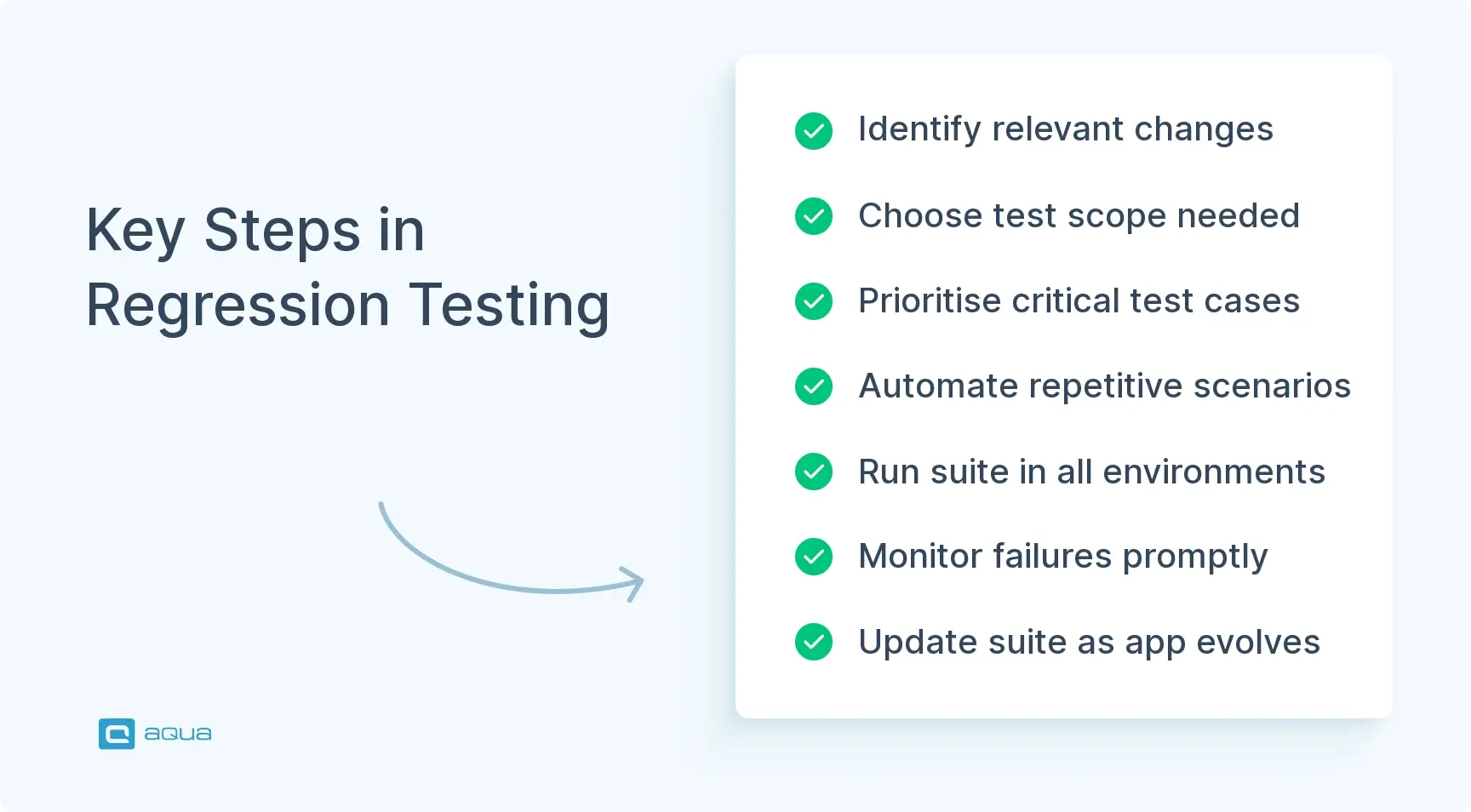
Regression testing process:
Identify trigger events: Determine which code changes warrant regression testing
Select test scope: Choose between full regression, partial regression, or unit-level regression based on change impact
Prioritise test cases: Focus first on critical business functions, high-risk areas, and frequently used features
Automate repetitive tests: Build automated regression suites for stable features that need consistent re-testing
Execute test suite: Run selected tests across all relevant environments and configurations
Monitor results: Track pass and fail rates, identify patterns in failures, and report issues promptly
Update test suite: Add tests for fixed bugs and remove obsolete tests for deprecated features
When to Use Functional and Regression Testing
Functional testing belongs at the front of your development cycle, right when features are being built. You are validating brand-new functionality against fresh requirements. Got a new checkout flow? Functional testing confirms it works. Built a reporting dashboard? Functional testing verifies every chart and filter behaves correctly. This is your first-pass quality gate before code reaches staging.
Regression testing and functional testing each have their trigger points. Regression testing kicks in after changes land in your codebase, whether those changes are new features, bug fixes, refactors, or dependency updates. Any time you touch code already in production, regression testing protects you from breaking what already works. It is particularly critical after hotfixes, where speed sometimes trades off against thoroughness, and before major releases, where stakes are highest.
Scenarios where each applies:
New feature releases: Use functional testing to validate fresh functionality meets requirements before moving forward
Bug fixes and patches: Run targeted regression tests on affected modules plus related features to catch unintended side effects
Code refactoring: Execute full regression suites since internal changes should not alter external behaviour, but often do
Framework or library updates: Comprehensive regression testing ensures third-party changes do not break integrations
Environment migrations: Regression tests verify features work consistently across development, staging, and production
Regular release cycles: Combine both. Functional testing for new features, regression testing for everything that already exists
The Role of Automation in Functional and Regression Testing
Automation transforms both functional and regression testing from time-consuming bottlenecks into continuous quality checks. For functional testing, automation works best once features stabilise and test cases become repeatable. You would not automate functional tests for a feature still being designed, requirements change too quickly. But once acceptance criteria lock down, those test cases become strong automation candidates.
Regression testing practically demands automation. Manually re-testing hundreds of scenarios after every code change is unsustainable as applications grow. Automated regression suites run on every commit, provide immediate feedback, and catch regressions before code reaches QA environments. Modern CI/CD pipelines integrate these suites directly into deployment workflows, blocking releases when critical tests fail. The right test automation solutions make this integration straightforward across most common stacks.
Common tools by use case:
Selenium WebDriver: Open-source browser automation supporting multiple languages and browsers, strong for functional UI testing across web applications
Cypress: JavaScript-based framework with fast execution and time-travel debugging, suited for both functional and regression testing of web apps
Playwright: Cross-browser automation with parallel test execution, a strong choice for comprehensive regression suites
TestNG and JUnit: Java-based frameworks for unit and integration testing, often paired with Selenium for functional test automation
Appium: Mobile automation for iOS and Android, essential for functional and regression testing across mobile platforms
Postman and Newman: API testing tools that automate functional validation of endpoints and regression testing of API contracts
Robot Framework: Keyword-driven framework with readable syntax, works well for teams with mixed technical skill levels
Matching tools to your specific context matters more than chasing the most popular framework. Consider your tech stack, team skills, budget, and CI/CD integration requirements before committing.
Key Differences Between Functional and Regression Testing
The difference between functional and regression testing comes down to purpose, timing, and scope.
Aspect
Functional Testing
Regression Testing
Primary Purpose
Verify features work according to requirements
Ensure changes do not break existing functionality
Testing Focus
New features and individual functions
Previously working features after code changes
Timing
During active feature development
After code modifications, bug fixes, or updates
Scope
Specific features or components
Entire application or affected modules
Test Case Origin
Derived from functional specifications
Reused from previous test cycles
Automation Priority
Moderate, after features stabilise
High, essential for efficiency
Change Frequency
Tests evolve with new requirements
Tests remain relatively stable over time
Typical Outcome
Pass means feature meets specs
Pass means nothing broke
The distinction is clearest in practice. Your team adds a “forgot password” feature. Functional testing verifies that feature works: users can request resets, receive emails, create new passwords. Regression testing confirms that adding this feature did not break the existing login system, user profile updates, or session management. Different questions, different approaches, both necessary.
Is Regression Testing Part of Functional Testing
Many teams ask: is regression testing part of functional testing? Regression and functional testing are related but distinct. Regression testing belongs to functional testing in the sense that it verifies functionality, but with a specific focus on previously working features after changes. When asking is regression testing a functional testing type, the honest answer is that it is a specialised form of functional testing focused on preventing regression of existing features.
Is regression testing functional or nonfunctional? Primarily, regression testing is functional because it verifies that features continue to work correctly. However, regression tests can also cover nonfunctional aspects like performance or security to confirm these have not degraded with new changes. Regression testing belongs to functional testing as a category, while also extending into nonfunctional territory depending on what the suite covers.
Functional Regression Testing
Functional regression testing is a combined approach that verifies both new features work correctly and existing functionality remains intact after changes. It is particularly valuable for critical workflows where you need to validate both aspects simultaneously.
Functional regression testing makes sense when new features integrate deeply with existing ones, when core business functionality changes, when system-wide updates are deployed, when multiple teams contribute to the same modules, or when critical user journeys need comprehensive validation in a single pass.
Conclusion
Functional and regression testing are not competing approaches. They are complementary strategies that protect software from different angles. Functional testing validates that new features meet requirements during development. Regression testing guards against unintended consequences after every change. Your strategy needs both, deployed at the right points in the development cycle. Automation amplifies their effectiveness, turning repetitive execution into reliable, continuous quality checks. The aqua cloud test management solution brings both practices together in one platform, giving teams the traceability and coverage visibility needed to run functional and regression testing consistently at scale.
Now that you understand the crucial differences between functional and regression testing, it’s time to implement a testing strategy that incorporates both approaches effectively. aqua cloud provides the ideal solution for teams looking to strengthen their testing processes. With aqua, you can manage your entire testing lifecycle from requirement traceability to test execution and detailed reporting in one centralized platform. What truly sets aqua apart is its domain-trained Actana AI, which generates project-specific, context-aware test scenarios grounded in your own documentation. This means your functional tests are more accurate, and your regression suites more comprehensive, with up to 97% time savings compared to manual methods. aqua’s intelligent platform adapts to your workflow while maintaining complete traceability between requirements, tests, and defects. With integrations for popular tools like Jira and support for both manual and automated test execution, aqua gives you everything needed to implement the balanced testing approach this article recommends.
Achieve 100% test coverage with intelligent test management that understands both functional and regression needs
Regression testing is primarily functional in nature. It verifies that features continue to work correctly after code changes, which makes it a functional activity. However, regression suites can extend into non-functional territory. Performance regression tests check that response times have not degraded. Security regression tests confirm that the new changes have not introduced vulnerabilities. So while the core of regression testing is functional, a comprehensive regression suite often covers nonfunctional aspects as well. The short answer to is regression testing functional or nonfunctional is that it is functional by default, with nonfunctional coverage added based on risk and scope.
What are examples of functional testing?
Functional testing covers any scenario where you are validating that a feature behaves according to its specification. Common examples include login authentication checks confirming valid credentials grant access and invalid ones trigger appropriate errors, payment processing validation confirming transactions complete correctly with valid data and fail gracefully with bad data, search and filter testing verifying results match query parameters, form validation checking that required fields block submission when empty, API endpoint testing confirming correct status codes and response structures, and file upload operations verifying supported formats succeed and unsupported formats are rejected with clear feedback. Each targets a specific function and produces a binary result: it works as specified or it does not.
What is regression testing vs functional testing?
Functional vs regression testing comes down to what question each one answers. Functional testing asks: does this feature work according to its requirements? Regression testing asks: did this change break anything that was already working? Functional testing runs during active development when new features are being built and validated for the first time. Regression testing runs after code changes land, whether those are bug fixes, new features, or refactoring. The difference between functional and regression testing is also in test case origin: functional test cases come from requirements and specifications, while regression test cases are reused from previous cycles and updated as the application evolves. Both are necessary. Functional testing is your first-pass quality gate. Regression testing is your ongoing stability check.
How does regression testing fit into an Agile development cycle?
Functional testing and regression testing serve different purposes in dynamic environments. In Agile, regression testing needs to run continuously rather than as a phase-end activity. Every sprint produces working software, which means every sprint also introduces code changes that could break existing functionality. Regression suites should run automatically as part of the CI/CD pipeline on every merge, with fast smoke-level regression providing immediate feedback and broader suites running before sprint releases. The definition of done for any story touching existing functionality should include regression sign-off. Teams that treat regression as a separate phase outside the sprint consistently discover issues too late, when the code context has gone cold and fixes become expensive. Integrating regression testing directly into sprint workflow, alongside functional testing for new features, is what keeps Agile delivery genuinely stable rather than fast and fragile.
What automation tools are best suited for functional and regression testing?
The right tools depend on your stack and what you are testing. For web UI automation covering both functional and regression testing, Cypress and Playwright are the strongest current options due to their speed, stability, and CI/CD integration. Selenium remains widely used for legacy stacks and multi-browser coverage. For API-level functional and regression testing, Postman with Newman for CI integration handles most use cases well. For mobile, Appium covers both iOS and Android. JUnit and TestNG handle unit and integration-level regression for Java stacks. Beyond individual frameworks, the test automation solutions that deliver the most value are those that integrate cleanly with your pipeline and surface results where your team already works, in pull requests, dashboards, and notification channels, rather than requiring a separate tool check to see what passed and what failed.
Home » 'How to' guides » Functional vs Regression Testing: Key Differences Explained
Do you love testing as we do?
Join our community of enthusiastic experts! Get new posts from the aqua blog directly in your inbox. QA trends, community discussion overviews, insightful tips — you’ll love it!
We're committed to your privacy. Aqua uses the information you provide to us to contact you about our relevant content, products, and services. You may unsubscribe from these communications at any time. For more information, check out our Privacy policy.
X
🤖 Exciting new updates to aqua AI Assistant are now available! 🎉
We use cookies and third-party services that store or retrieve information on the end device of our visitors. This data is processed and used to optimize our website and continuously improve it. We require your consent fro the storage, retrieval, and processing of this data. You can revoke your consent at any time by clicking on a link in the bottom section of our website.
For more information, please see our Privacy Policy.
This website uses cookies to improve your experience while you navigate through the website. Out of these, the cookies that are categorized as necessary are stored on your browser as they are essential for the working of basic functionalities of the website. We also use third-party cookies that help us analyze and understand how you use this website. These cookies will be stored in your browser only with your consent. You also have the option to opt-out of these cookies. But opting out of some of these cookies may affect your browsing experience.
Necessary cookies are absolutely essential for the website to function properly. These cookies ensure basic functionalities and security features of the website, anonymously.
Cookie
Duration
Description
cookielawinfo-checkbox-analytics
11 months
This cookie is set by GDPR Cookie Consent plugin. The cookie is used to store the user consent for the cookies in the category "Analytics".
cookielawinfo-checkbox-functional
11 months
The cookie is set by GDPR cookie consent to record the user consent for the cookies in the category "Functional".
cookielawinfo-checkbox-necessary
11 months
This cookie is set by GDPR Cookie Consent plugin. The cookies is used to store the user consent for the cookies in the category "Necessary".
cookielawinfo-checkbox-others
11 months
This cookie is set by GDPR Cookie Consent plugin. The cookie is used to store the user consent for the cookies in the category "Other.
cookielawinfo-checkbox-performance
11 months
This cookie is set by GDPR Cookie Consent plugin. The cookie is used to store the user consent for the cookies in the category "Performance".
viewed_cookie_policy
11 months
The cookie is set by the GDPR Cookie Consent plugin and is used to store whether or not user has consented to the use of cookies. It does not store any personal data.
Functional cookies help to perform certain functionalities like sharing the content of the website on social media platforms, collect feedbacks, and other third-party features.
Performance cookies are used to understand and analyze the key performance indexes of the website which helps in delivering a better user experience for the visitors.
Analytical cookies are used to understand how visitors interact with the website. These cookies help provide information on metrics the number of visitors, bounce rate, traffic source, etc.
Advertisement cookies are used to provide visitors with relevant ads and marketing campaigns. These cookies track visitors across websites and collect information to provide customized ads.