Ensuring GDPR Compliance in QA Processes: Effective Strategies
You always thought you might cut corners as a QA manager when it comes to regulations and compliances. For you, it has always been just another bureaucratic hassle. “Who needs these rules?” you would always say. But now, reality has caught up with you. There is a letter sitting on your desk, talking about fines, legal repercussions, and damage to your company's reputation. Now let’s stop for a minute and rise above this pessimistic but also possible outcome. If you think it could be you, this guide should be your wake-up call. Today, we talk about ensuring GDPR compliance in QA processes and how you can master them.
The General Data Protection Regulation (GDPR) is a set of rules created by the European Union (EU) to govern how personal data is handled in business. It applies to anyone who processes the personal data of individuals within the EU and the European Economic Area (EEA). Its main goal is to give people more control over their personal information and to ensure that organisations handle it responsibly. Data breaches resulting from inadequate security measures during QA can lead to hefty fines under GDPR, up to €20 million or 4% of global annual turnover, whichever is higher.
Under GDPR, organisations must obtain clear consent before collecting data, keep it safe and secure, and allow individuals to access and manage their data. Failure to follow GDPR rules could result in serious consequences, so it’s important to understand and comply with its requirements.
Main principles of GDPR
It’s no surprise that the GDPR is built upon several key principles that guide the handling of personal data. You should follow these principles to ensure GDPR compliance:
Lawfulness, Fairness, and Transparency: Personal data processing must be lawful, fair, and transparent to individuals.
Purpose Limitation: Personal data should be collected for specified, explicit, and legitimate purposes and not further processed in a manner incompatible with those purposes.
Data Minimisation: Data controllers should only collect and process personal data that is adequate, relevant, and limited to what is necessary for the intended purposes.
Accuracy: Personal data must be accurate and, where necessary, kept up to date.
Storage Limitation: Personal data should be kept in a form that permits the identification of data subjects for no longer than necessary for the purposes for which the data is processed.
Integrity and Confidentiality: Personal data must be processed in a manner that ensures appropriate security, including protection against unauthorised or unlawful processing and accidental loss, destruction, or damage.
Accountability and Responsibility: Data controllers are responsible for demonstrating compliance with GDPR principles and must implement appropriate measures to ensure compliance, including data protection by design and by default.
These principles form the foundation of GDPR and guide organisations in protecting individuals’ data and upholding their privacy rights.
Why is GDPR compliance important in software development?
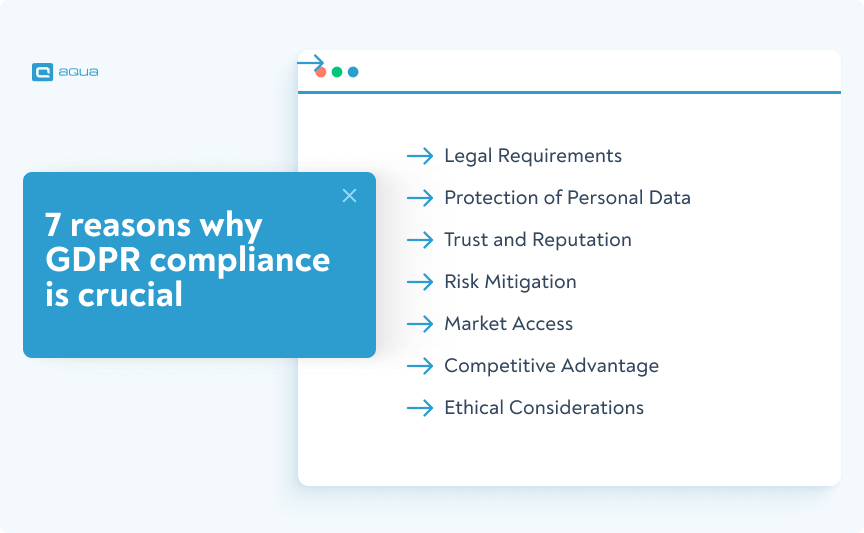
Besides your fear of being fined huge amounts of money or facing huge legal repercussions, the question still stands: why is it important? Here are the main reasons why you should not ignore GDPR in QA and overall software development:
Legal Requirements: Organisations handling the personal data of individuals within the EU and EEA are legally obliged to comply with GDPR.
Protection of Personal Data: GDPR ensures the protection of an individual’s data by establishing rights and obligations regarding its processing, thereby safeguarding privacy rights.
Trust and Reputation: Compliance with GDPR enhances trust and confidence among customers, stakeholders, and partners, leading to a positive reputation for your organisation.
Risk Mitigation: Non-compliance with GDPR can result in significant fines, legal actions, and reputational damage, making compliance essential for mitigating risks.
Market Access: Compliance with GDPR facilitates access to the EU and EEA markets, as organisations must adhere to GDPR requirements to operate within these regions.
Competitive Advantage: Demonstrating GDPR compliance can provide you with a competitive advantage by differentiating your organisation as a trustworthy and responsible custodian of personal data.
Ethical Considerations: GDPR compliance in QA reflects ethical considerations regarding the responsible handling of personal data and respecting individuals’ privacy rights.
Compliance testing will vary hugely depending on what company you're working for and what specific position you hold. In my current position I do approximately zero compliance testing, but we have a different QA team that spends the majority of their time on it.
Looking for a solution that effortlessly navigates heavily regulated industries? Dive into aqua cloud, your trustworthy partner backed by over 13 years of expertise serving clients in the banking, insurance, government, IT, and manufacturing sectors. With a robust portfolio and certifications, aqua provides all the required capabilities for you to comply with industry regulations or get certified with industry-known standards like ISO27001, DORA, SOC2, HIPPA and others. aqua also offers unparalleled flexibility, from On-Premise or Private Cloud options for application hosting to solutions tailored to your security needs to LDAP authentication and Single Sign-On integration. With REST API support, streamlined data migration, and granular user permissions, aqua easily guides you through GDPR compliance, empowering your organisation to thrive in any regulatory landscape.
Increase testing productivity by at least 50% in heavily regulated industries
Wondering how GDPR affects your testing efforts? Let’s break it down. First, when you’re testing, you must ensure you’re handling people’s personal data with care. That means getting clear consent before using any personal info in your tests. Keep it minimal; only use what you absolutely need. Accuracy matters, too; make sure the data you’re using is spot-on. And when you’re done testing, don’t hang onto that data any longer than necessary. Security’s a biggie, too—ensure that personal data is locked down tight. Lastly, don’t forget the paperwork; keep records of your use of that data. Now, let’s dive into the specifics:
Obtain Consent: Always get permission before using personal data in your tests.
Minimise Data Use: Only use the data you need for testing purposes.
Ensure Accuracy: Double-check that the personal data you’re using is accurate and up-to-date.
Limit Data Storage: Don’t hang onto personal data any longer than necessary after testing is complete.
Prioritise Security: Keep personal data secure from unauthorised access or breaches.
Maintain Documentation: Record how personal data is used in your testing activities to demonstrate compliance with GDPR.
Following these specifics will keep your testing processes secure, reliable, and compliant with the most necessary regulations.
Now it’s time to put your GDPR knowledge to the test. You’ve covered the key principles and strategies, but can you spot violations when they’re hiding in real code? Try our interactive Data Leak Detective challenge below to see if you can identify all six GDPR vulnerabilities in a QA test environment and match them to the correct principles.
🕵️ The Data Leak Detective: Interactive Challenge (Click to open)▼
Your Mission:
Test your GDPR knowledge by finding vulnerabilities in a real QA scenario. You're auditing a QA test environment. Click on suspicious elements to inspect them. You have 12 audit points, or attempts to identify a vulnerability. Each inspection costs a point. Find all 6 GDPR vulnerabilities and correctly match them to the violated principles!
Wondering how to ensure your testing aligns with GDPR compliance? Let’s dive into some examples and strategies:
Data Masking: Imagine you’re gearing up for testing, but you want to ensure privacy. That’s where data masking comes in. It’s like putting on a disguise for personal data, swapping real names and addresses with fictional ones, so you can test realistically without risking privacy breaches.
Consent Management: Ever been asked to agree to something before proceeding? That’s what consent management in testing is all about. Picture scenarios where users must click ‘agree’ before their data is used in tests. It’s a crucial step to ensure that every bit of data used has the green light from its owner.
Security Testing: It’s like hiring a team of cyber guardians to protect personal data during testing. They run tests, hunt down vulnerabilities, and patch up any weak spots in your systems. By beefing up security measures, you’re not just meeting GDPR requirements—you’re fortifying your defences against potential data breaches.
Anonymisation Techniques: Picture personal data in a cloak of invisibility. Anonymisation techniques like differential privacy and k-anonymity make it possible. They add layers of protection, protecting identities while still allowing you to get valuable insights from your test data.
Compliance Audits: Regular audits ensure everything stays in shape, from documentation to controls. By staying on top of compliance, you’re not just ticking boxes—you’re building trust and reliability in your testing processes.
User Access Controls: User access controls ensure only the right people get access to sensitive information. It’s about keeping data under lock and key, ensuring it’s handled carefully every step of the way.
Data Retention Policies: Consider it a spring cleaning routine for your testing data. Data retention policies set clear guidelines on how long personal data sticks around before it’s time to bid farewell. By sticking to these policies, you’re not just decluttering—you’re ensuring compliance and protecting privacy.
Incident Response Testing: In this case, you simulate a breach, see how your team responds, and fine-tune your procedures. It’s not just about being prepared—it’s about being proactive, ready to handle any curveballs GDPR throws your way.
Ready to take your compliance game to the sky? Dive into aqua cloud and unlock a world of seamless testing solutions. With aqua, you’re not just meeting regulations—you’re mastering them. Transparency and traceability, alongside granular permissions aqua brings, are must-haves for all regulations, not only GDPR. Say goodbye to compliance headaches and hello to effortless testing. Experience the benefits of aqua’s robust portfolio, including ISO certifications, On-Premise or Private Cloud options with custom-location datacenter hosting, LDAP authentication, and Single Sign-On integration. Plus, with aqua’s REST API support, data migration tool, and granular user permissions, you’ll have everything you need to conquer GDPR compliance confidently.
Turn GDPR compliance efforts into a breeze with a few clicks
Now that you’ve embraced the strategies outlined in this guide, you’re no longer afraid of non-compliance or data breaches. Your days are stress-free, and your QA processes are seamless and secure. And with a solution like aqua cloud at your fingertips, achieving this peace of mind has never been easier. Say goodbye to compliance woes and hello to a future of effortless testing with aqua cloud!
GDPR compliance means following the General Data Protection Regulation. It is a set of rules designed to protect the privacy and personal data of individuals within the European Union (EU).
To be GDPR compliant, your business must collect, store, and process personal data in a transparent, secure, and lawful manner. This includes giving individuals control over their data and allowing them to access, correct, or request the deletion of their information.
What is GDPR compliance testing?
GDPR compliance testing is all about ensuring your system handles personal data the right way. It checks if you’re collecting, storing, and sharing data in line with the GDPR rules— getting proper consent and protecting data from breaches.
You’re testing if things like data encryption and user rights (access, deletion) are in place to keep your users’ info safe and legal. You need to know you’re doing everything securely, so you don’t run into trouble later.
Home » Best practices » Ensuring GDPR Compliance in QA Processes: Effective Strategies
Do you love testing as we do?
Join our community of enthusiastic experts! Get new posts from the aqua blog directly in your inbox. QA trends, community discussion overviews, insightful tips — you’ll love it!
We're committed to your privacy. Aqua uses the information you provide to us to contact you about our relevant content, products, and services. You may unsubscribe from these communications at any time. For more information, check out our Privacy policy.
X
🤖 Exciting new updates to aqua AI Assistant are now available! 🎉
We use cookies and third-party services that store or retrieve information on the end device of our visitors. This data is processed and used to optimize our website and continuously improve it. We require your consent fro the storage, retrieval, and processing of this data. You can revoke your consent at any time by clicking on a link in the bottom section of our website.
For more information, please see our Privacy Policy.
This website uses cookies to improve your experience while you navigate through the website. Out of these, the cookies that are categorized as necessary are stored on your browser as they are essential for the working of basic functionalities of the website. We also use third-party cookies that help us analyze and understand how you use this website. These cookies will be stored in your browser only with your consent. You also have the option to opt-out of these cookies. But opting out of some of these cookies may affect your browsing experience.
Necessary cookies are absolutely essential for the website to function properly. These cookies ensure basic functionalities and security features of the website, anonymously.
Cookie
Duration
Description
cookielawinfo-checkbox-analytics
11 months
This cookie is set by GDPR Cookie Consent plugin. The cookie is used to store the user consent for the cookies in the category "Analytics".
cookielawinfo-checkbox-functional
11 months
The cookie is set by GDPR cookie consent to record the user consent for the cookies in the category "Functional".
cookielawinfo-checkbox-necessary
11 months
This cookie is set by GDPR Cookie Consent plugin. The cookies is used to store the user consent for the cookies in the category "Necessary".
cookielawinfo-checkbox-others
11 months
This cookie is set by GDPR Cookie Consent plugin. The cookie is used to store the user consent for the cookies in the category "Other.
cookielawinfo-checkbox-performance
11 months
This cookie is set by GDPR Cookie Consent plugin. The cookie is used to store the user consent for the cookies in the category "Performance".
viewed_cookie_policy
11 months
The cookie is set by the GDPR Cookie Consent plugin and is used to store whether or not user has consented to the use of cookies. It does not store any personal data.
Functional cookies help to perform certain functionalities like sharing the content of the website on social media platforms, collect feedbacks, and other third-party features.
Performance cookies are used to understand and analyze the key performance indexes of the website which helps in delivering a better user experience for the visitors.
Analytical cookies are used to understand how visitors interact with the website. These cookies help provide information on metrics the number of visitors, bounce rate, traffic source, etc.
Advertisement cookies are used to provide visitors with relevant ads and marketing campaigns. These cookies track visitors across websites and collect information to provide customized ads.






 Bankingaqua ALM helps banks increase testing productivity by over 50%