Best Test Management Systems for Software Testing Automation
I need you to think fast: what percentage of your QA process is automated? If it took you more than 10 seconds to answer, then all the struggle of manual work probably passed right before your eyes.
A test management system centralises all your test cases, execution data, and automation status in one workspace.
Automated test management works best when you pair it with clear test selection criteria and CI/CD triggers, not blanket automation.
Strong integration with tools like Selenium, Jenkins, and Jira determines how much time your TMS actually saves.
A short buyer’s checklist helps you compare vendors on integration depth, reporting, and onboarding time before you sign a contract.
aqua cloud pairs test management with AI-assisted test creation, letting your team automate close to 100% of QA workflows.
See how to pick the right TMS and put it to work for your team 👇
If you think of automation as something you’ll fully implement after you’ve caught up with the market, we’re here to let you in on a little secret: most of your competitors are already automating what takes you hours, sometimes days to complete.
Wow, what a depressing start, huh? Don’t worry; it’s not too late.
We’ll get you out of this anxious and unfair competition and give you a fair chance to revolutionise your whole QA with a single Test Management System (TMS).
Benefits of TMS for QA process and test automation
A test management system solves your biggest QA automation challenges. It centralises test assets, standardises execution, and keeps results traceable across your team.
Let’s break down the benefits of QA test automation management so you have no questions remaining:
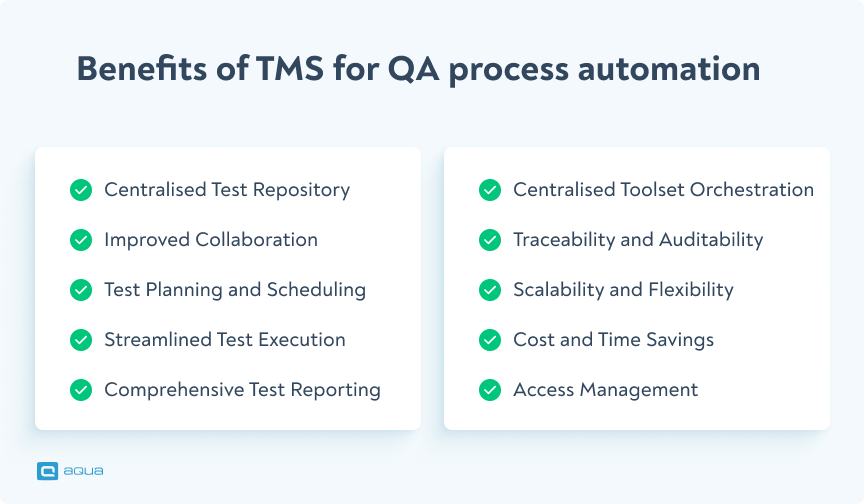
Centralised Test Repository
You can keep all your test cases, test scripts, and documentation in one organised hub for easy access and management. No more hunting through scattered files to find the test data you’re looking for!
Improved Collaboration
You should work seamlessly with your team by sharing test assets, results, and insights in real time. With an all-round TMS, collaboration is made easy, no matter where your team members are located.
Efficient Test Planning and Scheduling
Imagine being able to plan, schedule, and prioritise tests without effort. A TMS will empower you to maximise your resources and ensure timely execution with smart planning tools.
Streamlined Test Execution
You can automate execution to save time and reduce errors. It’s time to say goodbye to repetitive manual tasks and welcome efficient, error-free testing.
Comprehensive Test Reporting
You’ll receive detailed reports on test results, test coverage, and trends. Thus, you will stay informed and confidently make data-driven decisions.
Centralised Toolset Orchestration
Test management systems are designed for seamless integration with various automation frameworks and solutions—from Selenium and Appium to CI pipelines like Jenkins and GitLab CI.
Traceability and Auditability
You can easily trace requirements, test cases, defects, and all the history of changes or test runs. Staying compliant with regulations and effortlessly maintaining a clear audit trail is crucial, and a perfect TMS will give you just that.
Scalability and Flexibility
Scale your QA processes as your organisation grows. TMS for QA process automation allows you to easily adapt to new project requirements and methodologies.
Cost and Time Savings
Of course, one of the biggest benefits of a test management system is that automation saves you time and resources to help you get your products to market faster and more efficiently through effective regression testing.
Access Management
Control who can access specific test cases, documentation, and reports to ensure confidentiality, security, and accountability within your testing processes.
You might be doubtful: one tool and this number of benefits?
Of course! Allow us to introduce this solution for you: aqua cloud.
With aqua by your side, automating different QA processes is a breeze. Auto-prioritising your test cases will save you a lot of time and energy. You’ll have an easy-to-use, central repository where you can track all QA metrics, saving you from manual headaches.
Need help with integration? Aqua will help you connect leading test tools like Selenium, Ranorex, JMeter, and SoapUI in 3 clicks. aqua also has AI-powered capabilities to generate test cases in seconds, saving you a lot of manual work and time. Plan your tests, monitor their progress, execute tests efficiently, and let aqua do all the work when you just drink your coffee and watch the magic happen.
Do not automate in parts; automate 100% of your QA process to ensure software quality
How Test Automation Management Enhances QA and Test Management Systems
Automated test management connects test execution with your broader QA process, keeping automated testing efforts structured, efficient, and easy to maintain. Within a TMS, automation management helps teams coordinate running tests, tracking results, and maintaining test scripts—all within a centralized platform.
Test automation management plays a crucial role in QA automation management by streamlining work, reducing redundant manual tasks, and enabling faster feedback loops through CI/CD pipelines.
There are many good standalone test management solutions out there. All of them have their pros and cons, I’d really suggest registering a trial for all of them to see what fits your needs, they all have a demo project.
Design maintainable and scalable tests to reduce effort over time
Implement Version Control for Test Scripts
Integrate with CI/CD pipelines to ensure
Manage Test Data Efficiently
Implement Continuous Monitoring and Reporting
Regularly Review and Update Test Scripts
How to Implement Test Management for QA Automation
QA automation with test management systems follows seven practical steps, from assessing your current process to training your team and iterating after rollout:
#1: Assess Current QA Processes
Evaluate existing QA processes, including manual testing workflows, automated testing tools, and areas for improvement.
#2: Identify Requirements and Goals
Define your major toolset, emphasising seamless integration with automation tools as a primary requirement for your TMS. Prioritise TMS solutions with your chosen automation frameworks and tools that offer easy and comprehensive integration capabilities. This ensures that your process is fortified with efficient collaboration and streamlined processes, enhancing overall productivity and effectiveness.
#3: Research and Select a TMS
Research available test management systems, considering features, pricing, user reviews, and compatibility with existing tools and systems. Select a system like aqua cloud that best aligns with your requirements and goals, covering all the modern requirements of the QA process.
Remember to ask for a POC (Proof of Concept) to understand the TMS better, how it works, and whether it meets all your requirements. That POC should be like a trial version that ensures you have no doubts about the tool.
#4: Plan Migration and Integration
Migrate your project configuration and testing assets to the new TMS. Configure integrations to seamlessly connect with other tools and systems in the QA ecosystem, such as bug-tracking systems and CI pipelines. Additionally, map your automation scripts to ensure a smooth transition and uninterrupted testing workflows for seamless and complete migration.
#5: Customise and Configure the System
Customise the test management system to suit the specific needs and processes of your organisation. Configure user roles and permissions, test case templates, and reporting options according to your requirements.
#6: Ensure Team Training and Support
Provide training sessions and resources to familiarise QA team members with the new test management system. Offer ongoing support and assistance to address any questions or issues during the transition. If you have difficulties here, a professional TMS like aqua cloud will provide this training as part of the migration.
#7: Iterate and Improve
Continuously monitor and evaluate the effectiveness of the test management system in improving QA processes and outcomes. Gather feedback from users and stakeholders and make adjustments as needed to optimise performance and usability.
By following these steps, you can ensure successful testing automation and streamline your testing efforts for improved efficiency and quality.
Why QA automation? because manual QA made me sleep in the office (true). It is really boring for me and my first job didn't sell automation testing, so I went on my own.
Picking a platform based on its ranking on a review site is not enough for your team. QA automation with test management system rollouts succeed when you check these points first:
Integration depth: does it connect natively with your automation frameworks, CI/CD pipeline, and bug tracker?
Onboarding time: how long until your team can create and run its first automated test?
Reporting: can you trace a defect back to a requirement and a test run in a few clicks?
Scalability: will pricing and performance hold up as your team and test suite grow?
Support and training: does the vendor help with migration, or leave your team to work it out alone?
Teams that skip this step often end up switching platforms within a year. As one QA professional put it on Quora when evaluating test management tools, each project is unique and each team has its own requests. That is exactly why a checklist beats a leaderboard: it matches the tool to your workflow, not the other way around.
Connect your test management system to Jira, Azure DevOps, and Jenkins in minutes
Best test management tools for robust automation testing
So, how do you choose the best, all-around TMS for QA? Here is the list you need:
1. aqua cloud
Aqua offers you unique and complete automation capabilities. Its intuitive platform prioritises your tests intelligently, ensuring you focus on the most crucial tests before deployment.
With aqua, you can seamlessly connect leading automation tools like Selenium, Ranorex, JMeter, and SoapUI in just three clicks, streamlining test management and results tracking. Plus, aqua’s REST API enables you to effortlessly keep track of automated tests from any tool, eliminating manual updates and reducing wait times. You can even execute Linux and Windows automation scripts directly from aqua, simplifying the process for all team members, regardless of their automation expertise. But that is not all. aqua automates testing not only in regards to classic automation but also where automation frameworks can’t.
By using AI technology first in QA, aqua empowers you to accelerate testing processes, allowing you to swiftly open a requirement and effortlessly auto-create an entire test case, speeding up the process by a staggering 98% and saving you a lot of manual work.
aqua’s commitment to compatibility with emerging automation tools ensures you stay ahead of the curve, effortlessly integrating new software with just 30 minutes of work using the free REST API. With aqua, you can consolidate all your tests in one dynamic solution, effortlessly combining manual and automated testing to uncover issues at scale while maintaining meticulous attention to detail. Experience the future of QA automation with aqua, where efficiency meets innovation for unparalleled testing excellence.
Save at least 60% of your time with synergetic test automation
Here are four more honourable mentions you can consider:
2. QTest: A test management platform for organising, executing, and reporting on software testing activities, including test creation and regression testing.
3. Ranorex: Provides comprehensive test automation tools for GUI, web, and mobile application testing.
4. LoadRunner: Specialises in performance testing, enabling users to simulate thousands of users to identify system bottlenecks.
5. Postman: A popular API testing tool that simplifies the process of testing APIs and generating comprehensive test reports.
By choosing these tools, you can bolster your QA automation arsenal with diverse capabilities tailored to your testing needs. Whether you’re managing test cases, automating GUI testing, conducting performance testing, or testing APIs, these tools, led by aqua, offer comprehensive solutions to enhance your QA automation efforts and ensure the delivery of high-quality software products.
🧠 Test Workflow Configurator (Click to open)▼
Conclusion
We discussed testing automation with test management systems in this guide. Picture this: you no longer spend hours on simple tasks that otherwise need to be eliminated, you are in no rush, in peace, prioritising your tasks efficiently, and most importantly, you have peace of mind in the workspace. Sounds good? We deliver this life to you. Just contact us and see the magic happen.
Here’s a no-nonsense guide to getting started with QA automation:
Pick the Right Tool for the Job – Don’t waste time. Use Selenium for the web, Appium for mobile, and aqua cloud for AI-powered, generative automation, seamless integration and speed.
Write Simple, Reusable Scripts – Automate basic workflows first. Write modular scripts so they’re easy to scale later. No need for complex tests from the start.
Focus on High-Impact Areas – Start automating regression tests, smoke tests, and critical paths—these give you the most value for the least effort.
Don’t Ignore Test Maintenance – Automated tests break. Period. Make test scripts easily maintainable to avoid constant rewrites.
Integrate with CI/CD – Get your tests running automatically with every code change. Tools like Jenkins or GitLab work great for this.
Start With Data-Driven Testing – Once you get the basics down, try data-driven testing to easily expand coverage without writing extra code.
Measure Test Effectiveness – Track test execution time and flakiness. If tests are unreliable or slow, optimize or drop them.
Keep it simple, move fast, and get real results early.
Is QA harder than coding?
It depends on the perspective and the task at hand. Here’s the breakdown:
Coding requires a deep understanding of logic and algorithms and the ability to build systems. Once a feature is implemented, testing it can be more straightforward.
QA, on the other hand, demands an eye for detail and the ability to think like a user. You’re also responsible for edge cases and corner cases, which requires creativity and persistence.
While coding involves creating something from scratch, QA is often about finding where things break. Both have their challenges. But QA can feel harder because you’re constantly looking for flaws and ensuring quality, even in edge cases. So, it’s tough in its own way, just a different type of difficulty.
Can Python be used for automation testing?
Yes, Python is a great choice for automation testing. Here’s why:
Simple Syntax – Python’s easy-to-understand syntax lets you quickly write clean and readable test scripts.
Frameworks – There are powerful testing frameworks like Selenium, Pytest, and Robot Framework that make automation a breeze.
Cross-Platform – Python runs on any platform (Windows, Mac, Linux), so it’s perfect for testing across different environments.
Integration – You can integrate Python with other tools (like Jenkins for CI/CD) and test web, mobile, or API apps seamlessly.
What's the difference between a test management system and a test automation framework?
A test management system organises test cases, plans, and results across your QA team. A test automation framework executes scripted tests. Most teams pair both, using the TMS to track outcomes the automation framework produces.
Can a TMS integrate with existing automation scripts, or do I need to rewrite them?
Most modern platforms connect to your existing scripts through APIs or native integrations with tools like Selenium and Jenkins. Rewrites are rarely required; the TMS typically ingests results and status from scripts already in place.
Robert has several years of experience in process optimisation and test management. He is an expert in defining and implementing workflows by adapting aqua to the clients’ processes.
Nurlan, a QA Coordinator & Quality Standards Officer, takes pride in orchestrating seamless QA operations. His expertise in coordinating QA-focused projects and integrating QA solutions has consistently yielded top-tier client satisfaction. Aside from a full-time QA coordinator, Nurlan's role involves creating compelling content that educates…
Home » Test Automation » Best Test Management Systems for Software Testing Automation
Do you love testing as we do?
Join our community of enthusiastic experts! Get new posts from the aqua blog directly in your inbox. QA trends, community discussion overviews, insightful tips — you’ll love it!
We're committed to your privacy. Aqua uses the information you provide to us to contact you about our relevant content, products, and services. You may unsubscribe from these communications at any time. For more information, check out our Privacy policy.
X
🤖 Exciting new updates to aqua Intelligence are now available! 🎉