Reliability Testing in Agile: Importance, Types & Best Practices
You're three sprints deep, features are shipping, everything feels smooth. Then production hits and your app falls apart in front of real users. Reliability testing in agile is what stops that from happening. Not as a checkbox, but as something your team actually does every sprint, before someone's pager goes off at 2 AM.
Reliability testing in agile ensures software performs consistently under specific conditions, integrating testing throughout sprint cycles rather than postponing it to later phases.
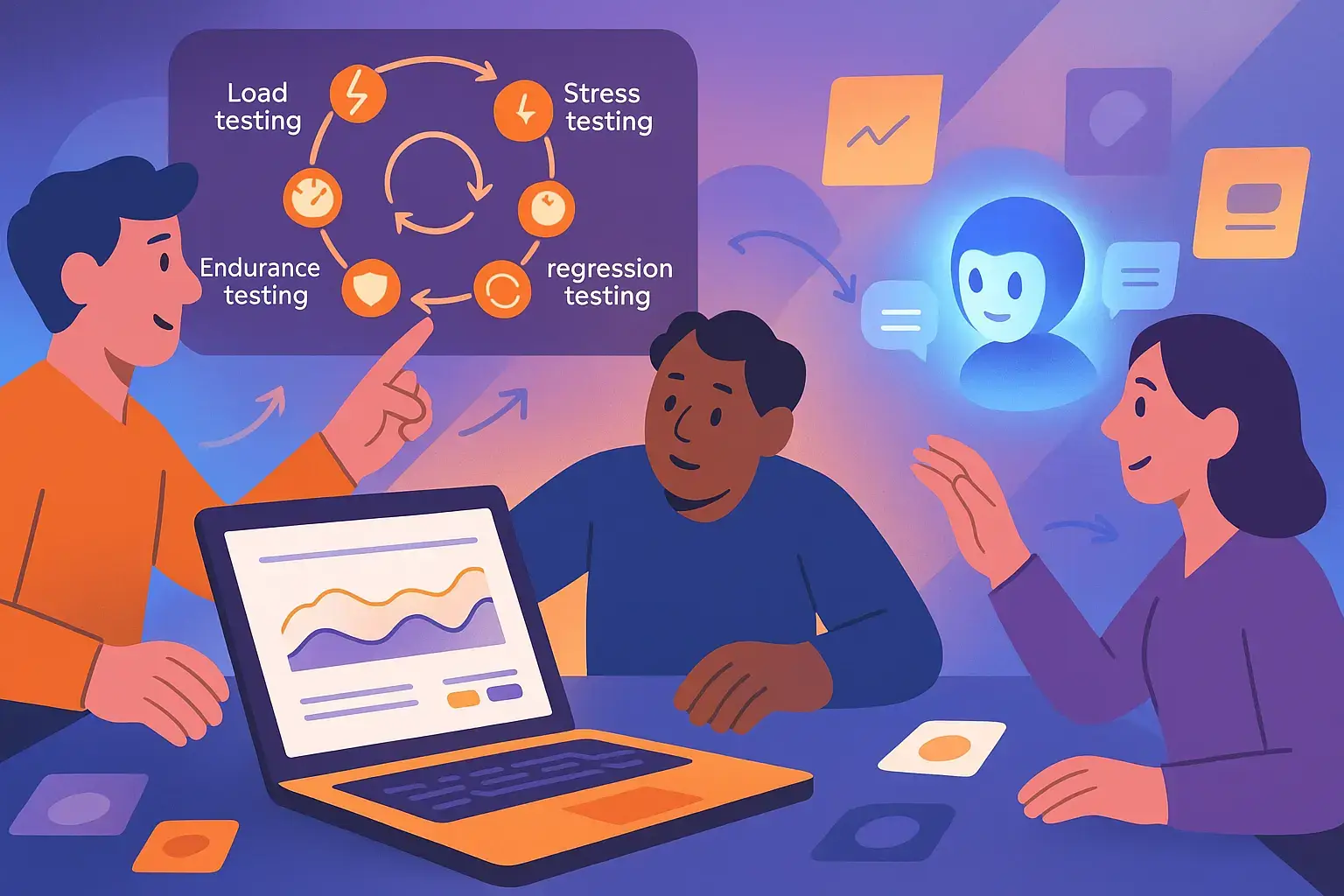
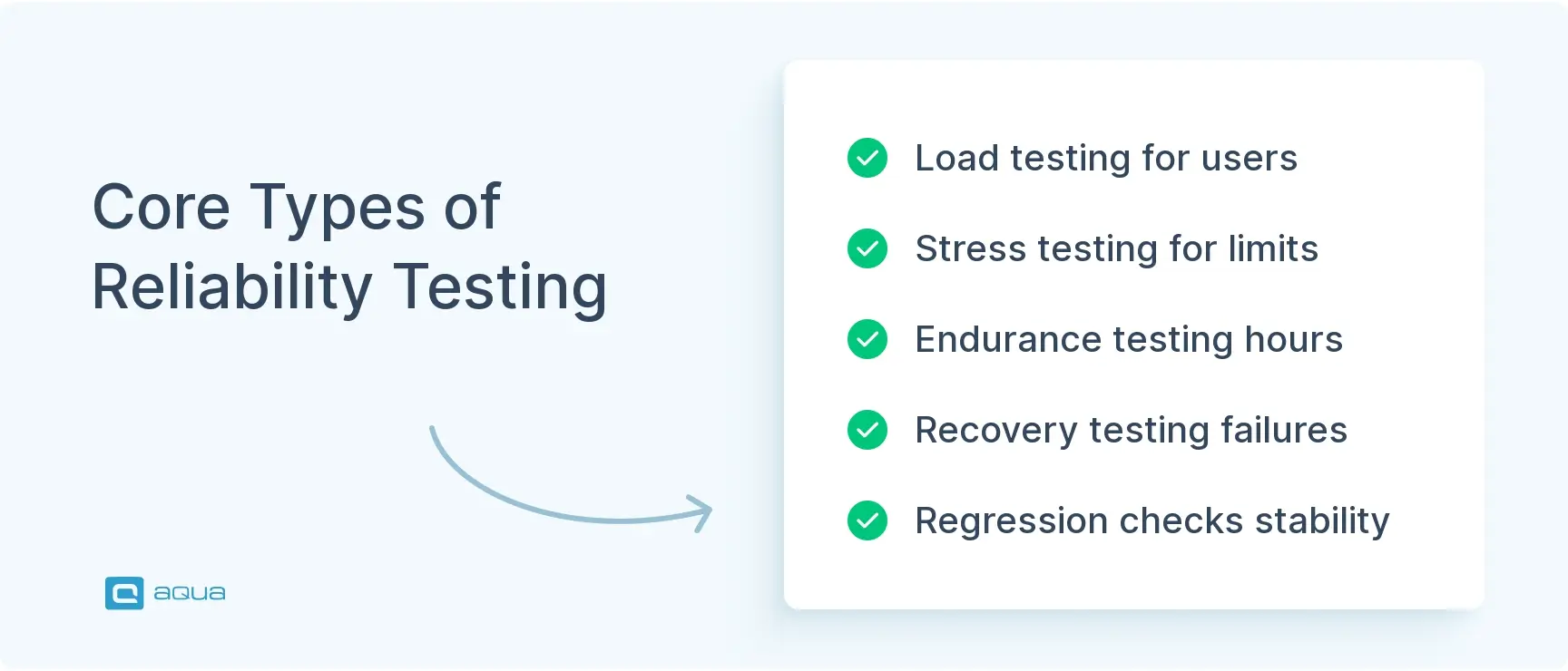
Each reliability test type serves a specific purpose: load testing verifies normal usage, stress testing finds breaking points, endurance testing reveals time-dependent issues, and recovery testing confirms system resilience.
The main challenges for agile teams include time constraints, limited resources, constantly changing requirements, and balancing speed with thorough testing.
Successful implementation requires treating reliability as a first-class concern from sprint zero, including it in the Definition of Done, and using a risk-based approach to focus testing efforts.
Automated reliability checks integrated into CI/CD pipelines remove the “should we test?” decision, making reliability validation a non-negotiable part of the deployment process.
Reliability testing is often sacrificed for feature development when deadlines loom, but skipping it creates technical debt that compounds quickly. Want to know how to implement it without slowing down your agile workflow? Read below 👇
What Is Reliability Testing in Agile?
Reliability testing confirms that your software does its job consistently, not just once in a clean environment, but repeatedly, under different conditions, with real load. In agile, this gets built into sprint cycles instead of being saved for some final phase that always gets cut when deadlines tighten.
The goal is straightforward. Find failure points before users do. Measure how the system behaves under normal and stressed conditions. Make sure new features do not quietly break what was already working.
What makes reliability testing different in agile is timing. You are not waiting until everything is “done” to see if it holds up. You are validating each increment as you go, which means problems surface when they are still cheap to fix. Build something, test it, learn, improve, repeat. One sprint at a time.
Reliability testing does not have to create tension between quality and speed. The right test management platform makes it a natural part of your agile workflow rather than something that competes with it. aqua cloud embeds reliability testing directly into your sprints through CI/CD integration and AI-powered test case generation. Its domain-trained Copilot generates reliability test cases from your requirements automatically, end-to-end traceability keeps every reliability requirement covered, and real-time dashboards surface coverage gaps before they become production problems.
Get 95% higher reliability coverage with less effort
Shipping fast only works if what you ship actually holds up. Here is what reliability testing does for agile teams in practice.
It prevents production disasters. Catching reliability issues in development costs a fraction of what it costs to fix them after they have taken down your production environment. With frequent deployments, each release carries risk. Reliability testing is your early warning system.
It builds user trust. Users do not care about your sprint velocity if the app keeps crashing. Reliable software creates the kind of trust that turns users into people who recommend your product rather than warn others away from it.
It keeps technical debt in check. Skipping reliability testing to meet a deadline is borrowing against your codebase’s future. Regular regression testing in Agile helps you maintain a stable foundation instead of stacking up issues that eventually require a full rewrite.
It makes continuous deployment viable. You cannot confidently automate deployments if you are not sure the software will hold up in production. Reliability testing is what makes that confidence possible.
It surfaces performance bottlenecks early. Reliability issues often show up as performance problems under specific conditions. Catching them while they are still manageable beats discovering them when they require architectural changes.
How Reliability Testing Fits into Agile
Agile moves fast. Reliability testing demands thoroughness. These two things are not in conflict if you integrate reliability testing correctly, meaning as a continuous practice, not a stage gate at the end.
In a typical agile workflow, reliability testing happens in layers. During sprint planning, the team identifies which components need reliability validation based on the stories being tackled. As developers commit code, automated checks run in the CI pipeline, basic endurance tests, consistency checks, anything that catches instability early. By sprint review, you already have reliability data that tells you whether features are genuinely done or need more work before they ship.
The feedback loop is what makes this sustainable. Instead of one massive reliability suite at the end of a release cycle, you run smaller focused tests continuously. If a new feature introduces instability, you know within hours, not weeks. That speed is what keeps reliability testing from becoming a bottleneck.
The cultural side matters too. When reliability metrics show up in standups and retrospectives alongside velocity and bug counts, they stop being someone else’s problem. Teams that do this well include reliability checkpoints in their Definition of Done and treat stability as a shared responsibility, not just a QA concern.
Types of Reliability Testing
Different problems need different tests. Here is what a solid reliability testing toolkit looks like.
Load testing confirms the system performs consistently under expected user volumes. It is your baseline, proving the software works under normal conditions before you stress it further.
Stress testing pushes the system past its limits to find where it breaks and how it fails. The goal is not just finding the breaking point but understanding the failure mode. Does the app crash gracefully or leave users stranded with corrupted data?
Endurance testing runs the system continuously under normal conditions for extended periods, hours or days. This is how you catch memory leaks and resource exhaustion that only appear over time, the kind of bugs that would never show up in a quick functional test but will absolutely surface in production.
Recovery testing deliberately crashes components or simulates network failures to verify the system can detect problems, fail over cleanly, and restore service without manual intervention. Critical for microservices architectures where partial failures are routine.
Feature reliability testing focuses on individual features or user workflows rather than the whole system. When you ship a new payment flow, you want to know that specific functionality holds up across different browsers, devices, and conditions. This fits naturally with agile’s incremental development model.
The best teams combine these strategically based on their risk profile, adjusting the mix as the product evolves.
Challenges of Reliability Testing in Agile
Reliability testing in agile is not always smooth. The core tension is real: agile is optimized for speed, and thorough reliability testing takes time. When you are closing out a sprint, a 48-hour endurance test feels impossible. That time pressure is the most common reason reliability testing gets deprioritized.
Resource constraints make it harder. Many agile teams run lean, without dedicated performance engineers or proper testing environments. Test environments that do not match production specs, shared infrastructure across teams, bottlenecks everywhere. Setting up realistic test scenarios requires expertise and tooling that does not come cheap, and when budgets are tight, reliability loses to feature development.
The shifting nature of agile adds another layer. Requirements change, features get reprioritized, and tests you built last sprint may be irrelevant this sprint. Over-investing in reliability tests for features that get redesigned two weeks later is frustrating and wasteful.
Automate the repetitive checks. Integrate reliability validation into your CI/CD pipeline so it runs automatically with every commit. Remove the “should we run this?” decision entirely.
Start with your highest-risk paths. Not everything needs exhaustive reliability testing. Payment processing, authentication, data persistence. Start there and expand as you build capability.
Use production-like environments. Containerization and infrastructure-as-code make this more achievable than it used to be. Get as close to production as you can.
Time-box reliability work per sprint. Allocate a fixed percentage of sprint capacity, around 15%, to reliability activities. It keeps testing realistic without letting it get perpetually bumped.
Add synthetic monitoring in production. Catch what slips through pre-deployment testing with tools that continuously validate reliability in live environments.
Teams that succeed here do not fight agile to fit reliability testing in. They adapt reliability practices to fit the agile rhythm.
Best Practices for Reliability Testing in Agile Teams
The teams that do this well start early. Reliability criteria go into user stories alongside functional requirements from the beginning, not after the fact. If a story says users can upload photos, the reliability criteria might specify the system handles 100 concurrent uploads without degradation. That makes reliability visible and testable from day one.
Include reliability in your Definition of Done. Before any story gets marked complete, it should pass the relevant reliability checks for its scope and risk level. A minor UI tweak does not need a full suite. A backend service or API endpoint does. Teams that enforce this consistently see reliability issues drop sharply because problems get caught and fixed within the same sprint they are introduced.
Developer and tester collaboration accelerates everything. When developers know the reliability criteria upfront, they can write with those requirements in mind and build their own reliability tests as they go. This removes the handoff problem where developers finish code without thinking about how it will hold up under real conditions.
Make the tooling accessible to everyone. Whether you are using JMeter, Gatling, or something else, the tools should be easy to run and interpret. Dashboards showing reliability trends over time, error rates under load, mean time between failures, make quality a shared conversation rather than a report that lives in one person’s inbox.
Good software testing strategies and continuous testing practices are what separate teams that sustain reliability from teams that treat it as an afterthought. The approach needs to match your product’s specific risk profile, and it will evolve as the product does.
Conclusion
Reliability testing in agile is not about slowing down. It is about building speed you can actually sustain. Integrate it into your sprints as a regular practice, automate what you can, focus on your highest-risk areas, and make reliability a team-wide conversation. The production incidents decrease. The on-call pages get quieter. And the software you ship is something users can actually depend on.
Reliability testing is only as good as the tools and processes behind it. aqua cloud integrates with your existing agile workflow, runs automated reliability checks with every build, and gives your whole team visibility into reliability metrics through dashboards that actually make sense. The AI Copilot generates test scenarios directly from your project documentation, nested test structures and reusable components let you build a reliability framework that scales with your product, and native integrations with Jira and Azure DevOps mean reliability testing becomes part of how your team already works, not another process to manage separately.
Reduce production incidents by 87% with intelligent reliability testing in every sprint.
A practical example of reliability testing in agile project is endurance testing a payment processing service by running it continuously under normal load for 72 hours. You are not looking for it to break immediately. You are watching for memory leaks, slow degradation, and error rates that creep up over time. Those are the issues that would never show up in a quick functional test but will absolutely surface after a few days in production.
What is reliability testing in Agile?
Reliability testing in Agile is the practice of validating that your software performs consistently across sprint cycles, not just once in a controlled environment. Instead of saving it for a final phase, agile teams run reliability checks continuously as part of their CI/CD pipeline, catching instability early when it is still cheap to fix. The goal is to make sure each increment you ship is dependable, not just functional.
How can reliability testing be integrated effectively into agile sprint cycles?
Start by including reliability acceptance criteria in your user stories alongside functional requirements. Add automated reliability checks to your CI pipeline so they run with every commit. Build reliability validation into your Definition of Done so nothing gets marked complete without passing the relevant checks. Time-box reliability work to around 15% of sprint capacity and focus first on your highest-risk components. Following best practices for test automation in Agile helps teams build this into a sustainable process rather than something that gets dropped when sprints get busy.
What tools and metrics are best for measuring system reliability in agile environments?
For load and stress testing, JMeter and Gatling are widely used and integrate well with CI pipelines. For resilience and recovery testing, Chaos Monkey and similar chaos engineering tools help validate how your system handles failures. On the metrics side, the most useful ones are mean time between failures, error rate under load, system recovery time, and availability percentage over time. The key is making these metrics visible to the whole team through shared dashboards, not buried in a report that only one person reads. Pairing these tools with a solid agile testing tool gives your team a single place to track reliability coverage alongside the rest of your testing work.
Home » Best practices » Reliability Testing in Agile: Importance, Types & Best Practices
Do you love testing as we do?
Join our community of enthusiastic experts! Get new posts from the aqua blog directly in your inbox. QA trends, community discussion overviews, insightful tips — you’ll love it!
We're committed to your privacy. Aqua uses the information you provide to us to contact you about our relevant content, products, and services. You may unsubscribe from these communications at any time. For more information, check out our Privacy policy.
X
🤖 Exciting new updates to aqua AI Assistant are now available! 🎉
We use cookies and third-party services that store or retrieve information on the end device of our visitors. This data is processed and used to optimize our website and continuously improve it. We require your consent fro the storage, retrieval, and processing of this data. You can revoke your consent at any time by clicking on a link in the bottom section of our website.
For more information, please see our Privacy Policy.
This website uses cookies to improve your experience while you navigate through the website. Out of these, the cookies that are categorized as necessary are stored on your browser as they are essential for the working of basic functionalities of the website. We also use third-party cookies that help us analyze and understand how you use this website. These cookies will be stored in your browser only with your consent. You also have the option to opt-out of these cookies. But opting out of some of these cookies may affect your browsing experience.
Necessary cookies are absolutely essential for the website to function properly. These cookies ensure basic functionalities and security features of the website, anonymously.
Cookie
Duration
Description
cookielawinfo-checkbox-analytics
11 months
This cookie is set by GDPR Cookie Consent plugin. The cookie is used to store the user consent for the cookies in the category "Analytics".
cookielawinfo-checkbox-functional
11 months
The cookie is set by GDPR cookie consent to record the user consent for the cookies in the category "Functional".
cookielawinfo-checkbox-necessary
11 months
This cookie is set by GDPR Cookie Consent plugin. The cookies is used to store the user consent for the cookies in the category "Necessary".
cookielawinfo-checkbox-others
11 months
This cookie is set by GDPR Cookie Consent plugin. The cookie is used to store the user consent for the cookies in the category "Other.
cookielawinfo-checkbox-performance
11 months
This cookie is set by GDPR Cookie Consent plugin. The cookie is used to store the user consent for the cookies in the category "Performance".
viewed_cookie_policy
11 months
The cookie is set by the GDPR Cookie Consent plugin and is used to store whether or not user has consented to the use of cookies. It does not store any personal data.
Functional cookies help to perform certain functionalities like sharing the content of the website on social media platforms, collect feedbacks, and other third-party features.
Performance cookies are used to understand and analyze the key performance indexes of the website which helps in delivering a better user experience for the visitors.
Analytical cookies are used to understand how visitors interact with the website. These cookies help provide information on metrics the number of visitors, bounce rate, traffic source, etc.
Advertisement cookies are used to provide visitors with relevant ads and marketing campaigns. These cookies track visitors across websites and collect information to provide customized ads.






 Bankingaqua ALM helps banks increase testing productivity by over 50%