Mastering Requirements Prioritization: Techniques and Strategies for Success
You have a dozen stakeholder demands competing for attention. Your backlog overflows. Everyone insists their feature is critical. Deadlines approach silently, and resources are limited. Total chaos.The solution? Requirements prioritization. But is it just moving urgent items to the top of your backlog, or is there an actual framework behind it? What methods and tools make prioritization effective? How do different teams approach it? This article covers exactly that.
Requirements prioritization transforms project chaos into clarity by ranking features based on value, urgency, and feasibility to ensure teams tackle high-impact work first.
The MoSCoW method categorizes requirements into four clear buckets: Must Have, Should Have, Could Have, and Won’t Have This Time, reducing scope creep and streamlining decision-making.
ICE scoring brings quantitative rigor by evaluating Impact, Confidence, and Ease on a scale of 1-10, then multiplying them for a comparable priority score.
Kano analysis focuses on customer satisfaction by categorizing features as Basic (expected), Performance (proportional satisfaction), or Excitement (delighters) based on user feedback.
Organizations implementing structured prioritization report 20-50% improvements in delivery metrics, 30-40% reduction in Cost of Delay, and significantly higher stakeholder satisfaction.
Without clear prioritization, teams waste effort on low-value items while critical features wait in backlo. Ready to transform your chaotic backlog into a strategic roadmap? Discover which prioritization framework fits your team best 👇
Understanding Requirements Prioritization
So what is requirements prioritization? Simply put, it is ranking project features, user stories, or backlog items based on their value, urgency, and feasibility.
It’s your roadmap for deciding which tests to automate first, which bugs to fix immediately, and which features can wait. For QA professionals, this means differentiating between critical functionality that blocks production and nice-to-have improvements that enhance user experience but don’t risk system stability.
Why is it important to prioritize requirements?
Now, why prioritize requirements? Every project runs on limited resources: time, people, budget. When you prioritize requirements effectively, your team tackles high-impact work first. A fintech app needs secure payment processing before launch. Dark mode UI is desirable but not essential. Without clear prioritization, teams waste effort building features nobody urgently needs while critical security tests sit in the backlog.
Research shows that organizations implementing structured requirements prioritization techniques achieve 20 to 50% improvements in delivery metrics and significantly higher stakeholder satisfaction. That’s real-world impact from teams that learned to separate what’s urgent from what’s merely interesting.
How prioritization works in practice
A healthcare platform QA team has 200 backlog items. Regulatory compliance checks. Performance optimizations. UI improvements. All competing for attention. Without a requirements prioritization framework, developers tackle whatever looks easiest. HIPAA compliance testing gets pushed back. That’s a problem when launch day arrives.
Structured methods change this. Teams categorize requirements by business value, risk level, and implementation effort. Compliance gets addressed first because the product can’t legally ship without it. Performance issues affecting user retention come next. Cosmetic improvements that don’t block adoption come last. This approach through requirements management transforms chaotic work into strategic execution. Projects stay on track. Real business needs get met.
The Importance of Requirements Prioritization
Most projects fail because teams build the wrong things at the wrong time. When you skip requirements prioritization or handle it poorly, you waste resources, miss deadlines, and frustrate stakeholders waiting for their “critical” feature. QA teams feel this pain the most. They’re the last checkpoint before release, leaving testing features that should have been deprioritized months earlier.
Without clear prioritization, chaos creeps in. Scope expands through constant “just one more thing” requests. Feature bloat appears as products fill with half-finished ideas. Worst of all, you lose stakeholder trust. Leaders stop believing delivery timelines. Engineers burn out chasing shifting priorities. QA gets blamed for being “slow” when they’re cleaning up after poor scoping decisions.
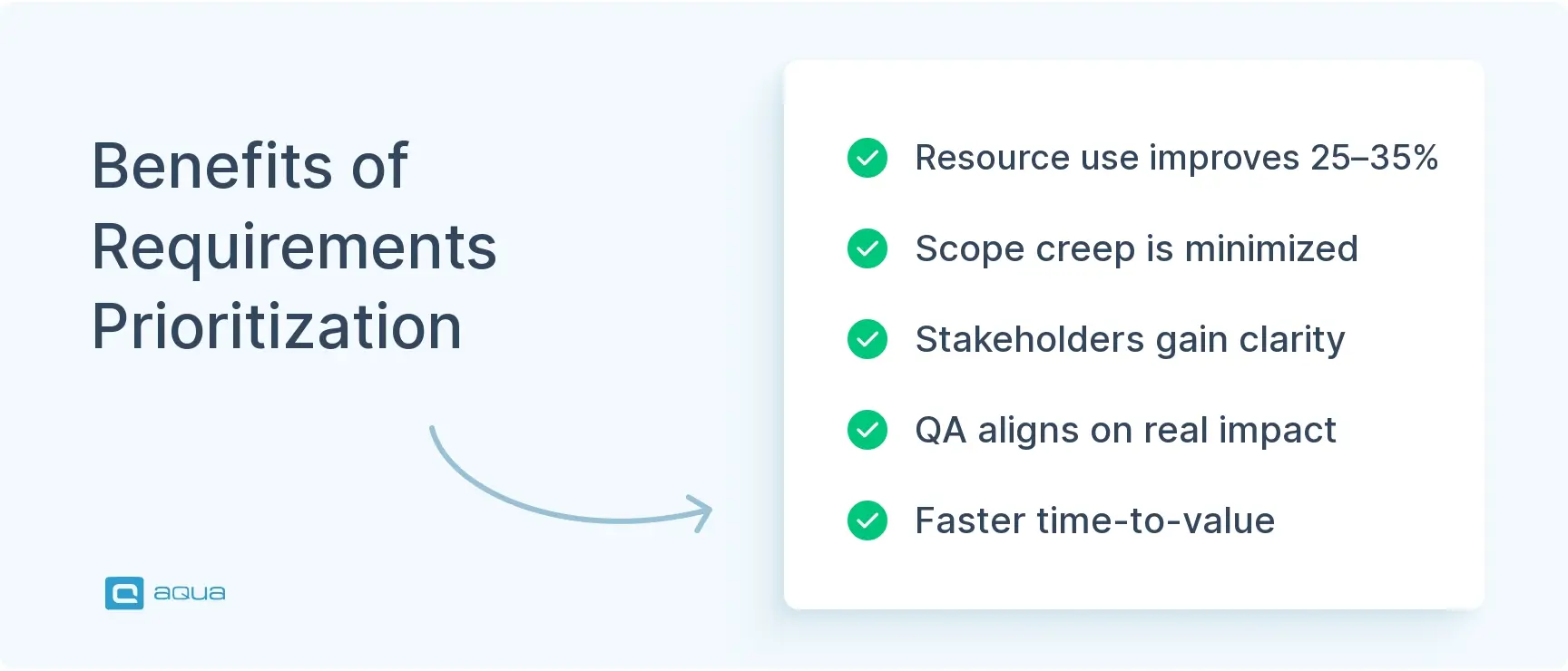
Proper prioritization changes that. It brings structure and focus:
Resource Optimization: Teams spend time on high-value work, not vanity features.
Transparency: Everyone understands why certain features move down the list.
Collaboration: A shared prioritization framework keeps developers, testers, and stakeholders aligned.
Risk Management: Critical issues are addressed before they reach production.
Faster Time-to-Value: High-impact features reach users sooner and start delivering results.
Think of prioritization as your noise filter. Stakeholders will always have more ideas than capacity allows. Your job isn’t to build them all. It’s to choose what drives the most value within your constraints. Teams using structured prioritization models report 25–35% better resource utilization with the same headcount and budget.
For you, this focus changes everything. Testing aligns with what truly affects users. Time isn’t wasted on marginal features. Quality becomes a competitive edge that supports delivery speed instead of slowing it down.
Three Key Techniques for Prioritizing Requirements
Once your team understands the value of prioritization, the next challenge is choosing the right approach. There’s no single formula that works for every project. The right method depends on what you’re building, how your stakeholders think, and how fast your team needs to move. Let’s look at three of the most proven requirements prioritization techniques used by experienced QA and development teams: MoSCoW, ICE scoring, and Kano analysis.
One way to mitigate things when you have to let people down is to just be human with them. Something along the lines of: I understand this is a problem we need to work through, please help me understand more context about the problem, what's been done so far, when does it need to be done by, here is some context about my situation and competing priorities, ultimately here is my priority, can we make any compromises both sides, lets work through a solution together.
ICE scoring introduces data into what often becomes a political conversation. It rates each requirement on Impact, Confidence, and Ease—scoring each from 1 to 10. Multiply the three numbers, and you get a total score that ranks items by potential return versus effort.
Impact – How strongly the requirement influences business or user outcomes. Boosting conversions by 15%? That’s a 9 or 10. Minor design polish? Maybe a 3.
Confidence – How sure you are about that impact. If A/B tests or analytics back it up, confidence is high. If it’s guesswork from one meeting, it’s low.
Ease – How simple it is to implement. Quick wins score high. Months-long rebuilds score low.
For example:
Feature A scores Impact=8, Confidence=7, Ease=6 → 336
Feature B scores Impact=9, Confidence=9, Ease=2 → 162
Even though Feature B seems more valuable, it’s harder to deliver. ICE balances ambition with practicality, helping teams avoid chasing “big wins” that delay everything else.
ICE works best when you’ve got good data: usage analytics, test results, customer insights. If you’re guessing, the model loses accuracy. And since it weighs all three factors equally, teams focused on speed might tweak the formula with custom weights. Still, for most product and QA teams, ICE scoring delivers faster, data-backed prioritization that replaces intuition with evidence.
Requirements prioritization gets a lot easier when your tools actually support how you work. Frameworks like MoSCoW, ICE, and Kano help you decide what matters, but you still need a platform that turns those decisions into action. aqua cloud’s requirements management system does exactly that. It gives you flexible prioritization with custom fields for risk and importance, drag-and-drop backlog management, and 100% traceability between requirements, test cases, and defects. You get full coverage and visibility across every stage of development, so nothing slips through the cracks. aqua also integrates smoothly with Jira, Azure DevOps, and Confluence, keeping your teams in sync no matter where they work. Its domain-trained AI Copilot with RAG grounding learns from your own documentation, offering context-aware suggestions that cut manual work by up to 97%. With dependency mapping, risk tagging, and smart automation, aqua turns prioritization from guesswork into a clear, connected process that keeps QA perfectly aligned with business goals.
Achieve strategic, risk-based prioritization with AI that understands your project's context
The MoSCoW method brings order to chaos by forcing every requirement into one of four categories: Must Have, Should Have, Could Have, or Won’t Have This Time. It’s intentionally rigid. You can’t have fifty “must-haves” because that breaks the logic. Must-haves are the features your product can’t live without. For a payment gateway, that’s encryption and transaction logging, not animated loading screens.
Here’s how each category plays out in real life:
Must Have – The non-negotiables. Without them, the product fails its purpose. In an e-commerce flow, that’s secure payment, order confirmation, and inventory updates.
Should Have – Important but not essential. One-click reordering or saved cards enhance user experience but don’t block launch.
Could Have – Nice-to-haves like product recommendations or social sharing buttons. Great if time allows, first to go when it doesn’t.
Won’t Have This Time – Documented as out of scope, managing expectations upfront. Maybe international shipping waits for version 2.0.
MoSCoW works best in agile sprints where capacity is fixed. Most of the sprint goes to must-haves, leaving breathing room for should-haves if velocity allows. Because the framework defines what won’t happen early, it prevents mid-sprint surprises. When someone requests a new feature halfway through, the team can easily ask: Does this replace a must-have, or can it wait? That clarity keeps conversations productive and decisions grounded. Teams using the MoSCoW requirements prioritization framework report smoother sprint planning and fewer debates about priorities because the categories speak for themselves.
Kano Analysis Framework
Kano analysis looks at prioritization through your customer’s eyes. Created by Dr. Noriaki Kano, it classifies features based on how they influence satisfaction. It only cares how much users care.
The model defines three feature types:
Basic Features – Expected by default. Their absence frustrates users, but their presence doesn’t excite anyone. Secure login in a banking app or functional brakes in a car.
Performance Features – Satisfaction scales with performance. The faster the app, the happier the user. These are measurable and directly tied to user perception.
Excitement Features – Unexpected delighters. When absent, nobody notices; when present, users love them. Early smartphone voice assistants or instant expense scanning in finance apps.
To apply Kano, teams survey users with paired questions like:
“How would you feel if this feature existed?” and “How would you feel if it didn’t?”
Responses reveal which category each feature belongs to.
Kano is especially useful when resources are tight. It helps teams choose between satisfying must-haves and investing in features that surprise users. Over time, though, delighters lose novelty. Because today’s wow becomes tomorrow’s norm. Touchscreens were once innovative; now they’re just expected.
For QA teams, Kano is a game-changer. It shifts testing focus from checking everything equally to focusing on what drives satisfaction. That means more test coverage on the features that define customer experience and less on marginal ones. It’s smart prioritization for testing effort as much as for product design.
Agile Methods for Requirements Prioritization
After exploring structured models, it’s time to look at how these ideas evolve inside Agile environments. Agile frameworks treat prioritization as an ongoing process rather than a single planning event. Unlike traditional waterfall projects that lock everything up front and assume stability, Agile welcomes change. How? Let’s dig in.
Priority Poker
Priority Poker turns prioritization into a shared, transparent activity instead of a top-down directive. Inspired by planning poker used for effort estimation, it lets the team collectively vote on what matters most. Each member gets cards labeled Low, Medium, High, and Critical. The product owner presents each backlog item, provides context, and answers questions so everyone shares the same understanding. Then all team members reveal their votes simultaneously.
The real value emerges when votes differ. If half the team votes Critical while others vote Medium, that signals a misunderstanding worth addressing. Developers might see technical challenges that stakeholders missed. QA may flag compliance risks or test coverage concerns. Discussing these differences creates alignment and results in better-informed decisions. Because votes are visible to everyone, the process builds trust and accountability. Developers understand why a feature is marked Critical despite complexity, while stakeholders appreciate the technical realities that sometimes require deferral. The end result is prioritization driven by facts and shared context rather than assumptions or hierarchy.
Cost of Delay
Cost of Delay (CoD) measures the financial impact of waiting to deliver a feature. It answers a simple but crucial question: What value or revenue do we lose by not releasing this right now?
If a feature brings $5,000 in monthly revenue and takes three months to complete, its Cost of Delay is $15,000. This forces a concrete discussion about trade-offs instead of vague statements like “this is important.”
When features have similar CoD values, teams use CD3 (Cost of Delay divided by Duration, scaled by 1,000) to decide sequencing.
Feature B ranks higher because it delivers the same value faster, unlocking future opportunities sooner. This method introduces objectivity by replacing emotional arguments with economic reasoning.
The impact is measurable. Teams that prioritize by value-to-duration ratio often reduce total Cost of Delay by 30–40% compared to those using arbitrary sequencing. For QA, this alignment is equally valuable. Testing effort follows economic importance. High-CoD features receive deeper validation to protect revenue, while low-CoD features can be tested later or with lighter scope. This ensures quality assurance supports business impact directly, turning QA into a partner in delivery speed and strategic value.
Opportunity Scoring and Value-Driven Decisions
In agile prioritization, your main goal is to deliver the most value with the time and resources you have. Requirements prioritization in agile is about constantly asking one question: What brings the most benefit right now? That question never really goes away. Priorities shift as you learn from users, test new ideas, and see how the market changes.
You don’t have to stick to one requirements prioritization method either. In fact, agile thrives on flexibility. You might use MoSCoW for release planning, RICE scoring for day-to-day feature ranking, and Cost of Delay when planning your roadmap. Each requirements prioritization framework helps you look at value from a slightly different angle, and together they give you a clearer picture of what deserves your attention.
What matters is having a clear, consistent approach.
Stay aligned with business goals so you’re building what truly matters.
Keep your process transparent so everyone understands why something is a priority.
Review priorities often, and what was critical last sprint might not be now.
Be aware of human bias; sometimes, the loudest request isn’t the most valuable one.
When you approach requirements prioritization this way, you stop being just a doer and start acting like a strategist. You help shape what gets built and when. Developers, testers, and QA specialists all play a part. You decide which features deserve deep validation and which can be checked lightly. That kind of ownership builds trust, reduces conflict, and speeds up delivery — because everyone understands they’re contributing to the same value-driven outcome.
Challenges in Requirements Prioritization
Even if you use the best frameworks, **requirements prioritization** is never easy. You’re constantly balancing limited data, shifting goals, and people with very different opinions about what matters most. Knowing the common challenges helps you deal with them early instead of repeating the same mistakes every project.
Stakeholder Alignment and Competing Interests
Everyone believes their priorities are the most important. Sales wants new features to close deals. Marketing wants updates that strengthen the brand. Customers want fixes for their specific pain points. Executives push for revenue-driving capabilities.
When all of these compete, consensus quickly disappears. Without a structured requirements prioritization framework, decisions often fall to whoever speaks the loudest or has the highest title. The classic HiPPO (Highest Paid Person’s Opinion) effect.
Techniques like Priority Poker solve this by turning prioritization into a transparent and collaborative discussion. Every voice is heard, and trade-offs are made based on shared understanding rather than politics. This helps you align stakeholders around facts instead of opinions.
Scope Creep and Changing Requirements
Modern projects change fast. New market data, user feedback, or regulations can flip priorities overnight. If you only prioritize once at the start, your roadmap will go stale long before delivery.
Successful teams treat prioritization as a continuous process. They revisit priorities at regular intervals (every sprint or quarter) and adjust based on what’s changed. Agile frameworks make this natural by building reprioritization into each sprint cycle. That flexibility keeps your work relevant to real business needs.
Data Quality and Uncertainty
Strong prioritization depends on strong data, but many teams make decisions based on weak assumptions. You might guess a feature’s business value, underestimate effort, or overestimate impact. When that happens, your requirements prioritization model becomes unreliable.
Modern tools are starting to fix this. For example, AI tools for requirements management can analyze historical project data to predict which features are likely to succeed, detect inconsistencies, and even extract new requirements from feedback. These insights help you make more data-informed prioritization decisions. But human judgment is still essential for context and validation.
Subjective Interpretation and Bias
Another common challenge in requirements prioritization is inconsistent interpretation. What does “high impact” really mean? Revenue growth? Customer satisfaction? Technical stability? Without shared definitions, everyone applies their own logic.
Bias creeps in, too, as people naturally prioritize requests from influential colleagues or problems they personally care about. The fix is clarity and transparency. Use structured scoring systems and open discussions so everyone can see how each decision was made and challenge biased reasoning before it sticks.
Overcoming the Challenges
Start by creating a shared language for prioritization. Define what “high impact,” “high risk,” or “must have” mean in your organization. Document these definitions and revisit them regularly.
Run collaborative prioritization sessions that include business, technical, and QA perspectives. Review and adjust your backlog often, not once a year. Track the real results of your past decisions. How accurate were your impact predictions? Which features actually delivered value?
Use that feedback to improve your process over time.
Remember, there’s no such thing as perfect prioritization. You’re always making the best call with incomplete information. What separates strong teams from struggling ones is their ability to adapt fast when priorities change. When you treat prioritization as an ongoing strategic conversation, your team stays aligned on what truly matters right now.
How to Prioritize Requirements: A Practical Approach
When faced with the question of how to prioritize requirements in a project, consider following this structured approach:
Gather all requirements: Collect requirements from all stakeholders and ensure they’re clearly documented in a business requirements document (BRD).
Establish criteria: Define what factors will influence priority – business value, technical risk, customer impact, implementation effort, and strategic alignment.
Select an appropriate framework: Choose a requirements prioritization matrix or method best suited to your project context. For example, use MoSCoW for quick decisions, ICE scoring for data-driven choices, or the Kano model for customer-focused prioritization.
Involve key stakeholders: When determining how do you prioritize requirements in a BRD, ensure you include representatives from business, development, and QA teams in the prioritization process.
Score and rank: Apply your chosen prioritization framework to objectively evaluate and rank requirements.
Communicate decisions: Share the prioritized list with all stakeholders, along with the rationale for decisions.
Review regularly: The prioritization of requirements should be revisited periodically as new information emerges or business conditions change.
This structured approach helps teams answer the critical question of how to prioritize requirements while minimizing subjectivity and ensuring alignment with business goals.
As you begin implementing the prioritization techniques outlined in this guide, consider how the right test management platform can amplify your efforts. aqua cloud integrates these requirements prioritization approaches directly into your quality management workflow, with powerful features specifically designed for modern QA teams. Its comprehensive traceability ensures that when priorities shift, you can instantly see the impact across all linked test assets. With custom fields for risk and business value, you can implement frameworks like MoSCoW or ICE scoring directly within the platform. Most impressively, aqua’s domain-trained AI Copilot actively assists by generating test cases that align with your highest-priority requirements, saving up to 12.8 hours per tester weekly. The real-time dashboards show exactly where your coverage gaps exist, allowing you to make data-driven prioritization decisions rather than relying on gut feeling. By centralizing requirements, priorities, and testing in one platform with deep Jira integration, aqua ensures your entire team remains aligned on what truly matters most.
Transform your requirements prioritization from chaotic to strategic with 100% traceability and AI assistance
Requirements prioritization decides whether your team builds what matters or just stays busy. Frameworks like MoSCoW, ICE, and Kano help focus on features that drive real business value, while agile tools such as Priority Poker or Cost of Delay keep priorities fresh as conditions change. If you use clear, structured prioritization, you deliver faster, waste less effort, and keep stakeholders happier. You don’t need five methods at once. Pick one that fits your team and use it until it feels natural. There’s no perfect system, just smarter choices and quicker adaptation when things shift. The best teams learn, adjust, and keep building what matters most.
Requirements prioritization in Agile is the process of determining which user stories, features, or tasks should be addressed first to deliver maximum value in the shortest possible time. In Agile environments, priorities evolve quickly as customer feedback, market conditions, or business goals change. This flexibility ensures that teams focus on the most valuable work items during each sprint or iteration.
If you’re wondering how do you prioritize requirements in a project, Agile teams often use lightweight and collaborative techniques to prioritize requirements, such as MoSCoW (Must have, Should have, Could have, Won’t have), the Kano model, or value-based scoring. Each helps teams assess effort, impact, and customer value before deciding what to build next.
Understanding why it’s important to prioritize requirements in Agile comes down to efficiency and alignment — the team avoids wasting time on low-value features and ensures every sprint contributes directly to business goals. The right requirements prioritization model Agile teams use depends on their workflow, product complexity, and customer needs. For more insights into Agile trends and adaptive planning, check out this overview of Agile testing trends.
What is the requirement prioritization model in PMP?
In PMP (Project Management Professional) frameworks, the requirements prioritization model is a structured method to rank project needs based on their business value, risk, and dependencies. While Agile focuses on flexibility, PMP emphasizes predictability and traceability.
Common business requirements prioritization methods in PMP include:
MoSCoW analysis — classifies requirements by criticality.
Analytical Hierarchy Process (AHP) — uses pairwise comparison to calculate priority weights.
100-point method — stakeholders distribute points among competing requirements to indicate importance.
Value vs. Risk Matrix — balances expected business value against implementation risk.
These techniques to prioritize requirements ensure transparency in decision-making and help justify trade-offs when scope or budget constraints arise. PMP practitioners also integrate prioritization with test case selection and validation strategies, similar to test prioritisation approaches used in continuous delivery.
What are the main challenges in prioritizing requirements?
Even with structured models, teams face several recurring challenges when they try to prioritize the requirements effectively:
Conflicting stakeholder interests — business leaders, end users, and developers often have different definitions of “high priority.”
Limited data for decision-making — especially in early stages, when impact or ROI is uncertain.
Changing business goals — frequent market or client shifts can make initial priorities outdated.
Poor communication and documentation — unclear or duplicated requirements make ranking difficult.
Overemphasis on short-term gains — focusing too heavily on quick wins can undermine long-term strategy.
Addressing these issues requires combining clear business alignment with adaptive requirements prioritization techniques. Strong communication, transparent scoring systems, and regular review cycles help maintain focus and keep every team member aligned on what truly matters.
Home » Best practices » Mastering Requirements Prioritization: Techniques and Strategies for Success
Do you love testing as we do?
Join our community of enthusiastic experts! Get new posts from the aqua blog directly in your inbox. QA trends, community discussion overviews, insightful tips — you’ll love it!
We're committed to your privacy. Aqua uses the information you provide to us to contact you about our relevant content, products, and services. You may unsubscribe from these communications at any time. For more information, check out our Privacy policy.
X
🤖 Exciting new updates to aqua AI Assistant are now available! 🎉
We use cookies and third-party services that store or retrieve information on the end device of our visitors. This data is processed and used to optimize our website and continuously improve it. We require your consent fro the storage, retrieval, and processing of this data. You can revoke your consent at any time by clicking on a link in the bottom section of our website.
For more information, please see our Privacy Policy.
This website uses cookies to improve your experience while you navigate through the website. Out of these, the cookies that are categorized as necessary are stored on your browser as they are essential for the working of basic functionalities of the website. We also use third-party cookies that help us analyze and understand how you use this website. These cookies will be stored in your browser only with your consent. You also have the option to opt-out of these cookies. But opting out of some of these cookies may affect your browsing experience.
Necessary cookies are absolutely essential for the website to function properly. These cookies ensure basic functionalities and security features of the website, anonymously.
Cookie
Duration
Description
cookielawinfo-checkbox-analytics
11 months
This cookie is set by GDPR Cookie Consent plugin. The cookie is used to store the user consent for the cookies in the category "Analytics".
cookielawinfo-checkbox-functional
11 months
The cookie is set by GDPR cookie consent to record the user consent for the cookies in the category "Functional".
cookielawinfo-checkbox-necessary
11 months
This cookie is set by GDPR Cookie Consent plugin. The cookies is used to store the user consent for the cookies in the category "Necessary".
cookielawinfo-checkbox-others
11 months
This cookie is set by GDPR Cookie Consent plugin. The cookie is used to store the user consent for the cookies in the category "Other.
cookielawinfo-checkbox-performance
11 months
This cookie is set by GDPR Cookie Consent plugin. The cookie is used to store the user consent for the cookies in the category "Performance".
viewed_cookie_policy
11 months
The cookie is set by the GDPR Cookie Consent plugin and is used to store whether or not user has consented to the use of cookies. It does not store any personal data.
Functional cookies help to perform certain functionalities like sharing the content of the website on social media platforms, collect feedbacks, and other third-party features.
Performance cookies are used to understand and analyze the key performance indexes of the website which helps in delivering a better user experience for the visitors.
Analytical cookies are used to understand how visitors interact with the website. These cookies help provide information on metrics the number of visitors, bounce rate, traffic source, etc.
Advertisement cookies are used to provide visitors with relevant ads and marketing campaigns. These cookies track visitors across websites and collect information to provide customized ads.






 Bankingaqua ALM helps banks increase testing productivity by over 50%