Test Case Design Techniques in Agile: Ultimate Guide
Shipping fast without breaking things is a matter of prioritization. Not being able to set priorities properly is an organizational problem as much as a testing problem. Both may result in unnecessary expenses, though. You are, for sure, aware that sprints often produce more scenarios than your team can fully cover. Test case design techniques help you handle that testing scope issue by providing workscope boundaries and guiding your QA approach. This guide covers the core techniques, how to apply them in Agile workflows, where automation fits in, and which tools make the approach work at scale.
Agile testing happens alongside development with testers as embedded collaborators from day one
Test design techniques like equivalence partitioning, boundary analysis, and decision tables help maximize defect detection with minimum overhead in fast-paced Agile environments.
Automation should focus on stable, repetitive tests while manual testing handles usability, visual bugs, and complex edge cases that require human judgment.
Effective test case management requires tagging tests by risk and feature area, linking them to user stories.
Traditional test planning phases don’t work in Agile. Explore techniques that deliver maximum value with minimal overhead. 👇
Understanding Agile Testing Methodology
Agile testing methodology is a way of working where QA runs continuously alongside development, with each sprint producing tested, validated output. Testing runs through the iterative cycle from day one, so issues get caught while a feature is still being developed, well before it gets shipped to production.
At the same time:
Test case design is the process of defining what needs to be tested: which inputs to use, what conditions to set up, and what outcome the system should produce. In Agile, test cases get written close to implementation and based directly on user stories and acceptance criteria, which keeps them accurate and relevant throughout the sprint.
Core characteristics of Agile testing methodology:
Continuous testing: QA runs in parallel with development across every sprint.
Shift-left approach: Testing begins at requirements and design stages, catching defects before code is written.
Collaborative ownership: Developers, testers, and product owners in your team share responsibility for quality.
Just-in-time test design: Test cases are created close to implementation, so they stay current and actionable.
Updatable documentation: Test suites evolve with the product and don’t reflect outdated specs.
Fast feedback loops: Automated checks and exploratory sessions surface issues within hours.
Traditional models had testers receiving finished builds and validating against frozen requirements. Agile works differently. Your team participates in backlog refinement and asks “how do we test this?” before a line of code exists. They also feed insights back during retrospectives when defects reach production. The result is earlier defect detection, tighter collaboration, and test coverage that reflects how the product actually works today.
These test case design techniques only deliver their full value when your team has the infrastructure to apply them consistently. Aqua cloud, a dedicated, AI-powered test and requirement management platform, makes that possible. With aqua cloud, your team can apply test case design techniques in Agile like boundary analysis and decision tables directly within your workflow. aqua’s actana AI, trained specifically on testing methodologies, generates test cases from requirements in seconds, saving up to 12.8 hours per tester every week. Native integration with Jira, Azure DevOps, Jenkins, Selenium, and 10+ automation tools means your test cases link directly to user stories. Your team gets the traceability Agile requires without added documentation overhead. aqua’s nested test case functionality also lets your team reuse components across scenarios, which makes maintenance straightforward when requirements change mid-sprint.
Agile teams need test case design techniques that deliver maximum defect detection with minimum overhead, whether your team is writing automated checks or running exploratory sessions. Boundary analysis, equivalence partitioning, and decision tables have been around longer than Scrum. The Agile twist is when and how you apply each test design technique in Agile projects: during backlog refinement, in tandem with coding, and always with automation in mind.
1. Equivalence Partitioning
Equivalence partitioning divides input data into groups where all values within a group produce the same behavior. Because of this, your team only needs to test one representative value per group. Instead of covering every possible input, you identify meaningful categories and validate one value from each. For input fields with wide data ranges, where exhaustive testing is neither feasible nor useful, this technique pays off quickly.
How it works:
Identify the input field or condition to be tested
Define valid and invalid data ranges or categories
Group inputs so that all values within a group produce the same output
Select one representative value from each partition
Design test cases using those representative values only
Input: A discount code field that accepts active codes, expired codes, and category-specific codes for different product lines. Free-text entries in invalid formats also count as a separate group, with each behaving differently from the system’s perspective.
Output: Four targeted test cases, one per partition, giving your team solid coverage without redundant testing. Invalid format codes fail at validation; expired codes return a specific error state. Category codes apply only to eligible products, while active codes complete successfully.
2. Boundary Value Analysis
A test case design technique that focuses on the edges of input ranges, where defects are most likely to occur. Most logic errors cluster at boundaries: off-by-one mistakes, inclusive vs. exclusive range handling, and threshold conditions that frequently get misimplemented.
How it works:
Identify the valid input range for a given field or condition
Determine the minimum and maximum boundaries of that range
Define test values at the boundary, just below it, and just above it
Design test cases for each of those boundary points
Verify that values inside boundaries pass and values outside fail as expected
Input: A discount percentage field with a documented valid range of 5% to 50%, used in a promotional pricing engine.
Output: Test cases for 4%, 5%, 50%, and 51%. The values 5% and 50% must be accepted and applied correctly. Meanwhile, 4% must be rejected with a validation error and 51% must trigger an out-of-range failure. These four cases catch the boundary logic defects that testing a mid-range value like 25% would never surface.
3. Decision Table Testing
A technique that maps combinations of input conditions to their corresponding expected outputs in a structured grid. For your team, this ensures all logical combinations get covered, the edge cases as much as the happy path.
How it works:
Identify all conditions (inputs) that influence the system’s behavior
List all possible actions or outcomes (outputs)
Build a table where each column represents a unique combination of conditions
Define the expected output for each combination
Design one test case per column in the table
Input: A shipping calculator influenced by order total, destination zone, and membership tier. An active promo code adds another layer of conditional logic on top.
Output: A complete set of test scenarios covering every combination your team needs to validate. Edge cases like a premium member applying a promo code to a below-threshold international order are exactly what get missed without this structure.
4. State Transition Testing
A technique that models how a system moves between defined states in response to events or inputs. Your team then tests each transition to verify correct behavior at every step.
How it works:
Identify all possible states the system or feature can exist in
Map the events or inputs that trigger transitions between states
Draw or document a state transition diagram
Define expected outcomes for each valid and invalid transition
Design test cases that walk through critical paths, including error and recovery states
Input: A user account with three states: active, locked after 3 failed logins, and reset via email link.
Output: Test cases covering successful login, progressive failure leading to lockout, and successful unlock after reset. Each transition gets validated as a discrete defect zone where incorrect state handling causes security or UX failures.
5. Exploratory Testing
A simultaneous test design and execution technique where your testers use domain knowledge and structured investigation to discover defects that scripted tests typically miss.
How it works:
Define a test charter with a clear scope, such as: “Explore checkout with mixed payment methods and promo stacking”
Set a time box, typically 60 to 90 minutes
Execute tests while simultaneously designing new ones based on observed behavior
Document findings, anomalies, and questions as you go
Debrief with your team and log defects or follow-up charters
Input: A checkout flow with promo code stacking and mixed payment methods. Back-navigation behavior in various browser states also needs to be covered.
Output: Documented session findings including unexpected states and coverage gaps. No pre-written script would have surfaced this kind of insight. The findings feed directly into follow-up test cases or automation candidates for your team.
These techniques work best in combination. Equivalence partitioning and boundary analysis drive automation well. Exploratory testing fits novel risk areas and ambiguous features. Context shapes which approach delivers the most value: a financial application calls for exhaustive decision table coverage, while a content platform may lean more heavily on exploratory sessions.
Agile doesn’t prescribe any sort of process around test cases or even test cases at all. You could really use any method.
In Agile, automation means using tools and scripts to execute predefined test cases without manual intervention. In the context of test case design, structured test scenarios get translated into repeatable, executable scripts that run as part of the development pipeline, covering equivalence partitions, boundary checks, and state transitions.
What gets automated in practice:
Regression suites that validate existing functionality after every code change
API contract tests that verify backend behavior at the integration layer
Smoke tests that confirm core workflows function after each build deployment
Data-driven tests that iterate through equivalence partitions and boundary values automatically
UI flows for stable, high-frequency features using tools like Playwright or Cypress
Test automation in Agile gives teams the feedback loops that make continuous delivery viable. Failures surface before they reach production, and regression coverage grows with the product without growing headcount.
Business benefits of automating test case design:
Automating structured test cases turns one-time QA effort into compounding value. Every test your team writes runs indefinitely, across every build, without additional cost.
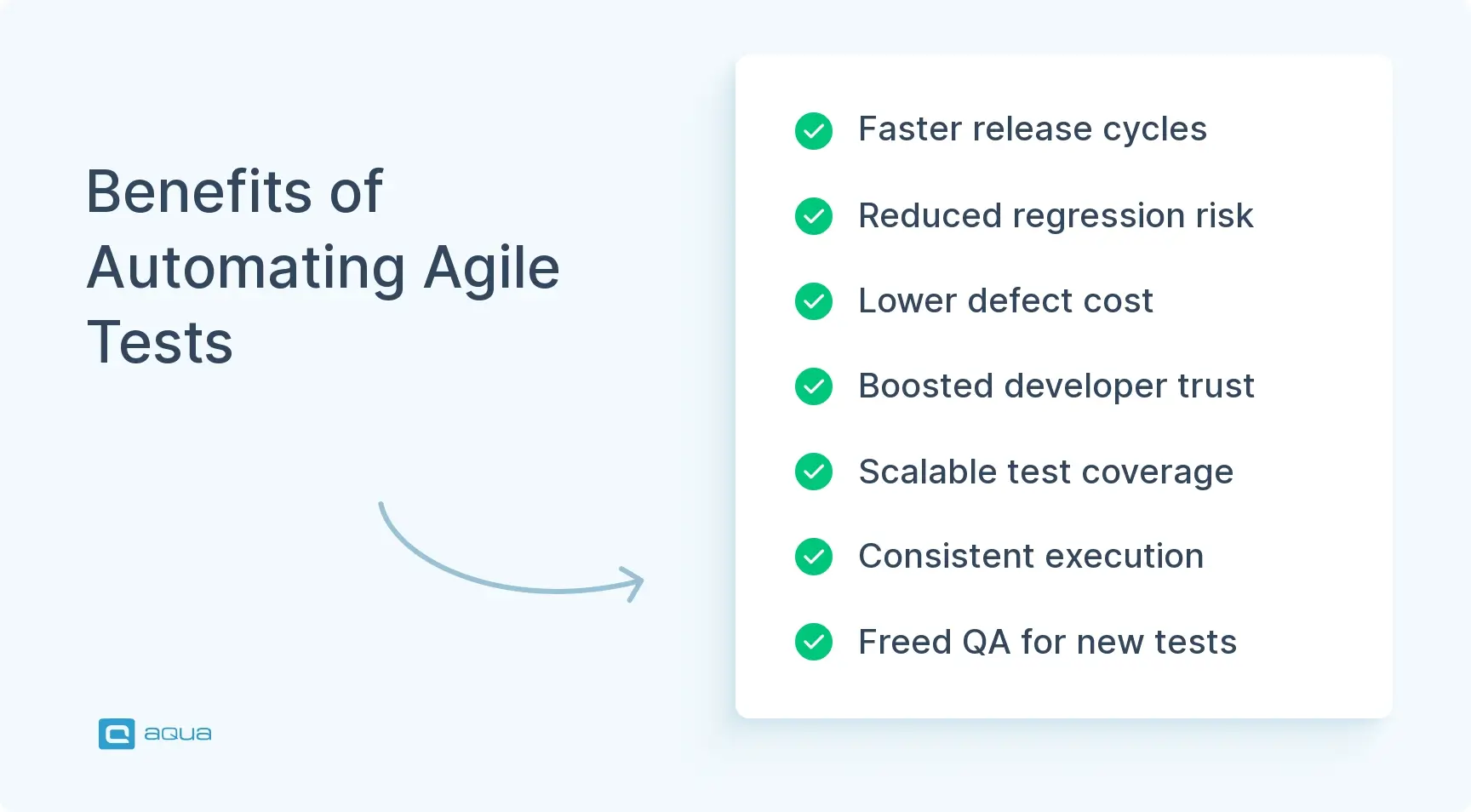
Faster release cycles: Automated suites execute in minutes, removing testing as a release bottleneck.
Reduced regression risk: Every code change gets validated against the full test suite automatically.
Lower cost per defect: Defects caught in CI/CD cost a fraction of what they cost in production.
Increased developer confidence: Reliable automation lets your team refactor and iterate features without fear.
Scalable coverage: As your product grows, automated suites grow with it without proportional QA overhead.
Consistent execution: Scripts run the same way every time, eliminating human variability in regression testing.
Freed QA capacity: Automation handles repetitive validation, freeing your team members for exploratory and high-judgment work.
Automation handles the stable and repeatable work. Manual testing covers usability, visual bugs, and early-stage features still in flux. Used deliberately together, both approaches keep blockers from piling up.
Best Practices for Agile Test Case Management
Test case management in Agile means balancing enough structure to maintain coverage and traceability against the risk of process overhead that slows your team down. The goal is an organizational system that keeps pace with continuous change and adds no unnecessary documentation on top of existing work.
1. Organize tests by risk, feature area, and execution type
Tagging or grouping test cases from the start makes prioritization straightforward when sprint scope shifts. Useful dimensions to tag by include:
Risk level such as high, medium, or low
Feature area such as authentication, checkout, or reporting
Execution type such as smoke, regression, integration, or exploratory
High-risk areas like payment processing and user authentication warrant priority automation. Low-risk cosmetic changes may skip formal test cases entirely in favor of quick manual checks.
2. Link test cases directly to user stories and acceptance criteria
Aligning test cases to Jira tickets or Azure DevOps work items creates traceability without excess process. When a story moves to “in progress,” its associated tests should already exist: drafted during refinement, reviewed by developers, and ready to execute. Without this, development finishes, but nobody can confirm how to validate it. Tools like Zephyr or aqua cloud make this linking native to existing project workflows.
3. Treat test code like production code
Outdated tests that fail because the UI changed will erode trust in your automation suite. They create noise that masks real failures and makes teams second-guess results. Sustainable test suites need ongoing care:
Regular refactoring of brittle selectors and hardcoded values
Extraction of reusable components and helper functions
Deletion of tests covering deprecated or merged features
Sprint-level reviews asking “does this test still add value?”
Lean test suites run faster and produce fewer false positives. Maintenance stays manageable because it never balloons into a separate project.
4. Use traceability to manage change efficiently
When requirements change mid-sprint, traceability shows exactly which test cases need updating. Linking tests to requirements in your project management tool means a single requirement change surfaces all affected tests immediately. Without this, stale coverage stops reflecting current behavior, and gaps only show up when something breaks in production.
One approach that I've been using recently is BDD (Behaviour Driven Development), which focuses on describing expected behaviour in gherkin format (Given, When, Then) in your user stories. These expected behaviours and outcomes serve both as an acceptance criteria and as the basis for test cases.
The right tools for test automation embed testing into your workflow so that applying test case design techniques in Agile becomes part of how your team builds, with no extra process layered on top.
aqua cloud is an AI-powered test and requirement management solution. The platform lets you organize cases by risk and feature area, so reprioritizing when sprint scope shifts takes seconds. With aqua’s domain-trained actana AI, your team generates professionally designed test cases using test design techniques in Agile projects like boundary analysis and equivalence partitioning. Real-time dashboards give your team an immediate view of coverage and execution status. Whether your team runs exploratory sessions or manages large regression suites, aqua gives you the structure Agile testing demands. Test cases link directly to requirements in Jira or Azure DevOps for full traceability. Automation connects to your CI/CD pipeline with Jenkins, Selenium, Ranorex, and GitLab via REST APIs, so you can have aqua easily integrated with your entire tech stack.
Achieve 100% requirement coverage with 60% faster release cycles
Zephyr is closely bound to Jira. It handles test case creation, story linking, and execution tracking without leaving the Atlassian interface. For teams that want traceability within Jira but have no need for a separate platform, it covers test case organization at a workable level.
Cucumber and SpecFlow support BDD-style test case design by turning acceptance criteria written in plain Gherkin into executable specifications. Where QA, development, and product collaborate closely on test design, these tools fit naturally. For execution tracking at scale, they work best paired with a dedicated management layer.
Playwright and Cypress are UI automation frameworks where designed test cases get implemented and run. Playwright handles cross-browser coverage with parallel execution; Cypress is faster to set up and easier to debug locally. Both connect to test management platforms via REST API, so results stay tracked and flaky tests surface over time.
Domain-trained actana AI, nested test cases, real-time dashboards
Jira, Azure DevOps, Jenkins, Selenium, Playwright, Cypress (REST API), Confluence, Ranorex, and 10+ more
Requires initial setup to configure workflows
Zephyr
Basic test case organization and traceability within Jira
Zero context-switching within Atlassian
Built directly into Jira
Limited capabilities outside Jira ecosystem
Cucumber / SpecFlow
Collaborative test case design via BDD scenarios
Business-readable Gherkin scenarios co-authored by QA and product
Works with most CI/CD pipelines
Requires team-wide alignment on Gherkin syntax
Playwright
Test case implementation for UI flows
Speed, cross-browser support, parallel execution
Native CI/CD integration; connects to management tools via REST API
Not a test management tool on its own
Cypress
Test case implementation for UI flows
Fast feedback loop, developer-friendly debugging
Tight CI/CD integration; connects to management tools via REST API
Limited cross-browser support
The right stack depends on your team’s size and workflow. Tools that fit into how your team already works accelerate delivery; tools that require a separate process create friction.
Conclusion
Good test case design in Agile keeps coverage aligned with how your product actually changes. Combining boundary analysis and decision tables with BDD and exploratory testing covers more ground than any single approach. Stable paths suit automation; while anything requiring judgment stays manual. Enough structure to track what matters, no more. Teams that weave testing into refinement and deployment consistently ship faster and break less.
Test case design techniques are structured methods for selecting and defining the inputs, conditions, and expected outcomes used to validate software behavior. They help your team achieve solid coverage without testing every possible scenario. The focus stays on the combinations and boundaries most likely to surface real defects.
How can test case design techniques in Agile be adapted for continuous integration?
Test design techniques in Agile like equivalence partitioning and boundary value analysis translate directly into data-driven automated tests that run on every commit. Encoding these structured inputs into CI/CD pipelines gives your team fast, repeatable validation of critical paths without manual intervention. Feedback loops stay short and release quality stays consistent.
What challenges do testers face when applying traditional test design techniques in Agile environments?
Traditional techniques were designed for stable, fully-defined requirements. In Agile, requirements shift mid-sprint, leaving pre-written test cases outdated before execution. Your team needs to apply test case design techniques in Agile just-in-time during refinement and build test suites flexible enough to absorb change without full rewrites.
How do you decide which test design technique in Agile projects to use for a given feature?
The choice depends on the feature’s complexity and risk profile. Input-driven features with defined ranges suit boundary analysis and equivalence partitioning. Features with complex conditional logic benefit from decision tables, while multi-step workflows call for state transition testing. For novel or high-risk features with ambiguous requirements, exploratory testing is the stronger starting point for your team.
How often should test cases be reviewed and updated in an Agile project?
Test cases should be reviewed every sprint, ideally during backlog refinement and retrospectives. Any requirement change or deprecated feature should trigger immediate updates or deletions. When your team treats test maintenance as ongoing sprint work and schedules it alongside other tasks, suites stay in sync with the product.
Home » Test Automation » Test Case Design Techniques in Agile: Ultimate Guide
Do you love testing as we do?
Join our community of enthusiastic experts! Get new posts from the aqua blog directly in your inbox. QA trends, community discussion overviews, insightful tips — you’ll love it!
We're committed to your privacy. Aqua uses the information you provide to us to contact you about our relevant content, products, and services. You may unsubscribe from these communications at any time. For more information, check out our Privacy policy.
X
🤖 Exciting new updates to aqua AI Assistant are now available! 🎉
We use cookies and third-party services that store or retrieve information on the end device of our visitors. This data is processed and used to optimize our website and continuously improve it. We require your consent fro the storage, retrieval, and processing of this data. You can revoke your consent at any time by clicking on a link in the bottom section of our website.
For more information, please see our Privacy Policy.
This website uses cookies to improve your experience while you navigate through the website. Out of these, the cookies that are categorized as necessary are stored on your browser as they are essential for the working of basic functionalities of the website. We also use third-party cookies that help us analyze and understand how you use this website. These cookies will be stored in your browser only with your consent. You also have the option to opt-out of these cookies. But opting out of some of these cookies may affect your browsing experience.
Necessary cookies are absolutely essential for the website to function properly. These cookies ensure basic functionalities and security features of the website, anonymously.
Cookie
Duration
Description
cookielawinfo-checkbox-analytics
11 months
This cookie is set by GDPR Cookie Consent plugin. The cookie is used to store the user consent for the cookies in the category "Analytics".
cookielawinfo-checkbox-functional
11 months
The cookie is set by GDPR cookie consent to record the user consent for the cookies in the category "Functional".
cookielawinfo-checkbox-necessary
11 months
This cookie is set by GDPR Cookie Consent plugin. The cookies is used to store the user consent for the cookies in the category "Necessary".
cookielawinfo-checkbox-others
11 months
This cookie is set by GDPR Cookie Consent plugin. The cookie is used to store the user consent for the cookies in the category "Other.
cookielawinfo-checkbox-performance
11 months
This cookie is set by GDPR Cookie Consent plugin. The cookie is used to store the user consent for the cookies in the category "Performance".
viewed_cookie_policy
11 months
The cookie is set by the GDPR Cookie Consent plugin and is used to store whether or not user has consented to the use of cookies. It does not store any personal data.
Functional cookies help to perform certain functionalities like sharing the content of the website on social media platforms, collect feedbacks, and other third-party features.
Performance cookies are used to understand and analyze the key performance indexes of the website which helps in delivering a better user experience for the visitors.
Analytical cookies are used to understand how visitors interact with the website. These cookies help provide information on metrics the number of visitors, bounce rate, traffic source, etc.
Advertisement cookies are used to provide visitors with relevant ads and marketing campaigns. These cookies track visitors across websites and collect information to provide customized ads.






 Bankingaqua ALM helps banks increase testing productivity by over 50%