Requirement Traceability in the Age of AI: List of the Best Practices
Requirement traceability is a crucial stage for QA, but it is also where many errors occur, especially as projects grow in complexity. Picture this: requirements evolve faster than you can track, becoming harder to monitor manually and analyse in different coding and testing stages. These might sound like a lot, but AI steps in as an ultimate solution, saving you time, resources, and energy. How? This article will guide you through the challenges, benefits, and best practices and provide the ultimate tool for your needs.
AI requirement traceability automates the links between requirements, test cases, design documents, and defects, so your team spends less time on manual tracking and more time on actual QA work.
AI catches the impact of requirement changes instantly, helping your team adapt before problems compound across the project.
The process works best when your team maintains high data quality. AI is only as accurate as the requirements it reads.
Common challenges include integration complexity, overreliance on automation, and data inconsistency. Each has a practical fix.
Tools like aqua cloud bring AI-powered traceability, real-time reporting, and full bidirectional coverage into one place.
Here is how AI changes requirement traceability in practice and what your team needs to make it work. 👇
Key Benefits of Integrating AI to Requirement Traceability
AI requirement traceability means using artificial intelligence to automatically link and manage requirements across every stage of development, so your team always knows what is covered, what has changed, and what the impact is.
At the same time:
Requirement traceability involves linking and managing requirements across various stages of development to ensure the final product aligns with initial expectations. It is about building a roadmap for a project, ensuring every step in the journey—from the initial idea to the final product—stays on track. However, it’s not an easy road to navigate. Imagine having a hundred different puzzle pieces, each representing a requirement, and trying to fit them together as the project progresses. This process gets even trickier when these pieces keep changing shape and size.
“The most difficult part of requirements gathering is not recording what the user wants; it is the exploratory development activity of helping users figure out what they want.”
Steve Mc Connell, author and founder of Construx Software Builders
This is where AI steps in, saving time, ensuring accuracy, and catching changes that could easily slip through manual monitoring. Sounds too generic? Here is how integrating AI with requirement traceability will benefit you, specifically:
Enhanced traceability: Integrating AI into requirements traceability can significantly enhance the traceability process throughout the software development life cycle. AI can automate the creation of a requirements traceability matrix (RTM), ensuring that every requirement is linked to corresponding test cases, design documents, and code, which are the crucial components for Quality Assurance.
Change Impact Analysis: When requirements change, AI helps you quickly understand how it impacts the project. It’s like having a fast assistant that assesses these changes swiftly, allowing you to adapt and respond faster without spending hours figuring out the implications. According to a case study by Accenture, integrating AI for impact analysis reduces the time spent assessing changes by 70%.
Enhanced Visibility and Reporting: With AI-powered requirement management tools, you gain real-time visibility into requirement coverage. Using AI algorithms, these tools analyse project elements like code and test cases, offering straightforward insights into the status of each requirement. This enhanced visibility ensures that project teams and stakeholders can quickly assess the alignment between development efforts and defined requirements. Additionally, the tools generate dynamic reports, keeping everyone informed about the current state of requirement coverage, and enabling more informed decision-making in the QA process.
Comprehensive oversight: This traceability matrix provides a comprehensive overview of the software development process, enabling both forward traceability (tracing requirements to their implementation) and backward traceability (tracing deliverables back to their requirements). By maintaining bidirectional traceability, AI-powered requirements management software can ensure that no requirement is overlooked. This way, you also ensure the project remains aligned with its initial goals throughout the project lifecycle.
Efficient adaptability: AI also helps in managing traceability data more effectively by continuously updating the traceability matrices as requirements evolve. This is particularly useful in agile environments where changes are frequent. Moreover, by automating the software testing phase, AI can ensure that all requirements are adequately covered, reducing the risk of critical defects in the final product.
Regarding requirements management and traceability, what could be a better solution than aqua cloud? With aqua’s AI-powered capabilities, you effortlessly see how your tests cover requirements and match each one to its perfect test counterpart. Generate detailed reports, share progress with stakeholders in any format you prefer, and prioritise your backlog using tailored boards for requirements, defects, and test cases—whether you’re a Kanban enthusiast or follow a Waterfall approach. Streamline QA planning with Scrum boards designed explicitly for test cases, ensuring meticulous organisation within sprints or dedicated QA cycles. Engage in centralised discussions, review, collaborate, provide feedback, and approve requirements—all within aqua’s collaborative hub. Turn requirement management into a triumph with aqua cloud.
Best practices for requirement traceability using AI
Knowing the benefits is one thing. Getting AI requirement traceability to work consistently in your team’s daily process is another. These are the practices that make the difference. How can you implement AI into the process perfectly? Here is your step-by-step guide:
Clear Requirement Identification: Start by ensuring clear and well-defined requirements. AI thrives on clarity, so the better you define your needs, the more effectively AI can trace and manage them.
Implement Robust AI Tools: Choose AI-powered tools like aqua cloud, which specialises in requirement traceability. Look for automation features that link requirements across development stages, ensuring accuracy and efficiency.
Regularly Update and Monitor: Keep requirements updated and monitored regularly. AI can help continuously track and link as requirements evolve throughout the project.
Data Quality and Consistency: Maintain high-quality data for AI analysis. Consistency in data formatting and input improves AI’s ability to link and trace requirements accurately.
Team Training and Collaboration: Train teams to effectively use AI tools for requirement traceability. Encourage collaboration and communication to leverage AI insights for better decision-making.
As long as you follow these best practices, you can maximise AI’s power in requirements management and traceability. But you might ask, does it guarantee a flawless, 100% efficient process with no challenges? The answer is no, which we clarify in the next part.
Let’s see how AI shifts the way requirements are connected to the test cases and to different major elements of QA in the interactive simulation below. Imagine the visual as QA brain and press the buttons to see the interactions between elements:
🧠 Interactive AI Traceability Brain Visualization
(Click to open)
▼
Functional Requirements
Non-Functional Requirements
Test Cases
Design Documents
Impact Propagation
Watch how AI transforms scattered requirements into an intelligent neural network. Each neuron represents a requirement,
and the synaptic connections show traceability links formed by AI analysis.
How to Build and Maintain an AI-Powered Requirements Traceability Matrix
A requirements traceability matrix (RTM) maps every requirement to the test cases, design elements, and defects connected to it. Building one manually is slow and error-prone. With AI, the matrix updates automatically as your project evolves.
Step 1: Define your traceability scope.
Decide which elements the matrix will cover. At minimum, link requirements to test cases and defects. For full coverage, also include design documents, user stories, and code modules. The wider the scope, the more useful the matrix becomes for impact analysis.
Step 2: Structure your requirements clearly.
AI requirement traceability depends on well-written requirements. Each requirement needs a unique ID, a clear description, and an unambiguous acceptance criterion. Vague requirements produce inaccurate links. Before feeding requirements into your AI tool, review them for completeness.
Step 3: Let AI generate the initial links.
Feed your requirements into an AI-powered tool like aqua cloud. The AI scans existing test cases, defects, and documentation to suggest traceability links. Review these suggestions with your team before accepting them. This review step is not optional: AI generates strong starting points, but your team’s domain knowledge closes the gaps.
Step 4: Validate coverage gaps.
Once the initial matrix is built, use it to identify requirements with no linked test cases. These are your coverage gaps. Prioritise filling them based on the risk exposure of each requirement. High-risk requirements with no test coverage need immediate attention.
Step 5: Keep the matrix current.
The matrix loses value the moment it stops reflecting reality. Set up automated alerts for requirement changes so your team reviews affected links immediately. Schedule a full matrix review at the start of each sprint or release cycle. Archive retired requirements and their links for audit purposes.
A well-maintained RTM gives your team, your stakeholders, and your auditors a single, accurate view of where the project stands at any point in time.
Key Traceability Metrics and KPIs
Tracking the right metrics tells your team whether your AI requirement traceability process is working, and where it is breaking down.
Requirements coverage rate measures the percentage of requirements linked to at least one test case. A coverage rate below 100% means some requirements have no validation. For any release, your team should aim for full coverage on high and critical-priority requirements at minimum.
Formula: (Requirements linked to at least one test case ÷ Total requirements) × 100
Defect traceability rate tracks how many defects are linked back to a specific requirement. A low rate suggests your team is finding bugs without understanding which requirement they violate, which makes root cause analysis harder and slower.
Formula: (Defects linked to a requirement ÷ Total defects found) × 100
Requirements change frequency monitors how often requirements are modified after sign-off. High change frequency is a signal that requirements are not well-defined upfront, which puts traceability links at constant risk of becoming outdated.
Formula: Requirement modifications after sign-off ÷ Total requirements in scope
Orphaned requirements count identifies requirements with no linked test cases, design elements, or defects. These are gaps in your coverage. Any orphaned requirement in a high-risk area should be treated as a priority item before the next release.
Formula: Count of requirements with zero linked test cases, defects, or design elements
Link accuracy rate measures what percentage of AI-generated traceability links your team validates as correct after review. A rate below 85% suggests your requirements need better structure before AI can process them reliably.
Time to update traceability tracks how long it takes your team to update links after a requirement changes. Long lag times create misalignment between what is documented and what is actually being tested.
Formula: Date links updated − Date requirement changed
Review these metrics at the start of each sprint and after any significant requirement change. Teams that track traceability KPIs consistently catch coverage gaps weeks earlier than those that review only at release time.
aqua cloud gives your team full traceability across requirements, tests, and defects in one place.
Although the process has its challenges, you have no reason to fear as you can overcome each one of them. Here is a detailed breakdown of the challenges of requirements traceability with artificial intelligence:
1. Data Quality and Consistency: Inconsistent or poor-quality data, such as missing or false information in requirements documentation, harms AI’s ability to link and analyse data effectively. For instance, ambiguous or outdated requirements can lead to incorrect associations and misinterpretations by AI algorithms.
Solution: Implement solid data validation processes, conduct regular audits, and establish data cleaning protocols to ensure data integrity before AI analysis. You enhance AI’s ability to make accurate associations and traceability mappings by standardising formats, verifying accuracy, and regularly updating requirements.
2. Complexity of Integration: Integrating AI tools seamlessly into existing workflows can disrupt established processes. It can cause resistance or inefficiencies due to unfamiliarity or conflicting systems. For instance, incompatible interfaces or resistance to change among team members can hinder smooth integration.
Solution: Start with small-scale implementations, providing extensive training and phased integration to minimise disruption. Offer comprehensive support and clear communication to help teams adapt gradually, ensuring a smoother transition without compromising existing workflows.
3. Overreliance on AI: Excessive dependence on AI without human oversight can lead to blind trust in AI-generated results, potentially missing nuanced or context-specific requirements. This overreliance might lead to overlooking critical details or misinterpretation of requirements.
Solution: Maintain a human-AI balance by encouraging collaboration and incorporating manual validation. Foster an environment where AI insights are cross-validated by experienced team members to ensure comprehensive and accurate requirement interpretations.
4. Costs and Resource Allocation: The initial investment and allocation for AI implementation pose financial constraints or divert resources from other critical areas. It could lead to budgetary concerns or resistance from stakeholders due to high upfront costs.
Solution: Conduct comprehensive cost-benefit analyses, showcasing long-term efficiency gains and reduced manual effort to justify the initial investment. Efficient resource management and clear communication regarding the benefits of AI implementation can align stakeholders towards long-term advantages.
5. Adaptation and Training: Training teams to proficiently use AI tools for requirement traceability might require significant time and effort, potentially causing resistance or slowing down productivity during the learning curve.
Solution: Invest in extensive training programs, workshops, and ongoing support to facilitate a smooth transition. Encourage a culture of continuous learning to ensure teams adapt comfortably and efficiently to AI-powered tools.
6. Security and Privacy Concerns: AI systems handling sensitive data pose security and privacy risks if not adequately protected, potentially leading to breaches or non-compliance with data regulations.
Solution: Implement robust cybersecurity measures, encryption protocols, and compliance frameworks to safeguard data. Ensure strict adherence to regulatory standards and protocols to mitigate security risks and protect sensitive information handled by AI systems.
By addressing these challenges with comprehensive solutions, you’ll be better equipped to navigate the complexities of AI-powered requirement traceability effectively.
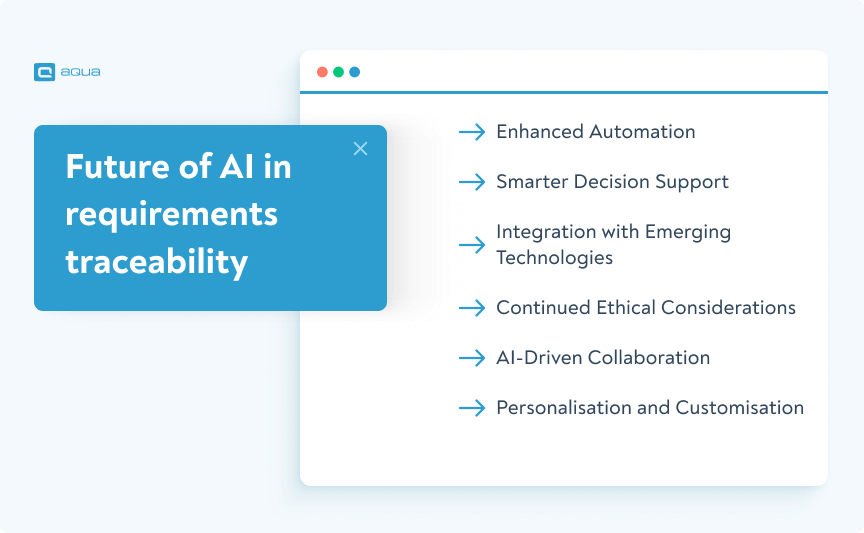
Future of AI in requirements traceability
Now, the question arises: what lies ahead? Where are we headed with AI in requirements management? AI will likely become more ingrained in software development and QA processes as technology evolves, reshaping how we handle requirements. Here’s the list of predictions based on how the progress of AI has evolved in recent years:
Enhanced Automation: AI will continue streamlining requirement traceability, automating more intricate tasks. Expect AI to delve deeper into understanding natural language, enabling more sophisticated linking and analysis of requirements across diverse development stages.
Smarter Decision Support: AI-driven analytics will evolve, providing predictive insights into the potential impact of requirement changes. This foresight will empower you to make informed decisions earlier in the development cycle, mitigating risks and optimising resource allocation.
Integration with Emerging Technologies: AI will fuse with emerging technologies like augmented reality (AR) and virtual reality (VR), transforming how requirements are visualised and understood. This integration could revolutionise requirement communication and comprehension among cross-functional teams.
Continued Ethical Considerations: As AI plays a more significant role, ethical considerations regarding bias, privacy, and transparency will become increasingly vital. Expect a continued focus on ethical AI practices in requirement traceability to ensure fairness and compliance.
AI-Driven Collaboration: AI will facilitate seamless collaboration among global and remote teams, offering real-time insights and enabling effective communication on requirement changes and their implications.
Personalisation and Customisation: AI’s adaptability will enable personalised requirement traceability tools tailored to specific project needs, catering to varying methodologies and industries.
For now, let’s focus on what AI-powered tools already do, shall we? With the right tool, you’ll effortlessly align tests with requirements, generate comprehensive reports tailored to your preferences, and prioritise your backlog using boards designed for your methodology, be it Kanban or Waterfall. You’ll also effortlessly transform user inputs or text into precise, crystal-clear requirements like PRDs and User Stories. Can you do all that with one tool? Of course, you can; it is called aqua cloud! With aqua, you’ll also engage in focused QA planning with dedicated Scrum boards for test cases and enjoy centralised collaboration, where reviews, feedback, and approvals seamlessly converge—all within aqua cloud’s collaborative hub. Do not sweat over requirements management problems: let aqua do everything for you.
A Requirements Traceability Matrix (RTM) is your QA safety net. It’s a document or tool that links requirements to test cases. With proper RTM, you guarantee every feature is tested and nothing gets missed.
The inner workings can be explained like this: one column lists requirements, another maps them to test cases, and a third tracks their status (pass/fail). This way, you will spot potential gaps, achieve higher test coverage, and eventually keep stakeholders happy. With advanced solutions like aqua cloud, you can achieve 100% traceability, linking every test case easily to its requirement.
What is Requirements Traceability?
Requirements traceability means tracking and linking requirements throughout the software development lifecycle (SDLC). You monitor the requirements to see if every one of them is connected to its corresponding test cases, design elements, and even defects. This way, you can answer critical questions: Was every requirement tested? Did any changes break something? Where did this bug come from?
Without traceability, you’re flying blind, with it, you’ve got clarity, accountability, and confidence in your software’s quality.
What Should a Requirements Traceability Matrix Template Include?
A good Requirements Traceability Matrix (RTM) template should look like a well-organised spreadsheet for keeping your QA process on track. At its core, it should include:
Requirement ID: A unique identifier for each requirement.
Requirement Description: A brief explanation of what needs to be tested.
Test Case ID: The specific test cases linked to each requirement.
Test Status: Pass, fail, or not executed—so you know where things stand.
Defect ID: Any bugs tied to the requirement or test case.
Optional but helpful columns include priority levels, test types (manual/automated), and notes for additional context. This way, you’ll create a clear, visual map where every requirement is tested and nothing slips through.
How does AI create traceability links between requirements, tests, and defects?
AI scans the text of requirements, test cases, and defect reports to identify semantic similarities and explicit references. It then suggests links based on shared terminology, acceptance criteria matches, and historical patterns from similar projects. Your team reviews and confirms these suggestions before they become part of the official traceability matrix.
What KPIs should teams track to measure requirements traceability?
The most useful KPIs are requirements coverage rate, defect traceability rate, orphaned requirements count, and link accuracy rate. Review them at the start of each sprint. A drop in coverage rate or a rise in orphaned requirements before a release is a signal your team needs to address before sign-off.
How can teams validate AI-generated traceability links?
Set a review step after every AI-generated link batch. Assign a domain expert and a tester to cross-check links against the original requirement text and acceptance criteria. Track the link accuracy rate over time. If accuracy drops below 85%, review your requirement quality first: AI performs better when requirements are specific, uniquely identified, and free of ambiguity.
Robert has several years of experience in process optimisation and test management. He is an expert in defining and implementing workflows by adapting aqua to the clients’ processes.
As a former QA Automation Engineer, Kirill has a deep curiosity about how systems work and how they can be crushed. He kept this approach when switching to product management and later, top management at aqua. Automation and everything related to it is his biggest…
Nurlan, a QA Coordinator & Quality Standards Officer, takes pride in orchestrating seamless QA operations. His expertise in coordinating QA-focused projects and integrating QA solutions has consistently yielded top-tier client satisfaction. Aside from a full-time QA coordinator, Nurlan's role involves creating compelling content that educates…
Home » Best practices » Requirement Traceability in the Age of AI: List of the Best Practices
Do you love testing as we do?
Join our community of enthusiastic experts! Get new posts from the aqua blog directly in your inbox. QA trends, community discussion overviews, insightful tips — you’ll love it!
We're committed to your privacy. Aqua uses the information you provide to us to contact you about our relevant content, products, and services. You may unsubscribe from these communications at any time. For more information, check out our Privacy policy.
X
🤖 Exciting new updates to aqua Intelligence are now available! 🎉