Agile Testing Pyramid: Definition, Benefits, & Best Practices
Have your teams ever struggled to balance dev speed, scope, and cost? If your QA process has any related inefficiency, then you are likely not using the Agile testing pyramid framework correctly, or you don’t use it at all. This is why your testing strategy is top-heavy, lacking fast checks at the unit level, and expensive to fix. The Agile testing pyramid distributes tests across three layers based on speed and cost, which cuts expensive reworks and allows for shipping more reliable code. This guide walks through what the pyramid is, how each layer works, and what a realistic implementation looks like for teams working in active codebases.
The testing pyramid provides a strategic framework for balanced test coverage. Teams that follow it catch bugs faster, maintain stable releases, and avoid the slow feedback loops of top-heavy testing strategies.
Testing Pyramid Layers
Unit Tests (Base) – Fast, isolated tests for individual functions and methods running in milliseconds.
Integration Tests (Middle) – Verify component interactions, API contracts, and database operations.
End-to-End Tests (Top) – Validate complete user workflows through the actual interface sparingly.
Ideal Distribution – Follow 70% unit, 20% integration, 10% E2E ratio for optimal speed and coverage.
Shift Left Philosophy – Catch defects at lower pyramid levels where they're cheaper and faster to fix.
aqua cloud supports pyramid implementation with test type classification, execution time tracking, and pyramid balance analytics. Teams using aqua achieve 80% faster feedback cycles by optimizing their testing distribution.
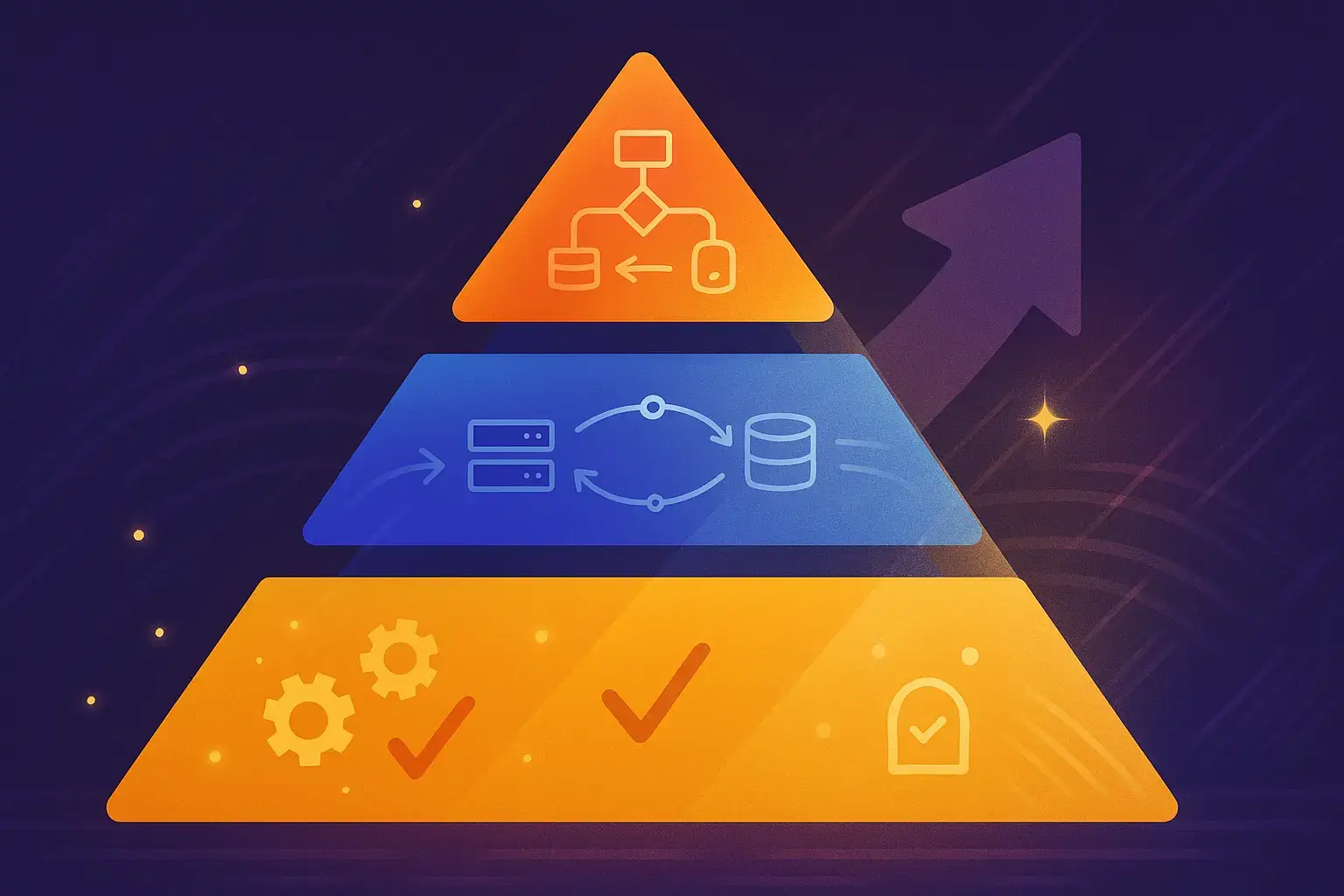
The Agile testing pyramid is a visual framework for organizing automated tests by speed, cost, and scope. It’s also commonly referred to as the software testing pyramid.
According to the ISTQB glossary, this graphical model represents the relationship of the amount of testing per level, with more at the bottom than at the top.” In practice, it tells your team where to invest automation effort so that feedback stays fast and quality stays high, even when you’re deploying multiple times a day.
Martin Fowler frames it as a way of balancing test automation, so you’re not burning resources on slow, fragile tests when faster ones would catch the same bugs. The pyramid shape reflects that balance: wide at the base with many fast tests, narrowing toward the top where tests are fewer but broader in scope.
Here’s what the Agile testing pyramid comprises:
Unit tests (base): Fast, isolated tests covering individual functions or classes. They run in seconds, are owned by developers, and are written alongside code.
Integration tests (middle): Tests that verify components interact correctly, covering APIs and services, without requiring a full application environment.
End-to-end tests (top): Full-stack user journey tests that exercise the entire system through the UI. Valuable but slow, brittle, and expensive to maintain.
Proportions matter: A healthy pyramid typically has 70%+ unit tests, 20-25% integration tests, and 5-10% end-to-end tests.
Speed decreases upward: Unit tests run in milliseconds. Integration tests take seconds to minutes. E2E tests can take 30-60 seconds each.
Cost increases upward: Infrastructure, maintenance burden, and flakiness all grow as you move toward the top.
The pyramid model is specifically suited to Agile because it front-loads verification. When your test suite runs in minutes rather than hours, your team can merge more frequently, catch bugs while context is fresh, and maintain the rhythm that Agile delivery depends on.
Setting up Agile testing automation pyramid across all three layers requires a solid tech stack to keep everything traceable and organized. aqua cloud, an AI-powered test and requirement management platform, is built exactly for such Agile purposes. With aqua, your team can manage manual and automated tests with full visibility between requirements, test cases, and defects across every pyramid layer. On top of that, aqua’s domain-trained AI Copilot generates high-quality, project-specific test cases grounded in your own documentation, chats, or even voice notes. 42% of test cases created with aqua require no additional editing, which accelerates your QA. aqua integrates natively with the tools your team already uses: JUnit for unit testing, SoapUI and JMeter for service and API tests, Ranorex and Selenium for UI automation, and Jira, Azure DevOps, and Jenkins for your broader development workflow. That means your pyramid layers stay connected and easily accessible from one digital environment.
Save up to 12.8 hours per tester per week with aqua's AI-powered test management.
Each layer serves a distinct purpose and comes with its own tooling, tradeoffs, and ownership model. What belongs at each level, and the reasoning behind those boundaries, is what separates a well-maintained suite from one that slowly becomes a bottleneck.
Unit Tests: The Base Layer
Unit tests sit at the foundation of the pyramid because they’re the fastest, cheapest, and most reliable form of automated verification. Each test covers a single function, class, or module in complete isolation. External dependencies like databases and APIs are mocked or stubbed out.
Run thousands of checks in under a minute, unit tests give developers feedback before they even open a pull request. Bugs are caught while the code is still fresh, not days later in a QA cycle. For a deeper dive, refer to our unit testing guide.
What makes a strong unit test layer:
Written in the same language as the application code and co-located with the files they test
Named descriptively so they serve as living documentation
Structured with arrange-act-assert to keep logic readable
Focused on one behavior per test, with no multi-step scenario chains
Covering conditionals, edge cases, and business rules rather than chasing 100% line coverage
Run automatically on every commit as a merge gate in CI
Common tooling: JUnit and TestNG for Java, pytest for Python, Jest for JavaScript.
Unit tests should make up somewhere north of 70% of your suite. With solid coverage at this layer, your team can refactor confidently and keep shipping without accumulating regression risk.
It is a three layer model, don’t complicate stuff. Unit, service, UI.
Integration tests occupy the middle of the pyramid, and Mike Cohn, who popularized the testing pyramid, called them the “forgotten” layer. Many teams jump straight from unit tests to full UI automation, skipping the tier that often delivers the highest return on investment. This layer is where your team validates that components actually work together: does the API endpoint return the right response? Does the service layer correctly coordinate database writes? Does the authentication middleware reject unauthorized requests as expected?
Unlike unit tests, integration tests don’t mock everything. They test at real boundaries, between your code and a database, between services, or between an API and its consumers. Bugs that only appear when components interact, such as serialization mismatches, transaction edge cases, and timeout handling, get caught here rather than in production.
As a QA lead, this is the layer where you’ll get the most leverage in modern architectures. API contracts, service dependencies, and data flows all get validated here, well before a browser ever opens.
What makes a strong integration test layer:
Tests are scoped to specific component boundaries, not the full stack
Environments are controlled using Docker containers or Testcontainers for consistency
Test data is seeded deterministically and cleaned up after each run
Execution time stays in the range of a few minutes, not tens of minutes
Tests run before deployment to staging and block the pipeline on failure
Common tooling: RestAssured or pytest with requests for HTTP APIs, Newman for Postman collections, in-memory databases or containerized instances for data layer tests.
This middle layer is especially valuable for microservices and API-first architectures, where service contracts matter as much as the logic inside individual components.
End-to-End Tests: The Top Layer
At the top of the pyramid sit end-to-end tests, which are basically full-stack user-journey validations. These tests interact with UI elements and verify that critical workflows complete successfully across frontend, backend, and database layers. When an E2E test passes, you have genuine confidence that a real user can complete that task. For more information, see our detailed article on end-to-end testing.
That confidence comes at a cost, though. A single UI test can take 30-60 seconds, and at scale, that adds up to hours of execution time. E2E tests are also inherently brittle, depending on network latency, browser behavior, and timing. A CSS class rename or a repositioned button can break dozens of tests. Debugging failures is painful because the error could originate at any layer, and the message is usually something unhelpful like “element not found.”
What makes a strong E2E test layer:
Cover only critical business paths such as user registration, checkout flows, and core feature journeys
Use explicit waits and stable selectors, never arbitrary sleeps or fragile CSS queries
Keep test data deterministic and isolated from other test runs
Invest in observability: screenshots on failure and structured logs so failures are diagnosable
Run on a schedule or post-deployment rather than blocking every merge
Keep the total count low, aiming for 5-10% of your overall suite
Common tooling: Selenium, Playwright, Cypress, Appium.
The E2E layer is your safety net for user-facing flows, not your primary verification strategy. Too many tests at the top and you end up with an ice cream cone: top-heavy, slow to run, and increasingly expensive to maintain.
How to Implement the Agile Testing Pyramid?
Actually building the pyramid inside a real codebase requires a clear sequence of steps your team can follow. For engineering leaders and C-level executives evaluating where to invest, this step-by-step approach also provides a clear framework for measuring progress and demonstrating ROI.
Step 1: Audit your current test suite
Before writing a single new test, you should map where you stand. Count tests by layer, measure execution times, track flakiness rates, and identify where bugs are actually being caught, whether at the unit, integration, E2E, or production stage. This baseline tells you whether you’re dealing with an ice cream cone, an hourglass, or something closer to the ideal pyramid. Beyond that, it reveals where the most drag on your pipeline is coming from.
Step 2: Identify the highest-pain gaps
With your audit in hand, the next step is to prioritize. If you have almost no unit tests, that’s where to start. If integration tests are missing and bugs keep slipping through API boundaries, build that middle layer first. There’s no need to fix everything at once. Pick the gap causing the most velocity loss and address it sprint by sprint.
Step 3: Make testing a development activity, not a QA phase
The pyramid only works when tests are written alongside code, not weeks later in a separate QA cycle. Developers should own unit tests completely, in the same commit, the same pull request, and the same code review. For integration tests, pairing developers and QA engineers tends to work well: developers bring implementation context while QA brings edge-case instinct. E2E tests can be owned by automation engineers, but your team members on the development side need to support them by adding stable test IDs to UI elements and exposing test-friendly APIs.
Step 4: Wire every layer into your CI/CD pipeline
Automation is what makes the Agile testing automation pyramid sustainable at scale. Unit tests should run on every push and block merges on failure. Integration tests should run before deployment to staging. E2E tests should run post-deploy or on a schedule as a smoke suite. The feedback loop matters most here: developers need to see failures in minutes, not hours, so fixes happen while context is still fresh. A red build should stop the line until it’s green again.
Step 5: Apply the “shift-down” rule for new and existing tests
For all new features, the pyramid should be followed from day one: unit tests first, integration coverage for key paths, E2E only for critical user flows. For existing tests, a simple ongoing rule helps over time. Whenever an E2E test catches a bug, ask whether a lower-level test could have caught it first. If yes, you should:
Write the lower-level test
Simplify or delete the corresponding E2E test
Document the decision, so your team builds the habit
Over time, this gradually changes your suite without requiring a big-bang rewrite.
Step 6: Monitor and continuously improve test health
Your pyramid requires ongoing attention as the product and team grow. Tracking execution time, flakiness rates, and coverage deltas across layers gives you early warning when things drift. If E2E tests start creeping past 45 minutes, the right move is to parallelize or push coverage down a layer. If a service test flakes repeatedly, you should isolate the cause or remove it entirely. Running periodic “test hygiene” sprints, where your team improves suite health instead of adding features, keeps the pyramid from quietly degrading over time.
Key Benefits of the Agile Testing Pyramid
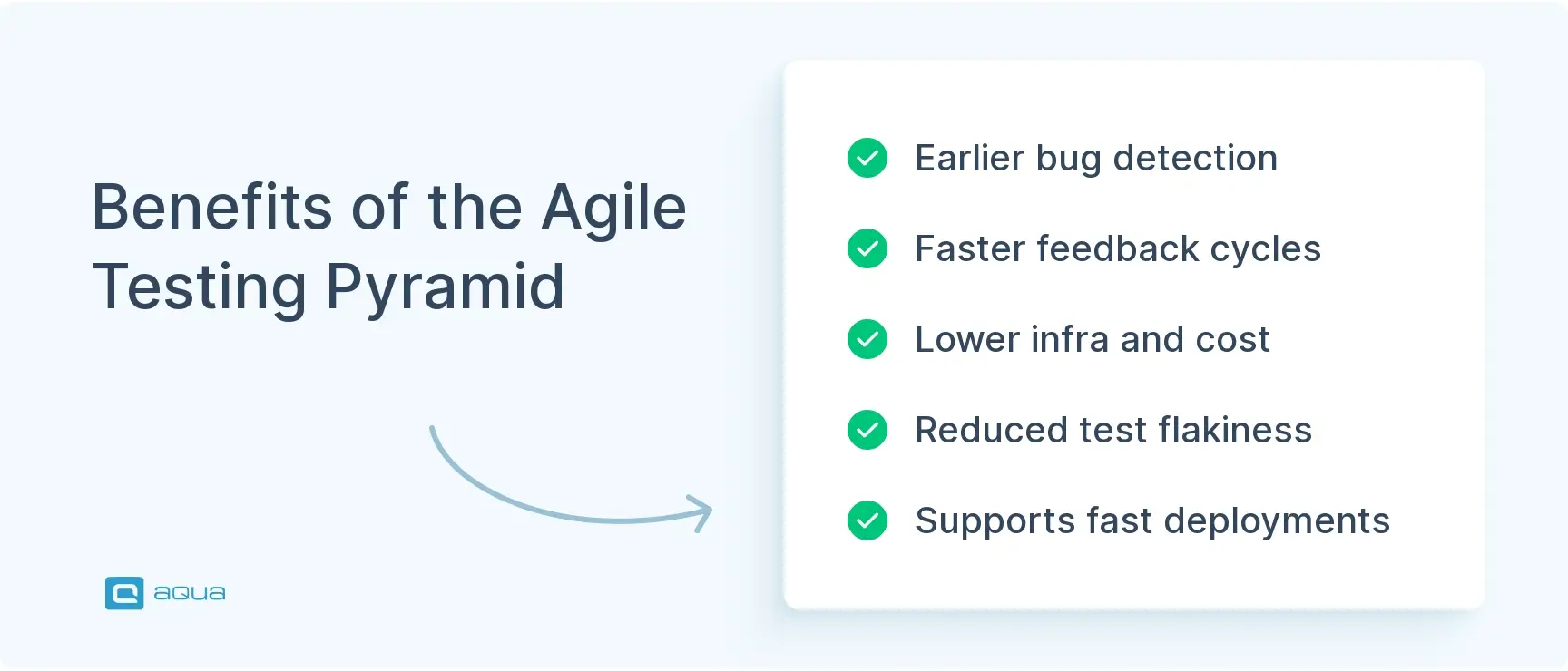
Beyond the structural appeal of the model, what actually matters is what the testing pyramid in Agile does for your team’s day-to-day work. Faster pipelines, fewer escaped bugs, lower infrastructure spend, and more predictable releases are where the real value shows up.
Structuring your tests deliberately, rather than accumulating automation without a strategy, delivers measurable outcomes across speed and cost:
Earlier bug detection: Unit tests catch issues in seconds, before code even gets committed. Bugs found at the source cost a fraction of what they cost in production.
Faster feedback loops: A pyramid-shaped suite keeps CI/CD pipelines snappy. Unit tests finish in a minute or two and integration tests in five to ten, so developers don’t wait long before they ship.
Lower infrastructure costs: Unit tests need no external resources. Integration tests use lightweight containers. Keeping expensive E2E tests sparse dramatically reduces tooling and maintenance overhead.
Reduced flakiness: The bulk of verification lives in deterministic, isolated layers. That stability compounds: fewer false failures mean your team trusts the suite and acts on real failures immediately.
Safer refactoring: Solid unit coverage gives developers confidence to change implementations without fear of breaking contracts. That’s what enables the continuous improvement Agile depends on.
Higher deployment frequency: Teams that adopt the pyramid consistently report build times dropping from hours to minutes and deployment frequency doubling, because their pipeline supports velocity instead of throttling it.
For QA leads specifically, the pyramid changes the nature of the work. Instead of spending sprints chasing flaky Selenium failures or maintaining hundreds of brittle UI scripts, your team spends time on designing meaningful test strategies and identifying coverage gaps.
Challenges in Adopting the Agile Testing Pyramid
Reshaping a test suite is rarely just a technical problem. The real friction tends to be cultural and organizational, and knowing where it typically comes from helps your team prepare rather than react.
1. Changing team roles and skills
Developers may have little experience writing unit tests. At the same time, QA engineers used to UI automation can feel displaced by the move toward service-layer testing. Pairing sessions and short, targeted training on frameworks like JUnit or pytest tend to close both gaps faster than top-down role reassignments.
2. Infrastructure constraints
Integration tests need databases, message brokers, or service mocks. E2E tests need browser grids. Open-source tooling like Docker and Testcontainers keeps the barrier low, and proving ROI on one feature area before scaling avoids overcommitting early.
3. Resistance to change
A large UI test suite represents real effort, and stakeholders often read a high test count as a sign of quality. Leading with data, specifically flake rates, build times, and bug escape rates, before and after a small pilot, tends to be more persuasive than any structural argument.
4. Test data management
Integration and E2E tests need consistent, realistic data across parallel runs. Database snapshots, transactional rollback, and containerized environments that reset between runs all help. Treating test data as a first-class concern from the start prevents flakiness from compounding later.
5. Maintaining the pyramid shape over time
Under deadline pressure, E2E tests accumulate because they feel thorough and require less architectural thought. Setting quality gates in CI that flag E2E count growth or coverage drops makes the drift visible before it becomes a real problem.
The simpler the test, the easier it was to maintain (you can find many pictures of the test pyramid that talk about cost and how it goes up as you go up the pyramid).
Best Practices for Successfully Implementing the Agile Testing Pyramid
Maintaining a healthy pyramid takes more than a good initial setup. Over time, deadline pressure, growing codebases, and team turnover all work against the shape you’ve built. The practices below are what keep it intact. For teams operating within SAFe, the balanced Agile testing pyramid in SAFe follows the same core principles while aligning test automation to program increments and value streams.
1. Start with a portfolio audit
Before adding any new tests, map your current state across all three layers. Count tests, measure execution times, and track where bugs are actually being caught. This baseline tells you which part of the pyramid is weakest and where to focus first.
2. Apply the shift-down rule consistently
Make the shift-down rule part of your post-bug review process. Every time a failure surfaces at the E2E layer, ask whether that coverage can live lower in the pyramid permanently. Over months, that habit does more to reshape your suite than any dedicated refactoring sprint.
3. Build cross-functional collaboration into sprint rituals
Testing strategy works better as a shared conversation than a handoff. During sprint planning, discuss which layer covers which scenarios to surface gaps early. Pairing developers and QA members on integration tests tends to produce stronger coverage, since each side brings something the other lacks. Rotating responsibilities occasionally helps too.
4. Enforce the pyramid shape through your pipeline
Discipline alone breaks down under deadline pressure. Configuring your CI/CD pipeline to enforce the structure is more reliable:
Block merges when unit tests fail
Block staging deployments when integration tests fail
Flag builds when E2E test count exceeds a defined threshold
Alert when coverage drops below a baseline
5. Parallelize and optimize aggressively
Slow test suites lose adoption quickly. Splitting E2E tests across multiple workers, using Testcontainers for isolated integration environments, and regularly pruning redundant unit tests all keep execution times low. When the suite runs fast, your team runs it constantly.
6. Treat test maintenance as a first-class activity
Scheduling regular “test hygiene” work inside your sprint cadence, rather than waiting for flakiness to become unbearable, keeps the suite healthy over time. As a business owner or engineering leader, budgeting time for retiring stale tests, refactoring slow integration tests, and tightening bloated E2E coverage is what separates teams that sustain the pyramid from those that quietly abandon it.
The Agile testing pyramid and your ability to use it rely on the infrastructure you have in place. aqua cloud, an AI-driven test and requirement management solution, gives you a unified platform where every layer of the pyramid is managed, measured, and continuously improved. With aqua, your team gets real-time dashboards that show exactly how your test distribution breaks down across unit, integration, and E2E layers. If your suite is drifting top-heavy, aqua’s reporting surfaces it immediately. aqua’s domain-trained AI Copilot goes further than generic test generation by creating project-specific test cases grounded in your own documentation, helping your team build the right coverage at each layer without starting from scratch. What ties it all together is aqua’s deep integration across your entire toolchain: Jira, Azure DevOps, Jenkins, Selenium, JUnit, SoapUI, JMeter, and Ranorex, among others. Your pyramid layers connect into a coherent, pipeline-ready strategy.
Boost your testing efficiency by 80% with aqua’s AI
The Agile testing pyramid is a practical investment strategy for your automation effort. By putting most of your confidence in fast, stable unit tests and keeping expensive E2E coverage sparse and focused, your team builds a suite that supports continuous delivery instead of blocking it. You get earlier bug detection, faster pipelines, and lower maintenance overhead, along with a foundation that scales as your product grows. Teams that commit to the pyramid ship faster, hit fewer production incidents, and spend less time managing flaky tests. If your ambition is multiple deploys a day and short feedback cycles, your testing strategy needs to match. For more insights, check out our article on implementing test automation in Agile.
The Agile testing pyramid is a framework for distributing automated tests across three layers: unit tests at the base, integration tests in the middle, and end-to-end tests at the top. It prioritizes fast, cheap tests at the foundation and reserves expensive UI tests for critical flows only.
How does the Agile testing pyramid help improve test automation strategy?
It aligns your automation investment with cost and speed. Unit tests catch bugs in seconds at minimal cost, integration tests validate business logic without browser overhead, and E2E tests provide a targeted safety net, keeping your CI/CD pipeline fast, reliable, and capable of supporting frequent releases.
What challenges do teams face when implementing the Agile testing pyramid?
Common obstacles include skill gaps on both the developer and QA sides, infrastructure requirements for integration environments, and ongoing test data management complexity. Stakeholder resistance to reducing UI test counts is also a frequent issue. Stay updated with the Agile testing trends to overcome these challenges effectively.
Enhancement of the aqua product is Martin’s main responsibility and biggest mission. His expertise covers ITIL Process Consulting, Change Management, Quality Assurance, Quality Management, and Requirements Management. Martin works in QA services for regulated industries for more than 18 years being an irreplaceable leader at…
Pavel, a Quality Assurance Consultant and Author, brings deep expertise to solving complex testing challenges. His background in software development has helped organizations transform their QA practices from reactive to proactive. Beyond consulting, Pavel develops best practice guides and case studies for aqua cloud that…
Home » 'How to' guides » Agile Testing Pyramid: Definition, Benefits, & Best Practices
Do you love testing as we do?
Join our community of enthusiastic experts! Get new posts from the aqua blog directly in your inbox. QA trends, community discussion overviews, insightful tips — you’ll love it!
We're committed to your privacy. Aqua uses the information you provide to us to contact you about our relevant content, products, and services. You may unsubscribe from these communications at any time. For more information, check out our Privacy policy.
X
🤖 Exciting new updates to aqua Intelligence are now available! 🎉