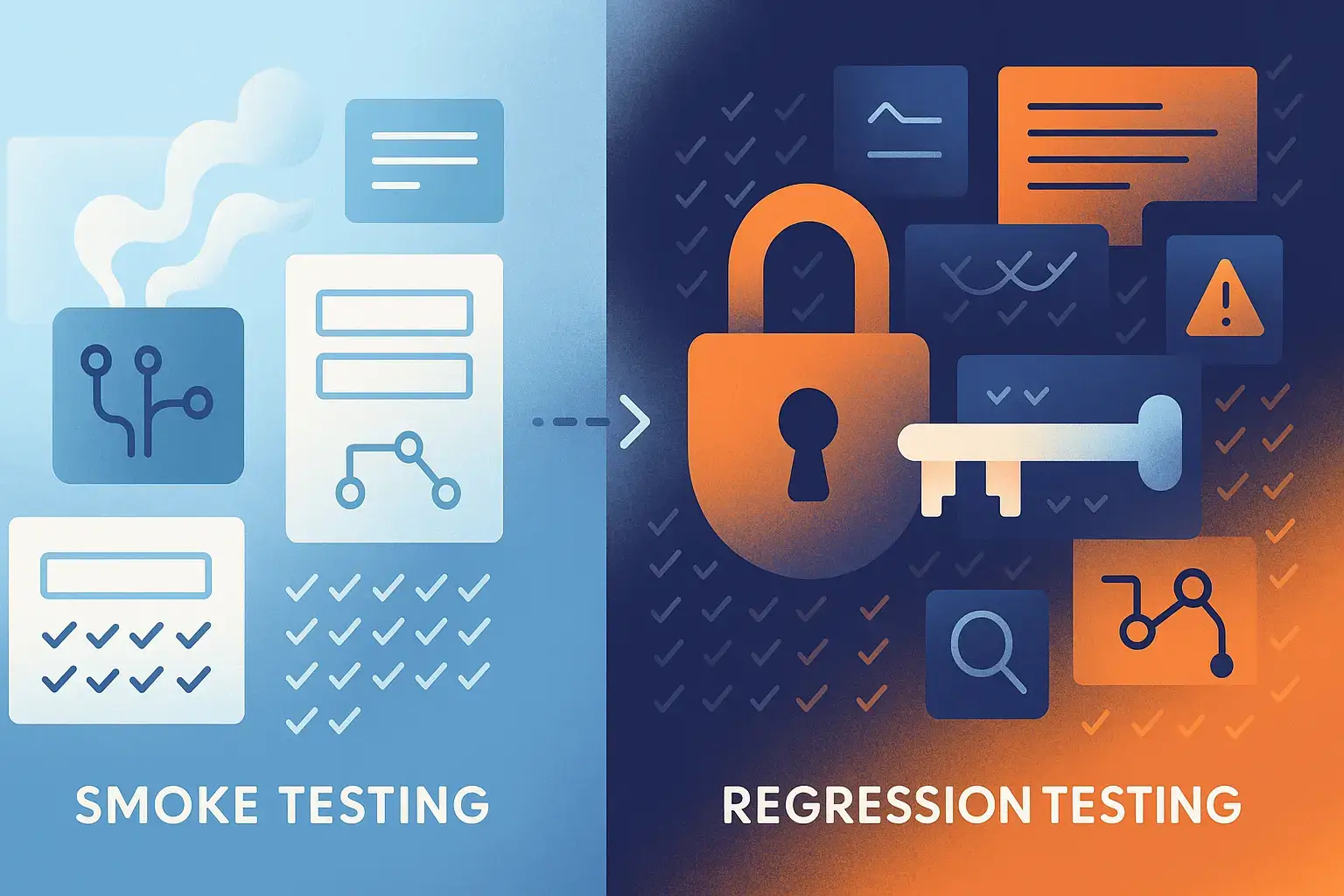
Smoke Testing vs Regression Testing: Key Differences Explained
Your team just pushed a fresh build. Someone asks: Should we run smoke tests or jump straight into regression? That question sounds simple, but getting it wrong costs hours, or worse, a broken production release. So, smoke testing and regression testing are not interchangeable. Two distinct quality gates serve different purposes, and knowing which one to use and when is what keeps your testing pipeline efficient.
Smoke testing verifies critical functionality in 5-30 minutes with 20-50 test cases, serving as a rapid health check to determine if a build is stable enough for further testing.
Regression testing validates that new code changes haven’t broken existing functionality, covering all features with hundreds to thousands of test cases that can take hours or days to complete.
Smoke tests should remain lean and focused on must-work basics like login and core features, while regression tests grow with the application and adapt based on code changes.
Smoke testing typically runs after every build or deployment in CI/CD pipelines, while regression testing is triggered by completed sprints, bug fixes, or major architectural changes.
Teams often struggle by incorrectly expanding smoke tests or neglecting regression suite maintenance, leading to inefficient testing processes and wasted resources.
Confusing smoke and regression testing can cost your team hours of wasted effort or result in broken production releases. Learn how to implement both strategically to ship faster and with more confidence 👇
What Is Smoke Testing
Smoke testing is your first line of defence against broken builds. It is a quick, shallow test suite designed to verify that the most critical functions of your application are working after a new build or deployment. The name comes from hardware testing. If you plug in a circuit board and it does not smoke, you are probably safe to proceed.
The goal is not comprehensive coverage. You are checking whether the app launches, whether users can log in, whether the database connects, and whether core workflows do not immediately crash. If your application cannot display the homepage or process a basic search, there is no point running a full regression suite. Smoke tests save you from that time sink by catching build-breaking issues in minutes.
A practical example: your dev team pushes a new build at 2 PM. Before QA dives into feature testing, a 10-minute smoke suite runs covering login, navigation to key pages, basic CRUD operations, and a critical API endpoint. If everything passes, the build is stable enough to test. If something fails, it goes back to dev immediately. That gatekeeper role is why smoke testing typically runs first in your CI/CD pipeline.
What Is Regression Testing
Regression testing verifies that recent code changes have not inadvertently broken existing functionality. It is systematic, thorough, and covers a much wider surface area than smoke tests. While smoke testing asks “does it work at all?”, regression testing asks “does everything still work the way it did before?”
Software is interconnected. You fix a bug in the checkout flow and the inventory management module starts throwing errors. You optimise a database query and a previously stable reporting feature times out. Regression testing catches these unintended side effects by re-running test cases that previously passed.
The depth is significant. A regression suite typically includes functional tests across all major features, integration tests for third-party services, UI tests across browsers and devices, and sometimes performance benchmarks. After updating a contact import feature in a CRM, you would run regression on contact editing, duplicate detection, email workflows, and dashboard analytics, not just the import function. You are validating that the ripple effects of your change did not create new problems elsewhere.
When deciding between smoke and regression testing, the right approach is to have the right test management infrastructure to support both. This is where aqua cloud excels as the ideal solution for implementing effective smoke and regression testing strategies. With aqua, you can organize test cases into custom folders and scenarios, easily creating separate suites for your quick smoke checks and comprehensive regression runs. The platform’s nested test case structure and reusable components mean you can maintain both test types efficiently without duplication. When a core function changes, it updates automatically across all relevant test suites. What’s more, aqua’s domain-trained Actana AI with RAG grounding can generate context-aware test cases for both smoke and regression testing in seconds, tailored to your specific project terminology and requirements.
Transform your testing strategy with intelligent test organization and AI-powered generation
Smoke Testing vs Regression Testing: How They Compare
The difference between smoke and regression testing comes down to scope, timing, and intent. Smoke tests are narrow and fast. Regression tests are broad and methodical.
Aspect
Smoke Testing
Regression Testing
Scope
Critical paths only
All features and integrations
Depth
Shallow, basic functionality
Deep, detailed behaviour and edge cases
Frequency
After every build or deployment
After code changes, bug fixes, major updates
Execution Time
5 to 30 minutes
Hours to days depending on suite size
Test Case Count
20 to 50 cases typically
Hundreds to thousands
Automation Level
Almost always automated
Mix of automated and manual
Goal
Determine build stability
Ensure no new defects introduced
Failure Impact
Build rejected immediately
Defect logged and prioritised
Smoke test suites stay relatively static. You are always checking the same critical paths. Regression suites grow with your application. Every new feature adds test cases. Every bug fix might spawn a new regression scenario. That growth is why regression testing becomes a bottleneck without proper automation and prioritisation, which is one of the core challenges in test management that teams hit as their products scale.
Is Smoke Testing Part of Regression Testing
No. They are separate practices with different purposes. Smoke testing is a pre-condition for regression testing. If smoke tests fail, regression testing does not run. There is no point validating detailed functionality on a build that cannot even start.
Think of them as sequential layers. Smoke testing is your go/no-go decision point. Regression testing is your comprehensive audit once the build is confirmed stable enough to test. Smoke testing and regression testing work together in the same pipeline, but neither is a subset of the other.
When to Use Each
Use smoke testing when:
You have received a new build and need to verify it is testable before committing QA resources
You are deploying to a new environment and want a quick confidence check
A critical hotfix has been applied and you need fast validation
Your CI/CD pipeline triggers on every commit and needs an automated gatekeeper
You are running nightly builds and need an early-morning pass/fail signal
Use regression testing when:
You have completed a sprint and are preparing for a release
Bug fixes have been applied and you need to confirm they did not create new issues
Major refactoring or architectural changes have occurred
You are integrating a new third-party service or upgrading a dependency
Compliance requirements demand comprehensive retesting before production
The trigger for regression testing is always change. Something in the codebase shifted and you need to confirm nothing broke as a side effect. The cadence depends on your release velocity and risk tolerance, but that trigger stays constant.
Real Examples of Smoke vs Regression Testing
E-commerce platform, smoke test.
A new build lands with updated product recommendation logic. Before anyone tests the recommendations, the smoke suite runs automatically. Can users access the homepage? Does search return results? Can a user add an item to cart and reach checkout? Does login work? This takes 15 minutes. If any of it fails, the build is flagged before a single QA hour is spent on it.
E-commerce platform, regression test.
Once smoke passes, the regression suite runs. It covers the old recommendation algorithm on category pages, personalised recommendations for logged-in users, abandoned cart email triggers, product filtering and sorting, checkout with multiple payment methods, and integrations with inventory systems and shipping calculators. This takes four to six hours and catches a bug where the new recommendation logic broke the “frequently bought together” feature on product detail pages. New code breaking old functionality is exactly what regression testing exists to find.
ERP system, smoke test.
After a security patch, smoke tests verify that SSO authentication works, the dashboard loads with recent transactions, a basic invoice can be created, and the database connection is stable. Ten minutes. If the patch locked anyone out, you know immediately.
ERP system, regression test.
Following the security patch, regression validates all procurement workflows, financial reporting, user permission hierarchies, API integrations with accounting software, approval notification emails, and multi-currency transactions. It uncovers that the patch changed session timeout behaviour, logging users out after five minutes instead of thirty. Without regression testing, that hits production and disrupts hundreds of users mid-workflow.
For more applied examples of how structured testing plays out across scenarios, examples of UAT testing show a similar layered approach in acceptance contexts.
Challenges and Best Practices
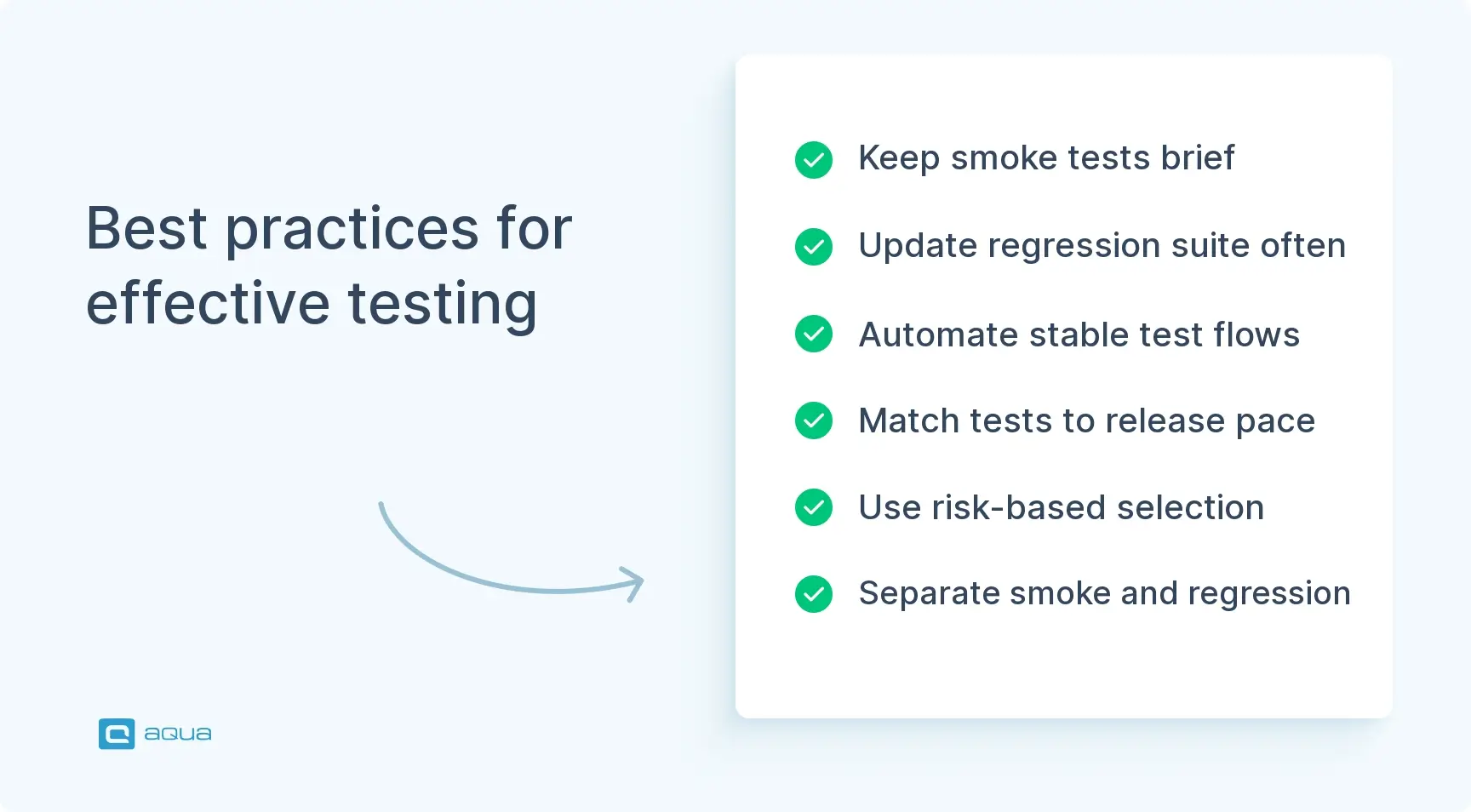
Keep smoke tests lean. The most common mistake is treating smoke tests like mini-regression suites. Teams add cases “just to be safe” and a 10-minute check becomes 45 minutes. When that happens, developers start skipping it, which defeats the entire purpose. Aim for 20 to 30 cases maximum. For every case you consider adding, ask: would a failure here make the build completely untestable? If not, it belongs in regression.
Maintain your regression suite actively. As your application evolves, old test cases go stale or break due to UI changes. Teams that do not regularly prune and update their regression suites end up with brittle tests that fail for the wrong reasons, creating noise and eroding trust. Treat your test suite as code. Version it, review it, and retire what no longer reflects how the product works.
Use risk-based test selection for regression. Not every code change requires running your entire regression suite. A typo fix in a confirmation email does not need a full payment processing regression. Test impact analysis tools can map code changes to relevant test cases, cutting execution time without reducing coverage where it matters. AI in regression testing is making this kind of intelligent selection increasingly accessible for teams running large suites.
Automate appropriately. Smoke tests should be 100% automated and integrated into your CI/CD pipeline. For regression, automate stable and repeatable scenarios: login flows, data validation, API contracts. Leave exploratory testing and complex UI validation to manual testers who can adapt to context and catch what scripted automation misses.
Align your testing strategies to your release cadence. Teams shipping weekly need regression that completes within that cycle. Teams in regulated industries may need full regression before every production deployment. Your testing strategies should reflect your actual risk profile and delivery velocity, not a generic template.
Now that you understand the critical difference between smoke testing and regression testing, it’s time to implement these practices with a tool that fully supports both approaches. aqua cloud offers the comprehensive test management capabilities you need to execute this dual-layer testing strategy efficiently. With aqua, you can organize smoke and regression tests using custom tags, labels, and flexible folder structures, making it easy to locate and run the appropriate suite when needed. The platform’s real-time custom dashboards give you instant visibility into the health of your builds through smoke test metrics, while detailed regression reports help you identify potential side effects from code changes. aqua’s Actana AI, powered by domain-trained artificial intelligence with RAG grounding, can automatically generate both focused smoke tests and comprehensive regression suites based on your requirements. It saves your team up to 97% of test creation time while ensuring they’re aligned with your project’s specific terminology and context. With centralized test management, seamless integrations with Jira, Azure DevOps, Confluence and other tools, and intelligent automation capabilities, aqua cloud transforms how you approach both smoke and regression testing.
Save 12.8 hours per tester weekly with AI-powered smoke and regression test management
Smoke testing and regression testing are not competing approaches. They are complementary quality gates that work best when you understand exactly when to use each one. Smoke tests give you rapid build validation, catching showstoppers before you waste time on deeper testing. Regression tests protect against the unintended consequences of change, ensuring your evolving codebase does not break what was already working. Keep your smoke suite tight and automated. Run regression based on risk and change. Treat both as living assets that evolve with your product. Get that balance right and your testing pipeline scales with your delivery velocity instead of becoming a bottleneck.
What is the difference between regression and smoke test?
The smoke testing and regression testing difference comes down to scope and purpose. Smoke testing is a shallow, fast check that confirms the build is stable enough to test. It covers the critical paths only, login, core navigation, basic workflows, and typically runs in under 30 minutes. Regression testing is a comprehensive audit that verifies recent code changes have not broken existing functionality. It covers all features, integrations, and edge cases, and can take hours depending on the suite size. So, what is smoke testing and regression testing, explained shortly? Smoke testing is your go/no-go gate. Regression testing is what runs once the build passes that gate. They work sequentially, not interchangeably.
What is smoke testing with an example?
What is smoke and regression testing in practice? Smoke testing is a quick verification that the most critical functions of an application are working after a new build or deployment. A practical example: a development team pushes a build with updated payment logic at 2 PM. Before QA tests the payment changes, the smoke suite runs automatically. It checks whether users can log in, whether the homepage loads, whether a product can be added to cart, and whether the checkout page renders correctly. The whole suite takes 15 minutes. If login fails, the build goes back to dev immediately. If everything passes, QA proceeds to feature and regression testing. Smoke clears the build, regression validates the details.
Why use smoke testing?
Smoke testing saves QA teams from spending hours testing a build that is fundamentally broken. Without it, a team might spend half a day running detailed feature tests only to discover that authentication has been broken since the build was created. Smoke tests act as an automated gatekeeper in your CI/CD pipeline, catching showstoppers in minutes so that testing resources get applied only to builds that are worth testing. Beyond efficiency, smoke testing builds confidence across the team. Developers get fast feedback on whether their changes broke anything critical. QA knows the build is stable before committing to deeper work. Product and stakeholders get a clear signal on build health without waiting for full regression results.
How do smoke testing and regression testing fit into continuous integration workflows?
What is regression and smoke testing in a CI/CD context? Smoke testing runs first and automatically on every build or commit. When code merges to the main branch, the pipeline spins up the build, executes the smoke suite, and notifies the team of the result before any human looks at it. If smoke fails, the pipeline stops and the build is rejected. If smoke passes, the pipeline proceeds to deeper testing. Regression testing runs at a later stage, typically triggered by a completed sprint, a release candidate, or a significant code change. In teams shipping weekly, regression runs as part of the release validation cycle. In teams with continuous deployment, a tiered regression approach works best: a fast automated regression layer runs on every build, with full suite regression running nightly or before production pushes. This layered structure is how modern teams maintain quality without making testing a bottleneck, and it is central to effective testing strategies at any release cadence.
What are the typical tools used for automating smoke and regression tests?
For smoke testing, Selenium and Cypress are the most common choices for web applications because they run fast and integrate cleanly with CI/CD pipelines via Jenkins, GitHub Actions, or GitLab CI. Postman and Newman handle API-level smoke tests well, verifying that critical endpoints respond correctly without touching the UI layer. For regression testing, Selenium, Cypress, and Playwright cover UI automation across browsers. JUnit and TestNG handle unit and integration-level regression for Java-based stacks. Appium covers mobile regression. On the test management side, connecting your automated results to a platform that tracks coverage, pass rates, and defect trends over time is what turns raw automation output into actionable data. AI in regression testing tools are also increasingly used to handle intelligent test selection, automatically identifying which regression cases are relevant to a specific code change rather than running the full suite every time. The right toolchain depends on your stack, but the principle stays consistent: automate smoke fully, automate the stable and repeatable parts of regression, and reserve manual effort for the exploratory and context-dependent scenarios that scripted automation consistently misses.
Enhancement of the aqua product is Martin’s main responsibility and biggest mission. His expertise covers ITIL Process Consulting, Change Management, Quality Assurance, Quality Management, and Requirements Management. Martin works in QA services for regulated industries for more than 18 years being an irreplaceable leader at…
Nurlan, a QA Coordinator & Quality Standards Officer, takes pride in orchestrating seamless QA operations. His expertise in coordinating QA-focused projects and integrating QA solutions has consistently yielded top-tier client satisfaction. Aside from a full-time QA coordinator, Nurlan's role involves creating compelling content that educates…
Home » Test Automation » Smoke Testing vs Regression Testing: Key Differences Explained
Do you love testing as we do?
Join our community of enthusiastic experts! Get new posts from the aqua blog directly in your inbox. QA trends, community discussion overviews, insightful tips — you’ll love it!
We're committed to your privacy. Aqua uses the information you provide to us to contact you about our relevant content, products, and services. You may unsubscribe from these communications at any time. For more information, check out our Privacy policy.
X
🤖 Exciting new updates to aqua Intelligence are now available! 🎉