The EU AI Act Compliance Timeline: Key Dates and Responsibilities
The first EU AI Act enforcement deadline passed in February 2025. If your team hasn't audited your AI systems since then, you might already be behind without realizing that. The EU AI Act implementation rolls out in phases. Different rules apply to different types of AI, and they kick in at different points between 2024 and 2027. If you're building, deploying, or testing AI systems in the EU market, the EU AI Act dates are real, and the penalties for missing them reach up to 7% of global revenue. This article breaks down every key date in the EU AI Act timeline for compliance so you know exactly what applies to your systems and when.
The EU AI Act rolls out in phases from 2024 to 2027, with enforcement starting February 2, 2025, when prohibited AI practices must be discontinued or face penalties up to 7% of global revenue.
General-purpose AI models face transparency obligations by August 2, 2025, requiring documentation of training data, risk assessments, copyright compliance, and security safeguards.
High-risk AI systems in healthcare, finance, employment, and critical infrastructure must meet full compliance requirements by August 2, 2026, including risk management, bias testing, and human oversight.
Penalties for non-compliance include fines up to 7% of global revenue and potential loss of market access, making proactive compliance essential rather than waiting for final deadlines.
See how to manage this complex regulatory rollout before enforcement catches you unprepared 👇
Key Dates of the Compliance Timeline
The EU AI Act timeline is a series of staggered milestones that ramp up in intensity from 2024 through 2027. Each phase brings new obligations for different categories of AI systems, and the enforcement mechanisms get sharper with every passing year. Understanding when does the eu ai act apply to your specific systems is the first step to avoiding enforcement risk. You can verify the full official schedule on the EU AI Act Implementation Timeline maintained by the EU AI Act resource site, which is continuously updated as new dates are confirmed.
Prohibited AI systems were switched off at the first enforcement date
General-purpose AI models caught many teams off guard with early obligations
High-risk systems in regulated sectors face a hard stop in August 2026
Medical devices and other regulated products embedding AI get until August 2027
The real danger for your organization is misreading which category your AI falls into and missing the EU AI Act enforcement date that applies to it. To understand how to prepare your team for what’s ahead, see our guide on how to prepare your QA team for test automation.
The EU AI Act’s compliance timeline demands documentation, audit trails, and traceability that hold up under regulatory scrutiny at every phase. aqua cloud, an AI Act compliance tool and AI-powered test and requirement management platform, is built for exactly this kind of ongoing compliance work. Automated audit trails capture every test activity and change, so nothing slips through when regulators ask for evidence. End-to-end traceability maps requirements directly to test cases and executions, which is what regulators look for when assessing high-risk AI systems. aqua’s domain-trained AI Copilot generates compliance documentation grounded in your specific project context. It produces output that reflects your actual systems and use cases based on your documentation, text, and voice notes, as well as existing requirements. And because aqua integrates with the tools your team already uses, such as Jira, Azure DevOps, CI/CD pipelines, and 12+ other tools, compliance documentation becomes part of your existing workflow.
Stay ahead of the EU AI Act with aqua's AI-powered test management
August 1, 2024, marked the EU AI Act effective date. The EU Regulation AI Act became law across all EU member states, which made it the starting line for the transition period. No enforcement began on this date, but organizations were expected to use the window to prepare.
Two months later, on November 2, 2024, EU member states faced their first hard obligation: identifying and publicly listing the authorities responsible for fundamental rights protection under the Act. This was an early signal that the EU AI Act implementation was already moving. For your team, this phase was about taking stock:
Which systems are prohibited outright?
Which fall into the high-risk category?
Which sit in limited-risk or minimal-risk territory?
The answers to those questions determined every subsequent deadline. Organizations that treated August 2024 as just another regulatory announcement spent the following months catching up on work that could have started right away.
2025 (February): First Compliance Wave
February 2, 2025 was when the EU AI Act stopped being theoretical. From day one, the rules on prohibited practices applied. Social scoring, manipulative nudging, exploitation of vulnerable users, and certain forms of biometric categorization were banned outright. Not to be adjusted. Not to be put on a roadmap. Missing this deadline puts your organization in the highest penalty tier, up to 7% of global annual revenue.
This wave also activated AI literacy obligations. Regulators expect more than a one-time training session from your team. What they look for includes:
Documented evidence that staff understand AI risks
User-facing disclosures confirming people know they’re interacting with a machine
Ongoing literacy programs, maintained over time
What caught many product teams off guard was how broadly “prohibited” could apply. Some behavioral nudging tools in fintech raised manipulation concerns. Certain HR screening systems that ranked candidates on personality traits edged into social profiling territory. Even some gamification features in consumer apps came under scrutiny. Teams that had never considered these features risky found themselves running urgent audits, while QA colleagues had to confirm that compliance changes hadn’t broken core functionality in the process.
The European Union's Artificial Intelligence Act (AI Act), the world's first comprehensive AI law, is rolling out with a staggered timeline, making immediate compliance efforts essential for global companies operating in or serving the EU market.
By August 2, 2025, the second major compliance wave arrived. This is when the EU AI Act takes effect for general-purpose AI models, such as LLMs, foundation models, and generative AI systems. If your team builds on top of any major foundation model, transparency obligations are now active. According to the official EU AI Act text (Article 53), your organization needs to have in place:
Documented training data sources
Explained model capabilities
Completed risk assessments, with extra scrutiny for systemic risks
Demonstrated copyright compliance
Implemented security safeguards
This date also marked the activation of the EU AI governance framework. The EU AI Office became operational and national authorities began coordinated oversight. As a result, the compliance ecosystem started functioning as an enforcement mechanism. August 2025 was a softer enforcement phase, where regulators focused on guidance and working with organizations in good faith. Penalties were still available for blatant non-compliance, and the grace period applied to teams making genuine, documented progress.
There is also a timeline split that directly affects your legacy systems. Models released after August 2025 must comply immediately. Models released before that date have an extended deadline running to August 2027. If your team is running QA on AI that has been in production for some time, that distinction determines your compliance window. Treating 2025 as your real target for legacy systems is the more defensible position, because waiting until 2027 puts your team in a race against certification backlogs and a compliance bar that only gets higher.
2026 (August): Main Compliance Enforcement
August 2, 2026 is the central date in the EU AI Act enforcement timeline. Full enforcement of high-risk AI obligations goes live. If your AI operates in healthcare, finance, employment, education, or critical infrastructure, your compliance documentation needs to be complete and verifiable by this date. Concretely, your organization needs all of the following in place:
A documented risk management system
Data governance protocols
Bias testing results
Technical and legal documentation
Human oversight mechanisms
Continuous monitoring processes
This is also when Article 50 transparency obligations become fully enforceable. AI-generated content must be clearly labeled and detectable, which affects everything from synthetic media to automated customer service outputs. If your testing pipeline produces AI-generated content, those outputs need to be tagged and traceable well before this date.
By August 2026, each EU member state is also required to have at least one operational AI regulatory sandbox in place, per Article 57 of the Act. These sandboxes give organizations a structured environment to test high-risk AI systems under regulatory supervision, and they’re worth exploring if your team is navigating complex certification requirements.
The EU AI Act enforcement timeline 2026 marks the point where the penalty regime fully activates. Audits become standard, investigations scale up, and regulators begin taking formal action against organizations that have not made a credible compliance effort. The GPAI Code of Practice is expected to be finalized around this time. Waiting for that playbook before building your compliance systems means you are already running late.
Organizations that want a head start on that documentation work can explore how aqua cloud compliance tooling fits into their existing testing workflows.
2027 (August): Final Deadlines for High-Risk Systems
August 2, 2027 is the final compliance checkpoint for high-risk AI embedded in regulated products. These cover medical devices, automotive systems, and industrial applications. These systems receive the longest runway because they require certification under other EU frameworks, conformity assessments, and safety validation cycles that cannot be rushed. The EU AI Act must align with existing product safety legislation, such as the Medical Device Regulation or automotive safety standards, and that alignment simply takes time.
Your team should already be deep into this work in 2025 and 2026. Certification bottlenecks and conformity assessment backlogs are real constraints, and safety validation processes do not compress under deadline pressure. Leaving the bulk of this work until 2027 is how organizations end up in enforcement conversations they could have avoided entirely.
This date also covers the transitional rule for GPAI models released before August 2025. Legacy foundation models have until August 2027 to reach full compliance, but by that point, the bar matches what is required of newer models. Organizations treating 2027 as a comfortable buffer will find the final months considerably harder than anticipated.
Most teams underestimate the documentation timeline. Four to six weeks is realistic if you already know your AI inventory. Longer if you don't.
Beyond 2027: Large-Scale IT Systems and Ongoing Review
The EU AI Act enforcement timeline does not stop at 2027. For AI systems embedded in large-scale IT systems listed in Annex X, the compliance deadline extends to December 31, 2030, provided those systems were placed on the market before August 2, 2027. This covers infrastructure-level systems in areas like border management, asylum processing, and law enforcement databases.
Separately, the European Commission is required to submit a full evaluation and review of the Act to the European Parliament by August 2, 2029. That review may lead to amendments, tightened requirements, or expanded scope. If your organization operates in any of the Annex X categories, the 2030 date is your hard deadline, and the 2029 review is worth monitoring closely.
The EU AI Act compliance timeline runs through 2027 and beyond, and each phase adds requirements that demand meticulous documentation and full traceability. aqua cloud, an AI-powered test and requirement management platform, delivers all of this and more. It gives your team automated audit trails, AI-assisted documentation grounded in your actual project data, and traceability that links every requirement to its corresponding test cases and executions. Organizations in regulated industries benefit from aqua’s predefined compliance templates and workflows aligned with international standards. The platform’s domain-trained AI Copilot understands your project’s specific context, producing documentation that satisfies regulators while preserving your team’s institutional knowledge. And with aqua’s integrations across tools like Jira, Selenium, Azure DevOps, and 12+ other tools, your existing workflows feed directly into a compliance record that holds up under inspection.
Achieve audit-ready AI compliance documentation with aqua cloud
The EU AI Act compliance timeline began in February 2025 with the prohibited AI ban, and each wave since has added new obligations with real penalties attached. The biggest mistake your organization can make is assuming compliance starts in 2026. For QA and engineering teams, test strategies now need to cover legal obligations around transparency, bias, documentation, and risk management alongside functional requirements. A solid risk-based testing approach keeps those obligations connected to the specific systems they apply to.
The EU AI Act’s effective date was August 1, 2024, when the regulation entered into force across all EU member states. Enforcement began in phases. The first enforcement wave started February 2, 2025, with the ban on prohibited AI practices. Full enforcement for high-risk AI systems follows on August 2, 2026.
What is the EU AI Act implementation timeline?
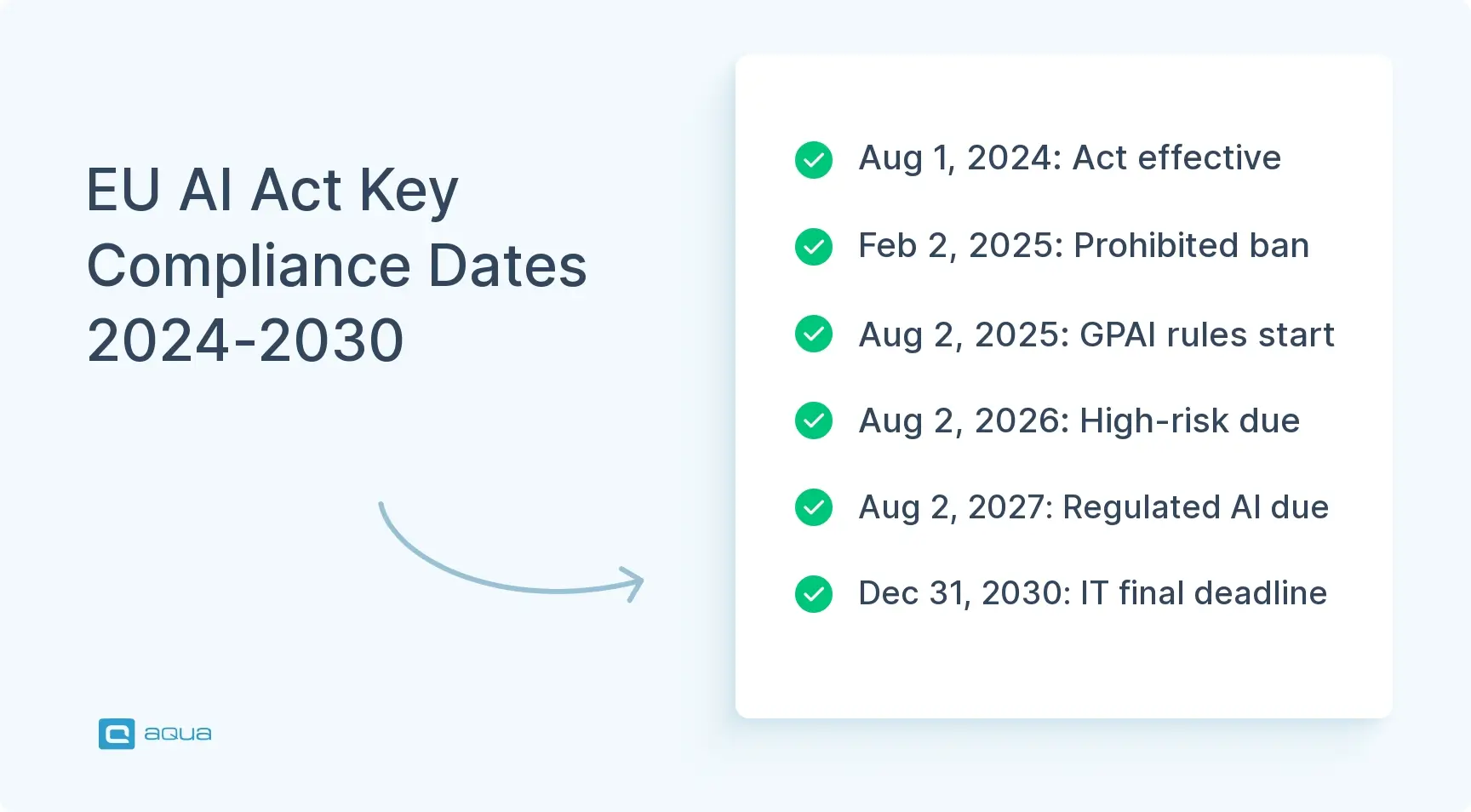
The EU AI Act implementation timeline runs from 2024 to 2030. August 2024 marked the entry into force. February 2025 activated the prohibited AI ban and literacy obligations. August 2025 brought GPAI transparency requirements. August 2026 triggers full enforcement for high-risk AI systems. August 2027 is the final deadline for high-risk AI embedded in regulated products and legacy GPAI models. Certain large-scale IT systems have a compliance deadline of December 31, 2030.
When will AI be regulated in Europe?
AI regulation in Europe is already active. The EU AI Act entered into force in August 2024, with phased enforcement running through 2027 and beyond. Prohibited practices have been banned since February 2025, and full enforcement for high-risk systems begins in August 2026.
What are the EU AI Act timeline key dates?
The EU AI Act timeline key dates are: August 1, 2024 (entry into force), November 2, 2024 (member state authority designation deadline), February 2, 2025 (prohibited AI ban and literacy obligations), August 2, 2025 (GPAI and governance obligations), August 2, 2026 (full enforcement for high-risk AI and regulatory sandboxes operational), August 2, 2027 (final deadline for regulated product AI and legacy GPAI models), and December 31, 2030 (large-scale IT systems compliance deadline).
When does the EU AI Act take effect for different types of AI systems?
The EU AI Act effective date varies by system type. Prohibited AI systems had to cease operating from February 2, 2025. GPAI model obligations began August 2, 2025. High-risk AI systems in sectors like healthcare, finance, and employment face full enforcement from August 2, 2026. High-risk AI embedded in regulated products such as medical devices has until August 2, 2027.
What are the key EU AI Act compliance deadlines businesses need to know?
The key EU AI Act dates for businesses are: February 2, 2025 (prohibited practices ban and literacy obligations), August 2, 2025 (GPAI transparency and governance obligations), August 2, 2026 (full enforcement for high-risk AI systems), and August 2, 2027 (final deadline for AI in regulated products and legacy GPAI models).
When do GPAI model obligations start under the EU AI Act?
GPAI model obligations under the EU Regulation AI Act started August 2, 2025. From that date, providers of general-purpose AI models, including LLMs and foundation models must maintain documented training data sources, conduct risk assessments, demonstrate copyright compliance, and implement security safeguards.
When do high-risk AI system rules become enforceable in the EU?
Full enforcement of high-risk AI system rules begins August 2, 2026. This is the central date in the EU AI Act timeline for compliance for organizations operating AI in healthcare, finance, employment, education, and critical infrastructure. By this date, risk management systems, bias testing, human oversight mechanisms, and technical documentation must all be in place and verifiable.
Enhancement of the aqua product is Martin’s main responsibility and biggest mission. His expertise covers ITIL Process Consulting, Change Management, Quality Assurance, Quality Management, and Requirements Management. Martin works in QA services for regulated industries for more than 18 years being an irreplaceable leader at…
Nurlan, a QA Coordinator & Quality Standards Officer, takes pride in orchestrating seamless QA operations. His expertise in coordinating QA-focused projects and integrating QA solutions has consistently yielded top-tier client satisfaction. Aside from a full-time QA coordinator, Nurlan's role involves creating compelling content that educates…
Pavel, a Quality Assurance Consultant and Author, brings deep expertise to solving complex testing challenges. His background in software development has helped organizations transform their QA practices from reactive to proactive. Beyond consulting, Pavel develops best practice guides and case studies for aqua cloud that…
Home » Testing with AI » The EU AI Act Compliance Timeline: Key Dates and Responsibilities
Do you love testing as we do?
Join our community of enthusiastic experts! Get new posts from the aqua blog directly in your inbox. QA trends, community discussion overviews, insightful tips — you’ll love it!
We're committed to your privacy. Aqua uses the information you provide to us to contact you about our relevant content, products, and services. You may unsubscribe from these communications at any time. For more information, check out our Privacy policy.
X
🤖 Exciting new updates to aqua Intelligence are now available! 🎉