Key takeaways
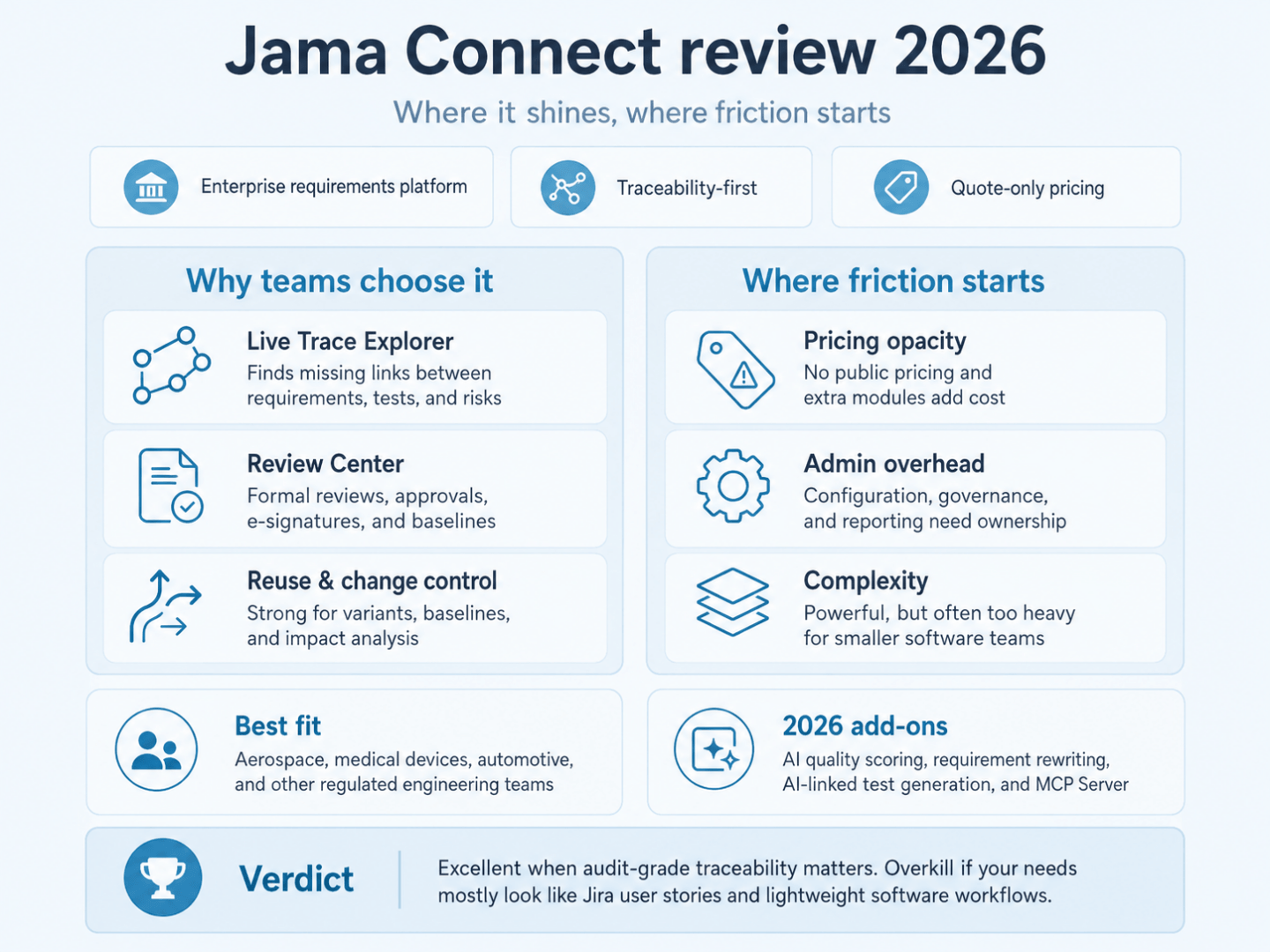
- Live Trace Explorer by Jama scores traceability completeness against a model you define, so missing links between requirements, tests and risks surface during development instead of during the audit.
- The 2026 AI additions cover INCOSE and EARS quality scoring, requirement rewriting, AI-generated test cases that auto-link to the source requirement, and an MCP Server that feeds approved specs to AI coding agents.
- Jama Connect pricing is quote-only. Advisor, MCP Server and Interchange modules are licensed separately on top of Creator, Tester and Test Runner seats.
- If you need the same requirement-to-test chain without the configuration project, aqua cloud’s requirements management gives you traceability, coverage mapping and AI-generated tests in the first week.
Full feature breakdown, licensing detail, and the verdict below 👇
This review covers what the platform delivers in 2026: which features earn their license, where admin effort accumulates, what the quote-based pricing hides, what current Jama Connect reviews keep repeating, and when a lighter platform such as aqua cloud provides the same traceability with considerably less setup.
Jama Connect at a Glance
| Aspect |
Details |
Key considerations |
| Type |
Enterprise requirements management and engineering platform |
Sized for hardware and systems work, not sprint tracking |
| Best for |
Aerospace, automotive, medical devices, industrial equipment |
Payback grows with audit exposure |
| Deployment |
Cloud (recommended), Customer-Validated Cloud, self-hosted |
On-premise puts Kubernetes upkeep on your side |
| Core strengths |
Live traceability, Review Center, baselines, reuse |
Also where most of the setup time goes |
| G2 rating |
4.3 / 5 (190+ reviews) |
Usability sub-scores sit below the average |
| TrustRadius score |
8.9 / 10 (174 ratings) |
Written feedback is harsher than the number |
| Pricing model |
Quote-based; Creator, Tester, Test Runner, Reviewer |
No way to size a budget without a sales call |
| Free trial |
30 days |
Short for validating an information architecture |
| Integrations |
Jira, DOORS, Excel, ReqIF, Simulink, PLM, MBSE, DevOps |
Several sit behind Interchange licensing |
| 2026 updates |
AI test generation, MCP Server, Live Trace diagrams, Datatap |
Each carries its own line item |
| Main friction |
Pricing opacity, reporting complexity, scale performance |
Plan for an administrator, not only seats |
Full feature breakdown, licensing detail, and the verdict below 👇
What Is Jama Connect?
Jama Connect is a requirements management platform from Jama Software, a Portland-based vendor acquired by Francisco Partners in 2024 for $1.2 billion. The company markets it as an AI-powered engineering management platform, and the underlying problem it addresses has not changed in twenty years: engineering artifacts scatter. Requirements land in Word, risk analyses in Excel, tasks in Jira, drawings in PLM, and approvals in somebody’s inbox.
Jama consolidates those artifacts into one structured model and keeps their relationships live. The platform answers four questions on demand: what are we building, why, how are we verifying it, and who signed off.
As software for requirements management, its scope spans requirements management and traceability, reviews and approvals, baselines and versioning, variants and reuse, test management, verification and validation, risk and hazard analysis, reporting, engineering tool integrations, and AI-assisted authoring.
Three deployment options exist: standard cloud, Customer-Validated Cloud (including AWS GovCloud for defense and government work), and self-hosted. Jama recommends cloud for most customers, and the reason is practical. Self-hosted installations place infrastructure, configuration, upgrades and a supporting Kubernetes environment on your team.
Not every team evaluating requirements platforms needs enterprise-grade complexity to get audit-ready traceability. aqua cloud, an AI-driven test and requirement management solution, provides structured requirements management and full traceability. Requirements, test cases and defects are tracked together without the learning curve or administrative overhead that platforms like Jama demand. You get hierarchical requirements organization, dependency tracking and visual coverage mapping that highlights gaps immediately, in an interface teams learn in days. aqua’s domain-trained AI Intelligence uses RAG grounding, so it learns from your project’s actual documentation and generates test cases specific to your product. Requirements link to those tests automatically, coverage reaches 100% with minimal manual work, and the traceability chain stays audit-ready throughout. It fits the stack you already run, with two-way Jira and Azure DevOps sync, CI/CD pipelines, and Selenium, Playwright and Cypress results landing in the same coverage view.
Achieve complete requirements traceability with 43% less manual effort
Who Jama Connect Is Built For
| Team type |
Why Jama fits |
Key considerations |
| Systems engineers |
Deep requirement hierarchies across physical, software and cyber-physical products |
The trace model has to be agreed before the first import |
| Aerospace and defense |
Formal verification, approval workflows, AWS GovCloud deployment |
Security review stretches procurement by months |
| Medical device manufacturers |
ISO 14971 risk analysis linked to verification evidence |
Hazard and control structures need a named owner |
| Automotive suppliers |
Product-line engineering, variants, supplier collaboration |
Without reuse governance, variants drift apart |
| Semiconductor, robotics, energy, industrial |
Multidisciplinary engineering over long lifecycles |
Admin ownership has to survive staff turnover |
| Compliance and QA |
Audit packages proving requirements are tested and approved |
Custom reports may need Velocity skills in-house |
If your requirements are mostly Jira user stories and acceptance criteria for a small software product, Jama will cost more in administration than it returns in traceability.
Without going into too much details were in the electric automotive space. We use it mostly for product and software requirements.
Jama Connect Features Reviewed
Quick orientation before the detail:
| Feature |
What it does |
Maturity in 2026 |
| Requirements management |
Structured items with fields, workflow, history, permissions |
Mature |
| Live Traceability |
Modeled relationships plus Trace Score gap analysis |
Strongest capability |
| Review Center |
Formal review, e-signature, auto-baseline on completion |
Strongest capability |
| Baselines and reuse |
Milestone snapshots, synced reuse across variants |
Mature |
| Test management |
Test cases, cycles, runs, defects, coverage |
Solid for V&V, no automation engine |
| Risk and hazard analysis |
PHA, FMEA, risk controls linked to verification |
Strong for regulated work |
| Advisor (AI) |
INCOSE/EARS scoring, rewriting, AI test generation |
New, separately licensed |
| MCP Server |
Approved spec context for AI coding agents |
New, separately licensed |
| Integrations |
Jira, ReqIF, Simulink, PLM, MBSE, BI exports |
Broad, with licensing caveats |
1. Requirements management
Requirements live as structured items, not as paragraphs buried in a document. Each item carries defined fields, status, relationships, history, permissions, categories, comments and workflow rules. That granularity lets you answer audit questions precisely: which requirement changed, who changed it, why, what depends on it, whether it was reviewed, whether verification exists, and which version was approved.
Document View softens the transition. It renders structured items as a conventional specification so engineers can read and edit sequentially without clicking through database records. The feature looks minor and matters considerably for adoption, because the standard objection to requirements tools has always been that Word feels more familiar.
Jama Connect is built for requirements engineering, and everything downstream of a requirement runs somewhere else. aqua starts from requirements and keeps going: test cases, execution, defects, and reporting live in the same workspace, with aqua Intelligence generating test cases straight from those requirements. Your team writes the specification and validates it without moving between two systems or reconciling two audit trails.
Write requirements and validate them in one workspace, no second tool required
aqua integrates with Jira (bidirectional sync), Jenkins, Azure DevOps, Confluence, JMeter, SoapUI, Ranorex, REST API, PowerShell, UnixShell, MSSQL, Oracle, and Capture.
Need a platform that supports 12+ tools that are already in your tech stack?
Try aqua cloud
2. Live Traceability
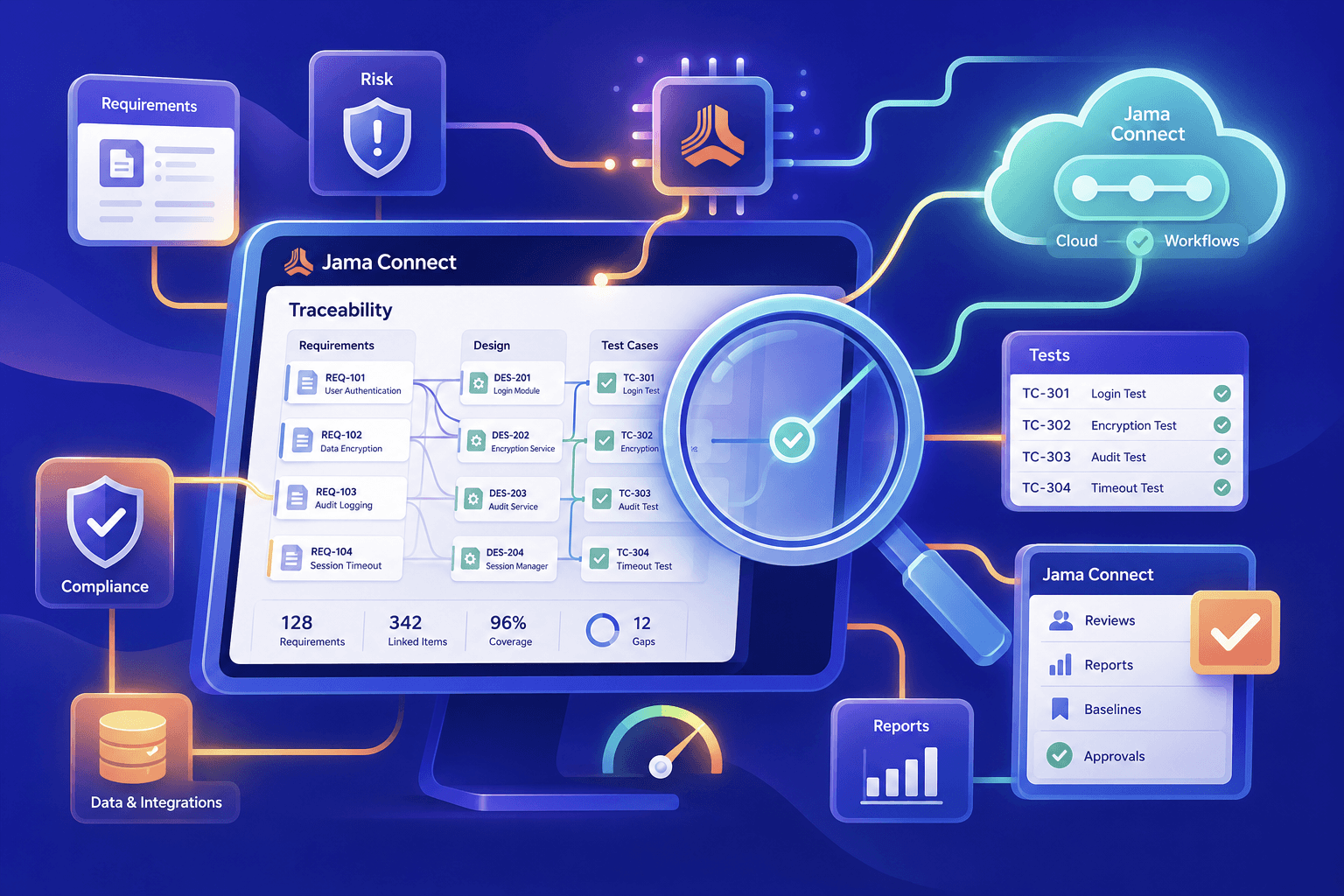
Traceability is where Jama Connect is strongest. Instead of linking items ad hoc and hoping the coverage holds, you define a Traceability Information Model that declares which relationships should exist. A simplified chain: stakeholder need system requirement subsystem requirement software requirement test case test result. A regulated device adds hazard risk control requirement verification.
With the model in place, Jama flags what is missing or suspicious. Live Trace Explorer measures completeness and produces a Trace Score against the expected relationships. Teams can review coverage every week instead of assembling a requirements traceability matrix the week before an audit. Version 9.37 added custom Live Trace Explorer diagrams and element rearrangement, so you can build subsystem-specific views without rendering the entire product graph every time.
Change impact analysis uses the same graph. Walk upstream and downstream from a proposed modification and see which requirements, tests, risks and components it touches. As a requirement traceability tool, this is where Jama separates from general task management. Linking one Jira story to another is possible in any tracker, while Jama Connect traceability is enforced by the model and analyzed against it.
3. Review Center
Review Center is the feature that appears most often in positive Jama Connect reviews. Requirements, tests, risks or whole artifact groups go into a formal review workflow. Participants comment, propose changes, approve or reject, compare revisions, reply to other reviewers, complete assigned tasks and apply electronic signatures. Moderators set deadlines, roles, approval thresholds and context. The full history stays version controlled, so who approved what, and when, is never in question.
External stakeholders can join the review. That matters in industries where specifications move constantly between OEMs, suppliers, contractors, regulators and customers. Reviewer licenses carry no additional charge, which makes broad participation practical without a budget conversation.
For regulated teams the value is concrete. Review Center replaces emailing Word files, reconciling tracked changes, chasing approvals and manually filing the evidence. Electronic signatures support workflows such as FDA 21 CFR Part 11. Version 9.37 added a useful guardrail: when configured correctly, Jama blocks a review from being finalized if the underlying item versions no longer match what was reviewed. It also creates a baseline automatically once the review completes.
4. Baselines, change management and reuse
Jama records item version history and lets teams baseline at milestones. That answers the questions that otherwise trigger a two-day archaeology exercise:
- What exactly was approved for release 1.0?
- How does release 1.1 differ?
- Which requirements changed after verification started?
- Which specification did the supplier actually receive?
- What did the system look like at the design review?
Versions and baselines can be compared directly to expose the deltas.
Reuse is the underrated enterprise capability here. Requirements can be reused across products and variants instead of copied into disconnected documents, and Jama maintains synchronization so teams see when an original and its reuse have diverged, then propagate changes selectively. For product-line engineering that capability carries the whole business case. An automotive supplier can reuse a common subsystem specification across several vehicle programs while keeping program-specific deviations intact.
5. Test management and V&V
Jama functions as requirements tracking software first and a test tool second, so it should not be purchased as a test automation framework. Teams create test cases, steps, plans, cycles, runs and defects, then link tests directly to requirements to establish verification coverage through its requirement tracker capabilities.
A separate Test Runner license lets QA and V&V staff execute tests, record evidence, manage certain test-plan activities and log defects without full authoring rights. Creating new test cases still requires Creator access, which is worth modeling into your seat count early.
The July 2026 Customer-Validated Cloud 9.35 release expanded activity logging across Test Plans, Test Cycles, Test Runs, defects and archival actions, which helps auditability.
Native testing performs well for formal verification and validation with documented evidence. It performs poorly as an execution engine. A software team running thousands of automated Playwright or Cypress tests will keep its existing tooling and feed results back into Jama, treating Jama as the record and not the runner.
6. Risk and hazard management
Jama extends past pure requirements into structured risk analysis. Native capabilities cover Preliminary Hazard Analysis, FMEA, hazard identification, risk estimation, risk controls and mitigation tracking, with risks linked directly to requirements and verification evidence. Jama positions these around ISO 14971 and IEC 60812.
This separates Jama from generic ALM tools and project management platforms. A medical device team can trace hazard hazardous situation risk control design requirement verification test, then close the gaps before assembling an audit package.
7. Jama Connect Advisor and AI
AI is the area where older jama reviews have aged worst, because the capability set changed substantially across 2025 and 2026.
Jama Connect Advisor is a separately licensed add-on for Jama Connect Cloud. It scores requirement language against INCOSE rules and EARS notation, flags the ambiguity that makes a requirement untestable, explains which rule was violated and proposes a rewrite, including splitting one statement into several independently testable requirements. Batch analysis covers a whole specification without opening every item. One documented limit: the detailed analysis follows a single-sentence model and reads only the first sentence of the selected statement, so it rewards teams that already write disciplined requirements.
Jama Connect 9.32 added AI-generated test cases. Advisor produces ten candidates per requirement, optionally with steps, and engineers accept, reject or edit them before creation. Accepted tests are automatically related to the source requirement, so generated artifacts land inside the traceability graph and count toward coverage.
Jama states that customer data is not used to train its general AI models and is not sent through publicly accessible LLM interfaces, and that users stay responsible for validating output. For proprietary or safety-critical specifications, obtain those statements in writing during procurement.
8. MCP Server and spec-driven development
The most notable 2026 addition is the Model Context Protocol Server, which exposes approved Jama product information to compatible AI development environments. Jama currently cites Claude, OpenAI Codex, Cursor, GitHub Copilot and Visual Studio.
The change is in the context an agent receives. Given an isolated Jira ticket, an AI coding agent works from partial information. Given MCP access, it can retrieve structured, permission-controlled product data from Jama, including specifications and their traceability relationships. Jama calls this spec-driven development. Existing permissions, workflows, versions and audit controls stay part of the context layer.
MCP Server is a separate purchase, so it should not be assumed as part of every subscription. It positions Jama as the approved specification source that both engineers and AI agents read product context from.
9. Integrations
Jama connects to Jira and work management, DevOps systems, MBSE and SysML tools, simulation, PLM, automated testing, risk tools and BI platforms. One licensing catch is worth surfacing during procurement: REST API access requires a Named Creator license, and a floating Creator license does not grant it. Price that in if you plan significant automation.
Jama Connect Interchange handles synchronization and data exchange, covering the Jama Connect Jira integration for Cloud and Data Center, Excel integration and ReqIF exchange.
Worth comparing during evaluation: aqua’s Jira integration ships inside the platform with two-way issue sync, so test coverage and defect status appear on the Jira issue itself with no additional module to license. ReqIF matters when requirements move between organizations on different toolchains, and Jama supports continuing round-trip exchange. Datatap adds scheduled file-based exports for Power BI, Tableau and data warehouses, and requires separate Interchange licensing.
How Live Traceability Works in Jama Connect
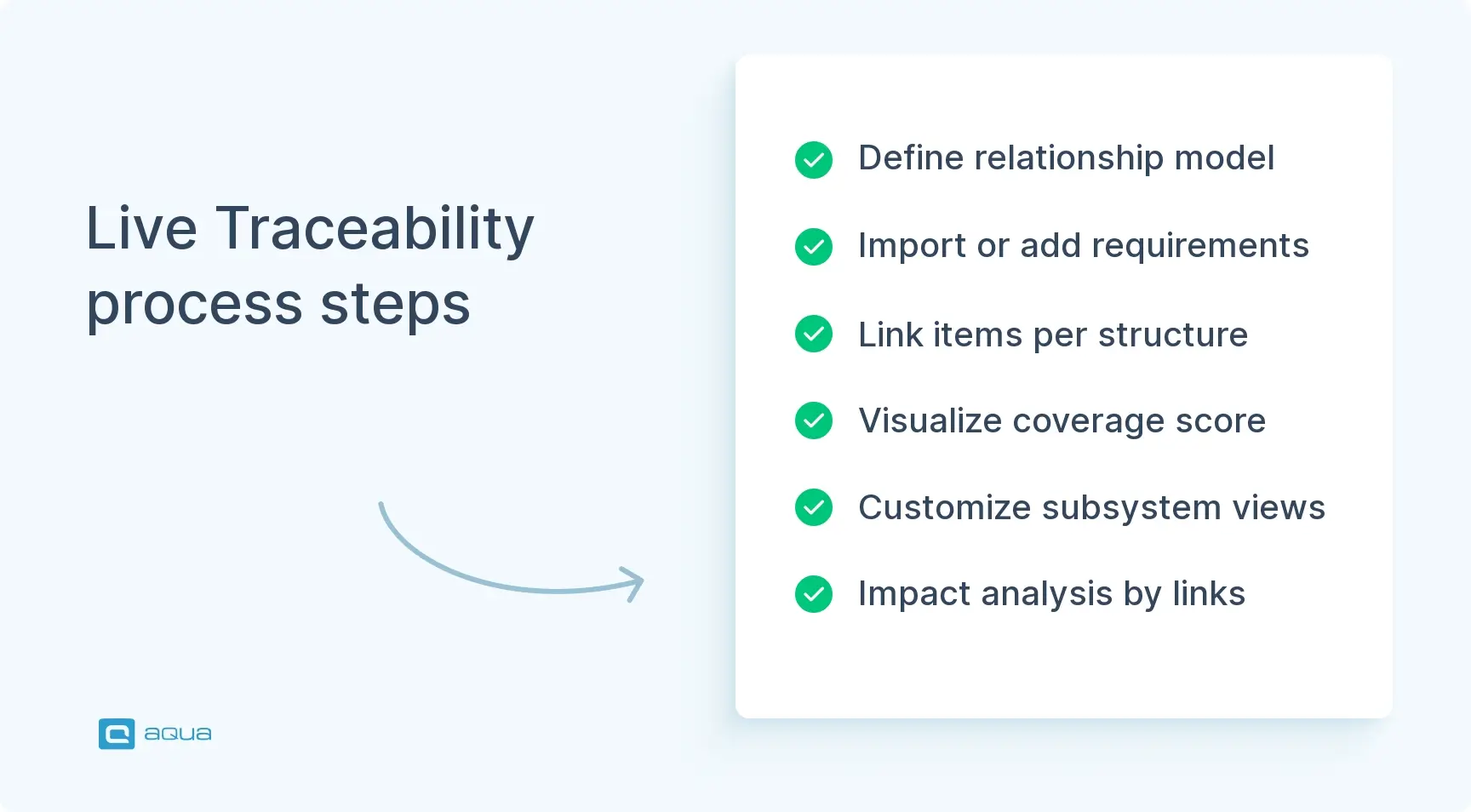
- Define a Traceability Information Model describing which relationships must exist (system requirement subsystem requirement test case, and so on).
- Create or import requirements from spreadsheets, ReqIF files or your existing requirements gathering tools.
- Link items according to the model so relationships follow a declared structure and not individual habit.
- Open Live Trace Explorer to visualize and analyze coverage across the product.
- Read the Trace Score to find missing or suspicious relationships.
- Filter and customize views to focus on a subsystem, variant or program.
- Run change impact analysis by walking upstream and downstream before approving a modification.
Teams that repeat this cycle weekly can export an audit package on request. Teams that leave it until submission usually spend several weeks reconstructing links under deadline.
Compliance and Regulated Industry Support
Buyers evaluating requirements management software for medical devices, automotive electronics or defense systems will find most of the required structures native to the platform.
| Standard / framework |
What Jama Connect provides |
Key considerations |
| ISO 14971 |
Risk management structures for medical devices |
Hazard definitions and acceptance criteria stay your call |
| IEC 60812 |
Alignment for failure mode and effects analysis |
Severity ratings still need engineering justification |
| FDA 21 CFR Part 11 |
Electronic signatures and audit trails in Review Center |
Configuration validation and SOPs sit with your QA lead |
| TISAX Level 2 |
Certification achieved July 2025 for automotive work |
Your own infosec obligations are unaffected |
| AWS GovCloud |
Customer-Validated Cloud for aerospace, defense, government |
Export-control terms need legal review before signing |
| SOC 2 Type II / ISO 27001 |
Security controls, penetration testing, OWASP practices |
Access governance and offboarding remain manual |
| ReqIF |
Requirement exchange without losing traceability |
Partners must agree the schema before the first transfer |
| Baselines and versioning |
Approved snapshots and change history |
Someone has to enforce when a baseline gets taken |
Jama Connect Pricing in 2026
| License type |
Purpose |
Cost |
| Creator |
Authoring requirements, tests and risks; full configuration access |
Quote-based |
| Tester |
Creating and editing test cases; read-only requirements access |
Quote-based |
| Test Runner |
Executing tests, recording evidence, logging defects (no test case creation) |
Quote-based |
| Reviewer |
Participating in reviews and approvals |
No additional charge |
What’s included vs what costs extra
| Capability |
Included in base subscription |
Requires separate license |
| Hosting, file storage, hosted sandbox |
Yes |
No |
| Reviewer seats |
Yes |
No |
| 30-day free trial |
Yes |
No |
| Jama Connect Advisor (AI scoring, test generation) |
No |
Yes |
| MCP Server for AI coding agents |
No |
Yes |
| Interchange modules (Jira, Excel, ReqIF) |
No |
Yes |
| Datatap scheduled exports |
No |
Yes, via Interchange |
| REST API access |
No |
Yes, Named Creator seat required |
Jama Connect pricing is not published as dollar figures. You request a quote. That opacity is a purchasing disadvantage, because prospects cannot model a realistic deployment cost from the website and have to enter a sales cycle just to size the budget.
Third-party reviews repeat a size warning. One July 2026 TrustRadius reviewer recommended Jama for larger collaborative groups and called it too expensive for a one- or two-person project. Before you request a quote, count your Creator seats honestly, and check whether Advisor, MCP or Interchange are must-haves. That distinction moves the number more than seat count does.
Jama Connect Pros and Cons
| Area |
Strength |
Trade-off |
| Traceability |
Live Trace Explorer gives continuous gap analysis |
Requires a well-designed traceability model up front |
| Reviews and approvals |
Formal workflows with e-signature and auto-baseline |
Moderators need training to configure them correctly |
| Version control |
Clear audit trail of who changed what and why |
Comparison views get dense on large baselines |
| Collaboration |
Everyone works from the same approved specification |
Adoption stalls if the data model confuses engineers |
| Customization |
Flexible item types, workflows, relationships and templates |
Over-configuration is the most common failure mode |
| Regulatory support |
Requirements, risks, tests and approvals stay connected |
Validation and SOPs remain your responsibility |
| AI capabilities |
Quality scoring, generated test cases, MCP Server |
All of it sits behind separate licensing |
| Reporting |
Highly configurable output for audit packages |
Advanced reports may need Velocity scripting and API knowledge |
| Usability |
Improving steadily across 2026 releases |
Parts of the UI read as dated; filtering is fiddly |
| Scale |
2026 releases raised supported limits |
Very large datasets still draw performance complaints |
| Pricing |
Reviewer seats cost nothing, hosting is included |
Quote-only model blocks early cost comparison |
Editorial scorecard
| Category |
Rating |
Comment |
| Traceability |
5 / 5 |
The reason to buy Jama |
| Review and approval |
5 / 5 |
Replaces document-based sign-off outright |
| Compliance readiness |
4.5 / 5 |
Strong coverage, evidence stays connected |
| AI capabilities |
4 / 5 |
Well integrated, licensed separately |
| Test management |
3.5 / 5 |
Good for V&V, no automation engine |
| Reporting |
3 / 5 |
Capable, often needs scripting |
| Usability |
3.5 / 5 |
Improving; some screens feel dated |
| Pricing transparency |
2 / 5 |
No public rate card |
It looks slick and feature rich. All the demos I have seen have impressed me. I worry that it has limitations for extremely large/complex projects. If anyone has tested it out at an enterprise level (dozens to hundreds of projects),
dusty545
On https://www.reddit.com/r/systems_engineering/comments/y79z1q/looking_for_some_people_who_have_jama_experience/
Jama Connect vs aqua cloud: Which Fits Your Team?
When you compare requirements management tools at this level, both platforms connect requirements to verification evidence. They differ in what that connection costs to set up and maintain.
| Criterion |
Jama Connect |
aqua cloud |
| Setup to first traceability report |
Weeks to months, data model first |
Days, hierarchy and links available on import |
| Coverage visibility |
Trace Score once the model is defined |
Coverage map populated as tests are created |
| AI test generation |
Advisor add-on, ten candidates per requirement |
Included, grounded on your own project docs via RAG |
| Test execution |
V&V runs and evidence logging |
Full execution, cycles and automation results in one place |
| Jira and Azure DevOps |
Jira sync licensed through Interchange |
Two-way sync included, coverage visible on the issue |
| Administration |
Dedicated administrator recommended |
Configurable by the QA lead |
| Reporting |
Advanced reports may need Velocity and API work |
Dashboards and traceability exports out of the box |
| Pricing |
Quote-based, plus Advisor, MCP and Interchange |
Published, no sales negotiation to get a number |
| Best fit |
Multi-year hardware programs with formal approval gates |
Teams that need coverage proof without a configuration project |
Getting Full Traceability Without the Enterprise Overhead
Most requirements tracking tools ask you to design the model before you get any value from it. Teams that walk away from a Jama quote still need the underlying capability, and here is how the same requirement-to-verification chain gets built in aqua cloud with no data-modeling phase:
- Import or write your requirements into a hierarchical structure, with parent-child relationships and dependencies visible from the start.
- Upload your existing documentation so the AI has real project context to ground against.
- Generate test cases from each requirement with the domain-trained aqua Intelligence AI, then review and edit before accepting.
- Let the links form automatically. Accepted tests attach to their source requirement, so the traceability chain builds while you work.
- Open the coverage map to see which requirements have no tests, which tests cover nothing, and where risk concentrates.
- Connect Jira or Azure DevOps so defects raised during execution link back through the test to the originating requirement.
- Export the traceability report whenever an audit, a customer or a stakeholder asks for evidence.
The chain is live within the first week, and reporting requires no scripting knowledge.
Jama Connect fits teams whose requirements process is the centre of the product, and that focus is also what sends some teams looking elsewhere. Our comparison of Jama Connect alternatives covers six platforms by breadth, so you can see which ones carry requirements through to test execution and which stop at the specification.
The right platform depends on your complexity, your regulatory obligations, and your team size. If you build software products where spreadsheets and distributed tickets stopped working months ago, aqua cloud, an AI-powered test and requirement management platform, is the right solution. You get structured requirements with full traceability, automated test case generation and visual coverage analysis, without the configuration burden or quote-based pricing uncertainty. aqua’s domain-trained AI Intelligence with RAG grounding turns requirements into context-aware test cases in seconds and maintains the requirement-to-test relationships that audit packages depend on. Add deep Jira and Azure DevOps integrations, workflows that adapt to your process, and real-time dashboards showing coverage gaps as they appear.
Get enterprise traceability without enterprise complexity. Save 12+ hours per week
Try aqua for free
Conclusion
Jama Connect handles the difficult part well. The graph linking requirements, risks, reviews, tests and verification results stays accurate as the product changes, and Review Center produces approval records that hold up in an audit. For medical devices, automotive components or aerospace hardware facing years of regulatory scrutiny, that depth is worth the price. Plan for what comes with it: a designed data model, an administrator who owns it for years, Velocity skills for advanced reporting, and a quote spread across seats plus Advisor, MCP Server and Interchange.
Most software and product teams are asking something narrower. They need to know which requirements have tests, which tests cover nothing, and what broke when a requirement changed. aqua cloud answers that in the first week, with AI-generated tests grounded on your own documentation, two-way Jira sync and pricing you can read before you talk to sales.