Key Takeaways
- 60% of global enterprises deploy untested AI-generated code, creating risks for financial losses, compliance violations, and security incidents.
- AI systems are probabilistic and context-dependent, so traditional pass/fail testing breaks down. You need semantic similarity scoring, rule-based checks, and source-grounding validation instead.
- The global average cost of a data breach is USD 4.4 million, and ungoverned AI systems are more likely to be breached due to an AI oversight gap.
- Testing AI in enterprises covers three distinct problems: using AI to improve QA work, testing AI-enabled product features, and validating AI-generated code before production.
- The EU AI Act becomes fully applicable on 2 August 2026, requiring documented test plans, risk assessments, bias evaluations, and audit trails for AI systems.
Most teams know AI testing matters, but only 15% have scaled it enterprise-wide. See how to scale QA👇
Why AI Testing Matters for Enterprises
AI has moved well beyond generating code for individual product features or rough code audits. It’s embedded in development pipelines and customer-facing workflows. Your dev team uses it to write code and generate tests. Your product team ships AI-powered search, chatbots, and decision tools. Both create risk at scale, and most organizations lack consistent testing controls covering both. AI testing for enterprise software is what closes that gap.
According to the World Quality Report 2025-26, 43% of organizations are experimenting with GenAI in QA, but only 15% have scaled it enterprise-wide. Tricentis’ 2026 Quality Transformation data shows that more than a half of global enterprises are deploying untested AI-generated code. That gap represents financial losses, rework, compliance violations, and security incidents waiting in production.
When your AI features fail, the damage extends beyond technical issues. Hallucinated customer records or bypassed access controls carry legal, financial, and reputational consequences that technical patches alone won’t resolve.
Here’s what’s at stake:
- Accuracy and reliability risks: AI-generated outputs can be factually wrong, contextually irrelevant, or hallucinated. That’s dangerous when the output feeds a business decision, workflow automation, or customer-facing report.
- Security vulnerabilities: Prompt injection, data leakage, insecure output handling, and excessive agency are real threats. If your AI assistant can be tricked into leaking API keys, bypassing permissions, or executing destructive actions, the system is compromised.
- Compliance and governance gaps: Regulations like the EU AI Act, ISO/IEC 42001, and the NIST AI Risk Management Framework require documented testing, risk assessment, bias evaluation, and audit trails. Systems that can’t demonstrate this are out of compliance.
- Cost and performance issues: LLMs are expensive. If an AI feature generates long responses, retrieves irrelevant documents, or loops on tool calls, you’re burning tokens and budget. Testing should catch runaway costs before they reach production.
- Data privacy breaches: IBM’s 2025 Cost of a Data Breach report puts the global average at USD 4.4 million and identifies an “AI oversight gap” as a compounding factor. Ungoverned AI systems are more likely to be breached and more costly when they are.
When building a testing strategy for AI-enabled enterprise applications, you need a platform that handles both the complexity of AI systems and the inflexibility of enterprise QA. aqua cloud, an AI-powered test and requirement management platform, delivers exactly that. With aqua’s domain-trained AI Copilot, comprehensive test cases are generated from requirements in seconds. Unlike generic AI tools, aqua’s AI is grounded in your project’s own documentation through RAG capabilities. Upload your internal standards, requirements, and domain knowledge, and aqua’s Copilot generates test cases that follow your compliance frameworks and cover your specific edge cases. This project-specific intelligence means you start from a solid, context-aware baseline. Aside from AI-assisted test generation, aqua provides enterprise-grade traceability, audit trails, and role-based access controls in one centralized platform. Teams working across development and QA benefit from native integrations with Jira (bidirectional sync), Confluence, Jenkins, and Azure DevOps, with automated workflows that help maintain quality control at every production and postproduction stage.
Cut 12.8 hours per tester per week with context-driven AI testing strategies
Key Challenges of Automated AI Testing for Enterprise Scale
The core risks that separate AI testing from standard QA:
- Non-deterministic outputs that break exact-match test logic
- Integration failures across multi-layer enterprise architectures
- Sensitive data exposure through prompt injection or misconfigured retrieval pipelines
- Compliance requirements that demand documented evidence beyond pass/fail results
- AI-generated code reaching production with undetected security vulnerabilities
Risks should map to a concrete testing challenge with a practical solution possible to implement:
Non-deterministic outputs
The same prompt can produce different answers depending on model version, temperature, or retrieved context. Your standard pass/fail tests cannot account for this variability across runs.
Solution: Use semantic similarity scoring, rule-based checks, and LLM-as-judge evaluation. Testing against answer ranges and factual accuracy thresholds, instead of exact string matches, captures meaningful variation without false failures.
Integration complexity
Enterprise AI features call APIs, retrieve documents, trigger workflows, and update records. A single chatbot response may involve five backend systems, each with its own failure mode.
Solution: Test integration points independently, then validate end-to-end flows. Error handling, timeout behavior, and role-based access must be covered in every integration test.
Sensitive data exposure
Prompt injection attacks, misconfigured retrieval pipelines, and hallucinated citations can all expose confidential data. This risk compounds when your AI agents have write access or can call external APIs.
Solution: Validate that sensitive data is redacted before model input, access-controlled in retrieval, and never logged insecurely. Adversarial tests should cover OWASP LLM Top 10 scenarios systematically.
Evolving governance requirements
The EU AI Act becomes fully applicable on 2 August 2026. ISO/IEC 42001 and the NIST AI Risk Management Framework require documented risk assessments, bias evaluations, and audit trails across the AI lifecycle.
Solution: Build test plans that produce compliance evidence. Golden datasets, evaluation results, approval records, and incident logs should be stored in an auditable format that survives a regulatory review.
AI-generated code risks
Your dev team using AI coding tools like GitHub Copilot may ship code with insecure defaults, hallucinated APIs, or missing authorization checks. A 2025 study of GitHub repositories found CWE-mapped vulnerabilities in AI-attributed files, with Python showing higher vulnerability rates than JavaScript and TypeScript.
Solution: Apply the same quality gates to AI-generated code as human-written code. Static analysis, security scanning, and human review are all necessary before merging AI-produced output into any branch.
You need to shift left and let your team carry on focusing on customer behaviour and ensuring it's all automated.
Types of AI Testing for Enterprise Apps
AI testing covers three distinct categories. AI-integrated QA testing for enterprise apps spans all three. All of them require different methods, tools, and governance controls.
1. AI-assisted QA
Using AI to accelerate QA work. This covers test case generation from requirements, test data creation, coverage gap analysis, regression prioritization, and defect summarization. All AI outputs require review before entering the test suite. The main risk is teams relying on AI-generated tests without validation, which leads to incomplete coverage or brittle automation.
2. Testing AI-enabled features
Evaluating product features where AI generates the output, such as enterprise search, document summarization, workflow copilots, or fraud detection. These features require accuracy scoring, hallucination checks, bias evaluation, latency measurement, and source grounding validation. Outputs vary across runs, making evaluation more complex than deterministic software testing.
3. Testing AI-generated code
Validating code, configuration, and scripts produced by AI coding tools like GitHub Copilot. This output needs the same quality gates as human-written code, plus additional review for insecure defaults, missing authorization, and hallucinated library references.
| Type |
What You’re Testing |
Primary Risks |
Key Evaluation Methods |
| AI-assisted QA |
AI tool outputs used in QA work |
Incomplete coverage, brittle test scripts |
Human review, coverage gap analysis |
| AI-enabled features |
Product features with AI-generated outputs |
Hallucination, bias, data leakage |
Semantic scoring, golden datasets, LLM-as-judge |
| AI-generated code |
Code, config, and scripts from AI tools |
Security flaws, insecure defaults |
SAST, code review, dependency scanning |
AI Testing Process for Enterprise Applications: Breakdown
A structured AI testing process covers the full lifecycle, from initial risk assessment through production monitoring. Phases should produce outputs that inform the next.
1. Risk definition. Each AI feature your team ships is documented with its business function, data access, user roles, and potential failure modes. This baseline shapes all downstream testing decisions and compliance evidence.
2. Golden test set creation. Test cases cover expected inputs, edge cases, adversarial prompts, and real user queries. Cases should include an expected answer range, source documents, and forbidden responses.
3. Automated evaluation. Tests for accuracy, relevance, hallucination, bias, privacy, latency, and cost run in your CI/CD pipeline before release. Rule-based checks, semantic similarity scoring, and LLM-as-judge evaluation are combined for coverage.
4. Security testing. Adversarial tests cover prompt injection, data leakage, tool misuse, and privilege escalation. Red-team exercises simulate realistic attacks against OWASP LLM Top 10 categories.
5. Access and permission validation. For AI features that retrieve documents or call APIs, testing confirms that role-based access controls are enforced and privilege escalation is not possible.
6. Integration testing. Each connected system, whether an API, database, or workflow engine, is tested. Common metrics do be accessed include error handling, timeout behavior, and failure logging.
7. Production deployment with monitoring. Active monitoring covers latency, cost, blocked prompts, escalation rate, and user feedback. Anomalies trigger alerts and feed new cases back into the test suite.
8. Incident handling and iteration. When failures occur in your production environment, root cause analysis informs test updates. Post-incident reviews identify gaps in evaluation criteria and test coverage.
How to Create an AI Testing Strategy for the Enterprise Step-by-Step
Most organizations discover AI testing gaps the hard way: a hallucinated output in production, a compliance audit nobody was ready for, or a model update that quietly broke a workflow. The steps below turn that reactive scramble into a planned process.
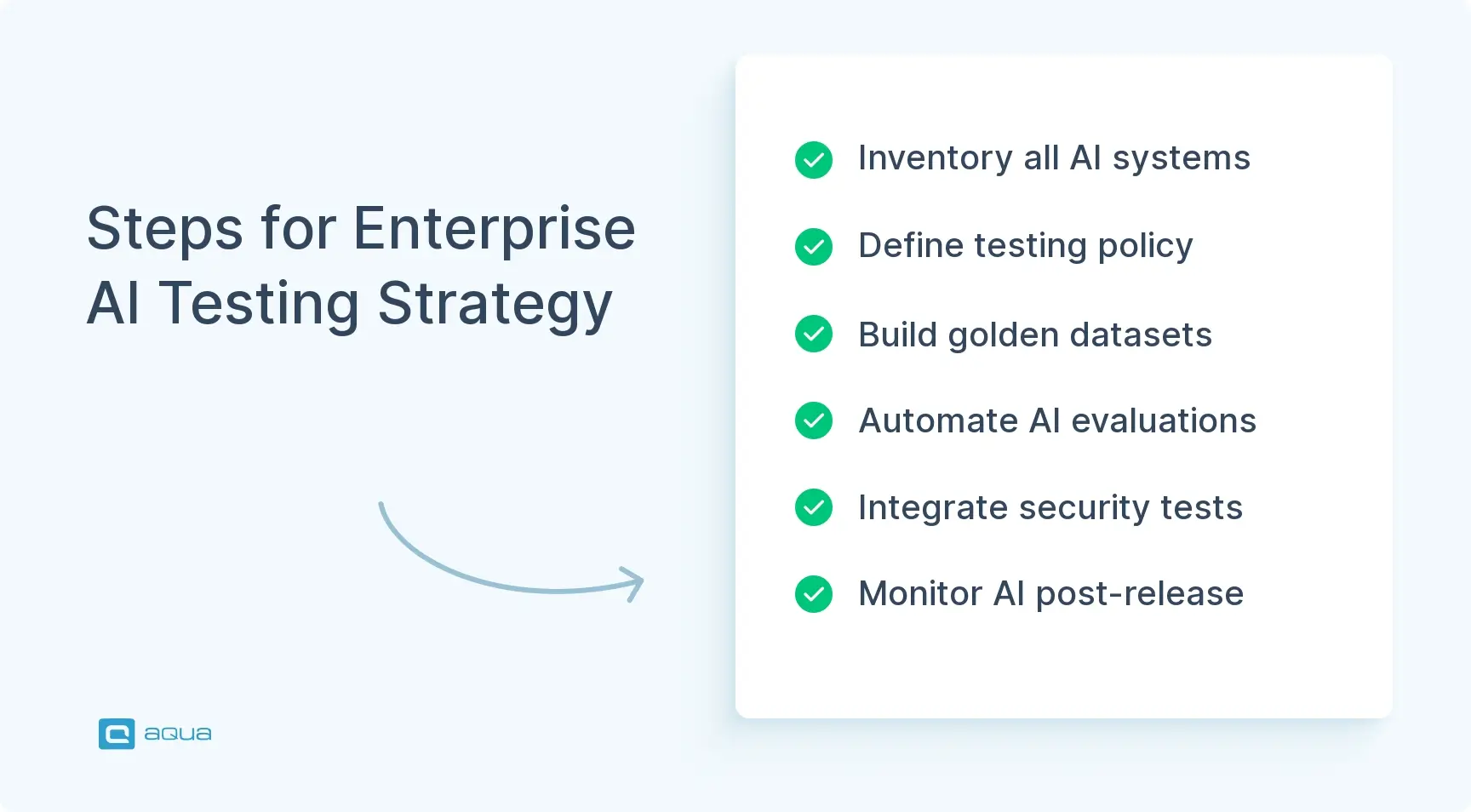
Step 1: Inventory Your AI Systems
Every AI use case across your organization needs to be catalogued before testing can be planned. This includes AI assistants, RAG-based search, automated decisions, document processing, and analytics copilots.
For each system, document the model in use, data sources, user roles, business risk level, compliance requirements, and approval workflows. This inventory becomes the testing backlog and the foundation for risk-based prioritization.
Step 2: Define a Testing Policy
Your testing policy sets the rules for how AI systems are tested, approved, and governed. Without one, your teams make inconsistent decisions about testing rigor, data handling, and release approval.
- Which AI outputs require human approval before release
- What data cannot be sent to external models
- Which models and tools are approved for use
- How prompts are versioned and tracked
- Who signs off on AI releases and how incidents are handled
Step 3: Build Golden Datasets
Your golden datasets serve as regression tests for AI systems. Datasets should cover a specific AI use case and includes input prompts, expected answer ranges, source documents, forbidden responses, and evaluation criteria.
These datasets run whenever a model is updated, a prompt changes, or a new version is deployed. Coverage should include positive cases, negative cases, edge cases, adversarial inputs, and real-world user queries drawn from production logs where available.
Step 4: Add Automated AI Evaluations
Your automated evaluations test for accuracy, retrieval relevance, hallucination, toxicity, bias, privacy, prompt injection, latency, cost, and role-based access. These tests run in the CI/CD pipeline before every release.
A combination of rule-based checks, semantic similarity scoring, LLM-as-judge evaluation, and source-grounding validation provides the coverage needed. For high-risk features, human-in-the-loop review should be added before deployment. Critical failures must block the build automatically.
Step 5: Integrate Security Testing
Your AI systems require security testing beyond standard application scanning. Coverage should include OWASP LLM Top 10 scenarios, prompt injection tests, sensitive data leakage checks, tool permission validation, dependency scanning, and model supply chain verification.
Security testing works best when it starts early in the development cycle. Finding a credential leak during a pre-release red-team exercise is far easier to address than discovering it after deployment.
Step 6: Monitor AI in Production
Your testing doesn’t end at release. Post-deployment monitoring should be set-up to track:
- User feedback
- Hallucination reports
- Failed retrieval
- Latency
- Token cost
- Blocked prompts
- Unsafe outputs
- Escalation rate
- Model drift over time.
When users report a hallucination pattern in production, those cases should enter the regression suite before the next release cycle begins. Monitoring and testing are the same loop, just at different stages.
Your AI testing strategy should also answer these questions:
- Who approves AI-generated outputs before release? Is it your dev team, your QA team, security, legal, or a cross-functional AI governance board?
- What are the pass/fail criteria for your AI features? How accurate does an answer need to be? What’s an acceptable hallucination rate? What latency is too slow?
- How are prompts and models versioned? Can you trace a production issue back to a specific prompt or model version?
- What happens when your AI feature fails in production? Is there an incident response workflow? Who gets paged? What does rollback look like?
- How are bias, toxicity, and safety issues handled? Are there automated checks? Is there human review? What’s the escalation path?
I am really looking forward to all the AI stuff, it's a bright future for testers, checking what the AI has done, to see if it's true or just wrong.
Best Tools and How to Choose AI Testing Platform for Enterprise
Any engineer would tell you that the right tool stack is one main decision in your AI testing strategy. Get it wrong, and you’re juggling disconnected platforms, duplicating audit trails, and losing traceability across the pipeline. Start with the category that anchors everything else. Enterprise AI testing tools and AI testing tools for enterprise companies should be evaluated first on governance, traceability, and compliance capabilities.
AI-Driven Test and Requirements Management
For enterprise AI testing, AI-driven test and requirements management is the most critical tooling layer. This category handles test case generation, traceability, golden dataset management, audit trails, and compliance documentation. These functions sit at the center of every AI testing workflow, and no other category covers all of them.
aqua cloud is purpose-built for this layer. aqua’s domain-trained AI Copilot generates test cases directly from requirements, grounded in your project documentation through RAG. Test cases reflect the project’s actual standards, terminology, and compliance requirements. aqua also provides full requirements-to-defect traceability, role-based access controls, and complete audit trails that satisfy regulatory frameworks like ISO, FDA, and the EU AI Act. For your QA, development, and compliance teams working in the same delivery pipeline, that centralized visibility is what makes AI testing governable at scale.
Boost the efficiency of your AI-driven testing by 80% with aqua's capabilities
Traditional QA and Automation Tools
UI testing, authentication flows, and API integrations all still require conventional functional testing alongside AI evaluation. aqua integrates natively with test automation tools including Selenium, Playwright, JMeter, SoapUI, Ranorex, and REST APIs, so automation outputs feed directly into aqua’s test management and traceability layer without manual handoffs between disconnected tools.
AI Evaluation Platforms
Tools like LangSmith and Langfuse evaluate AI outputs at scale. They provide prompt versioning, dataset management, automated scoring, and regression tracking across model versions. These platforms are built specifically for testing LLM features, which makes them a better fit for evaluating generative outputs than adapting standard test frameworks to that purpose.
Security Testing Tools
OWASP LLM Top 10 testing requires specialized tools for detecting prompt injection, data leakage, and tool misuse. Garak and custom red-team scripts simulate realistic attack scenarios against LLM-based systems. For static analysis and dependency scanning, tools like Snyk and Semgrep cover code-level vulnerabilities. Runtime monitoring adds a further layer for detecting anomalous AI behavior in production.
Observability and Monitoring Tools
Production monitoring tracks latency, cost, errors, and user feedback. Tools like Datadog and Grafana handle general observability. LangSmith’s tracing features add AI-specific visibility into tool calls, retrieval results, and escalation events. This production data feeds back into the golden test set and informs each subsequent release cycle.
When selecting AI testing tools for enterprise, here’s what to look for:
- Traceability: Can you trace a production issue back to a specific test, prompt version, or model version?
- Access control: Can you control who runs tests, deploys AI features, or accesses test data?
- Auditability: Are test results stored in a way that auditors can inspect them?
- Integrations: Does the tool integrate with the CI/CD pipeline, source control, and observability stack?
- Governance support: Does the tool produce documentation for risk assessments, approval workflows, and compliance evidence?
For your enterprise environment, tools that can’t explain their outputs, don’t support role-based access, or require workarounds for compliance requirements are a poor fit. The goal is a stack that reinforces the governance model.
When evaluating deployment options, confirm whether the platform supports on-premises, cloud-based, or hybrid configurations. Regulated industries often have data residency requirements that limit which cloud setups are acceptable. Platforms that maintain consistent audit trail behavior across deployment modes reduce governance complexity without requiring custom engineering. For teams with complex integration needs, also evaluate native support for automation frameworks and CI/CD tooling, since fragmented toolchains increase maintenance overhead and create traceability gaps across the delivery pipeline.
Building a reliable AI testing strategy requires more than good intentions and scattered tools. aqua cloud, an AI-driven test and requirement management solution, offers AI-powered test case generation grounded in your project documentation. It also provides comprehensive requirements-to-defect traceability across your entire tech stack and enterprise-grade governance. Complete audit trails for ISO, FDA, and regulatory compliance are included. aqua’s AI Copilot learns from the context you provide, including your standards, terminology, and compliance requirements, delivering test cases that are immediately relevant and audit-ready. Centralized test management, real-time dashboards, automated quality gate enforcement, and security controls that keep sensitive data protected come as part of one platform. Whether you’re evaluating AI features in production, validating AI-generated code, or accelerating QA work with AI assistance, aqua scales with your requirements. For teams managing complex delivery environments, aqua’s Capture integration records test execution with video and screenshots. Native support for PowerShell, UnixShell, Database (MSSQL and Oracle), SoapUI, Ranorex, and REST API means all parts of your stack stays connected without complicated configuration needed.
Achieve compliance with AI testing requirements with aqua cloud
Conclusion
AI testing covers three connected disciplines: evaluating AI-enabled product features, validating AI-generated code, and using AI to accelerate QA work. Each requires different methods, and all three need governance controls that produce evidence auditors can inspect.
Your team ships reliable AI features by versioning prompts, tracking regressions, and testing for hallucinations. It should also be supported by enforcing access controls and treating production monitoring as part of the testing cycle. Start with an inventory, define a policy, build golden datasets, and iterate from there.