Continuous Testing in DevOps: Importance, Principles and How to Implement
Pushing code and hoping nothing breaks in production is not a strategy. It is a liability. Continuous testing in DevOps replaces that anxiety with a systematic approach: quality checks embedded at every stage of development, catching issues while they are still cheap and easy to fix. This guide covers what makes continuous testing with DevOps work, what the core principles are, and how to implement it without rebuilding your entire workflow from scratch.
Continuous testing integrates quality validation throughout the entire development lifecycle instead of treating it as a separate phase that happens after coding is complete.
Teams implementing continuous testing deploy 208 times more frequently than low performers while maintaining lower failure rates, according to DORA research.
Fixing bugs found during development costs approximately 15 times less than addressing the same issues in production.
The “Shift Left” testing principle moves quality activities earlier in development, requiring QA engineers to participate in sprint planning alongside developers.
Successful continuous testing requires treating test code with the same rigor as production code, including code reviews and regular maintenance.
Still treating testing as a Friday afternoon task before releases? Discover how continuous testing transforms quality from a bottleneck into a safety net that catches bugs when they’re cheap to fix 👇
Continuous Testing vs Traditional Testing
Traditional testing operates on a build-first, test-later philosophy that made sense when software releases happened quarterly. Code gets written, handed off to QA, and manually verified in one large batch. Bugs pile up, developers context-switch back to code they wrote weeks ago, and release dates slip. This approach creates friction between dev and QA teams and produces long feedback loops where fixing a bug costs far more than it would have earlier in the cycle.
DevOps continuous testing embeds validation throughout the entire development lifecycle. Automated tests run with every commit, providing immediate feedback while context is still fresh. The approach requires tighter integration between development and operations, shared responsibility for quality, and automation infrastructure that can keep pace with daily deployments.
Aspect
Traditional Testing
Continuous Testing
Timing
Post-development phase
Throughout entire development cycle
Execution
Primarily manual
Heavily automated, strategic manual
Feedback Loop
Days to weeks
Minutes to hours
Team Structure
Separate QA team
Shared quality ownership
Test Environment
Limited, often shared
Dynamic, on-demand
Release Cadence
Weeks to months
Multiple times daily
Bug Detection Cost
High, found late
Low, caught during development
Risk Management
Large batch deployments
Small incremental changes
The shift requires more than better tools. It demands a cultural change where everyone owns quality. That is what makes continuous testing for DevOps professionals stick beyond the initial implementation.
What Is Continuous Testing in DevOps
What is continuous testing in DevOps? It is the practice of running automated tests as an integral part of the software delivery pipeline, at every stage from commit to deployment. Rather than a discrete testing phase, it is a continuous feedback mechanism that validates code quality, integration correctness, and deployment readiness in parallel with development.
The distinction from simply running tests more often is important. Continuous testing is defined by its integration into the pipeline, its automation coverage, and its feedback quality. Tests that run automatically but produce cryptic results or take 90 minutes to complete are not continuous testing in any meaningful sense. The output needs to be fast, clear, and actionable.
Benefits of Continuous Testing in DevOps
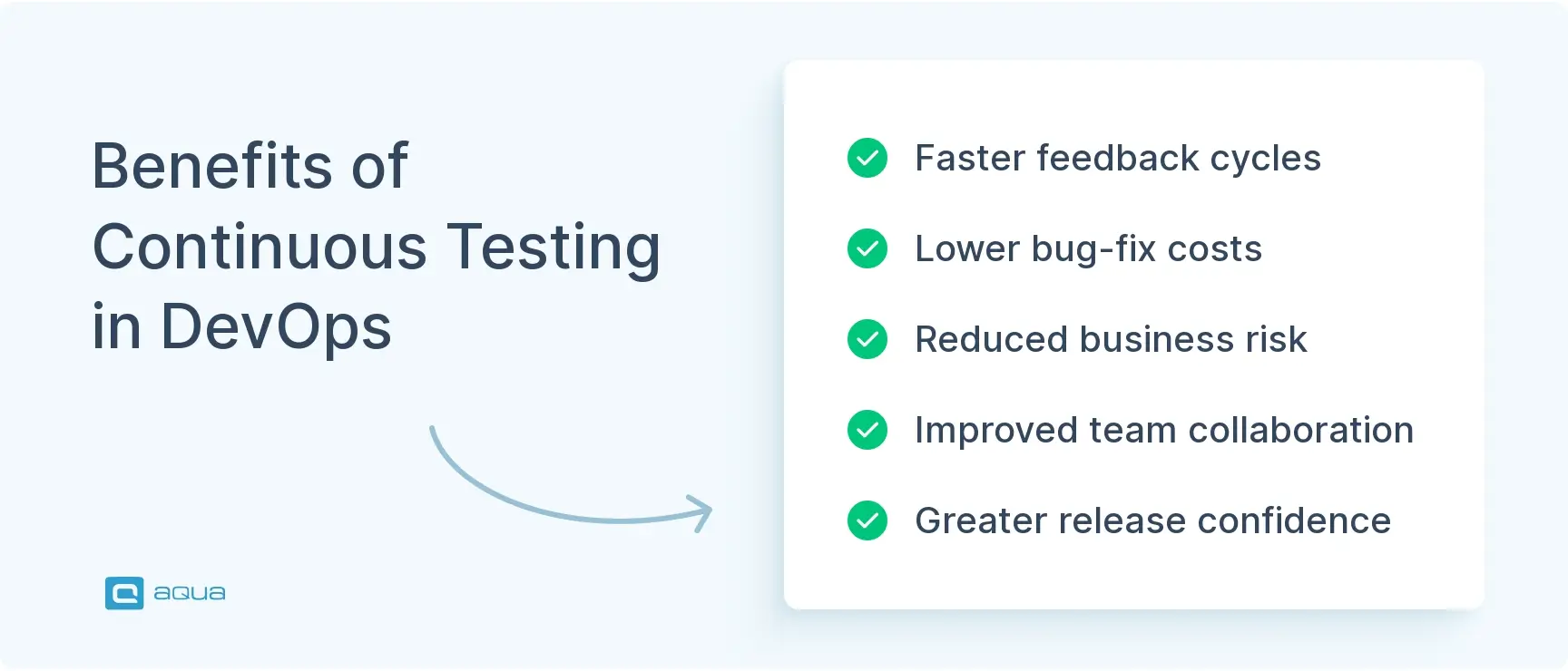
The most immediate benefit is compressed feedback loops. When tests run automatically with every commit, developers fix bugs while the code is still fresh rather than after moving on to three other features. Research from DORA indicates that elite performing teams deploy significantly more frequently than low performers while maintaining lower change failure rates, and continuous testing is a core practice separating those groups.
Early defect detection also reduces cost substantially. Fixing a bug during development costs a fraction of addressing the same issue in production, accounting for developer time, incident response, customer trust, and downstream rework. Multiple safety nets across the pipeline prevent defects from reaching users.
The benefits of continuous testing in DevOps extend beyond technical metrics. Teams with strong continuous testing practices consistently report less time spent on unplanned work and rework, faster recovery from incidents, and higher confidence in deployment decisions.
Key advantages:
Accelerated feedback cycles: Developers get test results within minutes of committing code, enabling fixes before context is lost
Reduced business risk: Smaller, more frequent releases with automated validation decrease the impact of any individual bug
Cost efficiency: Early defect detection is substantially cheaper than post-production fixes and emergency hotfixes
Enhanced collaboration: Shared quality ownership breaks down silos between dev, QA, and operations
Deployment confidence: Comprehensive automated coverage removes the anxiety from release decisions
As we explore the transformation from traditional to continuous testing, it’s clear that having the right tooling is essential to making this shift effectively. This is where aqua cloud delivers exceptional value; its comprehensive platform seamlessly integrates into your DevOps workflow, making continuous testing accessible and manageable. With aqua, you can automate test execution at every stage of your pipeline while maintaining centralized visibility across all your test assets. What truly sets aqua apart is its domain-trained Actana AI, which creates project-specific tests grounded in your own documentation, saving up to 97% of your testing time while ensuring comprehensive coverage. Teams using aqua have reported shortening their release cycles by up to 43%, allowing them to detect defects when they’re still 15 times less expensive to fix than in production.
Accelerate your DevOps testing transformation with AI that understands your project
Shift left testing moves quality activities earlier in the development cycle rather than concentrating them before release. Instead of discovering integration issues during pre-production, you catch them immediately after writing the code. This extends beyond running unit tests. It means embedding quality thinking into design discussions, code reviews, and feature planning. When QA engineers participate in sprint planning alongside developers, they identify testing challenges before a single line of code is written.
Comprehensive Automation
Automation is the mechanism that makes continuous testing scalable. You cannot manually test every commit when your team ships dozens of changes daily. But effective automation requires strategic decisions about what to automate first, maintaining test code with the same rigour as production code, and accepting that not everything benefits from automation. Exploratory testing still uncovers edge cases and usability issues that scripted tests consistently miss.
Actionable Feedback Loops
Tests that pass or fail without giving developers enough context to act are noise. Feedback needs to be specific, fast, and interpretable without deep investigation. Clear error messages, test isolation that pinpoints the failing component, and result delivery through channels developers actually monitor are what separate useful continuous testing from a checkbox exercise.
Risk-Based Prioritisation
Chasing arbitrary coverage percentages is less effective than focusing testing effort on high-risk areas. Critical business functions, frequently changed modules, and integration points between services deserve more coverage and tighter feedback loops than stable internal utilities. This prioritisation keeps pipeline execution fast while protecting what matters most.
Continuous Improvement
Test suites are living documentation that needs to evolve with the codebase. Flaky tests that fail inconsistently erode trust and need to be fixed or removed. Test cases for deprecated features create maintenance burden without providing value. Regular suite reviews that prune, refactor, and extend coverage keep continuous testing healthy over time.
How to Implement Continuous Testing in DevOps?
Continuous Integration focuses on verifying that new code merges cleanly with the existing codebase without breaking functionality. Developers commit multiple times daily, and each commit triggers automated builds followed by fast unit tests executing in seconds or minutes. The goal is rapid feedback: if a change breaks something, developers know immediately rather than after ten other developers have built on top of faulty code.
Integration testing validates component interactions and API contracts after unit tests pass. This stage runs more thorough checks covering how different parts of the system communicate, database interactions, and external service integrations.
Continuous Deployment validates production readiness with comprehensive suites including end-to-end tests, performance checks, and automated security scans. Some teams implement canary deployments where new code reaches a small subset of production traffic while monitoring for anomalies. Tests at this stage check not just whether code works in isolation, but whether it performs correctly under realistic conditions.
Post-deployment monitoring uses smoke tests and synthetic monitoring to continuously verify that real production behaviour matches expectations after each deployment.
Pipeline Stage
Testing Focus
Test Types
Typical Duration
Continuous Integration
Code quality, unit correctness
Unit tests, linting, static analysis
2-10 minutes
Integration Testing
Component interaction, API contracts
Integration, API, database tests
10-30 minutes
Continuous Deployment
Production readiness, system behaviour
End-to-end, performance, security
30-90 minutes
Post-Deployment
Real-world performance
Smoke tests, synthetic monitoring
Continuous
Not every test needs to run on every commit. Fast unit tests run with every push. Slower end-to-end tests run on merge to main or on a schedule. Tiering tests by speed and risk keeps pipelines fast while maintaining comprehensive coverage across the full delivery cycle.
Key Elements of Continuous Testing Tools in DevOps
The key elements of DevOps continuous testing tools form an interconnected ecosystem. Each component amplifies the others, and weaknesses in any one area undermine the whole system.
Automated test frameworks provide structure for writing maintainable tests across unit, integration, and end-to-end layers. The best teams treat test code with the same standards as production code: code reviews, refactoring, and clear ownership.
Test environment management is where many continuous testing initiatives collapse. Environments need to spin up quickly, mirror production accurately, and remain reproducible across runs. Containerisation has improved this significantly, making it possible to create isolated test environments in minutes. Test data management is equally critical: realistic data that reflects actual usage patterns without exposing sensitive information, typically through synthetic data generation or anonymised production subsets.
CI/CD integration triggers appropriate test suites at each pipeline stage with clear pass/fail criteria. Test results need to flow back to developers through the channels they actually use.
Feedback mechanisms deliver results with enough context to debug failures quickly. A test result that tells you something failed without indicating where or why costs more time than it saves.
Test monitoring and analytics track execution time, flakiness rates, and coverage trends over time. These metrics tell you whether your continuous testing investment is paying off or accumulating technical debt.
DevOps tools continuous testing selection should prioritise clean integration with your existing pipeline, support for multiple test types, and scalability as coverage grows. Modular toolchains that allow swapping individual components without rebuilding everything are preferable to monolithic platforms that create lock-in.
Best Practices for Continuous Testing in DevOps
The best practices for continuous testing in DevOps are not about running more tests. They are about running the right tests, maintaining them well, and making results visible and actionable.
Start with critical paths. Begin automation with the user journeys that, if broken, would stop business operations. Expand coverage from there based on risk and change frequency rather than trying to automate everything at once.
Apply production code standards to test code. Test code that nobody reviews, refactors, or maintains becomes a liability faster than production code because it runs constantly. Code reviews for test changes, clear ownership for failing tests, and regular refactoring sessions keep the suite healthy.
Optimise for speed from the start. Parallelise test execution, cache dependencies, and eliminate flaky tests aggressively. A slow pipeline that developers work around defeats the purpose of continuous testing.
Focus coverage on business-critical functionality. Coverage percentages are a proxy metric. What matters is whether your tests protect the functionality that users depend on. A payment processing service at 90% coverage matters more than an internal admin panel at 100%.
Integrate security testing early. Security scans embedded in the pipeline catch vulnerabilities when they are introduced rather than during pre-release security reviews. Treating security as a pipeline stage rather than a gate reduces the friction of addressing findings.
Review and prune the suite regularly. Tests for deprecated features, tests that never fail because they cover unchanged code, and tests that fail intermittently for non-bug reasons should be removed or fixed. A lean, reliable suite provides more value than a large, noisy one.
Make quality everyone’s responsibility. Train developers on testing principles. Involve QA engineers in sprint planning. Track quality metrics at the team level, not just within QA. The DevOps testing strategy that sustains itself over time is one where no single person or team is the gatekeeper for quality decisions.
Implementing continuous testing in DevOps requires a fundamental change in how teams approach quality throughout the development lifecycle. aqua cloud is purpose-built to support this transformation, offering a unified platform where manual and automated tests coexist, powerful integrations with CI/CD pipelines, and real-time dashboards that make quality metrics visible to everyone. The platform’s Actana AI takes continuous testing to another level by generating test cases instantly from your requirements and project documentation. Unlike generic AI tools, aqua’s domain-trained AI delivers context-aware, project-specific results that speak your product’s language. Companies across banking, manufacturing, and technology sectors have reduced testing time by 30-60% while simultaneously improving defect detection rates to 98%. With aqua, your team can finally break free from the “build first, test later” philosophy and embrace true continuous testing where quality becomes everyone’s responsibility.
Transform testing from a bottleneck into a competitive advantage with aqua cloud
Continuous testing in DevOps is a fundamental shift in how teams approach quality. Rather than a phase that happens before release, it is a continuous feedback mechanism embedded throughout the delivery pipeline. The investment in automation infrastructure, cultural changes around quality ownership, and ongoing suite maintenance pays back in faster releases, fewer production incidents, and more confident deployment decisions. Whether you are automating your first smoke tests or optimising a mature pipeline, the principle stays consistent: test early, test continuously, and make quality a shared responsibility across every team involved in shipping software.
Continuous testing is the practice of running automated tests as an integrated part of the software delivery pipeline rather than as a separate phase at the end of development. Every code change triggers a series of validation checks, from fast unit tests on commit to broader integration and end-to-end tests before deployment. The goal is to provide immediate, actionable feedback at every stage so that defects are caught when they are introduced rather than discovered after they have propagated through the codebase. Continuous testing with DevOps specifically refers to this practice within a DevOps culture of shared ownership, automation, and fast iteration, where testing is not a QA responsibility but a pipeline concern that every team member contributes to.
How can continuous testing improve software quality in a DevOps pipeline?
Continuous testing improves quality by compressing the feedback loop between introducing a defect and discovering it. When tests run automatically on every commit, developers find out within minutes whether their change broke something, while the context is still fresh and the diff is still small. This dramatically reduces the cost and complexity of fixes compared to discovering the same issue days later during a QA cycle or weeks later in production. Beyond defect detection, continuous testing creates a documented baseline of expected system behaviour that evolves with the codebase. Each passing test run is evidence that existing functionality still works. Over time, this evidence base builds deployment confidence and reduces the risk profile of each release, enabling teams to ship more frequently without increasing incident rates.
What tools are best suited for implementing continuous testing in DevOps environments?
The right devops tools continuous testing stack depends on your application type, team skills, and existing pipeline. For web UI automation, Cypress and Playwright are currently the strongest options for speed, stability, and CI/CD integration. Selenium remains widely used for legacy stacks and broad browser coverage. For API testing, Postman with Newman for CI execution handles most use cases. For unit and integration testing, JUnit and TestNG cover Java stacks, while pytest is the standard for Python. For mobile, Appium supports both iOS and Android. On the pipeline side, Jenkins, GitHub Actions, and GitLab CI all provide solid foundations for triggering test suites at each stage. The most important characteristic when evaluating continuous testing tools in DevOps is not feature breadth but integration quality: how cleanly does the tool fit into your existing pipeline, how quickly does it surface results, and how maintainable is the test code it produces. A simpler tool that integrates well beats a feature-rich platform that creates friction at every stage.
Home » Test Automation » Continuous Testing in DevOps: Importance, Principles and How to Implement
Do you love testing as we do?
Join our community of enthusiastic experts! Get new posts from the aqua blog directly in your inbox. QA trends, community discussion overviews, insightful tips — you’ll love it!
We're committed to your privacy. Aqua uses the information you provide to us to contact you about our relevant content, products, and services. You may unsubscribe from these communications at any time. For more information, check out our Privacy policy.
X
🤖 Exciting new updates to aqua AI Assistant are now available! 🎉
We use cookies and third-party services that store or retrieve information on the end device of our visitors. This data is processed and used to optimize our website and continuously improve it. We require your consent fro the storage, retrieval, and processing of this data. You can revoke your consent at any time by clicking on a link in the bottom section of our website.
For more information, please see our Privacy Policy.
This website uses cookies to improve your experience while you navigate through the website. Out of these, the cookies that are categorized as necessary are stored on your browser as they are essential for the working of basic functionalities of the website. We also use third-party cookies that help us analyze and understand how you use this website. These cookies will be stored in your browser only with your consent. You also have the option to opt-out of these cookies. But opting out of some of these cookies may affect your browsing experience.
Necessary cookies are absolutely essential for the website to function properly. These cookies ensure basic functionalities and security features of the website, anonymously.
Cookie
Duration
Description
cookielawinfo-checkbox-analytics
11 months
This cookie is set by GDPR Cookie Consent plugin. The cookie is used to store the user consent for the cookies in the category "Analytics".
cookielawinfo-checkbox-functional
11 months
The cookie is set by GDPR cookie consent to record the user consent for the cookies in the category "Functional".
cookielawinfo-checkbox-necessary
11 months
This cookie is set by GDPR Cookie Consent plugin. The cookies is used to store the user consent for the cookies in the category "Necessary".
cookielawinfo-checkbox-others
11 months
This cookie is set by GDPR Cookie Consent plugin. The cookie is used to store the user consent for the cookies in the category "Other.
cookielawinfo-checkbox-performance
11 months
This cookie is set by GDPR Cookie Consent plugin. The cookie is used to store the user consent for the cookies in the category "Performance".
viewed_cookie_policy
11 months
The cookie is set by the GDPR Cookie Consent plugin and is used to store whether or not user has consented to the use of cookies. It does not store any personal data.
Functional cookies help to perform certain functionalities like sharing the content of the website on social media platforms, collect feedbacks, and other third-party features.
Performance cookies are used to understand and analyze the key performance indexes of the website which helps in delivering a better user experience for the visitors.
Analytical cookies are used to understand how visitors interact with the website. These cookies help provide information on metrics the number of visitors, bounce rate, traffic source, etc.
Advertisement cookies are used to provide visitors with relevant ads and marketing campaigns. These cookies track visitors across websites and collect information to provide customized ads.