Crowd Testing: Definition, Benefits and Challenges
Your internal QA team is thorough. But they are testing on known devices, known networks, and known workflows. Your actual users are on three-year-old Android phones, spotty public Wi-Fi, and screen sizes you never accounted for. Crowdsourced testing closes that gap. It puts your software in front of distributed, real-world testers before launch day, surfacing the issues that controlled lab environments consistently miss.
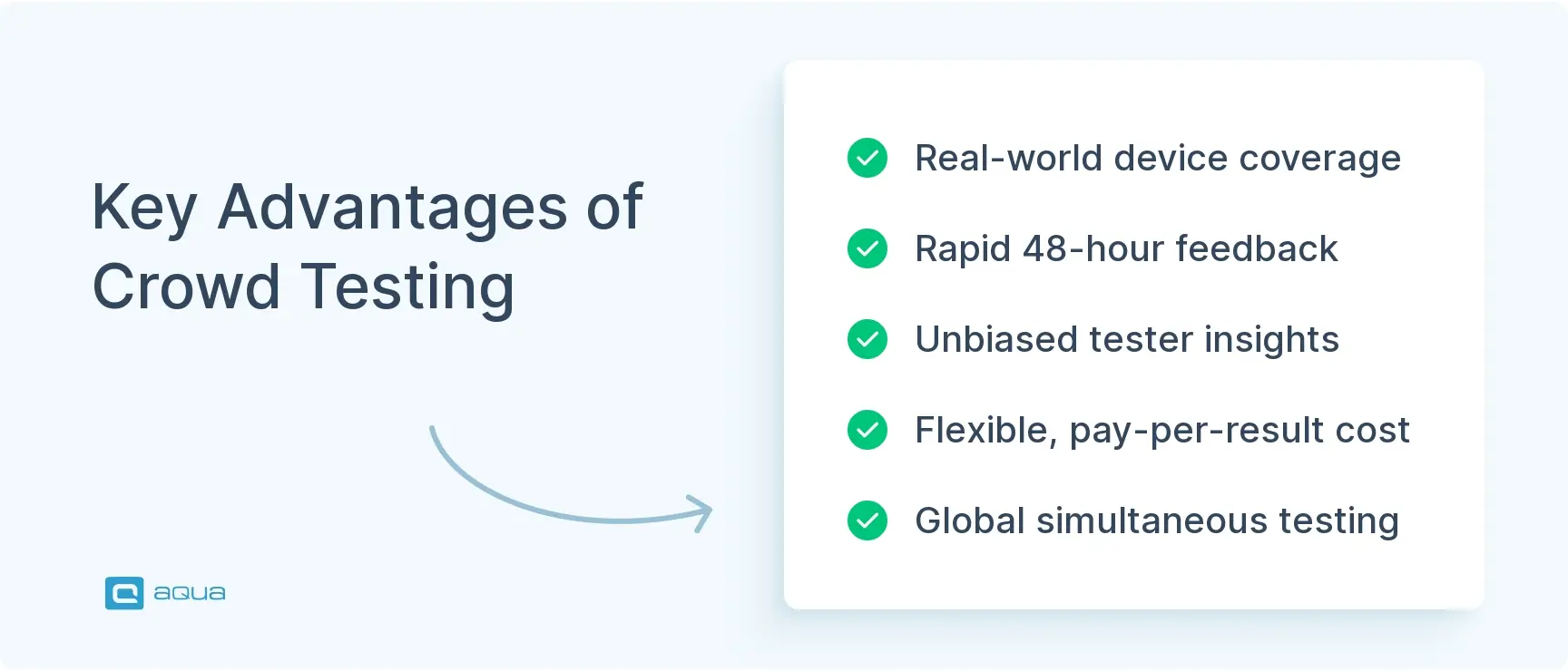
Crowd testing uses distributed networks of external testers to validate software on their own devices in real-world environments, providing more diverse feedback than traditional lab testing.
The crowd testing process follows five stages: planning with clear test cases, recruiting testers through specialized platforms, executing tests asynchronously, analyzing results to filter duplicates, and refining the approach for future cycles.
Unlike outsourced testing with fixed teams and monthly fees, crowd testing offers flexible scaling with pay-per-result pricing that aligns costs directly with actual testing activity.
Crowd testing enables validation across multiple device types, OS versions, and geographies simultaneously, compressing feedback loops that would take in-house teams weeks into just 48 hours.
Security risks, tester reliability, and quality control across numerous submissions remain significant challenges that require NDAs, tester filtering, and robust triage processes.
Your users are using it on cracked screens with spotty Wi-Fi in real life. Discover how crowd testing taps into thousands of real-world scenarios to catch bugs your QA team would never find 👇
What Is Crowd Testing
Crowd testing, or crowdsourced testing, is the practice of distributing software validation tasks to a network of external testers rather than relying solely on an in-house QA team or contracted vendor. These testers work on their own devices, in their own environments, and submit findings through a managed platform. You get coverage across device types, operating systems, browsers, geographies, and usage conditions that no fixed team can replicate at comparable cost or speed.
The value is not just in the numbers. A pool of 500 testers gives you scale, but the real advantage is diversity. Feedback from a user on an older Samsung device in rural India, a power user on a high-spec desktop in Berlin, and someone multitasking on a cracked iPhone during a commute collectively reveals issues that would never surface in a controlled test lab.
Crowd testing augments rather than replaces internal QA. In-house teams handle regression suites, unit tests, and deep product knowledge. The crowd handles exploratory testing, localization checks, usability feedback, and edge cases that require breadth rather than depth. Together they create a feedback loop that is both rigorous and grounded in how the software actually gets used.
The model also removes fixed capacity constraints. Need to validate a feature across 50 device-OS combinations before Friday? Possible. Need usability feedback from native speakers in six markets simultaneously? Also possible. Because testers engage on a project basis and are compensated for validated results rather than hours, the cost model stays variable and aligned with actual testing activity.
When you’re juggling diverse environments, devices, and user scenarios in your testing strategy, coordination becomes as crucial as coverage. This is where a modern test management system can transform your crowd testing efforts. With aqua cloud, you get a centralized hub that seamlessly organizes distributed testers, standardizes test case formats, and provides real-time visibility into progress across all your testing channels. Unlike traditional tools, aqua’s platform includes role-based permissions that let you securely onboard temporary crowd testers while protecting sensitive data. Plus, its powerful Actana AI, trained specifically on testing domain knowledge, can generate comprehensive test cases in seconds, giving your crowd testers clear, consistent instructions regardless of their location or experience level. This is more than organizing tests; it’s about making your entire crowd testing workflow more efficient and reliable.
Reduce crowd testing coordination time by 60% with a centralized, AI-powered test management platform
Differences Between Crowdsourced Software Testing and Outsourced Testing
Crowd testing and outsourced testing both involve external parties, but they operate on fundamentally different principles.
Outsourced testing means contracting with a dedicated QA vendor or consultancy. You work with a fixed team, often in a specific location, who follow your test plans, use your tools, and integrate directly into your workflow. It is structured, consistent, and close to extending your internal team across a different office. The vendor accumulates institutional knowledge about your product over time, which means smoother handoffs and fewer miscommunications as the engagement matures.
Crowd software testing replaces that fixed model with a fluid network of independent testers who engage on a project-by-project basis. No long-term contract, no single vendor. You post a testing need, testers get matched, they execute on their own devices in their own environments, and you pay for results rather than hours logged.
Aspect
Crowd Testing
Outsourced Testing
Team Structure
Distributed, on-demand network
Fixed vendor or consultancy team
Scalability
Instant scaling up or down
Requires negotiation and ramp-up time
Cost Model
Pay-per-result
Fixed retainers or hourly billing
Consistency
Varies, requires strong documentation
Higher, built on long-term familiarity
Flexibility
Project-by-project, no lock-in
Contractual commitments with defined scope
Neither approach is universally superior. Outsourced testing fits complex systems where context matters and testers need deep familiarity with intricate workflows. Crowd based testing fits scenarios requiring diversity, speed, and coverage at scale, particularly for exploratory testing, localization, and device matrix validation. Many teams use both: outsourced QA for core regression work and crowd testing for surge capacity, usability feedback, or market-specific validation.
Process of Crowdsourced Testing
Running a crowd testing project requires a structured cycle that balances flexibility with control.
Planning defines success before a single test runs. What are you testing? Which devices, OS versions, and browsers matter most? What constitutes a critical bug versus a minor issue? This stage involves drafting test cases or exploratory charters, setting acceptance criteria, locking down logistics like staging environment access and test account provisioning, and establishing security protocols for handling sensitive data.
Tester recruitment follows. Professional crowd testing platforms maintain pre-vetted tester pools filterable by location, device type, testing specialty, and industry experience. Need iOS testers in Japan or accessibility experts with WCAG knowledge? The platform handles matching, NDA signing, and initial onboarding. Many projects run a small pilot group first to validate that test cases are clear and results are useful before scaling to the full crowd.
Test execution is where coverage happens. Testers work asynchronously on their own devices in their own environments, following scripted test cases or operating in exploratory mode depending on the project scope. They document findings with screenshots, videos, logs, and reproduction steps, then submit through the platform. What might take a small in-house team a week can compress into 48 hours with a hundred testers working across time zones.
Results analysis is active triage, not passive data collection. You review submissions, filter duplicates, verify reproducibility, and prioritize by severity. Platform dashboards aggregate findings and surface patterns. The goal is separating signal from noise and routing validated, well-documented bugs to your development team with enough context to act on them immediately.
Refinement closes the loop. Which test cases produced useful results? Where did gaps emerge? What tester instructions need clarification? Each cycle builds institutional knowledge that makes the next one more efficient. Over time, you develop sharper intuition about when crowd testing adds the most value and how to structure projects for maximum output quality.
Benefits of Crowd Testing
Real-world testing coverage is the primary reason teams adopt crowd testing. Testers on their own devices, networks, and environments reproduce the conditions your actual users face: outdated OS versions, browser extensions, slow mobile connections, regional settings. This surfaces compatibility bugs, localization issues, and performance problems that controlled lab environments rarely catch.
Faster feedback loops compress release cycles. With testers distributed across time zones, QA runs around the clock. Post a test plan in the evening and review results the next morning. During product launches, seasonal peaks, or emergency patches, time compression matters significantly.
Unbiased perspectives address a blind spot that every internal team has. In-house testers know your product well enough to unconsciously avoid confusing workflows or overlook UI inconsistencies they have adapted to. Crowd testers approach the product without assumptions, following the same paths real users take and flagging friction that internal reviewers have stopped noticing.
Cost efficiency follows from the variable model. Rather than maintaining a full-time QA team sized for peak demand, you pay for testing activity when you need it. Light testing cycle? Minimal cost. Major release across 50 device-OS combinations? Scale up, then scale back down. That alignment between spending and actual testing needs reduces waste during slow periods.
Enhanced test coverage is the compounding benefit. Crowd-sourced testing validates across device types, OS versions, browsers, screen sizes, network conditions, and geographies simultaneously. Confirming your application works across Android versions 9 through 14, on multiple hardware manufacturers, in several countries, is not a theoretical capability. It is standard practice on most crowd testing platforms.
The benefits of crowd testing compound on each other. Real-world coverage surfaces bugs faster, which tightens feedback loops, which improves release velocity, which keeps costs in check, all while expanding coverage beyond what any single team could sustain internally.
Crowd Based Testing Types
Functional testing validates that features work as designed. Testers execute predefined test cases confirming that actions trigger correct responses, forms submit properly, data persists across sessions, and edge cases do not break core workflows. This is the backbone of most crowd testing engagements. The crowd’s value here is simultaneous coverage across device types, OS versions, and browsers, catching compatibility bugs that sequential in-house testing would take weeks to reproduce. For teams managing functional testing at scale, crowd testing provides the device and environment breadth that internal labs cannot match.
Usability testing shifts the question from whether features work to whether they are intuitive. Testers interact with the product as real users would, without guidance or inside knowledge, and attempt to complete defined tasks. Navigation structure, call-to-action clarity, error message usefulness, and onboarding flow are all evaluated through fresh eyes. This type is particularly valuable during redesigns, market expansions, or any release where user acceptance testing signals are critical before launch.
Performance testing validates load times, responsiveness, and stability under real-world conditions. Slow networks, low battery states, multitasking scenarios, and peak usage loads reveal memory leaks, sluggish API responses, and crashes that only surface outside of controlled environments. The geographic spread of crowd testers is specifically valuable here, providing data on how the application performs across varying infrastructure quality.
Localization testing validates translations, cultural appropriateness, and region-specific functionality including date formats, currency handling, and content that reads correctly in the target language. Accessibility testing confirms compatibility with screen readers, keyboard navigation, and colour contrast standards. Security testing can involve ethical hackers from the crowd probing for vulnerabilities before release.
Each type has a natural deployment moment. Functional testing fits feature releases and regression cycles. Usability testing adds the most value during redesigns or new market entry. Performance testing matters most before scaling events. The flexibility of crowd testing platforms means switching between types does not require standing up different teams. You adjust the testing charter and the crowd adapts.
Crowd Testing Challenges
Security risks require deliberate management. Granting access to staging environments, pre-release features, and test accounts to distributed external testers creates exposure. Testers working on personal devices may have weaker security hygiene than internal team members. The practical approach is enforcing NDAs through the platform, using ephemeral test accounts that expire after each project, anonymising sensitive data in test environments, and limiting crowd testing to non-sensitive modules when the product handles regulated data. Platforms with formal compliance certifications reduce this risk significantly.
Tester reliability varies across a distributed network in ways it does not with a fixed vendor team. Some testers submit detailed, reproducible bug reports with annotated screenshots. Others submit vague observations without context. Quality gates address this directly: filter by tester ratings, run a small pilot group before scaling, and provide detailed test case instructions with sample bug reports that set the expected standard. Clear expectations at the start raise the floor on what testers deliver.
Quality control across hundreds of submissions requires active triage infrastructure. Duplicate reports, false positives, and environmental quirks all land in your results alongside genuine defects. Deduplication tools built into most crowd testing platforms help, but assigning a dedicated QA lead to validate and prioritise submissions before they reach the development backlog is the more reliable safeguard. Proper bug reporting standards, communicated clearly during project setup, also reduce noise substantially.
Logistical management across global teams introduces time zone complexity, language barriers, and asynchronous coordination overhead. Write test cases in plain, unambiguous language that avoids idioms and cultural references that do not translate. Use platforms with multilingual support for projects spanning multiple regions. Set timelines that account for asynchronous work rather than expecting synchronous availability across time zones.
Practical checklist:
Security: Enforce NDAs, use ephemeral test accounts, anonymise sensitive data, vet platforms for compliance certifications
Reliability: Filter testers by ratings, run pilot tests, set clear quality expectations with sample outputs
Quality control: Implement deduplication tools, assign a triage lead, verify bugs before routing to engineering
Logistics: Write unambiguous test cases, use translation-friendly platforms, build asynchronous-friendly timelines
None of these challenges are dealbreakers. They are trade-offs managed through process discipline. Teams that succeed with crowd testing treat it like any managed vendor relationship: set expectations clearly, measure output quality, and refine based on results.
As you look to implement crowd testing in your organization, the right test management platform can make all the difference between chaos and clarity. aqua cloud bridges the gap between distributed testers and your core QA team by providing a single source of truth for all testing activities. Its web-based interface ensures testers anywhere in the world can access the same test cases, report findings consistently, and collaborate in real-time, addressing those tester reliability and quality control challenges head-on. The platform’s deep integrations with tools like Jira and Azure DevOps mean bugs discovered by crowd testers flow directly into your development workflow without friction. And with aqua’s domain-trained Actana AI, you can instantly generate test cases from requirements, helping crowd testers understand exactly what to test and how to report it, regardless of their familiarity with your product. This brings structure to the inherently flexible world of crowdsourcing software testing, giving you the best of both worlds: the diversity of real-world testing with the consistency of enterprise-grade test management.
Transform your distributed testing chaos into structured, actionable insights with aqua cloud's AI-powered platform
Crowd testing gives QA teams coverage that fixed internal setups cannot match: real devices, real environments, real usage conditions, at a scale and geographic spread that would be prohibitively expensive to replicate in-house. The benefits of crowd testing are most visible in the bugs that internal teams do not catch, the localization issues that only surface when native speakers test the product, and the performance problems that only appear on hardware outside your lab. Aqua cloud provides test management solutions that integrate crowd testing workflows into your broader QA process, keeping results organised, traceable, and actionable across every project. The teams getting the most from crowd sourced testing are the ones who deploy it intentionally, manage quality rigorously, and treat each project as a refinement opportunity for the next.
Crowd testing is the practice of distributing software testing tasks to a network of independent, external testers who work on their own devices in their own environments and submit findings through a managed platform. Rather than relying on a fixed internal team or contracted vendor, organisations access a pool of pre-vetted testers who can be mobilised quickly across geographies, device types, and testing specialties. The term crowdsourcing testing reflects the same principle as other crowdsourced work: tapping a distributed pool of contributors on demand rather than maintaining permanent capacity. Results are typically compensated on a per-finding or per-task basis, making the cost model variable and aligned with actual testing activity.
What is crowd beta testing?
Crowd beta testing is a specific application of crowdsourced testing where a product is released to a broader group of external users or testers before the official public launch. The goal is to validate the product under real-world conditions at scale, collecting feedback on functionality, usability, and stability from people who represent the actual target audience rather than internal stakeholders. Unlike structured crowd testing with defined test cases, beta testing often involves more open-ended exploration where testers use the product naturally and report issues or friction they encounter. It sits at the intersection of quality assurance and early user research, providing both bug reports and behavioural insights that inform final adjustments before general availability.
How does crowd testing improve software quality compared to traditional testing methods?
Traditional testing validates software against known scenarios in controlled environments, which means it is inherently limited by the devices, configurations, and usage patterns the team has access to. Crowd based testing extends validation to the conditions users actually face: varied hardware, different OS versions, inconsistent network quality, regional settings, and unpredictable usage behaviour. This surfaces a category of bugs, compatibility issues, localization errors, and performance problems under real-world constraints that controlled testing consistently misses. The unbiased perspective of testers who have no prior familiarity with the product also exposes usability issues that internal teams have adapted to and no longer notice. Combined, these factors improve the quality of the product that reaches users and reduce the volume of post-launch defects that require emergency patches.
What are common challenges organizations face when implementing crowd testing?
The four most consistent challenges are security, tester reliability, quality control, and logistical management. Security risks arise from granting external testers access to pre-release features and staging environments, which requires robust NDAs, ephemeral test accounts, and data anonymisation practices. Tester reliability varies across distributed networks in ways it does not with a fixed vendor team, requiring quality gates like pilot testing, tester rating filters, and clear submission standards. Quality control across high-volume submissions demands active triage infrastructure to separate genuine defects from duplicates, false positives, and environmental quirks before results reach engineering. Logistical management across global teams introduces time zone complexity and language barriers that require plain test case language, asynchronous-friendly timelines, and multilingual platform support. None of these challenges prevents crowd testing from delivering value, but they do require deliberate process design rather than a plug-and-play approach. So the abovementioned crowd testing solutions are necessary.
Home » Best practices » Crowd Testing: Definition, Benefits and Challenges
Do you love testing as we do?
Join our community of enthusiastic experts! Get new posts from the aqua blog directly in your inbox. QA trends, community discussion overviews, insightful tips — you’ll love it!
We're committed to your privacy. Aqua uses the information you provide to us to contact you about our relevant content, products, and services. You may unsubscribe from these communications at any time. For more information, check out our Privacy policy.
X
🤖 Exciting new updates to aqua AI Assistant are now available! 🎉
We use cookies and third-party services that store or retrieve information on the end device of our visitors. This data is processed and used to optimize our website and continuously improve it. We require your consent fro the storage, retrieval, and processing of this data. You can revoke your consent at any time by clicking on a link in the bottom section of our website.
For more information, please see our Privacy Policy.
This website uses cookies to improve your experience while you navigate through the website. Out of these, the cookies that are categorized as necessary are stored on your browser as they are essential for the working of basic functionalities of the website. We also use third-party cookies that help us analyze and understand how you use this website. These cookies will be stored in your browser only with your consent. You also have the option to opt-out of these cookies. But opting out of some of these cookies may affect your browsing experience.
Necessary cookies are absolutely essential for the website to function properly. These cookies ensure basic functionalities and security features of the website, anonymously.
Cookie
Duration
Description
cookielawinfo-checkbox-analytics
11 months
This cookie is set by GDPR Cookie Consent plugin. The cookie is used to store the user consent for the cookies in the category "Analytics".
cookielawinfo-checkbox-functional
11 months
The cookie is set by GDPR cookie consent to record the user consent for the cookies in the category "Functional".
cookielawinfo-checkbox-necessary
11 months
This cookie is set by GDPR Cookie Consent plugin. The cookies is used to store the user consent for the cookies in the category "Necessary".
cookielawinfo-checkbox-others
11 months
This cookie is set by GDPR Cookie Consent plugin. The cookie is used to store the user consent for the cookies in the category "Other.
cookielawinfo-checkbox-performance
11 months
This cookie is set by GDPR Cookie Consent plugin. The cookie is used to store the user consent for the cookies in the category "Performance".
viewed_cookie_policy
11 months
The cookie is set by the GDPR Cookie Consent plugin and is used to store whether or not user has consented to the use of cookies. It does not store any personal data.
Functional cookies help to perform certain functionalities like sharing the content of the website on social media platforms, collect feedbacks, and other third-party features.
Performance cookies are used to understand and analyze the key performance indexes of the website which helps in delivering a better user experience for the visitors.
Analytical cookies are used to understand how visitors interact with the website. These cookies help provide information on metrics the number of visitors, bounce rate, traffic source, etc.
Advertisement cookies are used to provide visitors with relevant ads and marketing campaigns. These cookies track visitors across websites and collect information to provide customized ads.






 Bankingaqua ALM helps banks increase testing productivity by over 50%