Mastering Agile Project Management for Senior Project Managers
Have you or your senior project managers found themselves caught between competing demands? Executives want predictability and governance, while teams need autonomy and flexibility. Traditional project management offers control but sacrifices adaptability. Pure Agile provides speed yet can feel chaotic at scale. This article reveals the frameworks and metrics, as well as governance structures. It also guides through main project management challenges and reveals solutions that enable senior PMs to deliver Agile's benefits without sacrificing visibility or control.
Agile project management for senior PMs focuses on optimizing value delivery under uncertainty through iterative approaches.
Senior PMs must choose the right operating mode between Scrum, Kanban, or hybrid approaches based on work characteristics.
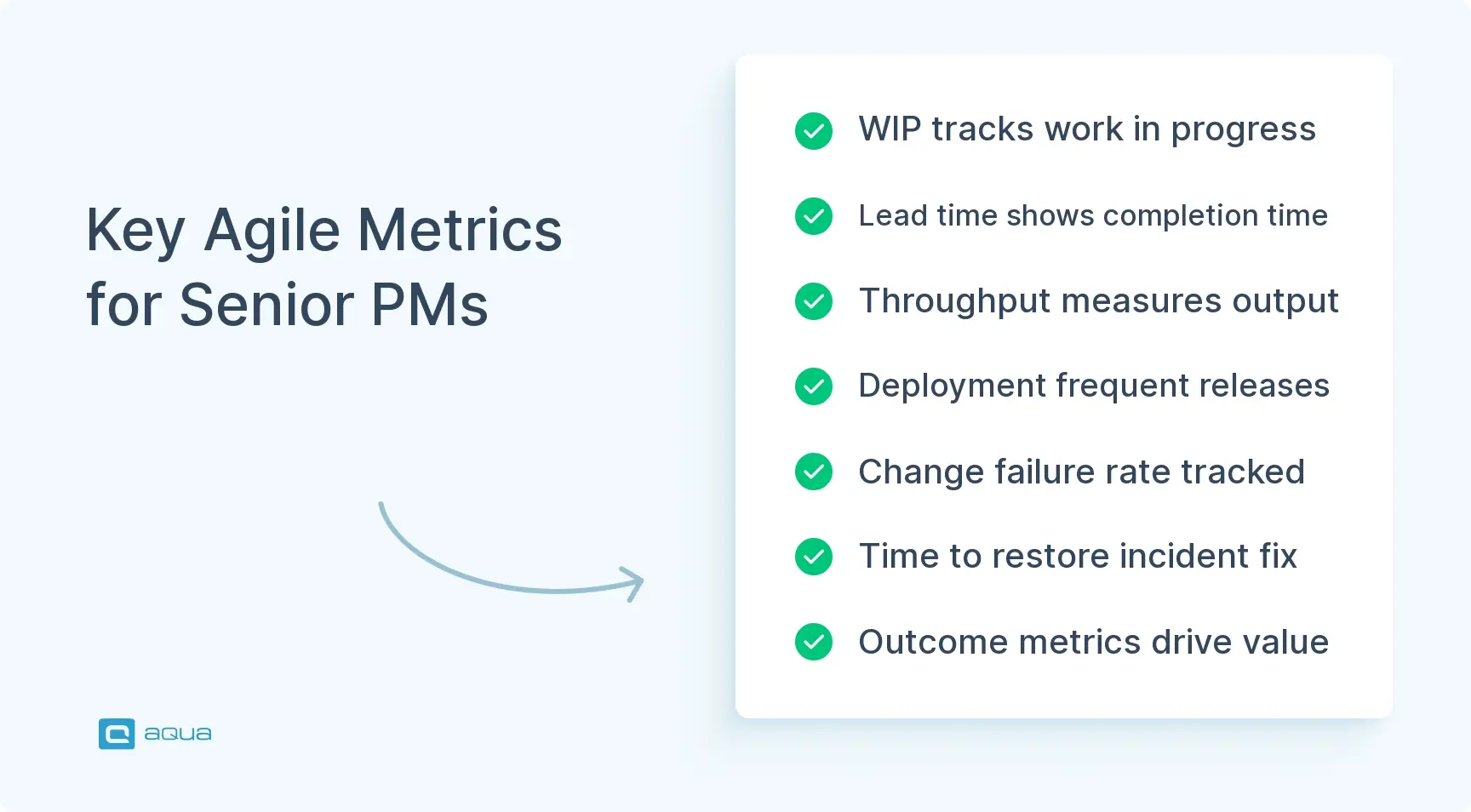
Success measurement shifts from output metrics to flow and outcome metrics, including DORA’s four keys: deployment frequency, lead time for changes, change failure rate, and time to restore service.
Effective Agile governance balances explicit rules with lightweight artifacts and automated processes, preventing the common pitfall where Agile becomes endless meetings.
Senior project managers face a unique challenge: leading Agile transformations while maintaining executive accountability. Read how to balance sprint-level autonomy with portfolio governance.👇
Understanding Agile Project Management
At the senior PM level, Agile project management methodology differs from team-level practices. Teams focus on sprint planning and daily standups. Senior PMs solve a system-design problem: creating clarity on outcomes while building a delivery system that responds to change without descending into chaos.
Agile project management combines several core elements:
Iterative value delivery that breaks work into manageable increments
Explicit feedback loops that surface problems early
Controlled work-in-progress to prevent system overload
Adaptive planning that responds to new information
This aligns with how the Scrum framework defines itself as an approach for solving complex problems through iterative, incremental delivery with built-in inspection and adaptation cycles. The Agile approach to project management recognizes that perfect upfront planning proves impossible when facing uncertainty. Instead, it optimizes for learning and course correction.
Organizations with mature agile testing trends and practices deploy code significantly more frequently than peers while maintaining higher quality. This isn’t about moving faster recklessly. It’s about building systems that can safely accelerate delivery without compromising stability.
For senior PMs, the practical definition becomes: Agile project management maximizes value delivery under uncertainty by creating measurable flow, establishing feedback mechanisms, and maintaining just enough governance to ensure accountability without killing adaptability.
Scaling Agile across multiple teams demands more than ceremonies and frameworks. You need unified visibility into delivery metrics, quality gates, and outcome tracking. aqua cloud, an AI-powered test and requirement management platform, provides senior PMs with this essential orchestration layer. The platform centralizes your Agile delivery system by connecting requirements, test cases, execution results, and defects in one traceable environment. aqua’s domain-trained AI Copilot generates test cases from project documentation, user stories, or voice notes in seconds. This dramatically accelerates quality assurance without adding overhead. Real-time dashboards give you executive-level visibility into flow metrics, quality trends, and release readiness across all teams. The platform maintains complete audit trails for governance and compliance needs while enabling team autonomy. Native integrations with Jira, Azure DevOps, Jenkins, Selenium, and other solutions ensure aqua fits seamlessly into your existing Agile tech stack.
The Agile project management principles that matter at the senior level differ from textbook definitions. These principles form the foundation for scaling Agile across complex organizations:
1. Outcome architecture over feature lists
Senior PMs maintain an outcome model connecting north-star outcomes to leading indicators to strategic constraints. Tie these to a small set of strategic bets rather than a sprawling roadmap. This ensures every team understands how their work connects to business value.
2. Eliminate waste systematically
Waste takes many forms. Redundant work and excessive documentation drain resources. Time spent on features users don’t need creates delays without adding value. Identify bottlenecks in your value stream and remove activities that don’t contribute to customer value or risk mitigation.
3. Build quality throughout the process
Don’t treat QA as a verification phase after development. Quality must be integrated continuously through practices like test-driven development and continuous testing practices. Automated feedback loops catch issues where they start, preventing them from spreading through your system.
4. Create decision clarity
Define who can change scope, who can stop the line, what triggers escalation, and what constitutes good enough for release. Without explicit decision rights, Agile methodology devolves into endless meetings and delayed decisions.
5. Establish portfolio-to-team line of sight: Every team member should answer four questions:
Why are we doing this?
What outcome are we moving?
How do we know it worked?
What is the minimal viable increment?
This alignment prevents teams from optimizing locally while the organization fails globally.
6. Respect people through enabling autonomy
Remove blockers that prevent your teams from doing their best work. Share ownership across the organization, making quality everyone’s responsibility rather than just QA’s job. When people feel true ownership, they find issues sooner and fix them faster.
7. Pursue continuous improvement
Regularly review processes through retrospectives focused on testing and delivery. Experiment with new approaches and refine test selection based on production data. Be honest about what’s working and what isn’t.
My title is “Senior QA Manager” and currently, I line manage 9 people (mix of SQA and SDETs) who are spread across 6 agile development teams. Each of those teams has a Development Manager. Each team is a slightly different version of someone’s interpretation of agile/Agile.
Senior PMs must choose the right operating mode for their context. The three primary Agile project management framework options each solve different problems.
Scrum: For Coherent Product Goals
Use the Scrum Agile project management framework when you can benefit from timeboxed planning and stable cadence. Scrum works best when you have a coherent product goal and can prioritize a sprint backlog. It excels when you need frequent inspection points at predictable intervals and can protect your teams from mid-sprint disruption.
Scrum’s minimal structure is intentionally small. Senior PM value comes from reinforcing focus and reducing noise, not adding bureaucracy. The framework provides the container. You provide the strategic direction.
Kanban: For Variable Flow
The Kanban Agile project management process excels when work is variable, interrupt-driven, or service-oriented. Use Kanban for production support and platform operations. It also works well for security response or shared services where many small items arrive at uneven rates requiring frequent reprioritization.
Research from Kanban University indicates that the Kanban method offers significantly more effective ways to manage work compared to previously employed methods. Your biggest problem becomes queueing and delays rather than sprint predictability. This makes flow management and WIP limits critical for success.
Hybrid: For Enterprise Scale
Hybrid approaches are often correct at enterprise scale. This might mean Scrum teams executing product work while Kanban systems handle intake and triage. You might have planned work with protected capacity for urgent items. Another common pattern is quarterly portfolio planning while your teams deliver weekly.
Many companies now use hybrid models combining predictive and Agile practices. They recognize that different work requires different approaches. The key is intentional design rather than accidental mixing of methodologies that creates confusion.
The Role of the Senior Project Manager in Agile Environments
Your role as a senior PM transforms dramatically in Agile environments. You’re no longer the person with the master Gantt chart controlling every task. Instead, you become the architect of the delivery system itself. This shift requires focus on three primary areas.
Design Outcome-Focused Deliverables
Your primary deliverables shift from feature lists to outcome architecture. You need to:
Maintain models connecting business outcomes to measurable indicators
Map strategic constraints across your delivery system
Ensure every team traces their work to customer or business value
Create transparency without micromanagement
Establish Decision Rights and Team Structure
Create portfolio-to-team line of sight so your teams understand why they’re building what they’re building. This means:
Defining who decides on scope changes and what triggers escalation
Clarifying what good enough looks like for each release
Designing team structures that reduce handoffs using Team Topologies principles
Enabling stream-aligned teams to own clear product boundaries while platform teams provide infrastructure as a service
Manage the Delivery Cadence
Your calendar becomes part of the delivery architecture:
Weekly portfolio sync focused on decisions, not status reports
Biweekly product reviews showing outcomes, learning, and next bets
Quarterly strategy refreshes to re-baseline constraints and funding
Organizations with structured project management approaches see significantly better project outcomes. Dependencies create the number one reason Agile delivery slows down in large organizations. Map dependencies at the epic level, establish integration cadences, define thin interfaces early, and ring-fence capacity for platform work.
Governance, Risk, and Compliance in Agile Projects
Governance doesn’t have to kill agility. You need to make it explicit, lightweight, auditable, and automated. The challenge is finding the balance that provides accountability without creating bottlenecks.
Build Your Minimum Viable Governance Pack
Start with the essentials that enable rather than constrain:
Definition of Ready and Done with quality gates and compliance hooks built in
Subtle but notable risk register showing top risks, owners, and mitigations
Dependency register with clarity on who, what, when, and mitigation plans
Change control rules specifying what your teams can change mid-sprint
Release policy indicating who signs off and what evidence you need
Make Decisions with Evidence, Not Opinion
This approach prevents the common antipattern where your Agile teams move fast locally but the organization grinds to a halt when coordinating releases. Base your decisions on:
Delivery performance data from your CI/CD pipeline
Customer feedback evidence from production usage
Integrate Compliance into Flow
You need to ensure compliance requirements integrate into your delivery flow rather than becoming gates at the end. Security reviews should trigger automatically at appropriate workflow stages. Architectural approvals and regulatory checks can follow similar patterns. When compliance becomes part of your pipeline through test management solutions, it stops being a bottleneck that delays releases. Your teams can move faster because quality and compliance checks happen continuously rather than in big batch reviews.
Measuring Success: Agile Metrics That Matter to Executives
You must move beyond output metrics like story points and velocity. Executives care about flow, outcomes, and business impact. Your metrics stack should cover three categories that provide real insight into delivery system health.
Track Flow Metrics for Operational Health
Use flow metrics to reveal where your delivery system has bottlenecks:
WIP levels showing how much work is in progress at any time
Lead time and cycle time indicating how long work takes to complete
Throughput measuring completed work per period
Aging work items revealing how long something has been stuck
These metrics expose constraints in your delivery system that prevent faster flow. When lead time increases, you know something is creating delays. When WIP grows, your teams are taking on too much work simultaneously.
Monitor DORA Metrics for Delivery Performance
DORA’s four keys remain the industry standard for software delivery performance. These metrics show you whether your teams can deliver software safely and quickly:
Deployment frequency: How often your teams release to production
Lead time for changes: Time from commit to production deployment
Change failure rate: Percentage of deployments causing production failures
Time to restore service: How quickly you recover from incidents
Use these metrics to spot systemic constraints like approval delays or testing bottlenecks. High deployment frequency means nothing if your change failure rate is also high. You need more automation and better code reviews to balance speed with stability.
Measure Business Outcomes, Not Just Output
Outcome metrics demonstrate whether your features actually deliver value:
Adoption, activation, and retention showing user engagement
Conversion and revenue tracking business impact
NPS, CSAT, or task success rates indicating user satisfaction
The critical difference is tying outcome metrics to hypotheses and experiment cadences. When you ship features, you’re testing bets about customer value that need rapid validation. Don’t wait for quarterly reviews. Set up dashboards that show whether each release moves your key outcomes.
Watch Team Health as a Leading Indicator
High-performing Agile teams demonstrate significantly better performance metrics alongside higher team satisfaction and engagement. Psychological safety matters more than most realize. Don’t ignore these indicators, as they predict long-term success better than most delivery metrics. They also serve as early warning signals for burnout or dysfunction. Use agile test management and DevOps integration to connect quality metrics with delivery speed across your entire value stream.
Often when the team highlighted issues with a story in it’s current format or planned implementation we were told something along the lines of “Do what’s there, we’ll be ripping it up and starting again in the near future but get it out the door now”. This was seen as an agile approach by our management.
Common Challenges and How Senior PMs Overcome Them
Senior PMs face predictable challenges when implementing Agile project management methods. Understanding these patterns and their solutions prevents wasted effort and accelerates successful transformation.
Challenge 1: Fake Agile Where Teams Run Ceremonies but Nothing Changes
Many organizations adopt Agile project management process rituals without changing underlying systems. Your teams hold standups and retrospectives. However, decision-making remains centralized. Releases still require extensive approval gates. Quality is inspected rather than built in.
Solution
Start by examining constraints. What actually prevents your teams from releasing more frequently? Usually it’s approval processes or environment access. Testing bottlenecks and unclear decision rights also create obstacles. Address these systemic issues before adding more ceremonies. Focus on managing your testing process to enable continuous delivery. Remove the gates that create delays without adding value. Establish clear decision rights so your teams know what they can change without approval.
Challenge 2: Dependency Gridlock at Scale
As organizations grow, team interdependencies multiply exponentially. What starts as a few teams coordinating becomes a complex web where no one can move without affecting others. Progress slows to a crawl despite individual teams working efficiently.
Solution
Address this through intentional architecture. Apply Conway’s Law in reverse by designing team boundaries to match your desired architecture. Establish thin interfaces between your teams with clear contracts that reduce coupling. Create platform teams that abstract complexity so product teams can move independently. Run dependency mapping workshops at the epic level, not the task level. Establish integration cadences with frequent integration testing to catch issues early. Ring-fence capacity for platform work so shared services don’t become bottlenecks.
Challenge 3: Executive Pressure for Certainty in Uncertain Domains
Executives often demand detailed long-term roadmaps and fixed commitments when the work is inherently uncertain. This tension creates pressure to provide false certainty that later erodes trust when reality diverges from the plan.
Solution
The solution is three planning horizons with different precision levels. Horizon A covers the now timeframe of days to two weeks. This includes current sprints or WIP with daily risk and impediment clearance. Horizon B handles the next timeframe of two to eight weeks. This sequences epics and features with dependency mapping and capacity allocation across product work, technical debt, risk, and discovery. Horizon C addresses the later timeframe of a quarter or more. This represents intent rather than commitment, focusing on option shaping and strategic tradeoffs.
Present this model explicitly to executives. Explain why precision decreases with time horizon and how this actually reduces risk by acknowledging uncertainty rather than hiding it behind false confidence.
Your teams run extensive test suites, yet still experience production incidents. Testing becomes a bottleneck while quality remains elusive. The testing effort grows but results don’t improve proportionally.
Solution
This indicates quality is being inspected rather than built in. Shift left by moving checks earlier in the development cycle, where fixes cost less. Implement test-driven development where appropriate to design for testability. Build comprehensive unit and API test coverage before investing heavily in UI tests that are expensive to maintain. Automate quality gates in your CI/CD pipeline so checks run continuously. Most importantly, make quality everyone’s responsibility, not just QA’s domain.
Challenge 5: Resistance from Traditional PMO Functions
Project Management Offices built around predictive methodologies often view Agile as threatening their role and expertise. This creates organizational friction that undermines adoption efforts and slows transformation.
Solution
Rather than fighting this resistance, evolve the PMO’s role. Position them as enablers of flow rather than controllers of compliance. Involve them in establishing metrics dashboards that provide visibility without micromanagement. Task them with removing organizational impediments and facilitating cross-team coordination. The PMO’s governance expertise remains valuable when applied to measuring outcomes rather than tracking tasks. Help them see how their skills translate to the new operating model.
When Agile Is and Is Not the Right Approach
You must make strategic choices about when Agile project management principles apply and when alternative approaches serve better. Despite Agile’s popularity, it’s not universal. Understanding these boundaries prevents misapplication that damages both Agile’s reputation and project success.
When Agile Excels
Agile project management methodology thrives in environments with significant uncertainty, where requirements will emerge through delivery. Use Agile when you need frequent feedback from users or stakeholders to validate direction. Apply it when the problem domain is complex and discovery-driven, requiring experimentation. Choose Agile when market conditions change rapidly, requiring adaptation. Select it when you can release incrementally to gather learning and adjust the course.
Software product development represents the canonical use case. Feature development with uncertain customer preferences benefits from rapid iteration, as teams can test assumptions quickly and pivot based on real user feedback. Platform modernization programs need flexibility to address discovered technical debt. As teams dig deeper into legacy systems, they often uncover unexpected dependencies that require adaptive planning. Innovation initiatives require experimentation to find product-market fit. In uncertain domains, adaptive planning consistently outperforms detailed upfront planning that becomes obsolete.
When Traditional Approaches Work Better
Some projects have well-understood requirements with fixed regulatory or contractual commitments. Construction projects with physical constraints can’t easily iterate once concrete is poured. Compliance programs with specific audit requirements need detailed documentation upfront to satisfy regulatory bodies. Infrastructure projects with clear specifications benefit from sequential planning that optimizes for efficiency.
Industries with strict sequential requirements and compliance obligations still rely predominantly on predictive project management. The physics of the problem demands sequential execution. Safety-critical systems need extensive upfront design to prevent catastrophic failures. Regulatory environments impose gates that can’t be eliminated without violating compliance standards. In these contexts, forcing Agile creates waste rather than value.
Hybrid Approaches for Complex Reality
Most large organizations benefit from hybrid models that apply different approaches to different types of work. Use Agile for customer-facing product development where learning matters most. Maintain predictive approaches for infrastructure and compliance work with well-known requirements. Apply Agile within iterations while planning at the portfolio level in larger increments.
The key is intentional design. Decide explicitly which work gets which approach based on characteristics of the work itself, not organizational politics or comfort levels. Match methodology to problem characteristics. Consider uncertainty levels, feedback needs, and regulatory constraints when choosing your approach.
Bringing cohesion to hybrid Agile implementations at enterprise scale requires a platform that supports both predictive and adaptive workflows. aqua cloud, an AI-powered test and requirement management solution, delivers this flexibility. Whether your teams use Scrum, Kanban, or hybrid approaches, aqua provides unified visibility into requirements, test coverage, and quality metrics across all delivery streams. The platform’s AI Copilot accelerates test case creation by up to 80%, analyzing your documentation and generating context-aware test scenarios that align with your Agile principles. Real-time dashboards give executives the outcome-focused metrics they need while preserving team autonomy in execution. aqua’s customizable workflows support different frameworks simultaneously, and its comprehensive audit trails satisfy governance requirements without imposing heavyweight processes. Connect your entire toolchain through native integrations with Jira, Azure DevOps, Jenkins, TestRail, and Selenium to create a seamless Agile delivery ecosystem.
Achieve 60% organization performance gain with aqua’s AI
Agile project management for senior PMs is a change from controlling execution to designing delivery systems. Organizations implementing Agile effectively achieve significantly better outcomes across delivery speed, quality, and team satisfaction. Success requires choosing the right frameworks for your context, establishing metrics that measure flow and outcomes, creating lightweight governance that enables rather than constrains, and managing dependencies systematically. Senior PMs who embrace continuous learning while staying grounded in core principles position their organizations for sustainable competitive advantage.
What role should a senior project manager play in an Agile environment?
Senior project managers in Agile environments become system architects rather than task controllers. They design delivery systems enabling team autonomy while maintaining strategic alignment, establish outcome architecture connecting work to business value, manage dependencies across teams, and create lightweight governance. The role emphasizes removing organizational impediments and measuring flow and outcomes.
Which Agile frameworks are most suitable for large or complex organizations?
Large organizations typically require hybrid approaches combining multiple frameworks. Scrum works for product teams with coherent goals. Kanban suits service-oriented work like operations and support. Intentionally designed hybrids work best, using Scrum for product development, Kanban for operations, and quarterly portfolio planning for strategic alignment.
How should success be measured in Agile projects from an executive perspective?
Executive-level Agile measurement focuses on flow metrics such as WIP levels and cycle time, delivery performance using DORA’s four keys including deployment frequency and change failure rate, and outcome metrics like adoption and revenue impact. Measure outcomes rather than outputs, since features shipped matter less than business impact delivered.
Home » Best practices » Mastering Agile Project Management for Senior Project Managers
Do you love testing as we do?
Join our community of enthusiastic experts! Get new posts from the aqua blog directly in your inbox. QA trends, community discussion overviews, insightful tips — you’ll love it!
We're committed to your privacy. Aqua uses the information you provide to us to contact you about our relevant content, products, and services. You may unsubscribe from these communications at any time. For more information, check out our Privacy policy.
X
🤖 Exciting new updates to aqua AI Assistant are now available! 🎉
We use cookies and third-party services that store or retrieve information on the end device of our visitors. This data is processed and used to optimize our website and continuously improve it. We require your consent fro the storage, retrieval, and processing of this data. You can revoke your consent at any time by clicking on a link in the bottom section of our website.
For more information, please see our Privacy Policy.
This website uses cookies to improve your experience while you navigate through the website. Out of these, the cookies that are categorized as necessary are stored on your browser as they are essential for the working of basic functionalities of the website. We also use third-party cookies that help us analyze and understand how you use this website. These cookies will be stored in your browser only with your consent. You also have the option to opt-out of these cookies. But opting out of some of these cookies may affect your browsing experience.
Necessary cookies are absolutely essential for the website to function properly. These cookies ensure basic functionalities and security features of the website, anonymously.
Cookie
Duration
Description
cookielawinfo-checkbox-analytics
11 months
This cookie is set by GDPR Cookie Consent plugin. The cookie is used to store the user consent for the cookies in the category "Analytics".
cookielawinfo-checkbox-functional
11 months
The cookie is set by GDPR cookie consent to record the user consent for the cookies in the category "Functional".
cookielawinfo-checkbox-necessary
11 months
This cookie is set by GDPR Cookie Consent plugin. The cookies is used to store the user consent for the cookies in the category "Necessary".
cookielawinfo-checkbox-others
11 months
This cookie is set by GDPR Cookie Consent plugin. The cookie is used to store the user consent for the cookies in the category "Other.
cookielawinfo-checkbox-performance
11 months
This cookie is set by GDPR Cookie Consent plugin. The cookie is used to store the user consent for the cookies in the category "Performance".
viewed_cookie_policy
11 months
The cookie is set by the GDPR Cookie Consent plugin and is used to store whether or not user has consented to the use of cookies. It does not store any personal data.
Functional cookies help to perform certain functionalities like sharing the content of the website on social media platforms, collect feedbacks, and other third-party features.
Performance cookies are used to understand and analyze the key performance indexes of the website which helps in delivering a better user experience for the visitors.
Analytical cookies are used to understand how visitors interact with the website. These cookies help provide information on metrics the number of visitors, bounce rate, traffic source, etc.
Advertisement cookies are used to provide visitors with relevant ads and marketing campaigns. These cookies track visitors across websites and collect information to provide customized ads.