Key takeaways
- Modular QA platforms separate testing functions into independent modules with clear interfaces, allowing teams to update individual components without affecting the entire system.
- AI capabilities function best as a separate capability plane in QA platforms rather than being embedded into core domain logic, enabling easier model swapping and controlled rollouts.
- The key challenges include resistance to change, integration complexity, and potential coupling creep, which can be addressed through versioned APIs and event-driven patterns.
Without modularity, AI features become architecture debt that locks you into specific models and working patterns. Discover how using a modular QA platform can improve testing speed while making AI integration more flexible 👇
The Current State of QA Platforms
Most QA platforms today cram too many features into one giant codebase. You get requirements management, test case libraries, execution tracking, defect workflows, and reporting all bundled together. On paper, this sounds efficient, but in reality, it becomes a maintenance nightmare.
When your platform runs as a monolith, every change brings regression risk. A new integration can break something that worked fine since 2019, so your team ends up tiptoeing around the codebase, afraid to touch anything critical.
Key challenges facing modern QA platforms:
- Tight coupling – Changes in one area ripple across the entire system, increasing regression risk
- Slow development cycles – Waterfall-era architecture can’t keep pace with two-week sprints and continuous delivery
- AI integration complexity – Adding AI features tangles synchronous UI workflows with asynchronous pipelines
- Vendor lock-in – Monolithic systems become coupled to specific model choices and vendor APIs
- Limited scalability – Unable to scale individual components independently as workload grows
The problem intensifies with modern development rhythms. You’re sprinting every two weeks and shipping continuously, yet your test framework still follows waterfall release cycles. Add AI to that equation—including context assembly, prompt routing, embeddings, and model fallbacks—and you’re juggling multiple competing demands. This includes operational data, artifacts, telemetry, and embeddings all competing for system resources.
When one provider deprecates an endpoint, you face serious disruption across the platform.
According to Gartner’s 2024 Market Guide for AI-Augmented Software-Testing Tools, 80% of enterprises will integrate AI-augmented testing tools by 2027, up from 15% in early 2023. However, only 3% of organizations have established and fully adhered to AI application development processes. This maturity gap reveals the core issue.
Teams need architectural flexibility more than additional features. Platforms must absorb change without collapsing, which means rethinking how these systems get built. This creates unique AI in software testing challenges that demand strategic solutions.
Traditional monolithic QA platforms struggle with the growing need for modularity, making it clear that testing architecture must evolve alongside AI capabilities. aqua cloud, an AI-driven test and requirement management platform with modular architecture under the hood, addresses these challenges directly. aqua organizes core functionalities like Requirements Management and Test Management into discrete modules that communicate through clean APIs. The platform also includes Defect Tracking as a separate module with well-defined interfaces. This design philosophy allows you to implement changes to one area without disrupting others. aqua’s domain-trained AI Copilot operates as its own capability plane rather than being hardwired into every workflow. With seamless integrations to Jira, Azure DevOps, Jenkins, Selenium, and 12+ other tools, aqua can be added to your tech stack without any disruption.
Boost testing efficiency by 80% with aqua's AI capabilities
Understanding Modular Architecture
Modular architecture separates an application into distinct, independently maintainable components. Each module carries well-defined responsibilities and clear boundaries. Instead of one massive application doing everything, you split your modular platform into modules that function without knowing each other’s internal details.
Core Components of Modular Architecture
1. Modules (Bounded Contexts)
Self-contained units representing specific business capabilities include Requirements Management and Test Design. Each module owns its data and business logic. It also controls its own processes.
2. Interfaces
Well-defined APIs, events, or contracts enable modules to communicate with each other. Interfaces hide implementation details and ensure loose coupling between components.
3. Data Isolation
Each module manages its own data store or schema. Consequently, this prevents tight coupling through shared databases. It also enables independent evolution of data models.
4. Service Layer
An orchestration layer coordinates interactions between modules. It does this without creating direct dependencies between them.
Architectural Patterns for QA Platforms
In QA platforms, modularity appears in three flavors. First comes the “monolith,” one big application where changing anything requires extensive safety nets and regression testing. Second, “microservices” offer independently deployable services that scale well but demand complex orchestration and operational overhead. Third, the “modular monolith” provides the sweet spot for most teams by balancing these concerns.
The modular monolith delivers organizational clarity like microservices without the operational overhead of managing dozens of separate deployments. You still ship one platform, but internally, you respect module boundaries and maintain separation of concerns. This pattern gives your team the benefits of both approaches while avoiding their respective drawbacks.
Key Features of Modular Architecture
- Bounded contexts – Each module has a clear, well-defined responsibility such as requirements or test design
- Interface-driven interaction – Modules communicate through APIs or events, not by reaching into each other’s databases
- Independent scalability – You can scale or upgrade one module without touching the others
- Pluggable extensibility – New capabilities like AI can be added as separate modules, not tangled into existing code
- Graceful degradation – If one module fails or gets disabled, the rest of the platform continues operating
- Parallel development – Your teams can work on different modules simultaneously without coordination overhead
- Technology flexibility – Different modules can use different tech stacks if needed
The principles stay straightforward. Each module owns a specific domain like test design or execution and exposes a clean interface to other modules while hiding implementation details.
Change how test cases get stored? As long as the “get test case” API stays consistent, the execution module doesn’t care about the internal changes. Similarly, swap out your defect tracker integration, and the test library module keeps running without interruption or awareness of the change.
Modular Architecture of aqua cloud, an AI-driven QA Platform
aqua cloud demonstrates modular architecture principles through domain-driven design and an AI-as-a-capability-plane approach. The platform organizes core functionalities around distinct modules: Requirements Management, Test Management, Test Execution, and Defect Management. Each operates independently while communicating through well-defined interfaces.
The platform’s architecture shows true modularity through several characteristics. For instance, aqua maintains parameterizable and modular test cases that enable “a very slim structure, high reusability and accelerate the creation of new tests,” as users confirm. This modularity extends to the entire platform structure, where each functional area operates as a bounded context with clear responsibilities and well-defined boundaries.
Indicators of aqua’s modular AI-driven architecture:
- AI as a Governed Integration – The AI Copilot operates as a separate capability plane, configured via integration settings and enabled or disabled at the server level, rather than being hardwired into workflows
- Centralized Yet Modular Data Management – Test assets remain in a unified repository while maintaining clear boundaries between modules
- Interface-Driven Integration – aqua’s REST API enables external systems to interact with specific modules without invasive customization
- Independent Feature Evolution – New capabilities can be added without disrupting core testing workflows
- Flexible Deployment Models – Support for cloud, private cloud, and on-premises deployment demonstrates architectural flexibility
This modularity particularly benefits enterprise and regulated industry teams. When compliance requirements change, aqua’s modular structure allows updating audit trails or reporting modules without touching test execution logic. Similarly, when AI models need upgrading or replacing, the AI Copilot module evolves independently while core QA workflows remain stable and unaffected.
For software engineering teams, aqua’s modular approach translates to faster innovation cycles. The platform adds new AI features quarterly without requiring platform-wide refactoring or architectural changes. Meanwhile, for QA managers, it means reduced risk when adopting new capabilities, as module boundaries prevent changes from cascading across the system unexpectedly.
The Role of AI in Modular QA Platforms
AI changes how architecture testing functions in QA platforms. Without proper structure, AI features get tightly woven into core logic, creating dependencies that are difficult to manage. Hardcoding a specific model into your requirements module means every model upgrade or vendor switch becomes a platform-wide refactoring exercise. This coupling creates technical debt that compounds with each AI iteration and model update.
The AI Capability Plane: Architectural Separation
Modular architecture addresses this by treating AI as a separate capability plane. This dedicated layer orchestrates AI tasks without embedding them into Requirements, Test Design, or Execution modules. The separation establishes AI as a replaceable, governable service rather than tangled logic scattered across workflows and feature implementations.
The AI capability plane handles:
- Prompt template management – Centralized storage and versioning of prompts
- Context assembly – Determining which data sources to retrieve for AI operations
- Model selection and routing – Directing requests to models with automatic fallback strategies
- Retrieval pipelines – RAG implementations for grounding AI responses in QA artifacts
- Guardrails and safety – Content filtering, bias detection, and compliance enforcement
- Observability – Monitoring model performance, token usage, and behavior drift
How AI Integration Works in Modular Systems
When a user asks AI to generate test cases from a requirement, the orchestration follows a clean, well-defined path through the system.
The Requirements module receives the request and provides requirement data via its API. Next, the AI orchestrator assembles context by pulling relevant artifacts, including past tests and defect patterns from the system’s history. Following that, the AI capability plane constructs the prompt, selects the appropriate model based on the task type, and executes the request against the chosen model.
Guardrails then validate the output, checking for hallucinations or policy violations that could compromise quality. Finally, the Test Design module receives the generated test cases through its standard interface, treating them like any other test case input.
Throughout this process, the Requirements module doesn’t know which AI model was used or how the prompt was constructed. It simply provided data and received structured results according to its interface contract. This separation enables flexibility at the AI layer. You can swap OpenAI for Anthropic, introduce an on-premises model, or change prompt strategies without touching core QA logic or business workflows.
I don't think you should be limited to any such pattern or principle to design your automation framework; the ideal framework should be modular, maintainable, and scalable.
Plastic-Steak-6788
Posted in
Reddit
AI Functionalities Enabled by Modularity
1. Self-healing test automation
AI monitors test failures asynchronously and identifies broken selectors or environmental changes that cause tests to fail. It then auto-suggests or applies fixes based on pattern recognition. This operates outside the core execution workflow, which means script maintenance doesn’t block active test runs or slow down your pipeline.
2. Natural language test case writing
Users describe test intent in plain language using natural phrasing and business terminology. AI translates it into structured test steps with proper syntax. The test library module stores the result using its standard interface without needing to understand AI mechanics or prompt engineering techniques.
3. Intelligent element identification
AI predicts UI elements for test interactions even when DOM structure shifts during application updates. Guardrails ensure fallback to traditional locators when confidence drops below acceptable thresholds, maintaining deterministic behavior for critical paths and high-stakes workflows.
4. Context-aware test generation
AI analyzes requirements and historical test data to suggest comprehensive test cases that cover edge cases. Retrieval pipelines index QA artifacts across the system. The AI orchestrator assembles relevant context from multiple sources. The test design module ingests suggestions through its API and presents them to users for review.
5. Defect prediction and analysis
AI examines code changes and test patterns to predict high-risk areas where defects are likely to occur. This operates as a separate analytical layer that feeds insights to the defect module without requiring changes to defect tracking logic or workflow rules.
By establishing AI as an independent capability plane, modular QA platforms handle what would be scattered, vendor-locked logic as a governable, swappable service. This architectural decision determines whether your AI investment becomes technical debt or a competitive advantage that accelerates your testing operations.
Benefits of Modular Architecture in QA
Switching to modular architecture delivers measurable improvements in speed and operational cost. When you can change one part of your QA platform without running a full regression suite, you move faster and deploy more frequently. When your team can work on test execution improvements while another squad builds AI-powered requirements analysis, you scale development capacity without adding coordination overhead. When you’re not rewriting core logic every time a vendor API changes, you save real money and engineering time.
Reduced Maintenance Costs
In a monolithic setup, every change carries risk and requires careful coordination. You touch a defect workflow, and suddenly test execution logging breaks unexpectedly. You upgrade a library, and requirements traceability stops working without clear cause. Modular systems reduce that blast radius significantly. Each module has its own tests and release cycle, which means fewer surprises and faster fixes when issues do occur.
According to research on modular software architecture, teams using modular designs achieve a 20-30% increase in development speed while reducing errors by up to 50%. A systematic review found that modular approaches result in a 40% reduction in technical debt. Over a year, these improvements add up to weeks of saved engineering time that can be redirected to feature development.
Enhanced Scalability
Scalability delivers another significant win for organizations managing growing QA workloads. As your QA workload grows with more projects and test runs, you don’t need to scale the entire platform uniformly or overprovision resources. Need more execution capacity? Spin up additional execution module instances without touching other components. RAG pipelines slowing down under load? Add compute to the AI retrieval layer specifically.
You’re scaling what you need, not everything indiscriminately. That’s cheaper and more responsive to actual demand patterns.
Accelerated Development
Collaboration also gets easier when modules have clear interfaces and well-defined contracts. Your teams can work in parallel without stepping on each other’s toes or waiting for other teams to finish. Your automation test architect can refine QA automation with test management while your AI engineers optimize prompt routing and model selection. Cross-team dependencies shrink, and development velocity increases across the board.
Modular platforms shorten testing cycles because you can deploy individual modules independently without coordinating releases. Want to roll out a new AI-powered test summarization feature? If it’s a separate AI module, you can ship it and gather feedback without touching test execution or requirements workflows. You move from quarterly releases to continuous delivery cycles that keep pace with modern development.
Superior Testing Efficiency
Research shows that by creating systems with modular architecture, developers and QA teams can test smaller, isolated modules more effectively. This proves easier than testing a monolithic codebase or heavily coupled system where changes propagate unpredictably. Your teams report significantly faster issue identification and resolution, leading to higher overall quality and fewer production incidents.
Real-World Performance Gains
- 30–40% faster feature delivery – Incremental architecture improvements deploy independently
- 20–30% reductions in defect escape rates – Better architecture testing catches issues earlier
- 50% faster defect resolution – Enterprise teams report significantly improved resolution times after modular migration
Industry research confirms that organizations using modular strategies increase their overall productivity by 25%. Additionally, IBM reports that companies using comprehensive evaluation frameworks for modular AI systems experience 65% faster development cycles and 42% fewer production rollbacks compared to traditional architectures.
According to 2024 research, elite performing teams deploying modular architectures deploy code 973 times more frequently than low performers. Their change failure rates drop 5 times lower than organizations still using monolithic approaches, demonstrating clear operational advantages.
Modular architecture turns your QA platform from a bottleneck into an accelerator. Modern modular test automation strategies must support this agility to remain competitive in fast-paced development environments.
Implementation Strategies for QA Platforms
Moving to modular architecture requires deliberate, phased transformation rather than big-bang rewrites. The first step involves assessing your current framework honestly and comprehensively. Map out your existing workflows: where requirements get created, how tests execute, and where defects get tracked throughout their lifecycle. Following that, identify the pain points—places where changes prove risky or integrations stay brittle and prone to failure. That’s your baseline for measuring improvement.
Next, define your target modules using a domain-driven approach that reflects actual business capabilities. Think in terms of capabilities like Requirements, Test Design, and Execution rather than technical layers like database or UI. Each module should own a clear piece of the QA lifecycle with minimal overlap.
Once you’ve mapped those out, prioritize based on impact and feasibility. Start with the module causing the most pain or blocking the most progress in your current workflow. Whatever it is, start there, carve it out with clear boundaries, give it clean interfaces with well-defined contracts, and validate that the rest of the platform can still communicate with it effectively.
Strategy 1: Domain-Driven Modularization
Domain-Driven Design principles guide the decomposition of your QA platform into bounded contexts that reflect real business capabilities. Start by identifying core domains like Requirements and Test Design through workshops with domain experts. Map existing functionality to these domains, ensuring each has clear ownership. Each domain becomes a module with clear ownership and boundaries that prevent overlap.
When to use: Best for greenfield projects or major platform overhauls where you can redesign from scratch with minimal legacy constraints. Also effective when your organization has clear domain experts who can define boundaries and validate the domain model.
Lay the groundwork for automation by keeping test cases modular and easily automatable in the future.
purplegravitybytes
Posted in
Reddit
Strategy 2: Strangler Fig Pattern
Incrementally extract functionality from the monolith into new modules while keeping the legacy system running for existing users. Start with the least coupled or highest-value component that delivers immediate benefits. Build it as a standalone module with proper interfaces. Route traffic to the new module and gradually retire the old code as confidence grows. This minimizes risk and allows continuous delivery during transition without service interruptions.
When to use: Ideal for legacy platforms with live users where you can’t afford downtime or service disruption. Suitable when you need to prove value quickly with minimal disruption to current operations and user workflows.
Strategy 3: API-First Modularization
Create clean API boundaries around existing functionality before physically separating modules into different deployments. Document and implement well-defined APIs for each logical component with clear contracts. Enforce API-only communication, meaning no direct database access or internal method calls. Then, gradually move modules into separate deployable units as needed when scaling or isolation requirements justify it.
When to use: Works well when your monolith already has decent separation of concerns internally and logical boundaries exist. Provides quick wins by establishing boundaries before tackling deployment complexity and infrastructure challenges.
Typical Implementation Process
Regardless of strategy, follow this structured approach:
1. Assess current state
Document existing workflows, dependencies, and pain points with concrete examples and metrics.
2. Define bounded contexts
Identify logical modules based on QA domain capabilities and business functions rather than technical layers.
3. Prioritize and sequence
Pick the highest-value or highest-pain module to extract first, ensuring early wins build momentum.
4. Establish interfaces
Define clean APIs or event contracts between modules with versioning and documentation.
5. Refactor incrementally
Extract one module at a time, validate its behavior thoroughly, stabilize the integration, then move to the next module.
6. Enable observability
Instrument modules with logging and metrics to catch integration issues early before they impact users.
7. Train and align teams
Assign module ownership, clarify responsibilities, and establish communication protocols between teams.
8. Iterate and extend
Once core modules are stable, add AI capabilities or new integrations as separate modules following established patterns.
Implementation requires more than technical refactoring—it demands organizational change. You’ll need to train your teams on the new boundaries and establish ownership for who’s responsible for each module’s development and maintenance. You’ll also build a shared understanding of how modules communicate through APIs and data contracts, including error handling and versioning. This is where many teams stumble: they refactor the code but leave the team structure unchanged and maintain siloed responsibilities. You end up with “modular architecture” maintained by one monolithic team that treats it like a monolith, defeating the purpose of modularization.
Planning the Transition
Planning the transition also means thinking about data architecture and storage patterns. You’ll likely need to split data planes: operational relational data, artifact storage, and AI embeddings into separate concerns. That’s manageable if you do it incrementally rather than attempting a complete redesign.
Start by ensuring each module owns its data and exposes it through controlled interfaces with appropriate access controls. Later, you can optimize storage or introduce dedicated vector databases for AI retrieval without breaking existing workflows or requiring changes to consuming modules.
If you’re building from scratch or evaluating platforms, look for modular building blocks already in place that demonstrate architectural maturity. For instance, aqua cloud’s REST API serves as a core modularity enabler that supports extensibility. You can treat aqua as a system of record and extend it via scripts or integrations without invasive customization or forking the codebase. That’s the kind of extensibility you want baked in from day one rather than retrofitted later.
When considering composable vs modular approaches, many organizations find that modular architectures offer more flexibility while maintaining system integrity and reducing operational complexity. Understanding the benefits of AI test automation within a modular context helps teams make informed architectural decisions that balance innovation with stability.
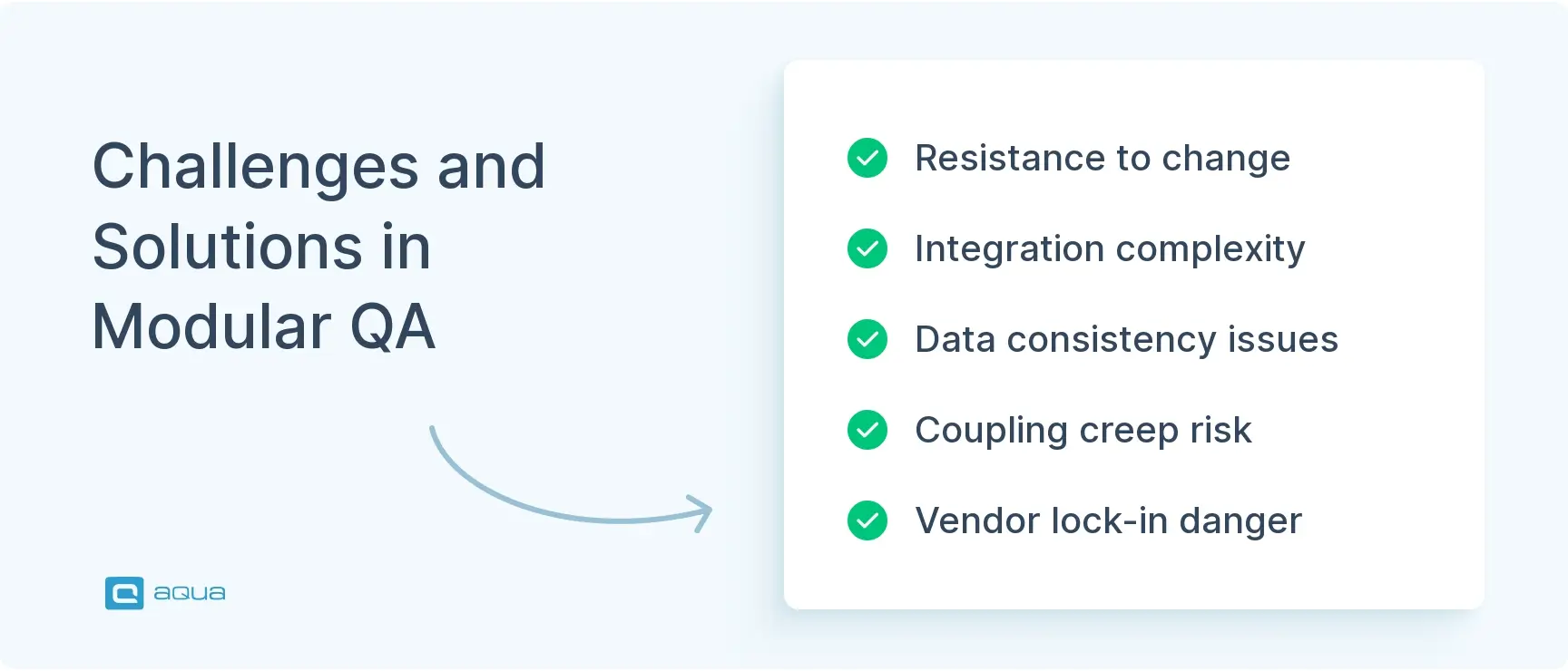
Challenges and Solutions in Modular QA Architecture
Moving to modular architecture sounds great on a whiteboard, but getting there proves messy in practice. The first challenge involves resistance to change from teams and stakeholders. Your teams that have lived with a monolith for years know its quirks and shortcuts intimately. Proposing a multi-month refactor to improve modularity can feel like trading known problems for unknown risks that haven’t been quantified.
1. Resistance to Change
Teams comfortable with a monolith know its quirks and workarounds through years of experience. Proposing multi-month refactoring to improve modularity can feel like trading known problems for unknown risks without guaranteed returns. Leadership may also question the business value of architectural changes that don’t immediately add user-facing features.
Solution:
- Start with one high-value module and extract it quickly to demonstrate feasibility
- Demonstrate improved speed or reduced defects with concrete metrics that resonate with stakeholders
- Use quick wins to build momentum and organizational buy-in across teams
- Celebrate early successes publicly to shift perception and create advocates for the approach
2. Integration Complexity
Splitting a monolith replaces in-process function calls with API calls or message queues, fundamentally changing how components interact. This introduces latency, error handling, and versioning challenges that weren’t present before. You’re suddenly thinking about what happens if the execution module goes down when a test run finishes, or how to handle schema changes in the requirements API without breaking downstream consumers that depend on specific data structures.
Solution:
- Use versioned APIs to prevent breaking changes and support gradual migration
- Build idempotent operations to handle retries safely without creating duplicate data
- Implement comprehensive instrumentation and distributed tracing to diagnose issues across module boundaries
- Design for failure with circuit breakers and fallback mechanisms that gracefully handle unavailability
- Accept eventual consistency where strong consistency isn’t critical to user experience
3. Data Consistency Challenges
In a monolith, transactions stay straightforward because everything lives in one database with ACID guarantees. In a modular setup, you might have eventual consistency across modules where changes propagate asynchronously. For QA platforms, most workflows can tolerate this delay. A test case update doesn’t need to instantly reflect in analytics dashboards. However, some workflows can’t accept eventual consistency, like user permissions and audit logs that require immediate accuracy.
Solution:
- Identify where strong consistency matters like permissions and audit logs through workflow analysis
- Accept eventual consistency elsewhere like test case updates reflecting in analytics with acceptable delay
- Use event sourcing or saga patterns for complex cross-module transactions that require coordination
- Implement compensation logic for failed distributed transactions to maintain data integrity
4. Coupling Creep
You can have modular code, but if every module directly calls five other modules through point-to-point integration, you haven’t actually decoupled anything meaningful. The solution involves event-driven architecture and clear contracts that minimize direct dependencies.
Instead of having the Execution Module directly call the Defect Module to log a bug synchronously, you emit a “TestFailed” event to a message bus, and the Defect Module subscribes to it independently. That keeps modules independent and testable in isolation without mocking multiple dependencies.
Solution:
- Favor event-driven architecture over direct module calls to reduce coupling
- Emit domain events that interested modules subscribe to rather than making direct calls
- Use message queues or event buses to decouple publishers from subscribers
- Establish clear contracts and avoid chatty communication patterns that create hidden dependencies
- Regularly review and refactor module dependencies to prevent coupling from creeping back in
5. Vendor Lock-In for AI
On the AI side specifically, vendor lock-in presents a real risk that many organizations overlook initially. If you hardcode OpenAI-specific prompt structures or response parsing into your modules, switching to Anthropic or a local model becomes a rewrite rather than a configuration change. This defeats the purpose of modularity in the AI layer.
Solution:
- Build an AI orchestration layer that handles vendor specifics and abstracts provider differences
- Expose a generic interface to the rest of the platform that doesn’t leak vendor-specific details
- Abstract provider-specific logic behind adapters or strategy patterns that encapsulate differences
- Use standardized formats for prompts and outputs where possible to minimize vendor coupling
- Implement provider-agnostic monitoring and observability to track performance across vendors
6. Testing Overhead
More boundaries mean more integration points to test comprehensively. Unit tests aren’t enough anymore. You need contract tests between modules to catch breaking changes early before they reach production. This is a critical consideration for your automation test architecture that requires upfront investment.
Solution:
- Implement consumer-driven contract testing like Pact to define expectations between modules
- Use contract tests to catch breaking changes early in CI/CD before integration testing
- Automate integration testing across module boundaries with realistic scenarios
- Invest in test data management to support realistic integration scenarios that reflect production patterns
7. Organizational Misalignment
Modular architecture works best with modular teams organized around capabilities. Small, autonomous squads own modules end-to-end including development, testing, and operations. If you’re still organizing by function with a frontend team, backend team, and AI team working in silos, you’ll struggle to maintain clean boundaries and fast iteration.
Solution:
- Structure teams around capabilities like the Requirements Team and the Execution Team rather than technical layers
- Give your teams end-to-end ownership of their modules including architecture decisions
- Clarify communication protocols and decision-making authority to reduce coordination overhead
- Consider Conway’s Law: system design mirrors organizational structure, so align them deliberately
An effective test automation framework architecture accounts for these challenges from the beginning rather than treating them as afterthoughts. The role of the automation testing architect becomes crucial in this environment, designing systems that support both modularity and comprehensive test coverage while addressing various challenges in AI in software testing.
A modular architecture that can absorb change without collapsing can be especially advantageous when integrating AI capabilities into QA platforms. aqua cloud, an AI-driven test and requirement management platform, embodies this approach with its flexible, module-based system. Unlike monolithic platforms that struggle with AI integration, aqua’s architecture treats AI as a replaceable capability layer with abstracted interfaces. You can benefit from cutting-edge AI features today while maintaining the freedom to evolve tomorrow as technology advances. The aqua AI Copilot uses your project’s own documentation as part of its intelligence, creating deeply relevant and context-aware test assets. With extensive integration capabilities for Jira, Azure DevOps, Jenkins, GitHub, GitLab, Selenium, and dozens of other tools via REST API, aqua provides the architectural flexibility and the connectivity your teams need.
Achieve 97% faster test design with a modular QA platform
Conclusion
Modular architecture of QA platforms with AI delivers a competitive edge in modern software development. When your platform absorbs change without breaking and iterates on AI features independently, you outpace teams constrained by monolithic systems. The benefits compound over time: faster delivery, lower costs, reduced technical debt. Start small by extracting one high-value module, proving ROI, then expanding systematically. Look for platforms with modular foundations featuring clean APIs and governed AI integrations. This software test automation architecture positions your organization to keep pace with modern development and whatever AI breakthroughs emerge next.






 Bankingaqua ALM helps banks increase testing productivity by over 50%