Key Takeaways
- Software testing tools for startups in 2026 prioritize team fit, integration ease, low maintenance costs, and transparent pricing rather than enterprise-level feature sets.
- AI-powered self-healing tests from companies reduce maintenance by 80% by automatically adapting to UI changes without breaking test flows.
- No-code and low-code platforms allow non-engineers to contribute to testing, spreading QA responsibility across product, support, and operations teams.
- Managed testing services deliver guaranteed coverage without requiring startups to build internal automation teams.
- The most effective startup testing approach often combines multiple tools: code-based unit/API tests, low-code platforms for critical flows, and occasional crowdtesting for real-world validation.
Startups face a paradox: they need enterprise-grade quality with fraction-sized teams and budgets. Find your perfect testing tool below 👇
Key Factors Influencing QA Tool Selection for Startups
Choosing a testing tool when you’re running lean comes down to survival math. Get it right, and you accelerate without breaking things. Get it wrong, and you’re either drowning in maintenance debt or shipping bugs that tank conversion funnels. Here’s what actually matters when evaluating the best automation testing tools for startups:
- Team reality dictates everything. If you’re a three-person engineering squad wearing ten hats, a framework that demands dedicated QA specialists is dead on arrival. You need tools that developers can pick up in an afternoon. Better yet, look for platforms where non-technical teammates can contribute. Low-code and no-code solutions are smart responses to the talent crunch. On the flip side, if you’ve got automation-savvy engineers who live in Git, a code-first framework with strong developer experience might be your speed.
- Integration friction kills momentum. Your tool needs to slot into your existing workflow without a week-long implementation saga. Startups can’t afford “integration sprints.” Look for platforms that treat CI/CD as table stakes, offer Docker support, handle secrets cleanly, and let you parallelize without custom infrastructure. Bonus points if they play nice with your observability stack so a failed test surfaces the actual root cause rather than generic error messages.
- Maintenance cost is the silent killer. Your new test suite feels great until UI changes start breaking 40% of your tests every sprint. Suddenly, you’re spending more time fixing automation than writing features. This is where ai tools for test automation, self-healing locators, visual-based testing, and component-level reuse become critical. Ask vendors for real numbers on flake rates and healing accuracy. Some platforms now position around outcomes, running and maintaining your tests as a service, which shifts the burden off your team entirely.
- Cost transparency matters more than the sticker price. Watch out for “seat creep,” usage overages, and lock-in tactics. Open-source frameworks like Playwright and Cypress have zero licensing costs but demand engineering time for setup and maintenance. Managed platforms charge subscriptions but can deliver coverage faster. Run the math: what’s cheaper over six months? Licensing fees or half an engineer’s salary wrestling with infrastructure?
The right tool matches your constraints today while supporting how you’ll work tomorrow. With those fundamentals clear, let’s meet the startups building solutions designed specifically for fast-moving teams.
Doing QA is super important for us because we produce a desktop app that is cross-released. We also maintain front-end websites, APIs, and Chrome extensions. That's a lot, and it's hard to test it all!
Here’s the main event: 21 tools for startups rewriting the QA playbook. Each one brings something different to the table, whether it’s AI-powered self-healing, software testing strategies that combine multiple approaches, or no-code automation that your entire team can rally around. We’ve organized them by what they solve, so you can zero in on your pain point.
Top 21 Software Testing Tools Startups
1. aqua cloud
Founded: 2019 | Location: Germany | Funding: Bootstrapped, customer-funded growth
If you’re tired of duct-taping together five different tools for test management, requirements, and best bug tracking software, aqua cloud offers an integrated answer. They’ve built a single platform that connects your test cases, feature specs, and defects without the usual plugin nightmare. Teams appreciate the traceability: requirements flow into test coverage reports, and gaps surface automatically.
Key strengths:
- Full requirements-to-test coverage mapping
- Built-in AI test case generation
- Bidirectional Jira synchronization
- Automated gap analysis and reporting
- Audit trails for compliance tracking
Best for: Startups struggling with agile releases and compliance pressures. If you need to prove what you tested and why you didn’t ship a bug, aqua’s audit trails and traceability dashboards provide clear visibility.
When selecting the right QA tools for your startup, you’re constantly balancing quality with speed and resources. aqua cloud, an AI-powered test and requirement management solution, makes this easier with centralized test management that eliminates the need for separate tools. With aqua’s domain-trained AI Copilot, you can generate comprehensive test cases from your requirements in seconds, saving up to 12 hours per team member every week. The AI learns from your project’s documentation to deliver contextually relevant test cases where 42% require no further editing. For startups juggling rapid releases and quality standards, aqua’s traceability features ensure complete requirements-to-test coverage mapping. The platform automatically tracks which requirements have test coverage and flags gaps before they become production issues. Plus, aqua integrates seamlessly with Jira, GitHub, GitLab, your existing CI/CD pipelines, and numerous external software solutions.
Save 97% of your testing time with aqua's AI
2. QA Wolf
Founded: 2019 | Location: United States | Funding: Series A, $20M+
QA Wolf positions as an outcome-focused service. They don’t just hand you a platform and wish you luck. Their model works like this: you define critical user journeys, they build and maintain end-to-end tests in parallel, and you get a shared Slack channel for ongoing support. Think of it as extending your QA capacity without hiring.
Key strengths:
- 80% test coverage guarantees
- Unlimited parallel test execution
- Automatic test maintenance included
- Shared Slack support channel
- Zero flake guarantee approach
Best for: Early-to-growth SaaS startups that need E2E confidence fast without building an internal automation function. You’re buying coverage and stability through a service model.
3. Rainforest QA
Founded: 2012 | Location: United States | Funding: Series B, $30M+
Rainforest takes a visual-first approach to no-code automation. Your tests interact with what users see, not brittle CSS selectors. That means when your design team ships a UI refresh, your tests remain stable. Non-engineers can author and maintain tests, which spreads the QA load across product, support, and ops teams.
Key strengths:
- Visual-based no-code test creation
- Desktop app testing via VMs
- Human crowdtesting for exploratory validation
- Cross-functional team authorship
- Regression and exploratory testing combined
Best for: Startups with high UI churn, limited automation expertise, and cross-functional teams who want to contribute to quality without learning Selenium.
4. Functionize
Founded: 2016 | Location: United States | Funding: Series B, $50M+
Functionize focuses on agentic AI that builds, runs, diagnoses, and self-heals tests with minimal human input. You describe what you want tested in natural language, and the AI generates functional tests. When something breaks, the platform analyzes root cause and suggests fixes rather than just retrying.
Key strengths:
- Natural language test generation
- Autonomous test healing capabilities
- Specialized AI feature testing modules
- Root cause analysis automation
- LLM and recommendation testing support
Best for: Teams dealing with high test maintenance overhead, products with rapid UI iteration, or SaaS companies starting to ship AI features that require non-deterministic assertion strategies.
5. mabl
Founded: 2017 | Location: United States | Funding: Series C, $80M+
mabl positions as an AI-native platform and focuses on low-code test creation with smart healing and auto-wait logic. Their platform runs tests in the cloud, captures full context including video and DOM snapshots, and integrates tightly with modern CI/CD pipelines. They’ve recently expanded their focus to testing AI applications.
Key strengths:
- Low-code test creation interface
- Self-healing locators via AI
- Visual change detection system
- AI application testing workflows
- Insight dashboards for flake analysis
Best for: Startups scaling fast who need broad E2E coverage, plus any team shipping AI-powered product features that don’t behave deterministically.
6. Testim
Founded: 2014 | Location: Israel / United States | Funding: Series B, $30M+ (acquired by Tricentis)
Testim blends low-code authoring with AI-powered self-healing locators. You record tests visually, then optionally jump into code for complex scenarios. When the DOM changes, Testim’s ML adapts locators to maintain test stability. This approach works for teams who want speed but don’t want to sacrifice version control or customization.
Key strengths:
- AI-powered element identification
- Low-code recording with code flexibility
- Reusable custom action library
- Parallel cross-browser execution
- Version control integration
Best for: Engineering-led startups that want test assets in Git but don’t want to hand-code every assertion. You get the flexibility of code with the speed of low-code recording.
7. testRigor
Founded: 2018 | Location: United States | Funding: Series A, ~$10M
testRigor works with plain English test descriptions using generative AI. The platform figures out how to execute them. “Click ‘Sign Up'” becomes executable automation. No locators, no waits, no brittle selectors. Just human-readable instructions. The platform is built for teams where QA isn’t a dedicated discipline.
Key strengths:
- Plain English test authoring
- Generative AI execution engine
- Email and PDF testing support
- 2FA flow handling built-in
- Intent-based self-healing
Best for: Non-technical teams or startups where product managers, support staff, and designers want to own quality checks without learning code.
8. BugBug
Founded: 2019 | Location: Poland | Funding: Bootstrapped
BugBug targets budget-conscious startups with low-code recording, reusable components, variables, and optional JavaScript for advanced steps. You record a test, abstract login as a component, then reuse it everywhere. Pricing is transparent and startup-friendly without enterprise sales requirements.
Key strengths:
- Component-based test architecture
- Local and cloud execution options
- Scheduled regression run support
- Transparent startup pricing model
- Optional JavaScript extensibility
Best for: Lean teams that need practical automation on a tight budget. You’re prioritizing speed and cost efficiency.
9. Global App Testing
Founded: 2013 | Location: United Kingdom | Funding: Series B, $30M+
Global App Testing operates a large network of professional testers across devices, geographies, and use cases. Rather than automating exploratory testing, you get humans who can break your app in ways scripts won’t discover. They specialize in real-device testing, accessibility checks, localization validation, and pre-launch smoke tests.
Key strengths:
- Vetted professional tester network
- 190+ country coverage availability
- Real device testing infrastructure
- Detailed bug reports with video
- Fast turnaround measured in hours
Best for: Startups launching globally, testing mobile apps across fragmented Android/iOS device matrices, or needing exploratory QA capacity before major releases.
10. Kobiton
Founded: 2016 | Location: United States / Vietnam | Funding: Series B, $30M+
Kobiton takes a mobile-first and scriptless approach. They provide real devices in the cloud, plus AI-driven test creation and execution for iOS and Android. You interact with devices manually to generate tests, then automate them without writing code. Their platform handles device farms, app performance monitoring, and cross-device regression testing.
Key strengths:
- Real device cloud infrastructure
- Scriptless AI-powered automation
- Session recording for debugging
- Performance insights baked in
- Thousands of OS/device combinations
Best for: Mobile-first startups, apps targeting diverse Android markets, or teams needing continuous device testing without maintaining physical labs.
11. Katalon
Founded: 2015 | Location: United States / Vietnam | Funding: Series B, $30M+
Katalon offers a full-stack testing platform with web, mobile, API, and desktop support all in one IDE. The platform is low-code but extensible with Groovy scripts. Teams use it to build cross-platform automation without juggling multiple frameworks. Built-in integrations for Jira, Git, Jenkins, and cloud execution round out the package.
Key strengths:
- Unified web/mobile/API testing IDE
- AI-powered object healing
- TestOps analytics and reporting
- Built-in CI/CD integrations
- Groovy script extensibility
Best for: Startups testing across multiple surfaces who want one tool instead of stitching together Selenium, Appium, and Postman separately.
12. Sauce Labs
Founded: 2008 | Location: United States | Funding: Series E, $250M+ (scale-up, included for platform relevance)
Sauce Labs pioneered cloud-based cross-browser and mobile testing infrastructure that smaller companies now rely on. You run Selenium, Appium, Cypress, or Playwright tests on their device/browser grid without managing VMs. Visual testing and failure analysis tools help triage issues efficiently.
Key strengths:
- 3,000+ browser/device combinations
- Video playback with command logs
- Major CI tool integrations
- Pixel-perfect visual testing
- Managed grid infrastructure
Best for: Startups needing broad compatibility validation but lacking infrastructure budget. You rent the grid instead of building it.
13. LambdaTest
Founded: 2017 | Location: United States / India | Funding: Series C, $60M+
LambdaTest offers a similar cloud grid model to Sauce Labs with browsers, real devices, and VMs, but with aggressive pricing and faster feature rollout. They support manual testing, automation with Selenium and Cypress, visual regression, and even real-time collaboration via built-in screen sharing.
Key strengths:
- HyperExecute parallel test orchestration
- AI-powered visual baseline management
- Geolocation testing capabilities
- Real-time collaboration features
- Aggressive startup-friendly pricing
Best for: Cost-conscious startups that need enterprise-grade infrastructure without enterprise contracts. Works well for remote teams doing live debugging together.
14. Applitools
Founded: 2013 | Location: United States / Israel | Funding: Series D, $100M+
Applitools specializes in visual AI testing with advanced screenshot comparison that understands what matters visually. Their Ultrafast Grid runs visual tests across browsers and devices in parallel, and AI filters out rendering noise while catching real regressions. It integrates with all major frameworks.
Key strengths:
- Visual AI eliminates false positives
- Root cause DOM change analysis
- Ultrafast parallel grid execution
- Responsive layout validation
- Major framework integrations
Best for: Product-led startups where UI/UX serves as a competitive edge. If pixel-perfect design and cross-browser consistency matter, Applitools provides reliable validation.
15. Percy (BrowserStack)
Founded: 2016 (acquired by BrowserStack 2021) | Location: United States | Funding: Part of BrowserStack
Percy handles visual regression testing with a developer-first workflow. You push snapshots to Percy via CI, and it diffs them against baselines. Approved changes update the baseline; unintended diffs alert your team. It integrates with GitHub PRs, so visual reviews happen inline with code reviews.
Key strengths:
- Snapshot-based visual diffing
- Responsive width testing mode
- Asset freezing for dynamic content
- GitHub PR integration
- Developer-friendly CI workflow
Best for: Frontend-heavy startups that want to catch CSS bugs and unintended layout shifts before they hit production.
16. Testlio
Founded: 2012 | Location: United States / Estonia | Funding: Series B, $30M+
Testlio combines human testers with platform-managed QA. They provide vetted testing networks, test case management, and analytics, all coordinated by a dedicated account team. You get exploratory, functional, regression, and localization testing on demand, backed by tools for visibility and reporting.
Key strengths:
- Managed networked testing service
- Dedicated account team coordination
- Exploratory and functional testing
- Localization validation support
- Existing tool integration
Best for: Startups outsourcing QA entirely or supplementing lean internal teams with on-demand expertise and execution capacity.
17. Reflect
Founded: 2020 | Location: United States | Funding: Seed, ~$5M
Reflect is a newer no-code test automation platform built for speed. You record tests in the browser, and Reflect generates stable automation. Tests run in the cloud, parallelized automatically, with built-in scheduling and CI integrations. The platform positions itself as E2E testing without complexity.
Key strengths:
- Browser-based no-code recording
- Automatic waits and retry logic
- Cloud parallelization built-in
- Visual debugging reports
- Out-of-box CI/CD integrations
Best for: Small engineering teams that want quick E2E coverage without writing code or managing infrastructure.
18. Checkly
Founded: 2018 | Location: Germany | Funding: Series A, ~$10M
Checkly blends synthetic monitoring with E2E testing using Playwright under the hood. You write or generate JavaScript-based checks, then schedule them globally to monitor uptime, performance, and user flows. Alerts fire when checks fail, and you get detailed traces for debugging. The platform combines monitoring and testing capabilities.
Key strengths:
- Monitoring as code approach
- Terraform/Pulumi infrastructure support
- Global checkpoint deployment
- Observability stack integration
- Playwright-based execution
Best for: Startups that want proactive monitoring of critical user journeys in production beyond pre-deployment testing.
19. Loadmill
Founded: 2016 | Location: Israel | Funding: Seed, ~$5M
Loadmill handles API and load testing with a focus on CI/CD integration. You record API flows, then replay them as functional or performance tests. It supports complex scenarios including auth, chaining requests, and dynamic data, and scales to thousands of virtual users for load testing.
Key strengths:
- API flow recording capability
- Functional and performance testing
- Complex scenario support
- Virtual user scaling
- Continuous CI/CD integration
Best for: API-first startups or backend-heavy platforms that need performance and functional validation without separate tools.
20. Testsigma
Founded: 2017 | Location: United States / India | Funding: Series B, $10M+
Testsigma offers unified test automation tools for web, mobile, and API in natural language. You write tests in plain English, and Testsigma’s AI handles locators, waits, and device orchestration. Cloud execution, self-healing, and visual testing are built into the platform.
Key strengths:
- Natural language authoring system
- AI-driven test maintenance
- Built-in cross-browser/device grid
- Unified web/mobile/API framework
- Cloud execution infrastructure
Best for: Startups needing broad automation coverage with minimal setup and no separate toolchains.
21. Octomind
Founded: 2021 | Location: Germany | Funding: Seed, ~$3M
Octomind takes an AI-first approach to E2E testing that auto-generates and maintains Playwright tests. You connect your app, and Octomind explores it, builds tests, and keeps them updated as your UI evolves. The platform runs in CI and surfaces real issues while filtering out noise.
Key strengths:
- AI-powered test auto-generation
- Continuous self-healing mechanism
- Auto-discovery of test scenarios
- GitHub Actions integration
- Zero-config CI setup
Best for: Tiny teams or solo developers who want E2E coverage without writing or maintaining tests manually.
Summary table: Quick-reference startup profiles
| Startup |
Primary Value Prop |
Best Fit |
| aqua cloud |
Integrated test + requirements management |
Compliance-aware agile teams |
| QA Wolf |
Managed E2E service with guaranteed coverage |
SaaS startups needing fast, stable automation |
| Rainforest QA |
No-code visual automation + crowdtesting |
High UI churn, non-technical authorship |
| Functionize |
Agentic AI builds/heals tests autonomously |
Maintenance-heavy environments, AI features |
| mabl |
AI-native low-code with AI app testing |
Scaling startups shipping AI products |
| Testim |
Low-code + AI locators + code flexibility |
Engineering teams wanting speed + control |
| testRigor |
Plain-English generative automation |
Non-technical QA contributors |
| BugBug |
Budget-friendly low-code with reusable components |
Lean teams, tight budgets |
| Global App Testing |
Crowdtested real-device validation |
Global launches, exploratory bursts |
| Kobiton |
Scriptless mobile automation on real devices |
Mobile-first apps, device fragmentation |
| Katalon |
Unified web/mobile/API IDE |
Multi-surface testing in one tool |
| Sauce Labs |
Cloud browser/device grid infrastructure |
Broad compatibility needs |
| LambdaTest |
Fast, affordable cloud grid alternative |
Cost-conscious distributed teams |
| Applitools |
Visual AI regression testing |
Pixel-perfect UI, responsive design |
| Percy |
Developer-first visual diffs in PRs |
Frontend-heavy teams, CSS safety |
| Testlio |
Managed networked testing service |
Outsourced or on-demand QA capacity |
| Reflect |
No-code E2E with cloud execution |
Small teams, quick setup |
| Checkly |
Monitoring-as-code with Playwright |
Proactive production user-flow monitoring |
| Loadmill |
API + load testing in CI |
API-first backends, performance validation |
| Testsigma |
Natural-language web/mobile/API automation |
Unified toolchain, minimal setup |
| Octomind |
AI auto-generates and maintains Playwright tests |
Solo devs or tiny teams, hands-off automation |
This table shows how startups are rethinking QA around your constraints: speed, cost, and team size. When evaluating the best testing tools for startups, the right choice solves the problem that’s killing your velocity today, whether that’s flake, coverage gaps, or maintenance overhead.
This isn't a case of under-funding testing vs other priorities. It's more a case of "my company is tiny, I'm getting some traction, and I'm trying to manage my time and my money wisely across a bunch of priorities". I place a lot of value on testing. I've been doing a ton of it and ready to look at ways to make it more productive.
nogoldenhandcuffs
Posted in
Reddit
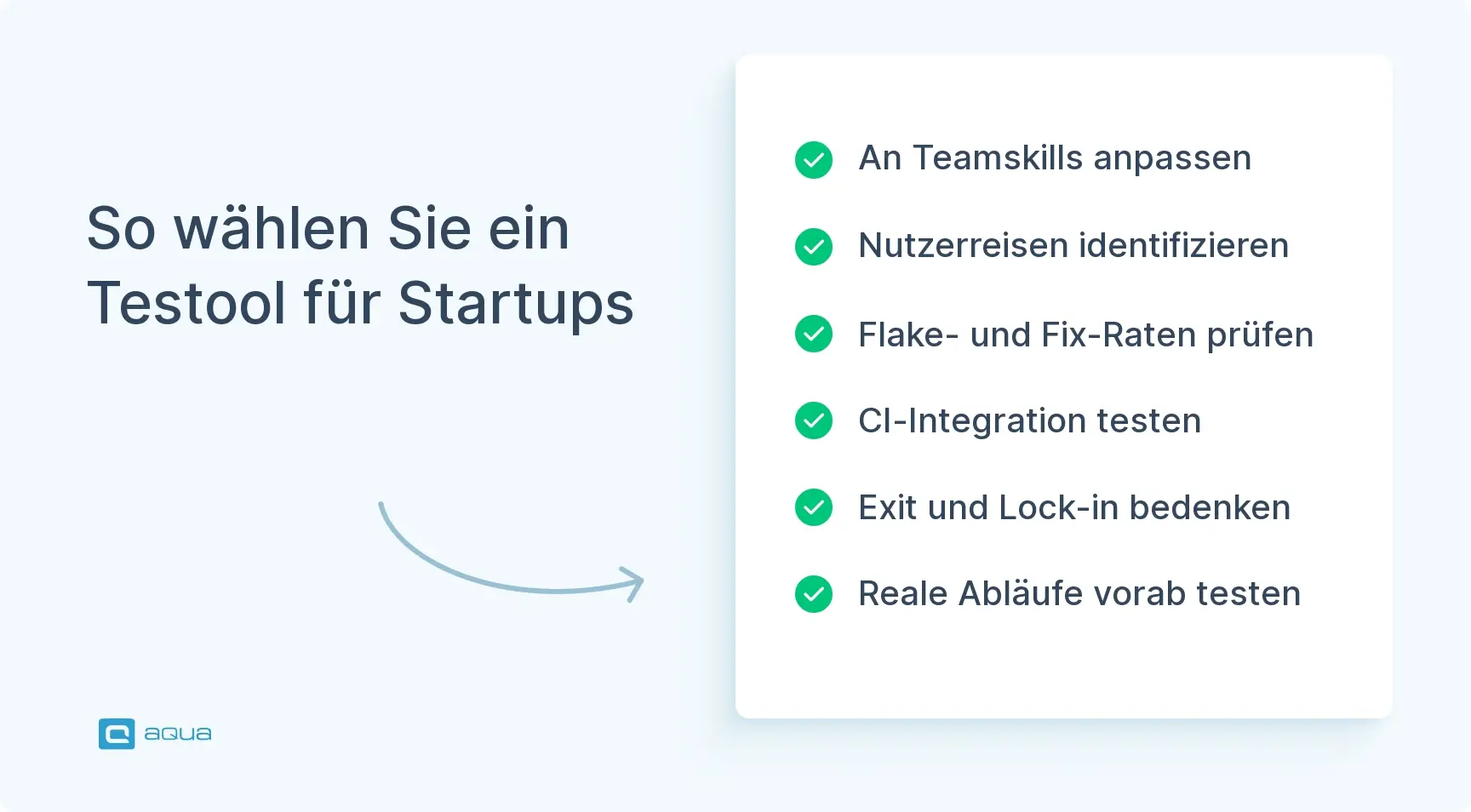
Tips to Choose the Right Testing Tool for Your Startup
Picking a testing tool comes down to matching the tool to your constraints and pain points. Here’s how to cut through the noise and land on something that actually works for evaluating the top software testing tools for startups.
1. Start with your team’s skills and capacity. If you’ve got automation engineers who live in code, a framework like Playwright or Cypress gives you full control. If your QA capacity is “whoever has time,” lean toward no-code or managed services. Don’t buy a tool that assumes expertise you don’t have yet.
2. Map your critical user journeys before shopping. Write down the 10 to 15 flows that directly impact revenue or retention. Think login, checkout, onboarding, and core workflows. Your testing tool must cover those reliably. Everything else is optional until you’ve got the foundation stable.
3. Ask vendors for flake and maintenance metrics. How often do tests break when the UI changes? What’s the average time to fix a broken test? How many self-healing attempts succeed? Real numbers provide better insight than marketing claims.
4. Test the integration story before committing. Spin up a trial, connect it to your CI pipeline, and run a few smoke tests. If it takes more than a day to get green builds, that’s a red flag. Your tool should slot into GitHub Actions or GitLab CI without heavy lifting.
5. Factor in exit costs and lock-in. Can you export your test assets if you switch tools? Are tests tied to proprietary formats, or do they live in standard code? Startups pivot frequently. Your tooling should support that reality.
6. Use a decision matrix weighted to your top pain. Score tools 1 to 5 on criteria like ease of authoring, flake rate, CI integration, cost, and team fit. Weight the categories that hurt you most. If maintenance is your nightmare, double the weight there. Add the scores, and the winner usually reveals itself.
7. Think portfolio over monolith. The best setup often mixes tools: unit and API tests in code, critical E2E flows in a low-code platform, and exploratory bursts via choosing the best beta testing tool. You don’t need one tool that does everything. You need a coherent stack that fits your workflow.
8. Run a pilot on real work. Pick three critical flows, automate them with your shortlisted tool, run them in CI for a week, and measure the pain. Did tests flake? Did they catch real bugs? Could your team maintain them without heroics? That pilot provides your clearest answer.
When evaluating the best test management tools for startups, don’t forget to consider the best free automation testing tools for startups as well. Many top automated testing tools for startups offer free tiers or open-source versions that can be perfect for getting started. The best startup testing automation tools can provide excellent functionality while keeping costs down as you build your testing infrastructure. Among the essential automated testing tools for startups, finding the best tools for startup testing solutions often means balancing immediate needs with long-term scalability.
As you evaluate the best testing tools for your startup in 2026, remember that the right solution should enhance your velocity rather than slow it down. aqua cloud, an AI-driven test and requirement management platform, addresses the core challenges startups face: limited resources and the need for trustworthy quality without enterprise-level overhead. With aqua’s AI Copilot, your team can generate comprehensive test cases and test data in seconds while keeping your proprietary information secure and compliant. For startups navigating the balance between speed and quality, aqua provides centralized test management, AI-powered efficiency, and clear reporting that demonstrates ROI. The platform scales with your team, supporting everything from initial MVP testing through enterprise-grade quality assurance as you grow. aqua integrates bidirectionally with Jira, connects to GitHub, GitLab, Azure DevOps, and supports REST API.
Achieve 100% requirements coverage with domain-trained AI
Conclusion
The startup testing niche in 2026 centers on a practical reality: it’s hard to afford traditional QA overhead, but you also can’t afford to ship broken software. The 21 startups in this guide understand that tension and are building solutions that fit how fast-moving teams actually work. Whether you need AI-powered automation that heals itself, no-code platforms your PM can use, or managed services that deliver coverage without expanding headcount, the right choice depends on what’s killing your velocity today. Flake, maintenance burden, coverage gaps, or simply a lack of time all require different solutions. Among the best startup testing tools available, quality doesn’t have to slow you down when you match the right tool to your specific constraints and workflow.






 Bankingaqua ALM helps banks increase testing productivity by over 50%