Test Automation in Agile: Advanced Strategies and Tools
Agile development moves fast. Your team ships features every sprint and responds to feedback in real time. But here's the problem: manual regression testing can't keep up. It becomes the bottleneck that lowers the project’s velocity. Most teams have adopted test automation to solve this. Yet flaky tests, slow CI pipelines, and maintenance overhead still plague their efforts. This guide shows you how to make test automation actually work in Agile.
Test automation in Agile requires starting early in development, with nearly 85% of teams using some form of test automation as part of their testing strategy.
The test automation pyramid follows a 70-20-10 distribution as a starting point: 70% unit tests, 20% integration/API tests, and 10% end-to-end UI tests, though teams adjust these ratios based on their architecture.
Teams must prioritize test cases based on business-critical flows, regression-prone areas, and high-frequency use cases rather than pursuing complete coverage.
Continuous Integration and Testing enables rapid feedback loops, allowing teams to catch issues within minutes of code changes instead of waiting until the end of a sprint.
Regular monitoring of metrics like pass/fail trends, flakiness rates, and execution time helps teams distinguish between real bugs and test-related issues.
Flaky tests can completely undermine trust in your automation suite, yet many teams still struggle with this fundamental challenge. Discover how to transform your test automation strategies for better results 👇
Understanding Agile and Test Automation
Agile methodologies work through short cycles of iterative development and continuous feedback. Instead of six-month waterfall projects, teams work in two-week sprints or shorter. Requirements evolve, user stories shift mid-sprint, and teams adapt quickly. This rapid pace demands testing approaches that keep up without becoming bottlenecks.
Test automation provides the tight feedback loops Agile teams need. When developers merge pull requests, automated checks run in minutes and catch regressions before they reach staging. When product owners tweak user stories mid-sprint, teams can re-run suites to verify changes didn’t break adjacent features. Agile automated testing makes the continuous integration and continuous delivery pipelines work safely for frequent deployments.
Agile depends on rapid iteration, and automation testing in Agile prevents testing from becoming a bottleneck. Without it, teams either cut corners on quality or slow down until “Agile” becomes meaningless. Teams running Agile or hybrid methods increasingly rely on automated testing to maintain pace. Implementing Agile methodology in automation testing has become necessary for teams wanting to maintain both quality and velocity.
Challenges of Test Automation in Agile
Integrating test automation and Agile practices sounds straightforward in theory. In practice, teams hit obstacles that can derail even well-intentioned efforts. Understanding these challenges upfront helps you sidestep common traps and build a sustainable automation strategy.
Key challenges include:
Time pressure and resource allocation. Agile sprints are short, typically two weeks. Teams often feel there’s no slack to build test frameworks or refactor existing suites. Automation tasks get deprioritized in favor of feature work. This creates a cycle where no tests mean more manual effort. Organizations often expect automation to pay off immediately and demand full ROI within a sprint or two. That’s unrealistic and sets teams up for frustration.
Flaky tests. Tests that pass one run, fail the next, and pass again without code changes erode trust in automation suites. When developers see red builds caused by unstable tests, they start ignoring failures. Common issues include timing problems like hard-coded sleeps instead of smart waits, environment instability such as shared test databases, and fragile UI locators that break when CSS classes change.
Dependency on up-to-date test data. As teams progress, data models evolve and APIs change. Tests relying on static fixtures break constantly. Privacy regulations like GDPR make it risky to use real user data for testing. Finding stable, representative, compliant test data is a puzzle many teams struggle to solve.
Balancing automation and manual testing. Agile doesn’t mean automating everything. Exploratory testing, usability checks, and edge-case hunting still require human judgment. The challenge is deciding what to automate and what to leave manual. Teams that try to script every acceptance criterion end up with bloated test suites. Teams that automate too little accumulate regression debt that eventually forces them to slow down or skip releases.
Integrating test automation into Agile requires an environment where quality supports speed rather than slowing it down. aqua cloud, an AI-driven requirement and test management platform, was designed to address this challenge. With aqua, you get CI/CD integration with Jenkins and Azure DevOps. The platform provides out-of-the-box support for automation frameworks like Selenium, Playwright, and Cypress. All tests are managed from a central repository where manual and automated tests live side-by-side. aqua’s domain-trained AI Copilot creates project-specific test cases grounded in your actual documentation and requirements. This ensures relevance and accuracy that generic AI tools simply can’t match. The platform connects with over 12 popular tools, including Jira, Ranorex, JMeter, and SoapUI. You can also use the REST API to integrate any other tool you need.
Save up to 12 hours per tester weekly with smart test management
Best Practices for Effective Test Automation in Agile
Building an agile test automation strategy that supports velocity requires discipline and smart prioritization. Here are the practices that separate high-performing teams from those stuck in maintenance mode.
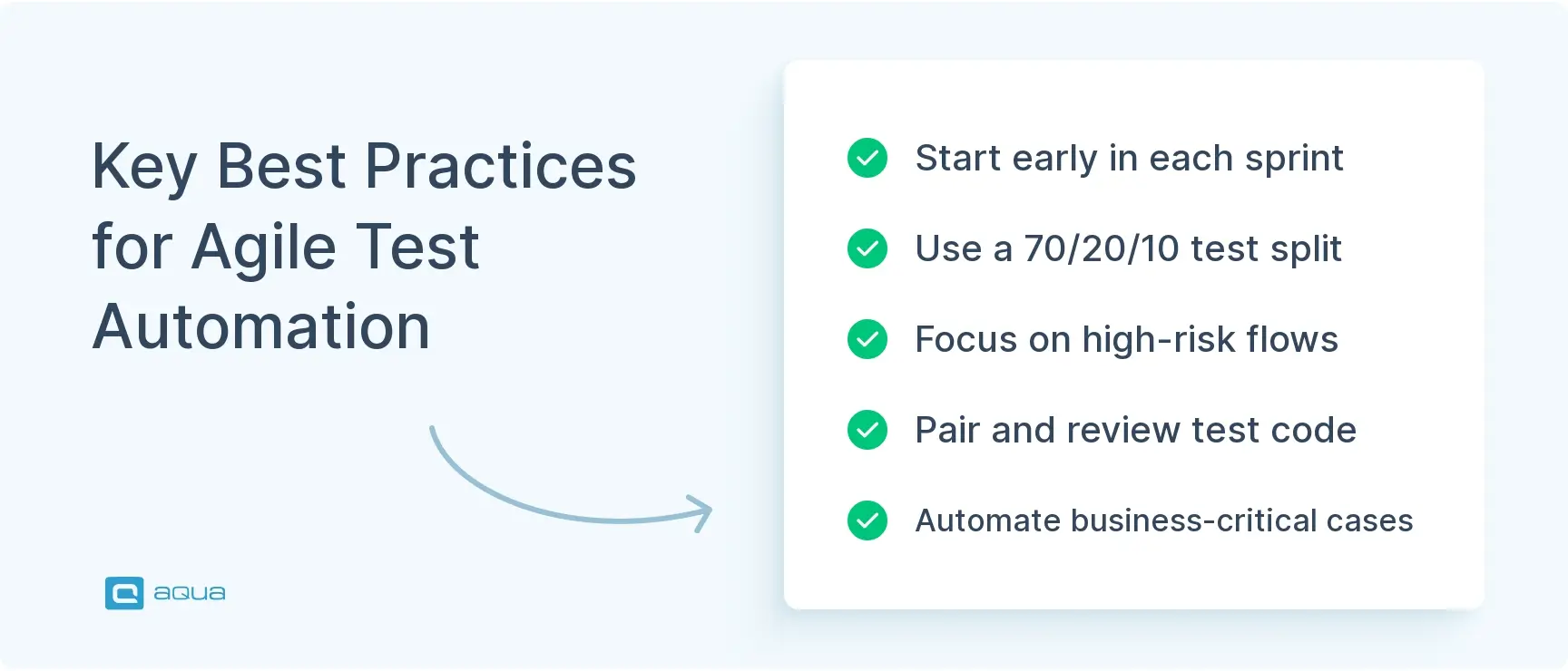
Start automation early in the development cycle
Don’t wait until a feature is done to think about tests. During backlog refinement and the Three Amigos conversation, map out acceptance criteria and identify which scenarios should be automated. When developers know a story will need automated coverage, they build it in a way that’s easy to test. Clean APIs, stable hooks in the UI, and clear separation of concerns all become natural outcomes. Teams that treat automation as an afterthought end up retrofitting tests onto brittle code, which multiplies effort and flakiness.
Maintain a solid automation framework that supports collaboration
Treat your test code like production code. Keep it clean, refactored, reviewed, and versioned. Use design patterns like Page Object Model to encapsulate UI interactions and keep tests readable. Avoid copy-paste duplication. Modern frameworks such as Playwright and Cypress support these patterns out of the box, but you need to enforce coding standards through reviews.
When only one or two people understand the test suite, you’ve created a knowledge silo. Make automation a team sport. Pair on writing tests. Rotate ownership of test suites.
I'm confused as to why you would not do automation 'in-sprint' and automate alongside code delivery in the same sprint-board. I worry every time someone makes it sound like fresh news that we should all be doing a thing. Because a lot of us are doing this already anyway I'll bet.
Not all features carry equal weight. A bug in the checkout flow costs you revenue. A typo in a help tooltip does not. Use a risk-based approach to decide what to automate first. Focus on business-critical user journeys that generate revenue, regression-prone areas that tend to break when you change nearby code, and high-frequency use cases where bugs surface immediately.
This ensures your automation delivers maximum value quickly rather than chasing 100% coverage across low-risk features. Start small. Automate the top five flows in your first sprint, then expand gradually. This forms the basis of a solid test automation strategy in Agile.
Embrace the test automation pyramid
This is probably the single most important architectural principle for Agile test automation. The classic 70-20-10 distribution provides a starting point: 70% unit tests, 20% integration tests, and 10% end-to-end tests. Unit tests are fast, stable, and pinpoint failures. UI tests are slow, brittle, and fail for vague reasons. If you invert the pyramid with lots of UI tests and few unit tests, you end up with a suite that takes hours to run. However, Agile teams need fast feedback. The pyramid delivers it. Understanding the continuous testing benefits helps teams make better decisions about their testing investment.
Choosing the Right Test Automation Tools
Tool selection can make or break your automation strategy. The best tool fits your team’s skills, tech stack, and Agile workflow. Here’s how to evaluate your options and what’s trending in 2025 to 2026.
1. Define clear selection criteria
Before you look at tools, define what you need. Can your team learn it quickly? Does it plug into your CI/CD pipeline like GitHub Actions or Jenkins? Can it report results into your test management system such as Jira with Xray? Do you need unit, API, UI, mobile, or performance testing? One tool might not cover everything. Just make sure your stack plays nicely together. If your team codes in TypeScript, a JavaScript-native tool makes sense.
2. Evaluate web UI automation options
Selenium is still the de facto standard. It’s mature, supports every major browser, and works in almost any language. But newer tools have gained traction. Playwright is the rising star with cross-browser support, built-in auto-waits that reduce flakiness, and parallelization out of the box. Many teams report that Playwright’s reliability has made it their go-to choice. Cypress remains strong for front-end-focused teams with its time-travel debugging and integrated test runner.
3. Consider mobile testing frameworks
For mobile testing, Appium is still the dominant cross-platform framework. It lets you write tests once and run them on iOS and Android. Native tools like Espresso for Android offer tighter integration but lock you into a single platform. Many Agile teams run mobile tests on cloud device farms like LambdaTest and BrowserStack. These platforms provide access to hundreds of real devices without the overhead of maintaining a physical lab.
4. Build out API and integration testing
This is where you build the middle of your test pyramid. Postman is ubiquitous for manual API testing and now supports automated collections that can run in CI. REST Assured for Java and Karate are popular for code-based API tests. Contract testing with tools like Pact works well for microservices. Instead of running full end-to-end tests for every service combination, you validate the contracts between services independently.
5. Implement test management and reporting tools
These help you organize test cases, link them to user stories, and track coverage trends. Jira with Xray or Zephyr are common in Agile teams already using Atlassian. TestRail and aqua are strong standalone options. Allure TestOps provides detailed reports and integrates with most automation frameworks. The key is traceability between requirements and tests.
Tool
Language Support
Browser Support
Auto-Wait
Parallel Execution
CI Integration
Selenium
Java, Python, C#, JS, etc.
Chrome, Firefox, Safari, Edge
No (manual)
Yes (via Grid)
Yes
Playwright
JS/TS, Python, Java, .NET
Chrome, Firefox, Safari, Edge
Yes
Yes (built-in)
Yes
Cypress
JavaScript
Chrome, Edge, Firefox (limited Safari)
Yes
Yes (paid tier)
Yes
Puppeteer
JavaScript
Chrome/Chromium only
Yes
Yes
Yes
AI-assisted and codeless tools are also trending. These can be useful for bootstrapping coverage or for teams with limited coding skills. Most high-performing Agile teams still rely on well-engineered code-based frameworks for flexibility. Finding the right Agile testing tools and Agile software testing tools requires understanding both your team’s needs and the rapidly evolving landscape. Our test automation tools guide covers this in more detail.
Pick tools that align with your team’s strengths and tech stack. Make sure they integrate cleanly into your CI/CD pipeline and provide the right balance of power and simplicity.
Choosing the right automation tools is one challenge. Managing them all in one place is another. aqua cloud, a dedicated, AI-powered platform, brings together test management, requirements management, defect tracking, and project management. This single platform is built specifically for Agile teams. aqua natively integrates with leading automation frameworks, including Selenium, Playwright, Cypress, Ranorex, JMeter, and SoapUI. You can manage both manual and automated test results side by side with full traceability to requirements. The AI Copilot generates test cases, requirements, and test data in seconds based on your project’s actual documentation. aqua platform scales to millions of test cases without performance issues. It connects seamlessly with your existing tools through native integrations for Jira, Jenkins, Azure DevOps, Confluence, and more. The comprehensive REST API handles any custom integrations you need.
Get a unified platform that covers all your Agile testing needs in one place
Implementing Continuous Integration and Continuous Testing
Continuous Integration and Continuous Testing drive test automation into Agile velocity. CI means merging code into a shared repository multiple times a day, with automated builds and tests running on every commit. CT means testing happens continuously throughout the pipeline as feedback is integrated into every step. Together, they let your Agile team ship fast without sacrificing quality.
How CI/CD enhances deployment efficacy
In a traditional workflow, you might run manual regression tests once at the end of a sprint before releasing. That creates a bottleneck. If tests find issues late, you either delay the release or ship with known bugs. CI/CD changes this. Automated tests run on every pull request and catch regressions within minutes of a code change. Fast feedback lets developers fix issues while the context is still fresh. When your main branch is always in a deployable state because tests validate it constantly, you can release whenever the business is ready.
The relationship between automated testing, CI/CD, and Agile success
Agile emphasizes working software and rapid iteration. CI/CD is the mechanism that makes those iterations safe. Automated tests are the safety net. Without automation, CI/CD pipelines become either too slow from waiting for manual checks or too risky from skipping checks to ship faster. Teams that treat automation as essential report higher deployment frequency and lower lead times. They embed tests into their Definition of Done, run them in parallel, and monitor metrics closely.
Here’s a typical CI/CD flow that integrates continuous testing:
On every commit or pull request: Run fast checks like linters, unit tests, and a small smoke suite covering API or critical UI flows. This should complete in under 10 minutes.
On main branch merge: Run a broader suite with more API tests, integration tests, and a subset of UI end-to-end tests. Use parallel execution to keep this under 30 minutes.
Nightly or scheduled runs: Execute the full regression suite, including slow end-to-end tests and security scans. These don’t block deployments but catch edge cases.
Deployment gates: Before promoting code to staging or production, require that essential test suites pass.
Technical enablers include parallel test execution with tools like Selenium Grid and Playwright’s built-in parallelization, infrastructure as code with Docker or Kubernetes to spin up test environments on demand, and feature flags to deploy code to production with features toggled off for safe testing.
Teams that excel at CI/CD and continuous testing ship faster with fewer escaped defects. Implementing test automation in Agile projects becomes more effective when integrated into a continuous testing strategy.
Automate what makes your dev teams' lives easier and gives you more confidence in your deployments. That's really what it comes down to: what can we automate to give our dev teams more confidence in making changes?
Case Studies: Success Stories of Test Automation in Agile Projects
Seeing how other teams have implemented automation in agile environments makes the strategies tangible. Here are real-world examples where organizations successfully transformed their testing approaches. Specific tool names and customer identities are withheld to maintain confidentiality.
Case study 1: Financial services company restructures test suite architecture
Imagine a team running Scrum struggled with a UI-heavy test suite that took excessive time to complete. Developers started skipping tests to meet sprint deadlines, which led to production bugs. They re-architected their suite around the test automation pyramid over several sprints, shifting coverage from UI tests to API and unit tests. They kept only essential UI flows automated end-to-end. Regression time dropped dramatically. Tests are now run on every pull request. Deployment frequency increased from weekly to daily.
Case study 2: E-commerce platform tackles flaky tests systematically
Picture this: a team using Kanban faced a flakiness crisis where a significant portion of tests failed intermittently. Developers stopped trusting the results. They introduced a systematic approach where any test that failed multiple times without code changes was automatically quarantined. The whole team dug into root causes and found that most flakiness came from timing issues, shared test data, and race conditions. After fixing those patterns, their flakiness rate dropped substantially.
Case study 3: SaaS company adopts contract testing for microservices
Imagine an organization running Scaled Agile Framework had multiple microservices owned by different squads. End-to-end tests across all services took hours and broke constantly as teams evolved their APIs. They adopted contract testing where each service published a contract defining what it expected from dependencies. Tests validated contracts independently without spinning up the full system. Deploy time shrank, and inter-team coordination friction eased.
Key takeaways: Focus automation on high-value areas rather than chasing complete coverage. Treat flakiness as a blocker because unstable tests undermine trust. Fix them proactively. Adapt tools to your architecture. These teams iterated on their automation strategy through retrospectives and metrics, following approaches detailed in our case studies on automation success.
Monitoring, Logging, and Continuous Improvement of Test Automation in Agile
Agile teams that excel at automation treat it as a living system that requires monitoring, logging, and regular tuning. Without visibility into how your tests perform, you’re flying blind. Without a culture of continuous improvement, your suite will slowly degrade.
Automated tests fail for many reasons. Code regressions, flaky logic, environment issues, or bad test design. If you only see red build in CI, you’re missing context. Monitoring and logging help you distinguish signal from noise.
1. Track essential metrics
Monitor key indicators. Are certain tests failing more often? What percentage of test failures are intermittent? Are tests getting slower? Are you testing the risky areas? Track pass/fail trends, flakiness rate, execution time, and test coverage gaps.
2. Implement comprehensive logging and reporting
Modern test frameworks provide built-in reporting, but you need to aggregate and analyze the data. Tools like Allure, ReportPortal, and TestRail offer dashboards that show trends over time and highlight flaky tests. Some teams feed test results into observability platforms like Grafana alongside application metrics. The key is making data actionable rather than showing raw pass/fail counts.
3. Conduct regular retrospectives focused on testing
Agile retrospectives are the perfect venue to inspect your automation strategy. What slowed us down this sprint? Which tests caused noise? Where did bugs escape? Use metrics to guide the conversation. If flakiness spiked, dig into root causes. If regression time crept up, profile the suite and identify bottlenecks.
4. Schedule regular health test audits
High-performing QA teams regularly review and refine their automation practices. They update frameworks, retire obsolete tests, and invest in stability fixes. Teams that neglect this see test debt pile up and maintenance consume all available time. Consider monthly or quarterly audits of suite performance, coverage, and ROI. For more insights, check our test automation ROI insights.
5. Build a sustainable improvement loop
Rotate ownership so different team members maintain different test areas each quarter. This spreads knowledge and prevents silos. Celebrate wins and learn from failures. When a test catches a bug in CI, share it. When a flaky test wastes time, do a blameless postmortem. Budget capacity for refactoring by reserving 10 to 20% of each sprint for improving test code.
By treating Agile automation testing as an evolving capability, you keep it aligned with Agile’s inspect-and-adapt principle. That mindset separates teams that sustain automation from those who give up.
Effective test automation in Agile requires a thoughtful strategy that balances speed, coverage, and sustainability. aqua cloud, an AI-powered requirement and test automation platform, delivers exceptional value for QA teams looking to optimize their testing workflows. It provides a unified solution where test management, automation, and AI-driven productivity work together seamlessly. With its powerful CI/CD integrations, you can run tests on every commit and ensure quality at every stage of development. aqua’s domain-trained AI Copilot with RAG grounding capabilities creates context-aware, project-specific tests by learning from your actual documentation. The result? Automated test suites that catch real issues earlier. Teams ship confidently. QA processes accelerate delivery instead of slowing it down. aqua integrates natively with Jenkins, Azure DevOps, Jira, Selenium, Ranorex, JMeter, SoapUI, and more. Plus, the comprehensive REST API lets you connect any other tool your team uses.
Achieve 98% faster test creation with aqua’s AI capabilities
Agile practices work when you treat automation as a team discipline, not a specialist’s side project. What’s can be recommended is to start early and build the right test mix using the pyramid. Prioritize ruthlessly based on risk and impact. Pick tools that integrate into your CI/CD pipeline and match your team’s skills. Don’t hesitate to monitor suite health. When automation fits naturally into your workflow and runs on every commit, testing stops being a bottleneck. The test automation benefits in Agile are substantial for teams committed to both speed and quality.
The test automation process in Agile involves continuously creating, executing, and maintaining automated tests throughout each sprint. Teams identify testable acceptance criteria during planning, develop automated tests alongside features, integrate them into CI/CD pipelines, and run them with every code change. This emphasizes early testing, continuous feedback, and iterative improvement rather than end-of-cycle validation.
Can automation testing fit in Agile?
Yes, automation testing fits perfectly in Agile and is necessary for maintaining velocity. Agile’s rapid iteration cycles make manual regression testing impractical. Automation provides the fast feedback loops needed for continuous integration and delivery. The key is starting small, prioritizing high-value tests, and treating test code with the same care as production code.
When to start automation testing in Agile?
Start automation testing as early as possible, ideally during sprint planning when defining acceptance criteria. For new features, consider automation during the Three Amigos discussion to ensure testability is built in from the start. Don’t wait until features are complete. Begin with essential flows and expand coverage incrementally each sprint.
What are the 5 C's of Agile?
The 5 C’s of Agile are Communication, Collaboration, Commitment, Courage, and Continuous Improvement. Communication ensures transparency across teams. Collaboration brings diverse perspectives to problem-solving. Commitment means dedicating to sprint goals. Courage involves making tough decisions and speaking up about issues. Continuous Improvement drives teams to inspect and adapt their processes regularly.
Is Jira a test automation tool?
No, Jira is not a test automation tool. It’s a project management and issue tracking platform. However, Jira integrates with test automation tools through plugins like Xray and Zephyr. These integrations let teams link automated test results to user stories, track test execution status, and maintain traceability between requirements and tests within the Jira ecosystem.
What is the QA process in Agile?
The QA process in Agile is continuous and collaborative rather than a separate phase. QA team members participate in sprint planning, collaborate on acceptance criteria definition, test features as they’re developed, automate regression tests, and work alongside developers throughout each sprint. Quality assurance becomes a shared team responsibility with testing activities distributed across the entire development cycle.
How does continuous integration influence test automation strategies in Agile?
Continuous integration fundamentally shapes test automation strategies by requiring fast, reliable test suites that run on every code commit. This influences teams to prioritize the test automation pyramid with heavy unit tests and light UI tests, implement parallel execution to reduce runtime, focus on test stability to avoid blocking builds, and create modular test architecture that scales efficiently. CI transforms agile testing agile from a periodic activity into a continuous validation mechanism.
What challenges do teams face when scaling test automation in Agile environments?
Scaling test automation in Agile presents several challenges. Maintaining test suite speed as coverage grows requires parallelization and smart test selection. Managing increased test flakiness across larger suites becomes harder. Coordinating automation efforts across multiple teams needs structure. Ensuring consistent frameworks and standards organization-wide takes discipline. Handling complex dependencies in microservices architectures adds complexity. Balancing automation investment with feature delivery pressure remains constant. Successful scaling requires deliberate architecture, clear governance, and ongoing maintenance prioritization.
Home » Test Automation » Test Automation in Agile: Advanced Strategies and Tools
Do you love testing as we do?
Join our community of enthusiastic experts! Get new posts from the aqua blog directly in your inbox. QA trends, community discussion overviews, insightful tips — you’ll love it!
We're committed to your privacy. Aqua uses the information you provide to us to contact you about our relevant content, products, and services. You may unsubscribe from these communications at any time. For more information, check out our Privacy policy.
X
🤖 Exciting new updates to aqua AI Assistant are now available! 🎉
We use cookies and third-party services that store or retrieve information on the end device of our visitors. This data is processed and used to optimize our website and continuously improve it. We require your consent fro the storage, retrieval, and processing of this data. You can revoke your consent at any time by clicking on a link in the bottom section of our website.
For more information, please see our Privacy Policy.
This website uses cookies to improve your experience while you navigate through the website. Out of these, the cookies that are categorized as necessary are stored on your browser as they are essential for the working of basic functionalities of the website. We also use third-party cookies that help us analyze and understand how you use this website. These cookies will be stored in your browser only with your consent. You also have the option to opt-out of these cookies. But opting out of some of these cookies may affect your browsing experience.
Necessary cookies are absolutely essential for the website to function properly. These cookies ensure basic functionalities and security features of the website, anonymously.
Cookie
Duration
Description
cookielawinfo-checkbox-analytics
11 months
This cookie is set by GDPR Cookie Consent plugin. The cookie is used to store the user consent for the cookies in the category "Analytics".
cookielawinfo-checkbox-functional
11 months
The cookie is set by GDPR cookie consent to record the user consent for the cookies in the category "Functional".
cookielawinfo-checkbox-necessary
11 months
This cookie is set by GDPR Cookie Consent plugin. The cookies is used to store the user consent for the cookies in the category "Necessary".
cookielawinfo-checkbox-others
11 months
This cookie is set by GDPR Cookie Consent plugin. The cookie is used to store the user consent for the cookies in the category "Other.
cookielawinfo-checkbox-performance
11 months
This cookie is set by GDPR Cookie Consent plugin. The cookie is used to store the user consent for the cookies in the category "Performance".
viewed_cookie_policy
11 months
The cookie is set by the GDPR Cookie Consent plugin and is used to store whether or not user has consented to the use of cookies. It does not store any personal data.
Functional cookies help to perform certain functionalities like sharing the content of the website on social media platforms, collect feedbacks, and other third-party features.
Performance cookies are used to understand and analyze the key performance indexes of the website which helps in delivering a better user experience for the visitors.
Analytical cookies are used to understand how visitors interact with the website. These cookies help provide information on metrics the number of visitors, bounce rate, traffic source, etc.
Advertisement cookies are used to provide visitors with relevant ads and marketing campaigns. These cookies track visitors across websites and collect information to provide customized ads.