Is a "test suite" just a fancy name for a "test case"? It’s easy to think so, especially if you’re new to software testing or an experienced professional using multiple terms daily. Many use these interchangeably, but knowing the difference between the two is crucial. If you can distinguish between test suite and test case, you go beyond terminology; it impacts how effectively you structure, execute, and analyse your testing efforts. Rest assured, this guide is all you need to gain a clear and comprehensive understanding of both terms.
A test case is a specific set of actions that verify whether a particular feature works correctly, including input, execution steps, and expected outcomes.
A test suite is a collection of related test cases grouped together to test a specific functionality or feature of the software.
Test cases provide clarity, repeatability, documentation, efficiency, and improved team communication for individual testing scenarios.
Well-structured test suites improve organization, efficiency, scalability, reporting, and reusability across different testing cycles.
Automated test case generation with tools like aqua cloud can create test cases 98% faster than manual creation, reducing 18 minutes of work to just 13 seconds.
While many use the terms interchangeably, understanding the difference between test suites and test cases significantly impacts how you structure, execute, and analyze your testing efforts. Learn how to optimize both in the article below 👇
What is a Test Case?
Let’s start with the test cases. A test case is a specific set of actions or variables under which you evaluate whether a software application is functioning correctly. It includes:
The input
Execution steps
Expected outcome
And it verifies that a particular feature or functionality meets the required standards.
Talking about test cases without mentioning requirements would be a rookie mistake. Requirements are the foundation upon which test cases are built; they define what the software should achieve.
Clear and well-defined requirements ensure the test cases meet your users’ needs and link back to specific functionalities. They also help you prioritise critical features and validate both functionality and user experience. So what makes the test cases so crucial?
Importance of Test Cases
Some people claim they don’t need test cases. Let’s look at this quote from Reddit:
I’ve not used test cases for almost 10 years now, except for the occasional scenario where it’s particularly useful or a specific stakeholder is demanding them.
RightSaidJames
Reddit
Although it really depends on the individual situation whether a QA might or might not need test cases, let’s try to debunk this claim. Here’s what test cases bring to your efforts:
Clarity: Test cases provide you with precise criteria for what needs to be tested. They eliminate confusion. Without clear test cases, you risk missing critical functionalities, which can cause defects that affect user satisfaction.
Repeatability: Test cases ensure consistent testing across different cycles. It becomes easier to reproduce results and identify defects. When you execute the same test case multiple times, you can be confident that your findings are reliable. It also confirms that any discrepancies are genuine issues, not just inconsistencies in your approach.
Documentation: Test cases are also a valuable reference for future testing cycles or audits. When you or your team need to revisit a feature months down the line, having test cases documented means you won’t have to scramble to remember what was done previously.
Efficiency: Well-structured test cases streamline your efforts in terms of time-saving and better resource allocation. Think about how much quicker you can execute tests when you have a straightforward script to follow instead of winging it each time.
Communication: Test cases enhance communication among your team members. They keep everyone aligned on testing objectives. When everyone can reference the same test cases, it reduces possible misunderstandings.
Let’s dive into some practical examples to illustrate test cases and their application.
Example of a Manual Test Case
When choosing a manual approach, you follow the steps outlined in the case without any help from automation tools. Here’s a straightforward example:
Test Case ID: TC001 Objective: Verify login functionality Preconditions: User is on the login page Test Steps:
Enter a valid username.
Enter a valid password.
Click the “Login” button.
Expected Result: The user should be redirected to the dashboard.
This is how a manual test case is designed to validate a specific feature. Next, let’s look at how test cases can be automated for greater efficiency.
I like writing in the Gherkin format (Given, When, Then). It helps me dive deeper into scenarios. If you’re writing scenarios with steps to follow you don’t need to write it out like a robot or include inane steps like logging in or simple navigation to get to the area you’re testing. I prefer writing it so it flows better. I find clunky steps difficult to follow, myself as opposed to a sentence that focuses on getting you to an end point.
Skwiffer
Reddit
Example of an Automated Test Case
Automation is taking over almost every single industry out there, and QA is no exception. Let’s give you a simple example: automation can boost defect detection by up to 90% compared to manual testing. Or, the global test automation market is expected to be valued at around 50 billion next year. So how does the shift from a manual approach to automation affect the test cases?
As you can see from the manual part, the main difference is, that you need the involvement of tools when creating automated test cases. For this practical example, we will use aqua cloud, the first solution that brought the power of AI to QA:
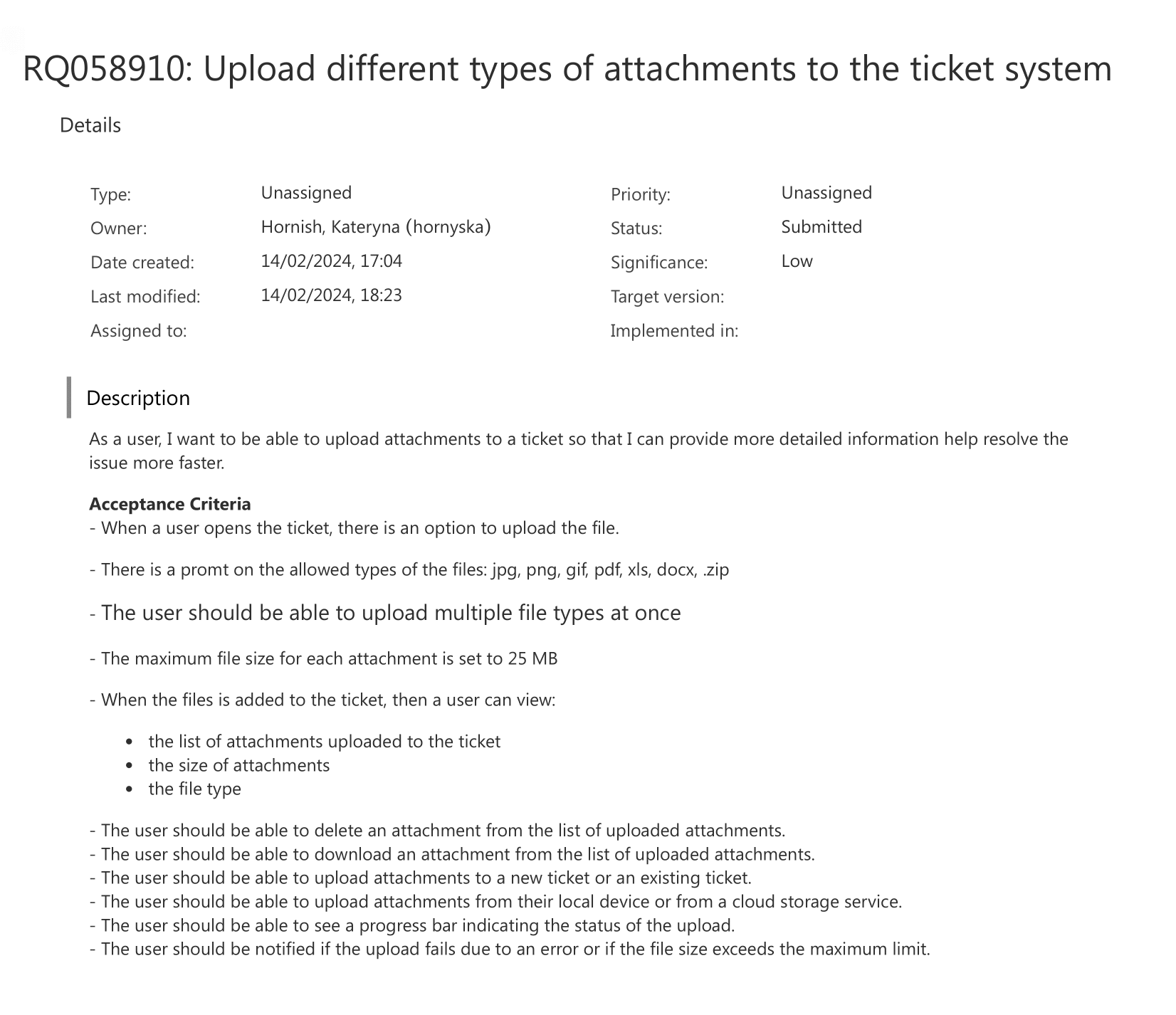
Scenario: Uploading Different Types of Files to a Ticket System
Requirements Creation:
The goal is to make it easy for users to upload files like images, documents, or archives all at once. This saves time and improves user satisfaction by providing a seamless way to share information. You create the requirement, click “Test It!”, and wait just a few seconds.
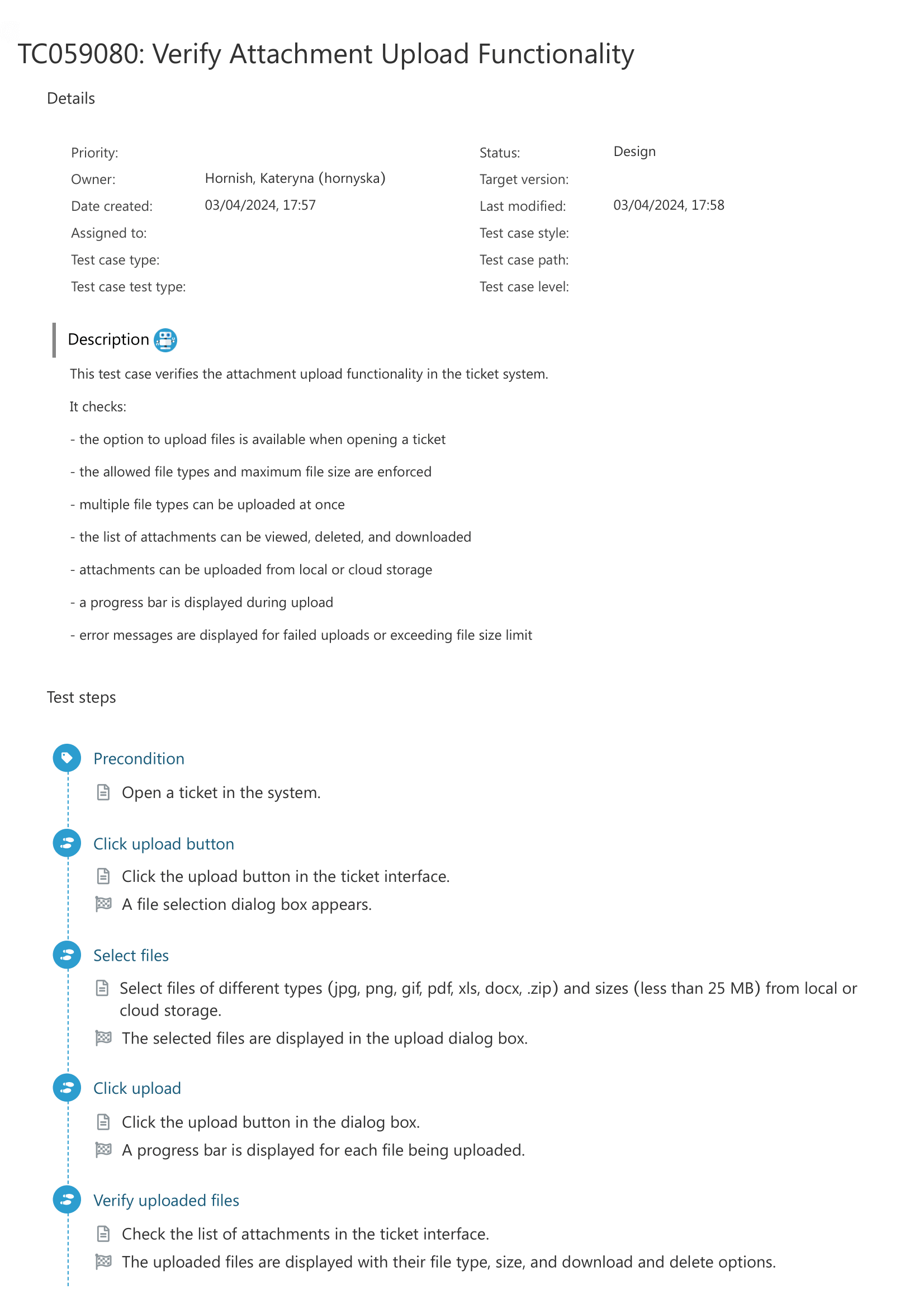
Test Cases Functionality: Here’s how aqua’s AI generates an automated test case for this scenario:
Let’s put it into perspective. Creating this test case manually would take you about 18 minutes. Remarkably, aqua completes this entire test case in just 13 seconds—98% faster than doing it manually! Imagine the potential savings when you need to create hundreds of test cases.
aqua also allows you to customise tests for different scenarios, including positive, negative, functional, and performance tests. For larger requirements, aqua can intelligently split test cases into smaller, manageable parts, all while maintaining speed and efficiency.
With aqua, automatic generation does not stop with test cases; you can also generate requirements and test data with a single click. But aqua goes beyond just test case creation; it also allows for easy customisation across various scenarios and intelligently splits larger requirements into manageable test cases while maintaining speed. With 100% traceability linking every test case to its requirements, you ensure comprehensive coverage and accountability, guaranteeing 100% testing coverage. The integration with Capture for one-click bug recording, along with insights from the AI Copilot, enables rapid identification and resolution of issues. Coupled with seamless integrations with Selenium, Jenkins, and Jira, aqua is the ideal Test Management System (TMS) to take the pain of testing away.
Achieve test case creation in just 13 seconds instead of 18 minutes
To maximise the effectiveness of your test cases, let’s look at the best practices you should follow:
Be Clear and Concise: Use straightforward language and avoid unnecessary jargon.
Include Preconditions: Clearly state each required setup before executing the test case.
Prioritise: Focus on critical features and high-risk areas for thorough testing.
Use Consistent Formatting: Maintain uniformity in the layout for easy understanding and tracking.
Review Regularly: Regularly monitor and update test cases to reflect changes in requirements or features.
If you follow the checklist, you’ll have a concrete strategy in place. Now that we’ve comprehensively covered the test cases, let’s move on to the test suites.
What is a Test Suite?
A test suite is a collection of test cases that are grouped together to test a specific functionality or feature of the software. It serves as an organised structure for executing multiple tests neatly. By bundling related test cases, a test suite allows you to efficiently manage and execute your testing efforts. It boosts your test coverage significantly.
🎯 Quiz: Testfall vs. Testsuite
Klicken zum Öffnen
▼
Fortschritt1/10
F1ANFÄNGER
Frage wird geladen...
Szenario...
Testfall oder Testsuite?
🎯 Quiz abgeschlossen!
8/10
Experten-Level!
Hervorragend!
📊 Übersicht
Test suite is a collection of test cases that cover a particular feature or span of features. For example, a test suite can cover all possible test cases for login. In another example, a test suite can cover all possible iterations of a checkout flow.
latnGemin616
Reddit
Importance of Test Suites
Understanding the role of test suites in your testing strategy is crucial. Here are some key points highlighting their significance:
Organisation: Test suites help you keep your test cases organised. Therefore, it is easier to manage testing efforts and track progress.
Efficiency: By grouping related tests, you can execute them all at once. This helps you save time and ensure you test related functionalities together.
Scalability: As your application grows, test suites enable you to scale your testing efforts more easily. This way, you are accommodating new test cases without losing structure.
Reporting: Test suites simplify reporting by providing a combined view of test results. This allows you to assess overall quality more effectively.
Reusability: You can reuse test suites for different testing cycles, so you don’t struggle with consistency while maintaining test coverage over time.
Having covered the importance of test suites, let’s look at a practical example to illustrate their application.
Example of a Test Suite
Consider a test suite designed to test the login functionality of a web application. This suite could include various test cases such as:
Test Case 1: Verify login with valid credentials.
Test Case 2: Verify login with invalid credentials.
Test Case 3: Verify the “Forgot Password” functionality.
Test Case 4: Verify session timeout behaviour.
This test suite will help you quickly check the overall login feature reliability and test all related scenarios thoroughly.
Differences Between Test Suite and Test Case
So where do the differences lie? Although some are already obvious, let’s put them into a comparison table:
Aspect
Test Case
Test Suite
Definition
A specific set of conditions to test a particular functionality.
A collection of test cases grouped for testing a feature or functionality.
Purpose
To verify a specific aspect of the application.
To organise and execute related test cases efficiently.
Scope
Narrow, focusing on a single test scenario.
Broad, encompassing multiple test scenarios related to a feature.
Execution
Executed individually to assess specific functionality.
Executed as a group to evaluate overall feature performance.
Documentation
Contains detailed steps and expected results for a single test.
Provides an overview of multiple tests, summarising their objectives.
Understanding these differences will help you better structure and organise your testing strategy. Ultimately, you’ll have more effective testing cycles and better software quality through targeted, efficient test execution.
Conclusion
So what did we learn? Test cases focus on specific functionalities and provide clear criteria for testing individual scenarios. Test suites group related test cases to streamline execution and enhance organisation.
You should use test cases to maintain detailed validation of each feature while organising related test cases into test suites for efficient execution.
aqua cloud offers features that perfectly fit within your test case and test suite management. With the ability to automatically generate test cases from requirements, aqua saves you significant time. This means a better focus on detailed validation. Additionally, you can customise tests for various situations—positive, negative, functional, and performance—ensuring that your testing covers all angles. Beyond individual test cases, aqua’s centralised repository organises related test cases into test suites, boosting your efficiency. With 100% traceability linking test cases to their requirements, you guarantee comprehensive coverage. While you’re benefiting from rapid bug detection through Capture and insights provided by the AI Copilot, integrations like Jira, Azure DevOps, Selenium, Ranorex, etc turn your toolkit into a superpower. Choosing aqua means high-quality standards, and you are just one click away from that.
Go beyond test case and suite management; have a 100% automated test strategy
A good test suite is well-organised, covering a comprehensive range of scenarios related to a specific feature or functionality. It should include clear, detailed test cases and ensure efficient execution for easy maintenance and updates. Additionally, it should allow for traceability and provide meaningful reporting to assess overall application quality.
What is a test suite in Agile?
In Agile, a test suite is a collection of test cases that are grouped together to validate specific features within an iterative development cycle. It supports continuous integration and delivery by enabling quick execution of related tests, ensuring that new code changes do not disrupt existing functionality. Agile test suites are often flexible and frequently updated to reflect evolving requirements.
Enhancement of the aqua product is Martin’s main responsibility and biggest mission. His expertise covers ITIL Process Consulting, Change Management, Quality Assurance, Quality Management, and Requirements Management. Martin works in QA services for regulated industries for more than 18 years being an irreplaceable leader at…
Nurlan, a QA Coordinator & Quality Standards Officer, takes pride in orchestrating seamless QA operations. His expertise in coordinating QA-focused projects and integrating QA solutions has consistently yielded top-tier client satisfaction. Aside from a full-time QA coordinator, Nurlan's role involves creating compelling content that educates…
Home » Best practices » Test Suite vs Test Case: What is the Difference?
Do you love testing as we do?
Join our community of enthusiastic experts! Get new posts from the aqua blog directly in your inbox. QA trends, community discussion overviews, insightful tips — you’ll love it!
We're committed to your privacy. Aqua uses the information you provide to us to contact you about our relevant content, products, and services. You may unsubscribe from these communications at any time. For more information, check out our Privacy policy.
X
🤖 Exciting new updates to aqua Intelligence are now available! 🎉