Katalon's free tier only covers writing tests. Running them from CI costs extra. That's the first thing that pushes teams to look for a Katalon replacement. This guide ranks the real Katalon Studio alternatives, including where aqua cloud closes gaps a pure automation tool can't touch.
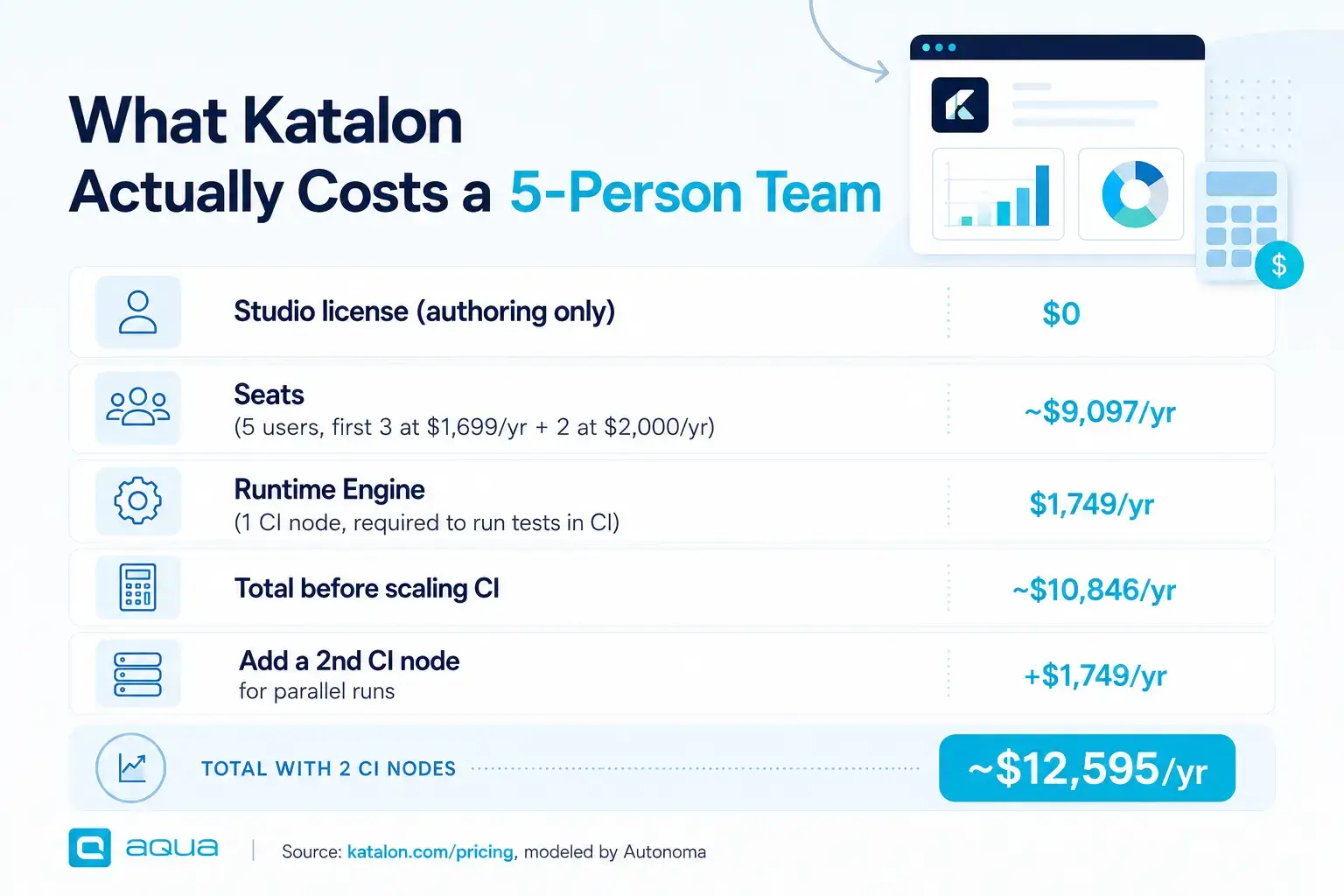
Katalon’s paid seats run $1,699 a year for each of the first three, then $2,000 a year after that, per Katalon’s own pricing page.
Playwright, Cypress, and Selenium cost nothing to license. Your team still writes and maintains every test.
aqua Intelligence drafts test cases straight from requirements, and 42% need zero edits, on top of requirements, automation, and bug tracking already living in one platform.
Testsigma hides its pricing behind a required sales call, according to G2 buyer reviews.
Katalon alternatives compared
Tool
Best for
Pricing model
Key differentiator
aqua cloud
Teams that want requirements, test cases, automation, and bug tracking in one platform
License-based, free guest licenses
AI drafts test cases from requirements, one coverage view across manual and automated testing
Playwright
Web teams with engineering resources
Free, open source
Fast, modern cross-browser automation
Cypress
JavaScript-heavy web apps
Free core, paid Cloud add-on
Fastest local debugging experience
Selenium
Teams that need maximum flexibility
Free, open source
Widest language and browser support
TestCafe
Small teams wanting a lightweight setup
Free, open source
No WebDriver dependency
Ranorex Studio
Enterprise teams needing low-code plus code access
Paid, quote-based at scale
Handles legacy and desktop apps
Testsigma
AI-assisted authoring across web, mobile, API
Quote-based, no public rate card
NLP test creation, large device library
Robot Framework
Teams wanting Katalon’s keyword style, free
Free, open source
Closest to Katalon’s syntax
Momentic
Teams ready to shift to AI-first testing
Paid, usage-based
Tests adapt to intent as the app changes
Appium
Mobile-specific automation
Free, open source
Standard for native iOS and Android
Why do teams look for a Katalon alternative?
Cost. Katalon Studio installs free. Running tests from CI needs a Runtime Engine license. That’s $1,749 a year, and it covers one concurrent run. A team of five engineers on two CI nodes lands around $7,200 to $9,600 a year once seats and execution licenses stack up, according to modeled estimates from Autonoma.
The desktop client. Every tester installs Katalon Studio locally. Teams running everything else through a browser find this step out of place. It slows onboarding for remote teams too.
Maintenance. The recorder is fast to start with. Object repositories and locators break every time the app changes. Teams spend real hours chasing flaky tests instead of fixing bugs.
Scope. Katalon automates. It doesn’t manage requirements or track coverage across manual and automated tests. Teams that need that layer end up running a second tool next to Katalon anyway.
What to look for in a Katalon replacement
Public pricing. Katalon, Ranorex, and Testsigma all need a sales call for real numbers. Open source tools and aqua cloud’s pricing page publish pricing you can model before you commit.
SaaS, not desktop. A browser-based tool cuts setup time and kills version drift across a distributed team.
Test management built in. This is the real gap for most teams leaving Katalon. If you need requirements traceability, manual test cases, and one coverage report in one place, a scripting framework can’t give you that no matter how well it scripts.
CI/CD depth. Most tools connect to Jenkins, GitHub Actions, Azure DevOps, and GitLab. If you’re evaluating a Katalon alternative with CI/CD integration specifically, test that pipeline in a trial. Don’t trust the feature list.
No lock-in. Pick a tool that exports standard test code or runs on an open format. It keeps your exit cheap if the tool stops fitting, which is exactly what teams mean when they search for a Katalon alternative no vendor lock-in.
Here’s a quick look at how much Katalon costs for a 5-person team:
This image was generated with AI.
The best Katalon alternatives, reviewed
aqua cloud
aqua cloud puts requirements, test cases, manual runs, automated runs, and defect tracking in one project. A QA lead pulls one coverage number instead of stitching data from three tools. This is what most people mean when they search for a Katalon alternative with test management: a scripting tool with no coverage layer underneath it, replaced by one that has it built in.
Teams researching a Katalon alternative with requirements traceability usually land here too, since every test case in aqua cloud links back to the requirement it was written to cover.
If you’re comparing tools on AI alone, aqua Intelligence is the reason aqua cloud shows up in most searches for a Katalon alternative with AI. Rebuilt from the ground up in July 2026, it does the test case writing most QA teams still do by hand. Paste in a requirement, and it drafts the test case using established methods like equivalence partitioning and boundary value analysis, and 42% of what it generates needs zero edits before it’s ready to run. Upload a spec sheet, screenshot, or UML diagram, and it pulls requirements and test cases straight out of the file, no manual transcription. Point it at an existing draft and tell it what to change through chat, no fixed prompts to fight. It also flags duplicate defects and ranks test cases so testers stop re-running low-value ones every cycle. Across all of that, aqua cloud reports around 12.8 hours saved per tester, per week, on suite maintenance alone.
Bug reporting runs through Capture, aqua’s built-in screen recorder that auto-logs the console output, network data, and every click leading up to a bug, then sends the report straight to aqua or Jira.
Pricing runs by license type: Requirements Manager, Test Manager, All-in-One, Test Runner/DEV. Every plan includes free, unlimited guest licenses for stakeholders who only need to view results. Automation runs through integrations with Selenium, Ranorex, and JMeter, so teams keep the automation stack they already trust and stop paying separately for the test management layer wrapped around it. Regulated teams in banking, pharma, and healthcare lean on this for the same reason: one auditable system instead of five loosely connected tools.
Best for: Teams that want requirements, test cases, automation, and bug tracking in one platform, with AI writing the first draft of every test case instead of a tester starting from a blank page.
Try a centralised, 100% AI-powered TMS that closes Katalon's gaps
Playwright is Microsoft’s open source browser automation framework. It’s the default pick for new web test suites now. It runs on Chromium, Firefox, and WebKit. Parallel execution is built in, and its auto-waiting behavior cuts down the flaky tests Katalon users complain about.
No license cost, at any scale. The catch is it’s a coding framework. Your team needs engineers who can write and maintain test code.
Best for: Engineering-led teams building a modern web suite with zero license budget.
Cypress
Cypress wins on developer experience. Tests run inside the browser. The debugger shows exactly what happened at each step. The core framework is free. Cypress Cloud, a paid add-on, adds parallelization and flaky test detection for bigger suites.
Best for: JavaScript and TypeScript teams testing single-page apps who want the fastest local debugging around.
Selenium
In Katalon vs Selenium comparisons, Selenium wins on flexibility every time. It’s the most established framework in the industry, and every other tool gets compared to it. It supports more languages and browsers than anything else on this list, and it plugs into almost every CI system out there.
Selenium hands you raw building blocks. You assemble the framework yourself, or use one built on top of it, like Robot Framework.
Best for: Teams that need maximum flexibility and already have engineers to build a framework around it.
TestCafe
TestCafe skips WebDriver. Setup is faster. One less thing to break in your environment. It runs modern JavaScript and TypeScript natively, cross-browser, no extra plugins.
Best for: Small teams that want something lightweight, fast to install, no heavy setup.
Ranorex Studio
Ranorex bridges low-code and full code access. It’s one of the few tools here that handles legacy desktop apps, not just web and mobile.
Pricing scales with team size, similar to Katalon. Teams switching purely to cut cost won’t necessarily save money here. The switch makes sense if you specifically need desktop coverage.
Best for: Enterprise teams testing legacy or desktop apps that web-only tools can’t reach.
Testsigma
Testsigma uses natural language test authoring and AI agents for test creation and self-healing locators. It covers web, mobile, API, desktop, Salesforce, and SAP, the broadest surface area on this list.
The catch is no public pricing. You negotiate for both Pro and Enterprise, according to G2’s comparison data. Reviewers also flag that covering five surfaces trades off depth in each one, mobile especially.
Best for: Teams that want one platform across multiple surfaces and don’t mind negotiating price.
Robot Framework
Robot Framework is the closest match to Katalon’s keyword-driven style, and it’s free. If your team likes how Katalon reads but not what it costs, this is the natural landing spot. It’s extensible through Python and backed by a large library of existing keywords.
Best for: Teams that migrate from Katalon and want to keep the keyword-driven workflow without the license.
Momentic
Momentic builds tests around user intent. It reads what a test is trying to do and adapts the steps automatically as the app changes, aiming to kill the maintenance problem brittle locators cause.
This is the biggest shift on this list. It changes how your team writes tests. Pick it if you’re ready for that change, not if you want a drop-in swap.
Best for: Teams willing to rethink their testing approach for less long-term maintenance.
Appium
Appium is the standard for native mobile automation on iOS and Android. Several other tools here, Testsigma included, build mobile support on top of it. It’s open source and framework-agnostic, so it pairs with whatever web tool you pick.
Best for: Teams whose real gap with Katalon is mobile, not web.
This image was generated with AI.
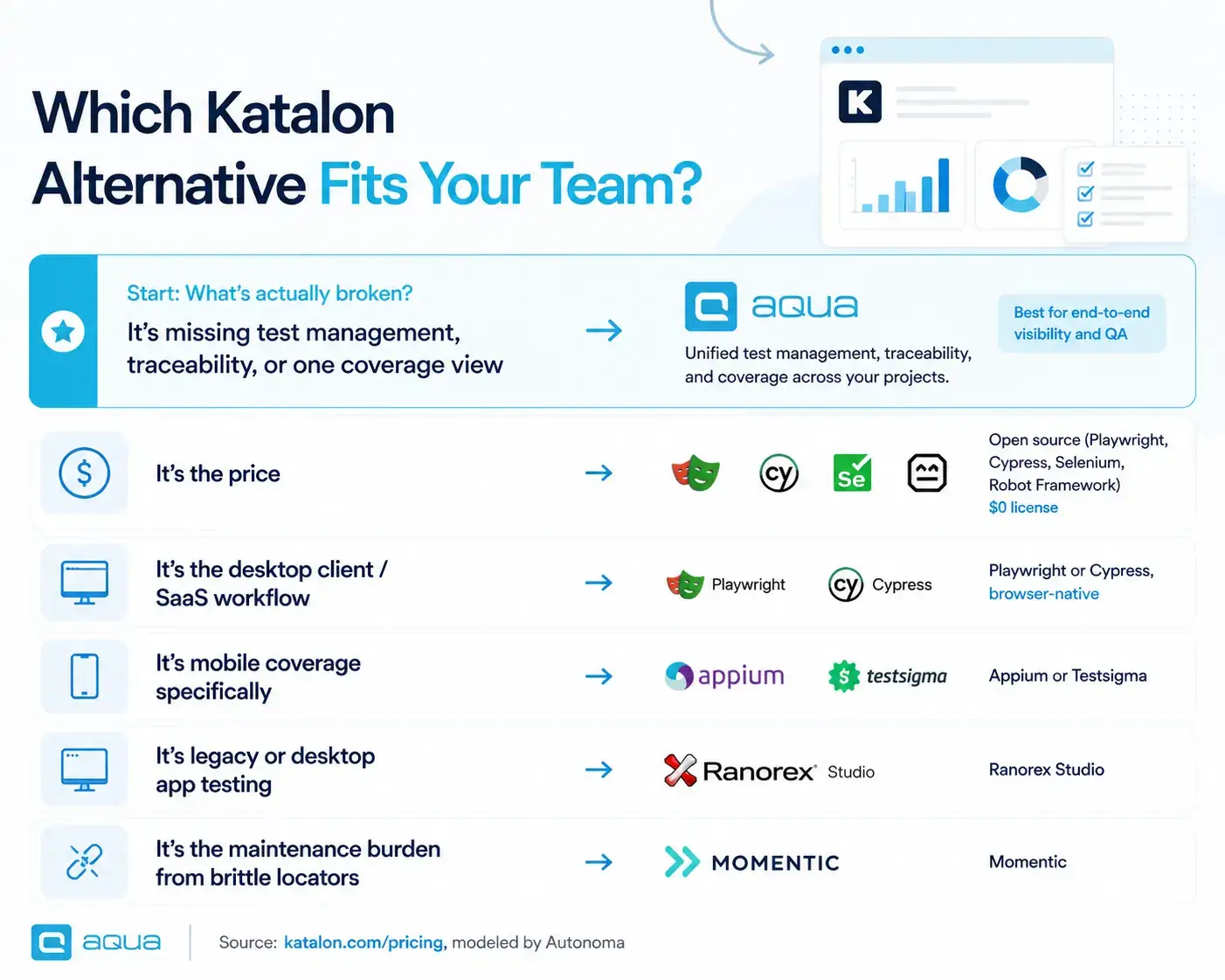
Katalon vs aqua cloud vs Playwright: which one fits
Pick Katalon if you’re already invested and the only complaint is cost. The recorder still gets non-engineers writing tests faster than pure code would.
Pick Playwright if your gap is purely technical. You have engineers who can write and maintain code, you don’t need test management, and cost matters more than a polished UI.
Pick aqua cloud when the real gap sits before and after the scripts themselves. If your QA lead can’t pull one coverage number across manual and automated tests without stitching data from three tools, that’s the gap aqua closes, and it does it with AI drafting the first version of every test case rather than a tester starting from zero.
Most teams don’t pick one and stop. A common setup: Playwright or Selenium for execution, aqua cloud for requirements, test case management, and reporting on top. aqua cloud integrates directly with both.
Yes. Playwright, Cypress, Selenium, TestCafe, Robot Framework, and Appium are all open source. Zero license cost. You write and maintain the tests yourself, and none of them include built-in test management.
What's the best Katalon alternative for API testing?
Selenium and Playwright both handle API testing through their ecosystems. If you want to plan and track API coverage next to UI and manual tests in one place, that’s what aqua cloud’s test management is built for.
Can you migrate test cases from Katalon to another tool?
Depends on the tool. Open source frameworks make you rewrite scripts in their syntax, since there’s no direct import from Katalon’s format. aqua cloud keeps test cases and automation scripts as separate objects, so you can move your test management over first and connect your automation tool of choice afterward.
Is aqua cloud a good replacement for Katalon?
Depends on what’s actually broken. If it’s your automation scripts, aqua cloud won’t replace that on its own since it doesn’t record or run automation the way Selenium or Playwright do. If it’s the missing requirements traceability, manual test case tracking, or a single coverage view, aqua cloud fixes that directly, and it plugs straight into the automation tools, Selenium and Ranorex included, that teams keep after leaving Katalon.
Nurlan, a QA Coordinator & Quality Standards Officer, takes pride in orchestrating seamless QA operations. His expertise in coordinating QA-focused projects and integrating QA solutions has consistently yielded top-tier client satisfaction. Aside from a full-time QA coordinator, Nurlan's role involves creating compelling content that educates…
Embodying the essence of a QA Coordination Maestro, Paul has excelled in curating and implementing quality strategies tailored to the nuances of each project. His expertise in the market of QA and Test Management solutions has contributed to a vast portfolio of successfully managed TMS…
Join our community of enthusiastic experts! Get new posts from the aqua blog directly in your inbox. QA trends, community discussion overviews, insightful tips — you’ll love it!
We're committed to your privacy. Aqua uses the information you provide to us to contact you about our relevant content, products, and services. You may unsubscribe from these communications at any time. For more information, check out our Privacy policy.
X
🤖 Exciting new updates to aqua Intelligence are now available! 🎉