Test Data Management Roles and Responsibilities: Ultimate Guide
Test data management roles and responsibilities decide who builds your test data and who keeps it safe. When the split is unclear, QA waits on developers, developers wait on DBAs, and everyone runs tests on whatever data is lying around. This guide covers each role, what it owns, and how to map it all in a RACI matrix.
Test data management roles and responsibilities split across five groups: the test data manager, QA engineers, developers, data engineers or DBAs, and security and compliance.
The test data manager owns strategy, tools, and governance. The other four groups own pieces of the work, such as requirements, fixtures, pipelines, and masking rules.
A RACI matrix gives every TDM activity one accountable owner, which ends the “I thought you were handling that” problem.
Each testing phase and test type needs different data, so ownership changes as work moves from unit tests to performance and UAT.
In Agile and DevOps teams, TDM moves from a central request queue to self-service and data as code that runs with every deployment.
If nobody owns test data, tests run on stale records and sensitive fields leak into test environments. Here’s who should own what.
What Is Test Data Management?
Test data management is how a team gets the right data into test environments and keeps it safe and current. It covers four activities:
Data subsetting – Pulling a usable slice out of a huge production database while keeping relationships between tables intact.
Data masking – Scrambling sensitive fields like names and card numbers so the data still works in tests.
Synthetic data generation – Creating realistic fake records from scratch, useful when production data doesn’t exist yet.
Provisioning – Delivering the data to the right environment at the right time.
Good TDM balances three demands that pull against each other. The data has to be realistic enough to catch bugs. It has to meet compliance rules, and testers can’t wait days to get it. Miss the first and you ship blind. Miss the second and you risk fines. Miss the third and builds pile up while someone scrubs a database export by hand.
Each of those demands needs a named owner, which is where roles come in.
Why Are Roles and Responsibilities Important in Test Data Management?
Roles matter because data without an owner goes stale. Developers assume QA sorted it, QA assumes the DBAs did, and the DBAs figure it’s a security job. Meanwhile your environments run on six-month-old records full of customers named “Test User 123.”
Clear ownership fixes that in practical ways:
Data quality improves – A named owner tracks freshness and realism instead of reacting to complaints.
Pipelines stop breaking at random – Automated tests stop failing because nobody refreshed the dataset.
Compliance gets checked early – Security reviews masking rules before an auditor does. GDPR and CCPA penalties run into the millions, so a leak of real customer data in a test database is expensive.
TDM also sits inside the broader test management roles and responsibilities of a QA organization. A test manager plans and reports. A test lead coordinates execution. The test data roles below plug into that structure and support it.
Key Test Data Management Roles
Five groups share TDM work. Each one owns a different slice:
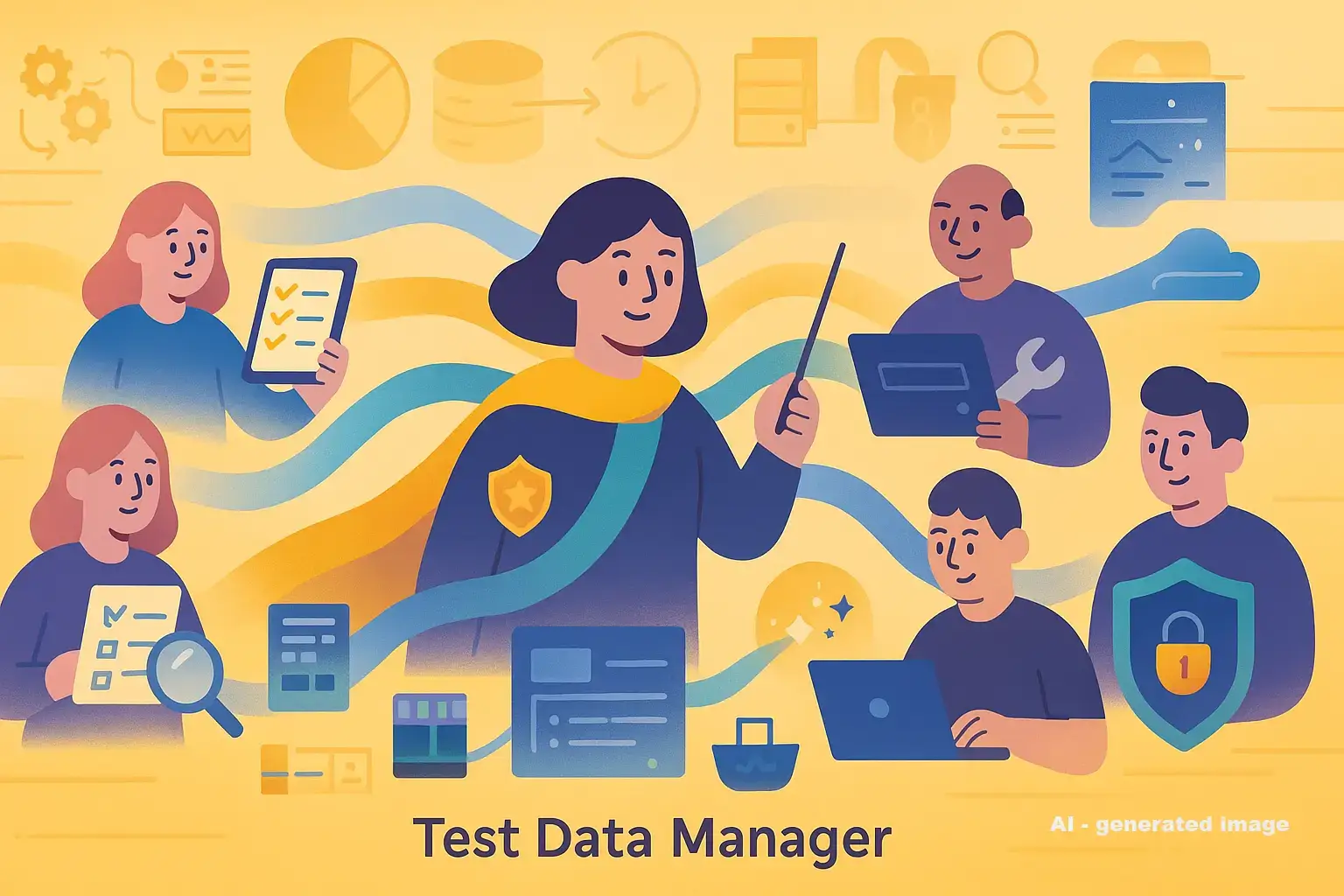
Test Data Manager – Owns the strategy, the tools, and the governance. Think of this person as the conductor of the whole operation.
QA engineers and testers – Use the data every day and know whether it’s realistic. They define what each test needs.
Developers – Build the fixtures and seed scripts they and their teammates use, and they know the schema best.
Data engineers and DBAs – Build the pipelines that extract, mask, and provision data across environments.
Security and compliance – Set masking rules, audit access, and check that test environments hold no unmasked sensitive data.
One practical catch. The roles installed with test management application setups usually stop at admin, manager, tester, and viewer. A test data manager rarely appears by default, so you’ll need to create that role and decide who holds it. A platform like aqua cloud also helps by letting you document data requirements next to the test cases that need them.
Test Data Manager Roles and Responsibilities
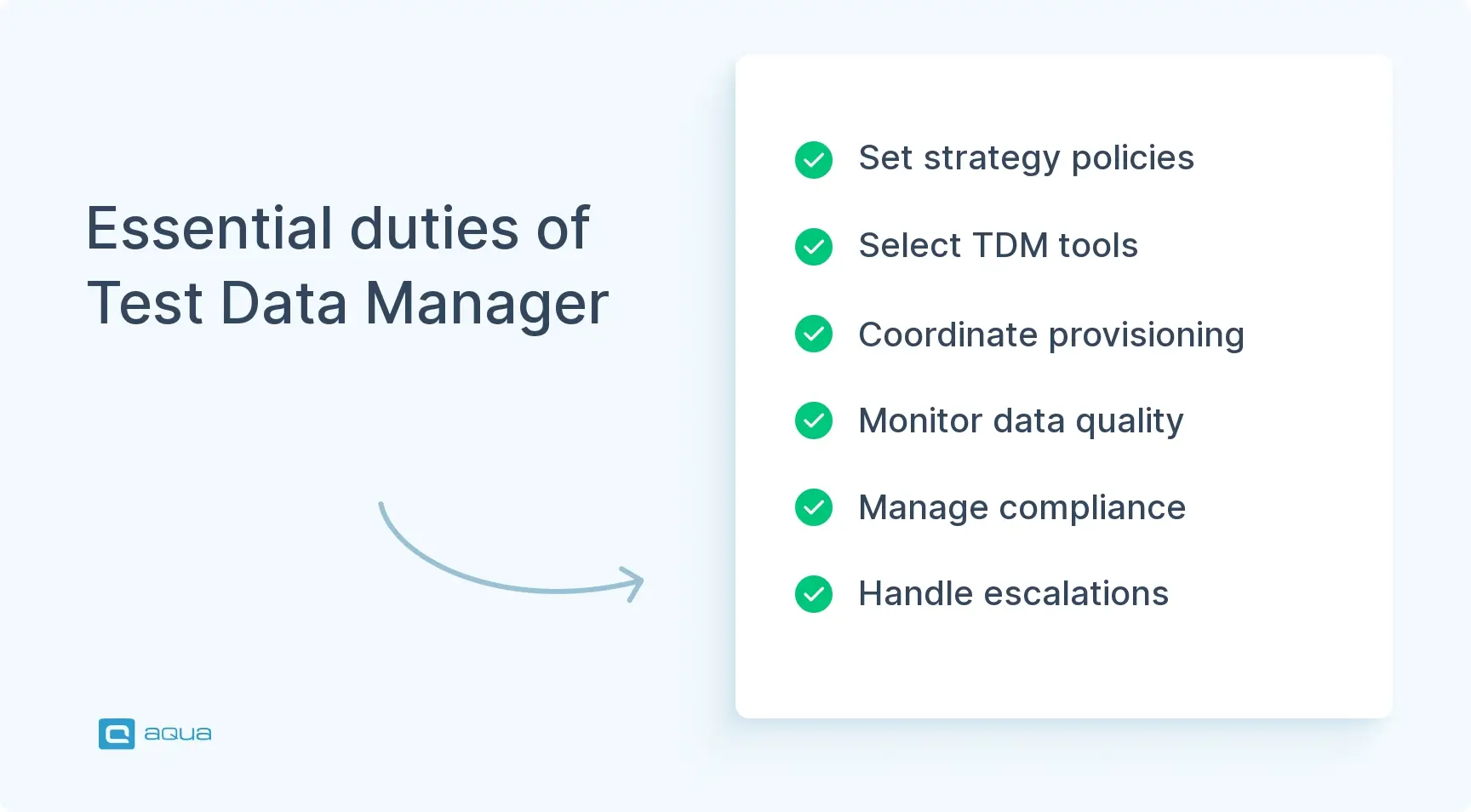
The test data manager is the one person accountable for TDM across projects. They translate “we need better coverage” into “here’s the data that makes it possible.” Core responsibilities:
Set strategy and governance – Write the policies that tie TDM to compliance rules and testing needs for every project.
Choose and manage tools – Evaluate masking, subsetting, and generation tools, and check they fit your CI/CD pipeline.
Coordinate provisioning – Make sure environments get refreshed data on schedule so releases don’t stall.
Track data quality – Monitor freshness, completeness, and realism, and add validation checks that catch problems early.
Manage security and compliance with the security team – Agree on masking rules, access controls, and audit logging.
Handle escalations – Be the first call when a pipeline breaks or a team needs a custom dataset for an edge case.
This role mixes technical depth with people skills. One hour you’re discussing query performance with a DBA. The next, you’re explaining to a product manager why copying production data isn’t an option. Strong candidates often come from QA and have added database and scripting skills along the way.
Success looks quiet. Testers stop thinking about data access because provisioning just happens.
QA Engineer and Tester Responsibilities in Test Data Management
QA engineers define what good test data looks like and report when it falls short. They’re the ones who notice that every synthetic customer lives in California and buys the same three products. Their responsibilities:
Define data requirements during test planning – State the volume, variety, and traits each scenario needs.
Validate data before running tests – Check that the dataset contains the edge cases and boundary values the tests depend on.
Report gaps with specifics – “No customers with orders older than two years” helps. “The data doesn’t work” doesn’t.
Use self-service provisioning – Refresh datasets when needed without blocking teammates.
Create small datasets for component tests – Build fixtures for narrow scenarios.
Verify masked data – Confirm masking didn’t break the data’s usefulness for testing.
The best QA teams write requirements as precisely as they write test cases. “1,000 customer records, at least 15% with order histories spanning several years” gives the TDM team something to build against. “Some customer data” gives them nothing.
The relationship works as a loop. QA finds an issue, reports it with context, and TDM adjusts the generation or masking rules. When either side stops listening, you end up with data that exists but doesn’t support real testing.
Here’s the challenge with all these TDM roles and responsibilities: they only work when everyone has visibility into the same system and can collaborate without friction. That’s where aqua cloud transforms how teams handle test data management. With aqua Intelligence (AI), you can generate context-aware test data in seconds directly from your requirements or test cases; no more waiting days for provisioned datasets or manual data creation bottlenecks. What makes this different from generic AI tools? aqua’s domain-trained AI with RAG grounding learns from your actual project documentation, generating test data that reflects your specific business logic, naming conventions, and data patterns. Your test data manager can define standards once, QA engineers can self-service generate variations for their scenarios, and developers can create fixtures that actually align with how your system works. Everything stays centralized, traceable, and compliant with full audit logs showing who generated what data, when, and for which test scenarios.
Generate project-specific test data that actually fits your reality – save 97% of manual data creation time with aqua
Developers need data fast and tailored to the code they’re changing. They also hold the schema knowledge that makes generated data meaningful. Their responsibilities:
Create and maintain fixtures – Build reusable datasets for unit and integration tests.
Write seed scripts – Let anyone populate a local database with minimal but realistic data.
Plan schema changes with test data in mind – Provide migration scripts so existing datasets don’t break.
Build data generators for new features – Produce realistic records for the entities they introduce.
Check referential integrity – Make sure foreign keys and dependencies stay consistent in fixtures.
Document data dependencies – Tell the TDM team which data traits their code expects.
Good teams treat test data like code. They version it, review each other’s seed scripts, and refuse to let it become a folder of SQL files nobody dares to touch.
Speed is the usual friction. Developers need data in seconds, but they can’t have open access to production. A masked-data API or an approved generator inside the dev environment gives them speed without breaking compliance.
Data Engineer and Database Administrator Responsibilities
Data engineers and DBAs make TDM work at scale. Without them, “we need test data” means someone running a manual SQL export. Their responsibilities:
Build subsetting logic – Extract relevant slices while keeping relationships intact across hundreds of tables.
Maintain masking pipelines – Apply transformation rules consistently, including keeping masked emails valid in format.
Tune provisioning speed – Get environment refreshes down to minutes, since slow refreshes slow every pipeline.
Run test database infrastructure – Provision instances and keep backups and monitoring in place.
Implement synthetic generation – Cover cases where production data doesn’t exist yet.
Monitor and fix pipelines – Handle failures and keep provisioning within agreed SLAs.
Their platform knowledge, whether PostgreSQL, Oracle, or MySQL, decides what’s technically possible. A DBA knows which subsetting strategy will tank performance and how to handle time-sensitive data.
Test facility management responsibilities overlap here. They cover the upkeep of the environments and hardware where testing runs, and the test databases fall under that umbrella. Someone has to patch them, back them up, and decide who gets access.
Data engineers add the orchestration layer: scheduled refreshes, dependencies between data sources, and REST APIs that let QA trigger a refresh on demand. The hard problems show up quickly, like subsetting a database with circular foreign keys or masking data while preserving the statistical distribution that performance tests need.
Security and Compliance Responsibilities in Test Data Management
Security and compliance teams make sure test data doesn’t become your next incident. Their responsibilities:
Classify data sensitivity – Decide which fields need masking, which can stay, and which must never reach test environments.
Set masking and anonymization standards – Write transformation rules for each data type and sensitivity level.
Audit test environments – Scan for unmasked sensitive data and check access controls.
Review TDM tools – Check that a proposed tool doesn’t add new vulnerabilities.
Enforce access controls – Apply least privilege and log any production data access.
Validate regulatory compliance – Turn GDPR, CCPA, HIPAA, and PCI DSS requirements into controls TDM has to follow.
Industry rules change what’s acceptable. Under HIPAA’s Safe Harbor method, you have to remove 18 types of identifiers, and that includes most parts of a date, so masking names alone isn’t enough. PCI DSS bars live card numbers in test environments unless those environments are protected to production standards.
Test databases often have weaker security than production. They’re easier to reach, less monitored, and sometimes missed during patching. If one holds poorly masked real data, it’s a soft target. Reviews should repeat on a schedule instead of happening once at setup.
The best security people don’t just say no. They help design masking that satisfies regulators and keeps data useful, and they automate scans so violations get caught fast.
Test Data Management Roles Across the Testing Lifecycle
Ownership changes as work moves through the testing lifecycle. Here’s who leads at each stage:
Test planning – The test data manager and QA define requirements, volumes, and coverage targets before any execution starts.
Unit testing – Developers own the data, using fixtures and mocks that isolate the code under test.
Integration testing – Data engineers provision subsetted or synthetic data that spans multiple components.
System testing – The test data manager orchestrates full environment refreshes while QA validates the data.
Performance testing – DBAs and data engineers generate or subset data at production scale.
Security testing – Security verifies that test data leaks nothing sensitive and that access controls hold.
UAT and staging – The test data manager provisions masked, production-like data so business users get realistic scenarios.
CI/CD – Automated pipelines provision lightweight data, with data engineers maintaining the infrastructure.
Handoffs between stages are where things break. If unit tests pass but integration tests fail on data mismatches, the developers’ fixtures probably didn’t match what integration environments hold. If a performance problem shows up late, earlier stages likely used datasets too small to reveal it.
Build feedback loops that run backward. A data gap found in UAT should update the system test data and possibly the integration fixtures too.
Test Data Management Responsibilities by Testing Type
Each test type needs different data, so test management responsibilities shift with it:
Functional testing – QA defines the business scenarios. The test data manager provisions data for happy paths, edge cases, and error conditions.
Performance testing – Data engineers and DBAs build production-scale sets. The distribution matters too. If 70% of production customers are repeat buyers, the test data should reflect that ratio.
Security testing – Security defines adversarial data, such as injection strings, boundary values, and authorization edge cases.
Regression testing – The test data manager keeps stable baseline datasets, and QA checks consistency between runs so failures point to code, not data drift.
Integration testing – Developers and data engineers coordinate data across systems so foreign keys resolve and states line up.
User acceptance testing – The test data manager provisions anonymized but realistic data, and product owners confirm the scenarios match real business use.
Exploratory testing – QA gets self-service tools to generate variations on demand.
Integration testing is the hardest case. Systems may have different owners, databases, and refresh schedules, so data engineers usually carry the coordination. Without it, system A’s customers won’t match system B’s orders and the tests pass for the wrong reasons.
Test Data Management RACI Matrix
A RACI matrix maps each TDM activity to who is Responsible, Accountable, Consulted, and Informed. It replaces tribal knowledge with a document anyone can check.
Activity
Test Data Manager
QA Engineer
Developer
Data Engineer/DBA
Security/Compliance
Define TDM strategy
A/R
C
C
C
C
Select TDM tools
A
C
C
R
C
Define data requirements
C
R
C
I
C
Create test data fixtures
I
C
R
I
I
Implement data masking
A
I
I
R
C
Provision test environments
A
I
I
R
I
Monitor data quality
A/R
C
I
C
I
Conduct compliance audits
C
I
I
C
A/R
Troubleshoot data issues
A
C
C
R
I
Maintain TDM documentation
R
C
C
C
C
Each activity has exactly one Accountable owner. That person answers when something goes wrong, even if someone else does the work. The Responsible role does the work.
Consulted roles give input before a decision. QA weighs in on masking rules because QA knows what makes data useful, and security reviews tool choices before purchase. Informed roles only need the outcome. Developers should hear when environments refresh, since builds may behave differently afterward. A Slack message is enough.
Expect the matrix to change. Early on, the test data manager might be Responsible and Accountable for most rows. As you scale, each squad may get its own TDM point person while the central manager stays accountable for strategy.
Test Data Management Roles in Agile Teams
Agile sprints leave no room for a two-week wait on test data. A central team that provisions data on request can’t serve ten squads at once. Here’s how roles adapt:
Test data managers become enablers – They build self-service tools and templates instead of working a request queue.
QA puts data needs into acceptance criteria – Test data becomes part of “ready” instead of a surprise mid-sprint.
Developers own more of TDM – Fixtures and seed data are part of feature work.
Data engineers automate pipelines – Data provisioning runs on demand and with deployments.
Product owners raise data scenarios in grooming – Needs surface during planning instead of blocking testing later.
Squad-level TDM specialists emerge – One team member, often rotating, coordinates data needs for the squad.
This model needs guardrails. Squads get autonomy, but they still follow security policy and compliance rules, and they shouldn’t build data silos that break integration testing. The central role moves from doing the work to supplying platforms, templates, and governance.
Add TDM to your retrospectives. Did data block any stories? Did we discover data needs too late? Without that conversation, the same problems return every sprint.
Test Data Management in DevOps and CI/CD
With multiple deployments a day, test data has to be automated. Provisioning becomes code, configuration, and infrastructure that runs inside the pipeline. Responsibilities change accordingly:
Data engineers build data-as-code pipelines – Generation scripts are versioned alongside application code.
Test data managers set provisioning policies – They encode in CI/CD config what data each pipeline stage needs.
DevOps engineers integrate TDM tooling – Provisioning becomes a built-in pipeline stage, not a manual step.
QA writes data validation tests – These run after provisioning and fail the pipeline if the data is bad.
Security automates scanning – Sensitive data in test environments gets flagged before it spreads.
Developers include data migrations in deployment scripts – Schema changes don’t break provisioning.
Containers make this practical. A pipeline can start a test database in Docker, seed it, run the tests, and tear it down in minutes. Every run starts from a known state, so data drift stops being a problem.
Each pipeline stage has its own data needs. The commit stage uses lightweight fixtures. Integration uses a fuller dataset across services. Staging uses masked production-like data. When a test fails in this setup, root cause has to be found in hours, since a failing pipeline blocks everyone. Monitoring and logging around provisioning tell you whether a failure came from code, infrastructure, or data.
Best Practices for Assigning Test Data Management Responsibilities
Role assignment sets the course for everything above. These practices come from teams that made it work:
Write responsibilities down – A wiki page survives when people leave. Tribal knowledge doesn’t.
Fit roles to your org structure – Inventing new reporting lines creates confusion.
Name one accountable owner – Execution can spread out, but someone makes the final call when speed, security, and quality conflict.
Build skills gradually – TDM needs technical and domain knowledge, so give people time and training.
Review roles quarterly – Systems and teams change, and your definitions should too.
Put TDM in job descriptions and reviews – Data stewardship shouldn’t be volunteer work.
Define escalation paths – Decide who rules when trade-offs can’t all be satisfied.
Start a community of practice – Let test data managers, QA, and data engineers share what’s working.
Placement of the test data manager matters. Under QA leadership, the role stays close to testing needs but may lack the authority to change how developers or DBAs work. Under platform or infrastructure teams, it gains technical reach but can drift away from what testers need. Whatever you pick, the person needs both credibility and authority.
Federate execution and centralize governance. The central role sets standards, provides platforms, and checks compliance. Teams run TDM for their own domains within those limits. It works like a franchise: corporate sets the menu and quality bar, and local operators run the kitchen.
Treat the setup as a maturity path. Early on, one person might wear every hat. Later, you’ll have specialists in each role. Mature teams distribute work across squads on top of shared platforms. Don’t skip ahead. Build the foundation, see what fits your context, then scale.
You’ve got the framework for assigning TDM roles, but execution still depends on having a platform that lets everyone play their part without stepping on each other’s toes. aqua cloud brings your entire TDM ecosystem together in one intelligent system where test data management becomes an integrated capability rather than a separate struggle. Your test data manager gets centralized governance and visibility across all projects and environments. QA engineers can generate unlimited test data variations with AI that understands your project’s context – not generic outputs that need hours of cleanup. Developers create fixtures that sync seamlessly with team standards. DBAs and data engineers maintain compliance through built-in audit trails and versioning that track every data change. Domain-trained aqua Intelligence (AI) with RAG grounding references your actual requirements, test cases, and project documentation to produce test data that’s genuinely relevant to your specific implementation. You get multi-environment support, seamless integration with Jira and your CI/CD pipeline, and the ability to scale TDM practices across Agile teams without creating bottlenecks. Whether you’re running DevOps deployments multiple times daily or coordinating test data across distributed squads, aqua provides the automation, governance, and intelligence that makes sophisticated TDM actually work in practice.
Transform TDM chaos into structured collaboration – achieve 100% data traceability and 97% faster provisioning with aqua
Test data management roles and responsibilities come down to ownership. The test data manager sets strategy, QA defines requirements, developers build fixtures, data engineers run the pipelines, and security keeps the whole thing compliant. Write that split down, add a RACI matrix, and revisit it as your team grows from manual refreshes to Agile and DevOps pipelines.
Once the basics hold, AI test data management can take over parts of data generation and provisioning with less manual work. It only helps if the roles underneath are clear.
What are the main roles and responsibilities in test data management?
Five groups share TDM work. The test data manager owns strategy, tools, and governance. QA engineers define data requirements and validate quality. Developers build fixtures and seed scripts. Data engineers and DBAs run subsetting, masking, and provisioning pipelines. Security and compliance set masking standards and audit test environments.
Who is responsible for test data management in a QA team?
The test data manager is accountable for it, ideally a named person inside or alongside QA. QA engineers share the work by defining requirements and reporting gaps. If your team has no dedicated test data manager, assign the accountability to a senior QA engineer or test lead, and write it down so it doesn’t depend on who happens to remember.
What does a test data manager do?
A test data manager sets TDM strategy and policy, picks and manages the tools, and coordinates data provisioning to test environments. They monitor data quality, work with security on masking and access control, and serve as the escalation point when pipelines break or teams need special datasets. Their goal is that testers spend their time testing and not hunting for data.
What are the responsibilities of QA engineers in test data management?
QA engineers define the volume, variety, and traits of data each test needs. They validate data before running tests, report specific gaps to the test data manager, and use self-service provisioning. They also create small fixtures for component tests and check that masked data still works for testing.
Who is responsible for test data security and compliance?
Security and compliance teams own it. They classify which fields are sensitive, set masking standards, audit test environments, enforce access controls, and check that practices meet rules like GDPR, CCPA, HIPAA, and PCI DSS. The test data manager works with them day to day and stays accountable for applying those rules in TDM processes.
Nurlan, a QA Coordinator & Quality Standards Officer, takes pride in orchestrating seamless QA operations. His expertise in coordinating QA-focused projects and integrating QA solutions has consistently yielded top-tier client satisfaction. Aside from a full-time QA coordinator, Nurlan's role involves creating compelling content that educates…
Embodying the essence of a QA Coordination Maestro, Paul has excelled in curating and implementing quality strategies tailored to the nuances of each project. His expertise in the market of QA and Test Management solutions has contributed to a vast portfolio of successfully managed TMS…
Home » Best practices » Test Data Management Roles and Responsibilities: Ultimate Guide
Do you love testing as we do?
Join our community of enthusiastic experts! Get new posts from the aqua blog directly in your inbox. QA trends, community discussion overviews, insightful tips — you’ll love it!
We're committed to your privacy. Aqua uses the information you provide to us to contact you about our relevant content, products, and services. You may unsubscribe from these communications at any time. For more information, check out our Privacy policy.
X
🤖 Exciting new updates to aqua Intelligence are now available! 🎉