Peer Testing: Importance, Process, and Best Practices
Have you already noted that sometimes testing issues don't boil down to tools only? One of the overlooked causes is insufficient test coverage. Even the best QA specialists find that solo testing reaches a ceiling in effectiveness, which results in unchallenged assumptions and unexplored edge cases. That's when you know it's time to consider peer testing methods. This article breaks down peer testing: what it is, why it works, and how to run it properly.
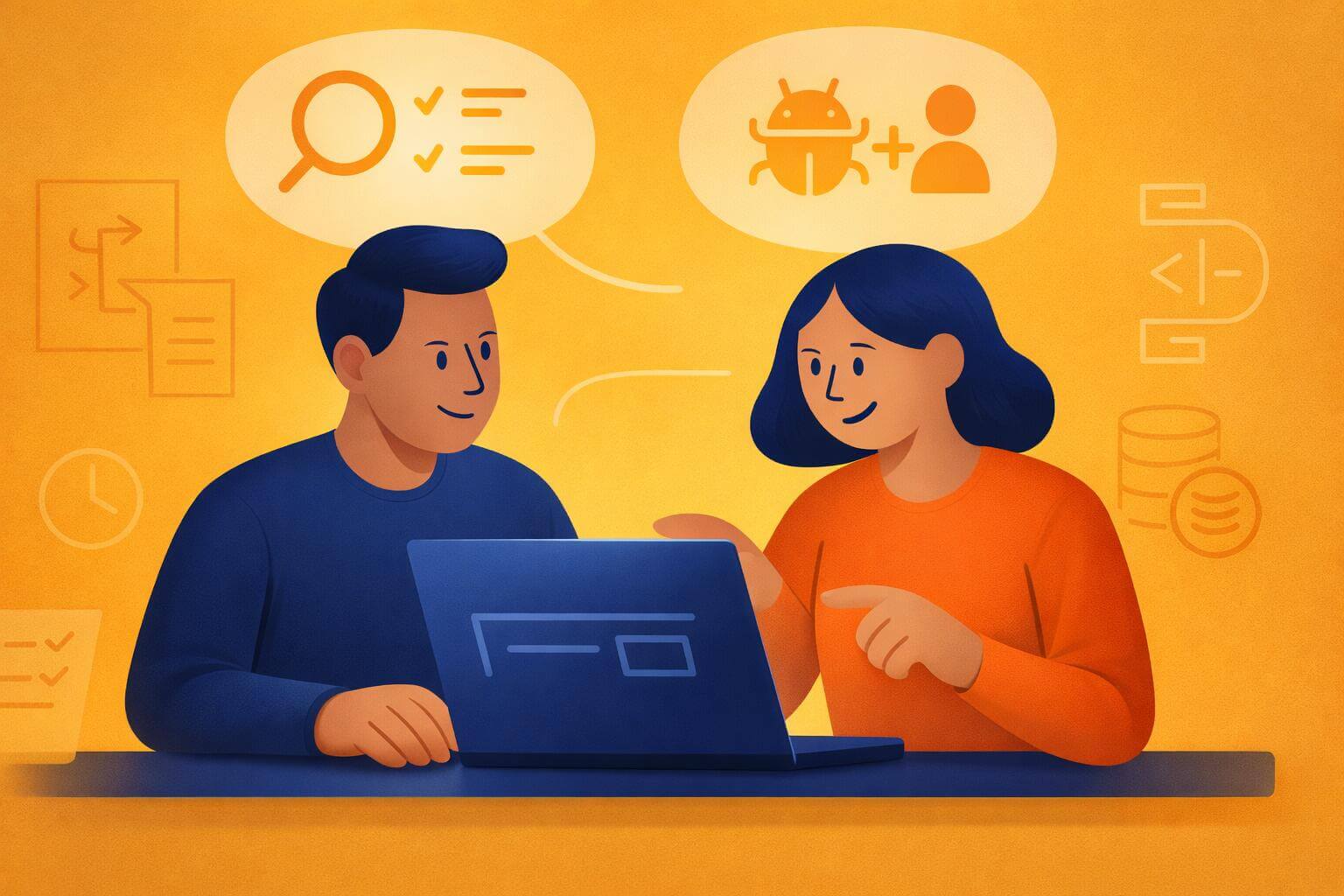
Peer testing involves two team members collaboratively exploring software in real time, with one person driving the application while the other observes, questions, and spots issues others might miss.
The practice significantly improves quality by combining different perspectives, catching defects faster, and enabling immediate diagnosis of issues without waiting for formal QA cycles.
Effective peer testing requires clear session charters, focused time boxes of 60-90 minutes, role rotation, and consistent documentation of findings and next steps.
Unlike comprehensive QA testing, peer testing works best when applied selectively to high-risk areas, complex features, or scenarios with ambiguous requirements.
Want to know if your current testing strategy has dangerous blind spots? Read the full breakdown of peer testing’s benefits and implementation below 👇
What is Peer Testing?
Peer testing is a quality practice where two members of your team investigate and validate software behavior together in real time. One person drives the application, clicking, typing, and executing scenarios. At the same time, the other observes, questions, and spots inconsistencies. Sitting firmly in the exploratory testing family, the peer testing definition centers on a simple premise: two different mental models catch more than one.
Here’s what makes peer testing in software testing distinct from a standard solo session:
It’s live and interactive. Your team members are actively learning about the software as they test it, not executing a script written last week.
It combines two knowledge bases. The tester focuses on user-facing behavior and business rules; the developer brings knowledge of system internals and failure mechanisms.
It’s dynamic. Unlike formal peer review in testing of documents or code, you’re working with a live system and making judgment calls together.
It typically happens during or immediately after development. Two people figure out whether the feature behaves correctly under real conditions and edge cases, with full context from both sides of your team.
The setup is deliberate. Both participants need access to the same environment, relevant test data, appropriate permissions, and ideally visibility into logs, API calls, or database state when things go sideways. The driver controls the interface while the navigator actively engages. Your team members aren’t just clicking together. They’re thinking together, and that distinction is where the value comes from.
Why is Peer Testing Important?
Main difference is that there’s different mindsets. Testers will have a product perspective… Developers have a code/technical perspective mostly…
Software testing is a cognitive activity, and cognition has limits when only one person is involved. When two team members bring different perspectives to the same problem, defect detection improves significantly. Here’s why that matters for your business in practice.
1. Faster defect detection and diagnosis
Your team can diagnose issues on the spot, inspecting logs, questioning the implementation, and deciding together whether something is a real defect or an environment quirk. Good defect tracking tools help capture what gets found, but peer testing is what accelerates finding it in the first place. That speed translates directly into fewer escaped bugs and shorter feedback loops, which your release schedule will reflect.
2. Knowledge transfer across your team
In most teams, expertise is fragmented. The person who wrote the code holds context that the tester never gets, and vice versa. Peer testing changes that dynamic. A junior tester learns how the backend behaves under unexpected inputs. A developer sees firsthand how requirement ambiguity affects validation from the user’s perspective. Over time, your team builds a shared understanding of the product that documentation handoffs alone can’t replicate. Better communication between developers and testers is a direct outcome, not a side effect.
3. Shared accountability for quality
When quality becomes a collaborative effort, your entire team starts thinking differently about risk and outcomes. Everyone owns the result, which reduces blame-shifting and strengthens delivery capability. Teams that introduce peer testing into their workflows typically see stronger cross-functional communication and faster resolution times, because people understand each other’s constraints before problems escalate.
The return shows up as fewer post-release hotfixes, clearer acceptance criteria, reusable automation ideas, and faster onboarding for new team members who pair with experienced testers early.
Looking at the collaborative dynamics of peer testing, you might be wondering how to structure this process efficiently within your team. This is exactly where aqua cloud, an AI-powered test and requirement management platform, can offer meaningful assistance. Its collaborative features create the perfect environment for effective peer testing, with unlimited guest seats allowing stakeholders to leave feedback, role-based access controls, and a comprehensive commenting system. What truly sets aqua apart is its domain-trained actana AI (AI Copilot). When peer reviewers identify gaps or suggest new scenarios, aqua’s AI can instantly generate additional test cases based on those insights, all while maintaining consistency with your project’s existing documentation and terminology. With dashboards and reporting that make test coverage transparent to everyone, aqua ensures peer testing becomes a structured, productive part of your quality process. aqua also connects with the tools your team already uses, including Jira, Confluence, Jenkins, Azure DevOps, and more.
Boost your testing efficiency by 80% with aqua’s AI
Structure is what separates effective peer testing from aimless exploration. Without a recognizable process for peer review in testing, sessions tend to drift into pleasant conversation that produces little actionable output. Here is how the process works in practice, and what your team should be doing at each stage.
1. Preparation: Identify the Target and Set Up the Environment
Your team should decide what’s worth testing together and why before touching the product at all. Complex features, unclear requirements, recent bug clusters, and high-visibility business flows make the strongest candidates. Stable, repetitive checks aren’t the best use of two people’s time.
Once the target is selected, both participants should prepare: relevant accounts, test data, supporting documentation like user stories or acceptance criteria, and access to any diagnostic tools needed if something goes wrong.
2. Alignment: Agree on Goals, Risks and Assumptions
The pair should align on what the feature is supposed to do. They should also define the main risks and the level of evidence the session needs to produce. This is where issues may appear. One person might assume a role change revokes access immediately; the other expects it only after re-login. These differences are valuable. They expose assumptions early enough to shape a better test mission, and catching them here costs far less than catching them in production.
3. Exploration and Execution: Test Live, Investigate Together
One participant drives the application while the other observes and proposes ideas. You’d typically start with a nominal workflow, then branch into negative scenarios, data variations, permission edge cases, or timing issues. The navigator actively asks what could go wrong, what state might persist incorrectly, or what sequence of actions a real user might take that wasn’t considered in the acceptance criteria.
When something unexpected happens, the pair shouldn’t just note it and move on. They should reproduce it, inspect logs, and determine whether the issue is client-side, service-side, or rooted in business logic.
4. Documentation: Record Findings While They're Fresh
Findings need to be recorded so the rest of your team can act on them. That includes actual bugs, suspected risks, unresolved questions, and coverage notes about what was explored and what remains untested. Even lightweight session-based documentation dramatically improves the reusability of results, and ensures the value of the session doesn’t disappear the moment it ends.
5. Debrief: Evaluate the Session and Plan What Comes Next
The pair should evaluate whether the session achieved its objective, what new questions emerged, and whether additional testing or automation should follow. Strong peer testing cultures use sessions to feed subsequent work: focused regression tests, clarified acceptance criteria, updated risk models, or earlier involvement in future features. That feedback loop is what turns peer testing from a one-off experiment into a repeatable part of your delivery process.
Requirements for Effective Peer Testing
Before scheduling peer testing sessions, your team needs specific technical and organizational conditions in place. Here’s a brief overview of tech requirements to set up effective peer testing:
#1. Shared environment access. Both participants must reach the same build, with identical permissions and test data, before the session starts. The indicator: if either participant needs to ask for access or credentials during the session, the environment isn’t ready. Resolve this in advance or reschedule.
#2. Diagnostic visibility. The pair needs live access to logs, API call inspection, and database state during testing, not just the application surface. Measure this by asking: can the pair tell, within 60 seconds of an unexpected behavior, whether the issue is client-side, service-side, or data-related? If not, observability is insufficient.
#3. A stable, representative build. Peer testing on an unstable build produces noise. The signal that a build is ready: it has passed basic smoke tests, known environment issues are documented, and the feature under test is complete enough to exercise end-to-end scenarios.
#4. Documented acceptance criteria. Both participants need written acceptance criteria or user stories before the session. The measure of sufficiency: the pair can write a session charter from the documentation alone, without needing to pull in a third person to clarify intent.
#5. A defined session charter. Every session needs a written mission statement, a stated scope, and a time box of 60 to 90 minutes. The indicator of a well-formed charter: it answers what question the session is trying to resolve, what the main risks are, and what a successful outcome looks like.
#6. A documentation channel ready before the session starts. Findings need a home from the first minute. Whether that’s a test management tool, a shared document, or a structured note template, it should be open and ready before the driver touches the application. Sessions that rely on post-session recall lose a significant portion of their findings.
Challenges in Peer Testing
Every team that introduces peer testing runs into friction at some point. The good news is that these challenges are consistent and well-understood, which means your team can prepare for them rather than being caught off guard. Here’s what to expect, and how to handle each one.
Cost concentration
Two people focused on one activity creates an immediate appearance of inefficiency, especially in organizations that measure productivity through individual utilization or raw test execution counts. If you’re a business owner or executive, this is likely the first objection you’ll hear from your managers.
Solution: The key is tracking the right numbers. Peer testing reduces expensive downstream effects like escaped defects, rework cycles, and prolonged bug-debug loops. When your team starts measuring defect escape rates and post-release rework time alongside session costs, the economics become much clearer. Framing matters here, and so does giving your stakeholders the data they need to see the full picture.
Lack of structure
Your team might introduce peer testing with good intentions, then run sessions without charters, clear focus, or agreed-upon outcomes. The result is vague exploration and low evidence yield, which gives the practice a bad reputation it doesn’t deserve.
Solution: A written session charter before every pairing session makes a significant difference. Even one sentence clarifying the mission is enough to keep your team on track. As the habit builds, you’ll notice that sessions with charters consistently produce better findings than those without them.
Interpersonal imbalance
A senior developer may frame every anomaly as expected behavior. An experienced tester may control the session so tightly that the partner becomes a passive observer. When both participants share similar blind spots, they can reinforce each other rather than diversify coverage, which defeats the purpose of pairing entirely.
Solution: Rotating pairs deliberately and setting explicit participation norms helps your team avoid this pattern. Both participants should be actively contributing. When one voice consistently dominates, it’s worth addressing as a process issue at the team level rather than leaving it to resolve itself.
Traceability and reproducibility gaps
Exploratory pair sessions generate valuable learning, but without proper documentation, it’s difficult to prove coverage or repeat steps later. This creates real tension if your business operates in a regulated environment or if your team has strict audit requirements.
Solution: Lightweight session notes linked clearly to risks and outcomes are usually sufficient. A short summary per session satisfies most traceability requirements without adding significant overhead to your team’s workflow. The goal is capturing enough context that someone who wasn’t in the room can understand what was explored and what was found.
Scalability limits
Peer to peer testing is human-intensive by design. Your team can use it to deepen understanding in selected areas, but broad, repeated regression coverage across a large system is a different problem that requires a different tool.
Solution: A hybrid model works best for most businesses. Peer testing handles discovery, ambiguity reduction, and risk investigation. Automation covers repetition and confidence maintenance over time. A good test management solution helps your team coordinate both without losing visibility into either.
Cognitive fatigue
High-quality collaborative testing demands sustained attention, active listening, and real-time judgment from both participants. Long sessions lose their value quickly, and this effect is even more pronounced for remote teams who are relying on screen sharing and verbal coordination throughout.
Solution: Keeping sessions to 60 to 90 minutes protects the quality of what your team produces. Scheduling them when both participants are mentally fresh makes a noticeable difference in output. Treating fatigue as a process constraint rather than a personal failing also makes it easier for your team members to speak up when they’re losing focus, which is exactly when you want them to.
Best Practices for Peer Testing
Implementing peer testing effectively is a leadership and organizational decision as much as a technical one. The following practices are aimed at what you, as a business owner or executive, should establish together with your tech leads to make peer review testing a reliable, high-value part of your delivery process.
1. Define peer testing as another quality factor for high-risk work.
You should treat peer testing as a structured activity with defined entry criteria, not an informal add-on. Your tech leads should identify feature categories, such as complex integrations, permission-sensitive flows, and ambiguous requirements, where peer testing is required before sign-off. Doing so removes ambiguity about when pairing happens and makes quality standards consistent across your team.
2. Establish session charter requirements as a non-negotiable standard.
Every peer testing session must begin with a written charter that states the mission, scope, and success criteria. When leadership makes charters mandatory, sessions produce measurable output. Without this standard, peer testing defaults to unstructured exploration that is difficult to evaluate or scale across your business.
3. Build pair rotation into team planning cadences.
Pair composition should be varied intentionally and tracked at the planning level. Rotating who pairs with whom spreads knowledge across your team, reduces single points of expertise, and prevents the blind spot reinforcement that happens when the same people always work together. As a decision-maker, this is a resourcing and planning call, not just a preference to pass along to your tech leads.
4. Invest in trustworthiness within organizational processes.
Peer testing fails in environments where team members are reluctant to surface issues or challenge assumptions. You should actively measure and address psychological safety in your team, because it directly determines whether peer testing produces honest, high-quality output or performative agreement. This includes how feedback is framed, how mistakes are handled in retrospectives, and whether constructive challenge is rewarded or penalized in your organization.
5. Connect peer testing outputs to your existing quality metrics.
Track what peer testing sessions produce: defect detection rates, escaped bugs, rework frequency, and onboarding time for new team members. Presenting these metrics alongside traditional QA data makes the business value visible to your stakeholders. Without measurement, peer testing remains invisible in quality reports and vulnerable to being cut during tight sprints.
6. Integrate peer testing findings into your automation backlog.
Insights from peer sessions should feed directly into test automation. Your tech leads should establish a process where validated scenarios from pairing sessions are converted into automated test cases. This compounds the value of each session and reduces the manual testing burden over time, which is a strong efficiency argument for continued investment in your team’s peer testing capability.
7. Align peer testing coverage with your risk management strategy.
Peer testing should be targeted based on risk. Working with your tech leads to map high-risk areas of the product and prioritize pairing sessions accordingly ensures that two-person attention goes where it delivers the most value for your business. This also gives you confidence that quality investment is proportional to actual business risk, rather than being distributed arbitrarily across your roadmap.
How to Perform Peer Testing
Running a peer testing session well requires deliberate preparation, clear role definition, and disciplined execution. Here is a step-by-step walkthrough of how a session should run from start to finish, with concrete instructions your team can follow directly.
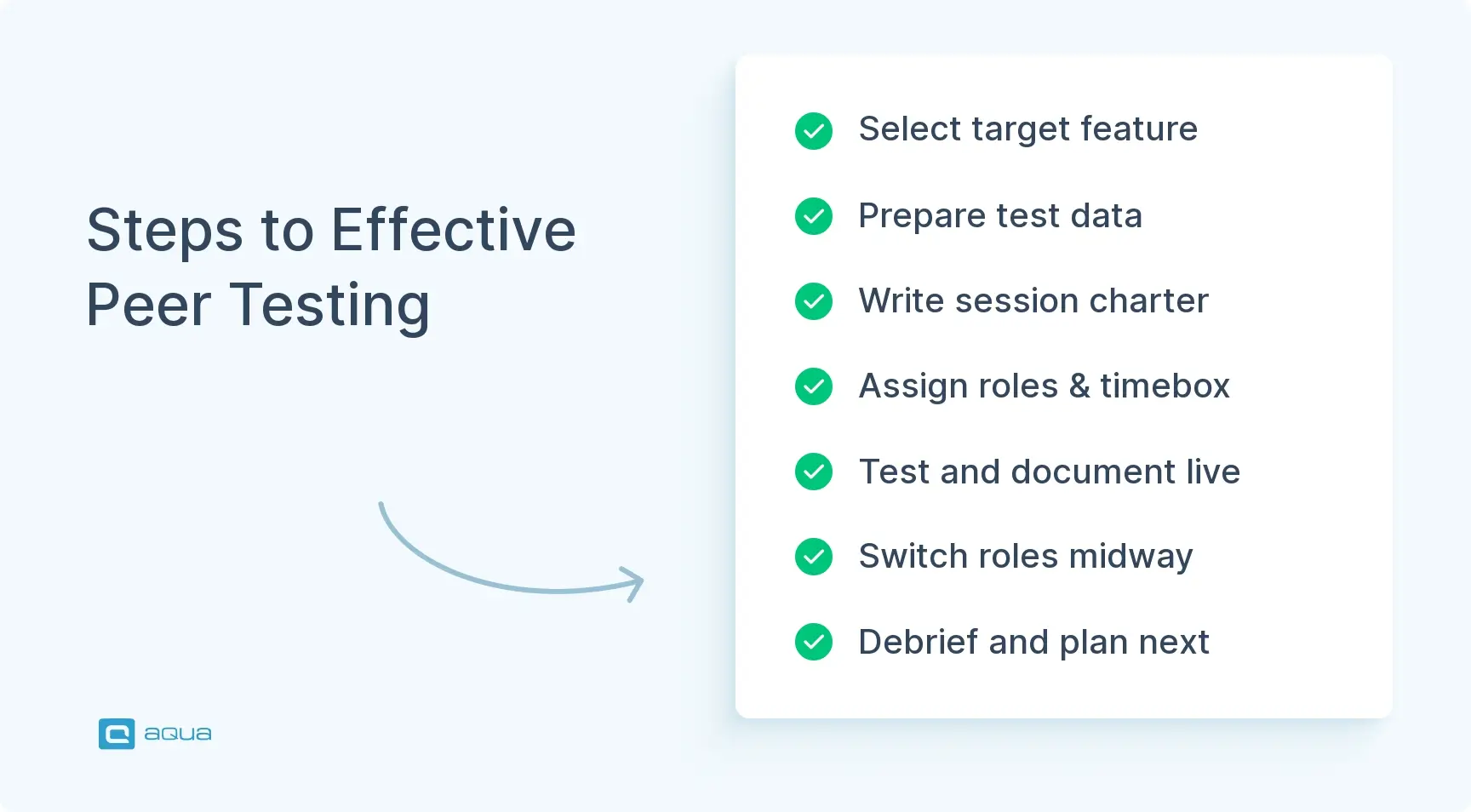
Step 1: Select the target and confirm scope.
Before scheduling the session, identify the specific feature, workflow, or risk area to test. Ask: Is this area complex, recently changed, or tied to a critical business flow? If yes, it’s a strong candidate. You should document the scope in one or two sentences so both participants start with the same understanding.
Example: “We are testing the role-change flow for admin users, specifically whether access permissions update correctly across active sessions without requiring logout.”
Step 2: Prepare the environment and test data.
Both participants must have access to the same test environment before the session begins. Your team should confirm the following:
Test accounts with the correct roles and permissions are set up
Relevant test data is in place and matches the scenarios to be explored
Logs, API monitoring tools, or database access are available if needed
The environment is stable and reflects the current build
If environment issues are unresolved, push the session back. Sorting out access mid-session wastes the time box and disrupts both participants’ focus.
Step 3: Write the session charter.
Before touching the product, both participants should agree on and write down the session mission. The charter needs to answer:
What question are we trying to answer?
What are the main risks we’re investigating?
What does a successful session look like?
Example charter: “Verify that admin role changes propagate correctly to active sessions, and identify any scenarios where stale permissions persist beyond expected boundaries.”
Step 4: Assign roles and set the time box.
Decide who drives first and who navigates. Set a timer for 60 to 90 minutes and plan to switch roles at the midpoint. The driver controls the application and narrates actions aloud. The navigator observes, proposes scenarios, and asks questions. Neither participant should be passive, and if one side goes quiet for too long, that’s a signal worth addressing.
Step 5: Execute the session with active narration and investigation.
The driver begins with the nominal workflow, narrating each action:
“I’m logging in as an admin, navigating to user management, and changing this account from Editor to Viewer.”
From there, the navigator probes actively:
“What happens if we change the role while that user has an active session open in another tab? Can we test that now?”
When something unexpected appears, both participants should stop and investigate immediately. They should reproduce the issue, check the relevant logs or API response, and determine whether the behavior is a defect, a design gap, or an environment artifact before continuing.
Step 6: Document findings in real time.
Your team should keep a running log during the session, not after it. For each finding, capture:
What action triggered the behavior
What was expected vs. what actually happened
Screenshots or log snippets as evidence
Whether it is a confirmed defect, suspected risk, or open question
Step 7: Switch roles at the midpoint.
At the halfway point, the driver becomes the navigator and vice versa. The new driver picks up from the current state or shifts to a new scenario branch. Role switching keeps both participants actively engaged and often surfaces issues the first driver’s approach didn’t reach.
Step 8: Debrief and assign follow-up actions.
In the final five to ten minutes, both participants should review what was accomplished:
Did the session answer the charter question?
What defects or risks were uncovered?
What areas remain untested and need follow-up?
What should be automated based on what was validated?
Your team should document the debrief summary and share it broadly. Confirmed defects go into your issue tracker, unresolved questions get flagged for the next planning session, and validated scenarios become automation candidates where appropriate. That’s how the value of a single peer testing session carries forward into your broader software quality testing process.
Peer Testing vs. QA Testing
Aspect
Peer Testing
QA Testing
Scope
Focused, exploratory sessions on specific features or risks
Broad, structured validation across the entire system
Timing
Happens early, often during or immediately after development
Typically happens later, after code is complete and stable
Purpose
Discover defects, clarify requirements, transfer knowledge
Confirm system meets requirements, validate regression, ensure compliance
Participants
Usually two people: tester-developer, tester-tester, or mixed roles
Regression validation, compliance checks, broad system coverage
Peer testing and QA testing serve different purposes in your quality strategy. Peer testing is narrow, exploratory, and human-intensive. Designed for discovery, ambiguity reduction, and fast feedback in uncertain areas, it works best early in the cycle. QA testing is broad, structured, and often automated, built for repetition, confidence maintenance, and compliance validation. Your team needs both. Insights from peer testing often become automated regression tests, and QA findings sometimes trigger focused peer sessions to investigate root causes. The key is knowing when to use each approach within your workflow, and not treating one as a substitute for the other.
Testing by QA means finding any glitches or odd behavior throughout the product. Whereas Peer Test includes whether the bug is fixed properly or if there is anything.
ashugupta34480 (Ashok Gupta)
on https://club.ministryoftesting.com/t/what-is-the-difference-between-testing-by-qa-and-peer-testing-by-dev/23835
Peer Testing vs. Pair Testing
Aspect
Peer Testing
Pair Testing
Definition
Informal term for collaborative testing, often used interchangeably with pair testing
Established term in testing literature for two people testing together
Formalization
Less standardized, more casual usage in practice
Recognized by ISTQB and exploratory testing literature
Scope
May imply broader team review or comparison across peers
Specifically refers to real-time, two-person collaborative testing sessions
Usage Context
Often used in informal team discussions or organizational shorthand
Used in professional testing discourse, training, and research
Relationship
Generally means the same thing as pair testing in practice
The technically accurate and preferred term in testing communities
The terms “peer testing” and “pair testing” are often used interchangeably, but pair testing is the more precise and established term in software testing literature. When practitioners describe two people testing together in real time, one driving and one navigating, they’re describing pair testing. If your team is writing formally, training others, or referencing testing standards, pair testing is the term to use. In casual discussions where everyone understands the peer testing meaning, either term works fine.
Peer testing is only as effective as the software system supporting it. aqua cloud, an AI-driven test and requirement management platform, gives your team the structure to make it count. Document peer sessions, track coverage, and maintain full traceability between requirements and test cases, all within one platform. Role-based access controls and a comprehensive commenting system keep peer review organized, while detailed dashboards give you and your stakeholders instant visibility into testing progress. When peer testers identify new scenarios or edge cases, aqua’s domain-trained AI Copilot generates corresponding test cases immediately, pulling context from your project’s own documentation to ensure relevance. Insights from peer sessions become executable test assets in seconds. aqua also integrates with the tools your team relies on every day, including Jira, Confluence, Jenkins, Azure DevOps, JMeter, Ranorex, SoapUI, and a REST API for any custom connections your workflow requires.
Save 97% of your test creation time while maintaining comprehensive peer review capabilities
Peer testing works because software quality is a cognitive problem, and two minds solve it better than one. When your team members bring different perspectives to the same feature, defects surface faster, root causes get diagnosed on the spot, and shared understanding of the product improves across the board. Used selectively on high-risk and high-uncertainty work, the practice delivers consistent value without replacing automation or structured QA. The teams that get the most out of it are the ones who treat it as a deliberate practice: chartered, time-boxed, documented, and continuously improved.
Peer testing, or peer review in software testing, is a practice where two team members test a feature together in real time. One drives the application while the other observes and challenges assumptions. The peer testing definition centers on combining two perspectives to catch what one person would miss.
How can peer testing improve software quality and team collaboration?
Peer testing in software testing improves quality by catching defects earlier and diagnosing root causes on the spot. Collaboration improves because testers and developers share context directly during sessions, which builds mutual understanding of requirements, system behavior, and risk across your team.
What are common challenges faced during peer testing and how can they be overcome?
The most common challenges in peer review testing are lack of session structure, interpersonal imbalance between participants, and difficulty proving coverage afterward. Each is addressable: session charters fix structure, pair rotation balances participation, and lightweight session notes satisfy most traceability requirements.
What is the difference between peer testing and QA testing?
Peer to peer testing is exploratory and focused, designed for discovering defects early in specific high-risk areas. QA testing is broad and structured, aimed at validating the full system against requirements. What is peer testing good for specifically? Early-cycle discovery, knowledge transfer, and fast feedback on uncertain features.
When should a team use peer review in testing vs. automated testing?
What is peer review in testing best suited for? Complex features, ambiguous requirements, and high-risk integrations where human judgment matters. Automated testing covers repetitive regression checks at scale. Your team should use both, with peer testing feeding validated scenarios into the automation backlog over time.
Home » 'How to' guides » Peer Testing: Importance, Process, and Best Practices
Do you love testing as we do?
Join our community of enthusiastic experts! Get new posts from the aqua blog directly in your inbox. QA trends, community discussion overviews, insightful tips — you’ll love it!
We're committed to your privacy. Aqua uses the information you provide to us to contact you about our relevant content, products, and services. You may unsubscribe from these communications at any time. For more information, check out our Privacy policy.
X
🤖 Exciting new updates to aqua AI Assistant are now available! 🎉
We use cookies and third-party services that store or retrieve information on the end device of our visitors. This data is processed and used to optimize our website and continuously improve it. We require your consent fro the storage, retrieval, and processing of this data. You can revoke your consent at any time by clicking on a link in the bottom section of our website.
For more information, please see our Privacy Policy.
This website uses cookies to improve your experience while you navigate through the website. Out of these, the cookies that are categorized as necessary are stored on your browser as they are essential for the working of basic functionalities of the website. We also use third-party cookies that help us analyze and understand how you use this website. These cookies will be stored in your browser only with your consent. You also have the option to opt-out of these cookies. But opting out of some of these cookies may affect your browsing experience.
Necessary cookies are absolutely essential for the website to function properly. These cookies ensure basic functionalities and security features of the website, anonymously.
Cookie
Duration
Description
cookielawinfo-checkbox-analytics
11 months
This cookie is set by GDPR Cookie Consent plugin. The cookie is used to store the user consent for the cookies in the category "Analytics".
cookielawinfo-checkbox-functional
11 months
The cookie is set by GDPR cookie consent to record the user consent for the cookies in the category "Functional".
cookielawinfo-checkbox-necessary
11 months
This cookie is set by GDPR Cookie Consent plugin. The cookies is used to store the user consent for the cookies in the category "Necessary".
cookielawinfo-checkbox-others
11 months
This cookie is set by GDPR Cookie Consent plugin. The cookie is used to store the user consent for the cookies in the category "Other.
cookielawinfo-checkbox-performance
11 months
This cookie is set by GDPR Cookie Consent plugin. The cookie is used to store the user consent for the cookies in the category "Performance".
viewed_cookie_policy
11 months
The cookie is set by the GDPR Cookie Consent plugin and is used to store whether or not user has consented to the use of cookies. It does not store any personal data.
Functional cookies help to perform certain functionalities like sharing the content of the website on social media platforms, collect feedbacks, and other third-party features.
Performance cookies are used to understand and analyze the key performance indexes of the website which helps in delivering a better user experience for the visitors.
Analytical cookies are used to understand how visitors interact with the website. These cookies help provide information on metrics the number of visitors, bounce rate, traffic source, etc.
Advertisement cookies are used to provide visitors with relevant ads and marketing campaigns. These cookies track visitors across websites and collect information to provide customized ads.






 Bankingaqua ALM helps banks increase testing productivity by over 50%